

Scaffold biocompatibility is critical in cultivated meat and tissue engineering. It determines how well a scaffold interacts with biological systems, promoting cell attachment, viability, and tissue formation. Key factors include material properties, surface chemistry, architecture, and degradation behaviour. However, challenges like poor correlation between lab and real-world results highlight the need for thorough testing.
Key Takeaways:
- Surface Chemistry: Influences cell adhesion via wettability and bioactive signals.
- Surface Topography: Guides cell behaviour; micro and nano-scale textures enhance adhesion.
- Material Type: Natural polymers mimic native tissues but have variability; synthetic polymers offer control but lack bioactivity.
- Mass Transport: Pore size and interconnectivity ensure nutrient diffusion and waste removal.
- Mechanical Stability: Scaffolds must match tissue stiffness and withstand bioreactor conditions.
- Degradation: Timing and by-products must align with tissue growth and meet food safety standards.
Testing Methods include cell adhesion assays, metabolic activity monitoring, and extracellular matrix analysis. For large-scale cultivated meat production, scaffold design must balance biocompatibility with scalability and food-grade requirements.
This article explores these parameters and offers insights into scaffold selection for efficient and safe cultivated meat production.
Biomaterials - II.3 - Biological Testing of Materials
sbb-itb-ffee270
Key Material Properties That Affect Biocompatibility
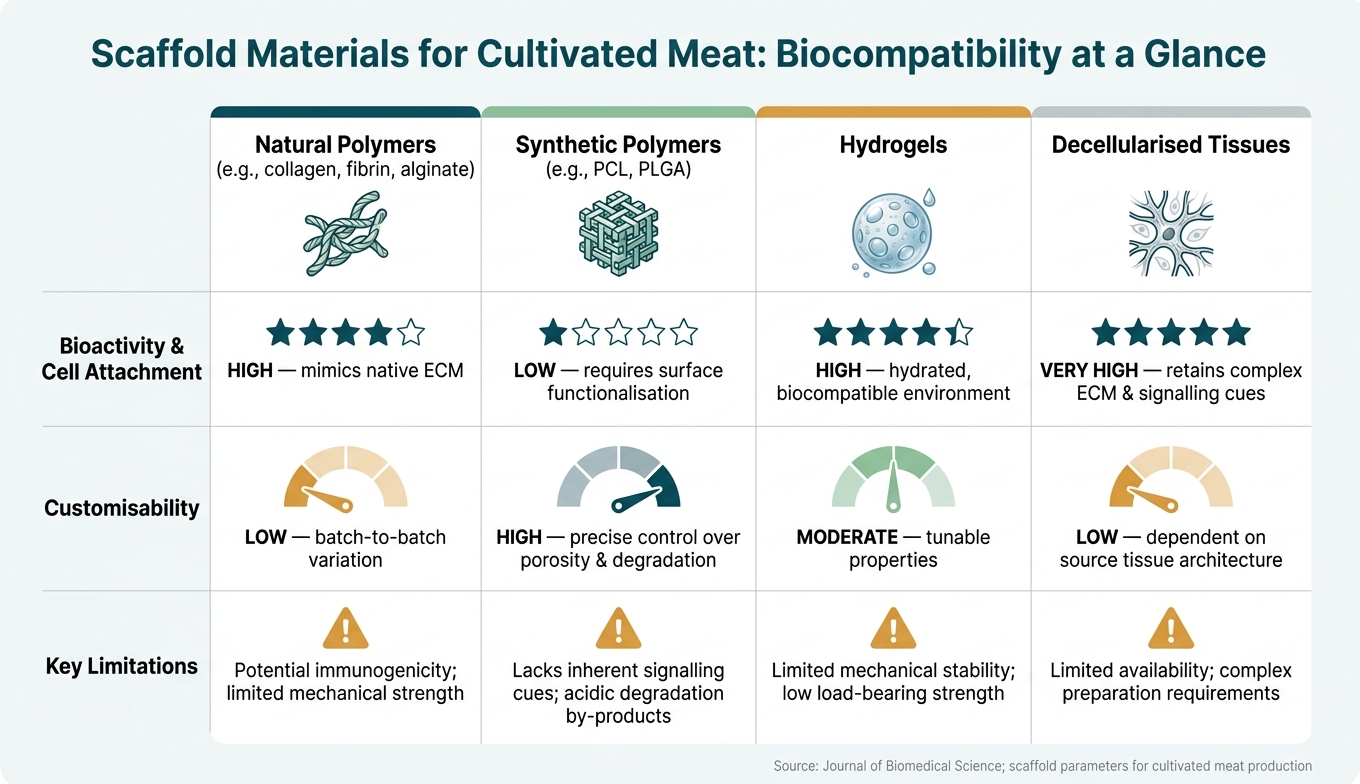
Scaffold Materials for Cultivated Meat: Biocompatibility Comparison
Surface Chemistry and Functionalisation
The surface chemistry of a scaffold plays a crucial role in how cells initially attach. Proteins quickly adsorb onto the scaffold, creating the interface needed for cell adhesion. Factors like surface wettability (hydrophilicity) and surface energy further influence how bioactive signals are presented to cells, shaping their adhesion and downstream signalling pathways [1].
Natural polymers such as collagen, fibrin, and alginate offer an advantage because their chemistry closely mirrors the native extracellular matrix (ECM). This similarity allows cells to easily recognise and attach to them [2]. On the other hand, synthetic polymers like polycaprolactone (PCL) and poly(lactic-co-glycolic acid) (PLGA) provide precise control over properties like porosity and degradation rates. However, they lack the biological cues inherent in natural polymers. This distinction is particularly important in cultivated meat production, where precise control is essential [2].
"Synthetic degradable polymers... generally lack inherent bioactivity, requiring additional modifications or coatings to promote cell adhesion and functionality." - Journal of Biomedical Science [2]
To address these shortcomings, functionalisation techniques are employed. By grafting bioactive molecules - such as ECM-like peptides or growth factors - onto the scaffold surface, cell attachment and function can be enhanced. For porous 3D scaffolds, controlling the surface chemistry radially ensures even cell colonisation throughout the structure, rather than limiting attachment to the outer layers [1].
Surface chemistry is closely tied to surface topography, which also plays a key role in guiding cell behaviour.
Surface Topography and Roughness
Surface topography significantly impacts how cells spread, polarise, and respond. For example, micro-machined textures on titanium substrates are designed to enhance fibroblast adhesion and activation [1]. This concept applies to polymeric scaffolds as well. Hierarchical porosity in PCL membranes, for instance, provides essential structural cues for tissue engineering [1].
Combining optimised surface chemistry with tailored topography yields better results than modifying either feature alone. These two parameters work together to enhance cell adhesion and tissue integration [1]. Advances in 3D printing now enable researchers to replicate the intricate architectural features of native tissues with high precision. By integrating material selection with controlled surface geometry, biomimetic scaffolds can be created that closely resemble natural tissue structures [3].
Bulk Composition and Crosslinking
While surface features are critical, the scaffold's internal composition and crosslinking determine its long-term performance. The bulk composition affects the scaffold's degradation profile and the impact of by-products on cell viability. For instance, synthetic polymers can release acidic degradation by-products, potentially altering local pH levels and impairing biocompatibility if not carefully managed [2].
Crosslinking is particularly important for scaffolds made from natural polymers like collagen. The degree and method of crosslinking influence the scaffold's structural and biochemical properties, as well as its foreign body response. Crosslinking also ensures that the scaffold can withstand the contractile forces exerted by cells during tissue formation, preserving the architecture needed for organised growth. This is especially relevant when designing scaffolds for cultivated meat systems. Evaluating bulk properties, such as resorption rates and degradation by-products, is a key step in biocompatibility testing [1].
| Scaffold Material Type | Bioactivity & Attachment | Customisability | Key Limitations |
|---|---|---|---|
| Natural Polymers | High; mimics native ECM [2] | Low; batch-to-batch variation [2] | Potential immunogenicity; limited mechanical strength [2] |
| Synthetic Polymers | Low; requires surface functionalisation [2] | High; precise control over porosity and degradation [2] | Lacks inherent signalling cues; acidic degradation by-products [2] |
| Hydrogels | High; provides a hydrated, biocompatible environment [2] | Moderate; tunable properties [2] | Limited mechanical stability; low load-bearing strength [2] |
| Decellularised Tissues | Very high; retains complex ECM and signalling cues [2] | Low; dependent on source tissue architecture [2] | Limited availability; complex preparation requirements [2] |
Evaluating Cell Behaviour on Scaffolds
Once the material properties of a scaffold are established, the next step is to assess how cells interact with it. This ensures the scaffold is biocompatible and capable of supporting living tissues. Controlled in vitro testing is essential for generating reliable data on scaffold performance.
Cell Adhesion and Viability
Initial cell attachment is a key indicator of scaffold compatibility. Techniques like scanning electron microscopy (SEM) provide high-resolution images, while phase contrast microscopy combined with fluorescence staining (e.g., Calcein AM for live cells and Ethidium homodimer-1 for dead cells) helps distinguish between viable and non-viable cells. To monitor cell viability over time without disturbing the culture, metabolic activity assays such as AlamarBlue (a resazurin-based assay) are widely used. A practical tip: transfer 3D porous scaffolds to a fresh well plate before performing these assays to avoid signal interference from residual media or reagents [1][4].
"Characterizing the biological response of biomaterials, scaffolds or medical devices is crucial to understanding and assure their functionality and safety." - Luis Maria Delgado, Bioengineering Institute of Technology [1]
Cell Proliferation and Differentiation
Beyond viability, a scaffold must promote both cell growth and maturation. Combining PicoGreen DNA quantitation with AlamarBlue can help differentiate between increased metabolic activity and actual cell proliferation. For cultivated meat applications, it’s equally critical to confirm that cells are differentiating into the desired tissue type. For example, in muscle cell cultures, monitoring myogenic markers can verify proper differentiation. SEM can also provide insights by showing whether cells are bridging the scaffold’s pores, further demonstrating its suitability [1].
Extracellular Matrix (ECM) Deposition
The deposition of ECM is a strong indicator that cells are actively remodelling their environment - a vital function for scaffold performance. A variety of techniques can be employed to assess this, including:
- Picrosirius red and H&E staining for visualising collagen networks and tissue morphology
- Atomic force microscopy (AFM) for analysing micromechanical properties
- Immunohistochemistry (IHC) and immunofluorescence (IF) to identify and quantify ECM protein expression
These methods collectively provide a detailed understanding of how well the scaffold supports tissue formation [1].
Scaffold Architecture and Mass Transport
The internal structure of a scaffold is just as critical as the material it’s made from. This architecture determines how effectively nutrients, oxygen, and signalling molecules can penetrate deep into the scaffold, as well as how efficiently metabolic waste is removed. Even if a scaffold's surface chemistry is compatible with cells, inadequate mass transport can prevent it from supporting tissue growth.
Pore Size and Interconnectivity
Porosity is a cornerstone of scaffold design, enabling the inward diffusion of nutrients and oxygen while allowing waste products to exit [2]. However, porosity alone isn’t enough - the pores must also be interconnected. Without interconnectivity, isolated pores create areas where cells cannot migrate, and waste accumulates, leading to necrotic zones.
One effective approach is hierarchical porosity, which incorporates pores of different sizes within the same scaffold. Smaller pores promote cell attachment and anchoring, while larger, interconnected pores support the bulk movement of gases and nutrients. For example, poly(ε-caprolactone) membranes have been engineered this way to balance high porosity with mechanical strength. However, achieving uniform cell distribution throughout a 3D scaffold remains a major hurdle. Without precise control over the architecture, cells often colonise only the outer layers, leaving the interior sparsely populated [1]. This architectural precision is crucial for optimising mass transport and ensuring long-term tissue viability.
Mass Transport Efficiency
Once pore design is optimised, the material’s mass transport properties must align with its intended application. Hydrogels, for instance, provide excellent permeability through their hydrophilic networks, closely resembling native tissue. In contrast, synthetic polymers like PCL and PLGA allow for customisable porosity, enabling tailored diffusion properties [2].
Scaffold-based microfluidics offer the highest level of control, using microscale channels to deliver nutrients and oxygen with pinpoint accuracy [2]. However, scaling these systems for the large volumes needed in commercial cultivated meat production remains a significant challenge. While microfluidics are ideal for R&D, hydrogel and synthetic polymer scaffolds are often more practical for larger-scale applications. Another critical consideration is maintaining effective mass transport as the scaffold degrades. Channels must remain functional throughout the culture period, requiring ongoing evaluation of scaffold architecture and degradation.
| Scaffold Type | Mass Transport Mechanism | Key Limitation |
|---|---|---|
| Hydrogels | High permeability via hydrated polymer network | Limited mechanical strength; prone to swelling |
| Synthetic Polymers | Customisable porosity during fabrication | Requires precise design to avoid bottlenecks |
| Microfluidics | Microscale channels with precise flow control | Poor scalability for large-volume production |
| Natural Polymers | ECM-like structure enhances diffusion | Less control over pore geometry |
Synchronising the scaffold’s degradation rate with tissue growth is just as important as its initial design. If degradation outpaces tissue formation, mass transport pathways may collapse, compromising cell viability. This balance requires continuous monitoring and refinement of scaffold architecture [1][2].
Mechanical Properties and Degradation Behaviour
When designing scaffolds for cultivated meat, mechanical stability and degradation behaviour are just as critical as material properties and cell interactions. These factors directly influence tissue development and the final product's quality.
Mechanical Stability During Culture
Scaffolds need to mimic the stiffness of natural muscle, which typically ranges from 2–12 kPa [5]. This stiffness provides essential cues for cell behaviour - lower stiffness supports cell expansion, while higher stiffness encourages differentiation. These mechanical properties also play a role in shaping the texture and sensory attributes of the final meat product.
In bioreactors, scaffolds must withstand forces like agitation and shear while retaining their shape until the tissue fully matures [5]. Cross-linking within the scaffold material is a key factor here, as it affects both mechanical and biophysical properties, which, in turn, influence cell interactions over time [1]. Adjusting the cross-linking density is critical to achieving the desired mechanical performance.
Synthetic polymers such as PCL, PLA, and PLGA are often used due to their scalable production and consistent mechanical properties [5]. However, plant-based and fungal materials, like bacterial cellulose, are also gaining traction. These materials offer high mechanical resistance and align well with consumer preferences for edibility and natural origins [5].
During the production process, it’s essential to synchronise the scaffold's mechanical stability with the tissue's growth and maturation.
Degradation Rate and By-Products
Scaffold degradation must be carefully timed to match tissue development. If a scaffold degrades too quickly, it may lose its structural role before enough extracellular matrix (ECM) is deposited. Conversely, a scaffold that degrades too slowly can hinder tissue integration and complicate later processing steps [1][5].
Another critical consideration is the safety of degradation by-products. Even if a scaffold is biocompatible for medical applications, it must meet strict regulatory standards for scaffold materials. This often involves additional testing, potentially delaying market entry [5]. For example, PLA scaffolds can produce acidic by-products that may require buffering to maintain cell viability [5]. In contrast, natural biopolymers like alginate break down into non-toxic sugars or organic acids, making them more suitable for food-grade applications [5].
| Scaffold Material | Degradation Rate | By-product Safety | Key Consideration |
|---|---|---|---|
| PCL | Slow (biodegradable) | Generally low toxicity | High mechanical strength; removal needed |
| PLA / PLGA | Tunable | Acidic by-products | Requires monitoring for cell viability |
| Alginate | Variable | Non-toxic | May need RGD modification for adhesion |
| Bacterial Cellulose | Slow | Non-toxic | High resistance; limited edibility |
| Self-assembling Peptides | Controlled cleavage | Mimics ECM breakdown | High cost limits scalability |
To streamline production, scaffolds can be designed to degrade in sync with ECM deposition. This approach reduces the need for complex cell dissociation steps and simplifies the overall process [5]. However, achieving this requires precise material selection and continuous monitoring to ensure that degradation remains aligned with tissue growth throughout the culture period [1].
In Vivo Validation of Scaffold Performance
While in vitro testing provides valuable insights into scaffold behaviour, it often falls short of painting the complete picture. This is where in vivo validation steps in, bridging the gap between lab-based analysis and real-world biological environments. For many biomaterials for cultivated meat scaffolds, discrepancies between in vitro and in vivo data necessitate this crucial phase of testing [1]. Animal models are indispensable for assessing how scaffolds perform under realistic physiological conditions.
Foreign Body Response
Once implanted, a scaffold encounters an immediate reaction from the host immune system. This foreign body response (FBR) is a decisive factor in determining whether the scaffold integrates effectively or becomes encapsulated in fibrous tissue - a scenario that can obstruct nutrient transport and impede tissue development [6].
A key player in this process is macrophage polarisation. M1 macrophages are associated with pro-inflammatory responses, whereas M2 macrophages facilitate tissue repair and regeneration. The ratio of these phenotypes, often measured through immunohistochemistry (IHC), serves as an early marker for predicting long-term scaffold integration [6]. Factors such as surface chemistry, structural design, and crosslinking methods significantly influence macrophage behaviour.
"The contact of biomaterials with tissue... induces immune reactions in a material and patient specific manner, where both surface and bulk properties of scaffolds, together with their 3D architecture, have a significant influence on the outcome." - Ezgi Antmen et al., Biomaterials Science [6]
Tissue Integration and Formation
After evaluating the immune response, the next critical step is determining how well the scaffold integrates with host tissue. Successful integration means the scaffold is gradually replaced by functional tissue rather than being isolated by fibrous encapsulation. Histological techniques are central to this assessment. For instance:
- H&E staining: Reveals overall tissue morphology and cell distribution.
- Picrosirius red staining: Highlights collagen fibre organisation and extracellular matrix density within and surrounding the scaffold [1].
- Multiplex IHC: Allows simultaneous analysis of multiple biological markers, offering detailed insights into scaffold–tissue interactions [1].
"The biological characterization... has to provide a greater understanding of cell toxicity, cell-biomaterial interactions, protein-biomaterials, biomaterial resorption or degradation, and how scaffolds are infiltrated or replaced by new tissue." - Luis Maria Delgado, Bioengineering Institute of Technology [1]
Validation procedures adhere to ISO 10993-1:2018 standards, ensuring a thorough biological evaluation [1]. Beyond the initial immune response, long-term monitoring is critical to identify potential issues like fibrous encapsulation or incomplete tissue replacement. Early biocompatibility does not always guarantee success in later stages [1][6].
How Cellbase Supports Scaffold Selection

A Curated Marketplace for Cultivated Meat
Finding biocompatible scaffolds for cultivated meat production can be a complex and time-consuming process. Researchers must sift through a fragmented supplier network while ensuring materials meet both biological and food-safety standards. Traditional lab procurement platforms are not equipped to handle these specific needs.
This is where Cellbase steps in. As the first B2B marketplace tailored specifically for the cultivated meat industry, Cellbase connects R&D teams and production managers with verified suppliers offering scaffolds designed for this field. The platform features a wide range of scaffold materials, including plant-based, algae-derived, and fungal options. What sets Cellbase apart is its rigorous vetting process. Suppliers are evaluated on critical parameters such as biocompatibility, biodegradability, and stability, and materials are verified to comply with food-grade or GRAS (Generally Recognised as Safe) standards. This focus on food safety is crucial because scaffolds suitable for clinical implants may still require expensive removal steps if they are not edible in the final product. By addressing these specific challenges, Cellbase streamlines the procurement process, making it more efficient and precise.
Reducing Procurement Friction
Matching scaffold surface chemistry to cell behaviour is another significant challenge in cultivated meat research. For example, plant-based scaffolds often need cell-binding domains, like RGD motifs or integrin-recognised sequences, to ensure proper cell adherence. Finding suppliers who can meet such specific functional requirements can be both time-intensive and risky.
Cellbase tackles this issue by offering a platform with searchable, use-case–tagged listings. Buyers can filter for essential properties such as surface functionalisation, mechanical stiffness, and degradation profiles. This allows researchers to identify scaffolds that meet the exact mechanical and biochemical criteria required for cultivated meat production. By reducing the chances of mismatches, Cellbase helps researchers avoid costly delays later in the development process [5].
Conclusion: Improving Scaffold Biocompatibility Testing
Effective scaffold biocompatibility testing involves thorough, multi-faceted evaluations. Factors like surface chemistry, topography, bulk composition, mechanical stability, and degradation behaviour all play interconnected roles in determining whether a scaffold will support or inhibit cell growth. No single factor can provide a complete picture, making it crucial to adopt integrated testing approaches that assess both laboratory and practical performance.
One major hurdle is the inconsistent correlation between in vitro and in vivo results for certain biomaterials [1]. This highlights the importance of combining standardised assays - such as PicoGreen DNA quantification and Calcein AM staining - with advanced techniques like quartz crystal microbalance (QCM) for real-time monitoring of protein adsorption. As Luis Maria Delgado from the Bioengineering Institute of Technology states:
"Characterising the biological response of biomaterials, scaffolds or medical devices is crucial to understanding and assure their functionality and safety." [1]
This challenge is especially critical in cultivated meat production, where scaffolds must meet rigorous safety and performance standards.
Additionally, selecting scaffolds that align with production goals means factoring in their performance during scale-up. As previously discussed, scaffolds need to maintain effective mass transport and ensure uniform cell colonisation in larger culture volumes. This reduces the need for redesigns during the scaling process.
For researchers making these complex decisions, Cellbase offers a practical tool. By providing verified scaffold listings tagged with specific use cases and properties - such as degradation profile and surface functionalisation - the platform helps teams identify materials that meet the unique demands of cultivated meat production.
FAQs
Which scaffold tests best predict real bioreactor performance?
Tests for cytotoxicity, degradation, and mechanical properties are key to evaluating scaffold performance in bioreactors. These assessments reveal how effectively scaffolds promote cell growth and degrade safely within bioreactor environments, ensuring they meet the requirements for cultivated meat production.
How do I choose pore size for good oxygen and nutrient transport?
Choosing the right pore size is a key factor in ensuring effective oxygen and nutrient transport within scaffolds. Larger pores improve diffusion, allowing oxygen and nutrients to reach deeper layers, which supports cell growth and viability. However, if the pores are too large, the scaffold may lose structural strength and provide less surface area for cells to attach. It's essential to strike a balance - pore sizes should be optimised to promote adequate diffusion while preserving scaffold stability and encouraging cell adhesion.
What degradation by-products are acceptable for cultivated meat?
For cultivated meat, acceptable degradation by-products are those that decompose into harmless and edible components. These breakdown products must align with strict regulatory standards, ensuring no inedible or unsafe residues are left behind. This guarantees the safety and quality of the final product for consumption.


