

Aseptic processing in cultivated meat production is all about keeping contaminations out. But challenges like microbial growth, human errors, and supply chain issues make it tricky. Here's what you need to know:
- Why it's hard: Nutrient-rich media for cell growth also encourages microbes. Without natural defences like in animals, contamination risks are higher.
- Key failures: Microbial contamination, procedural mistakes, cleanroom issues, and raw material quality problems.
- How to fix them: Use serum-free media, closed systems, strict SOPs, robust supplier checks, and continuous monitoring.
Bottom line: Prevention starts with tight controls at every stage - from cell sourcing to harvest. Solutions like single-use bioreactors, automated systems, and validated cleaning protocols and media sterility best practices are crucial for maintaining sterility.
Read on for detailed strategies to tackle each failure and improve aseptic practices in your facility.
EU GMP Annex 1 Explained: Contamination Control Strategy, Risk Management & Sterile Manufacturing
sbb-itb-ffee270
Regulatory Expectations for Aseptic Processing
Cultivated meat occupies a unique regulatory space, intersecting both pharmaceutical and food safety standards. However, it lacks a unified regulatory framework. Authorities like the UK Food Standards Agency (FSA) and Food Standards Scotland (FSS) are actively working to establish evidence-based safety requirements tailored to cultivated meat production [1]. These emerging guidelines are shaping the standards for aseptic practices, which are explored further below.
Key Standards for Aseptic Practices
Aseptic processing in cultivated meat production is guided by three primary frameworks: Good Manufacturing Practice (GMP), Good Cell Culture Practice (GCCP), and Hazard Analysis and Critical Control Point (HACCP).
- GMP brings in well-established environmental and procedural controls from pharmaceutical manufacturing.
- GCCP focuses on maintaining cell line integrity and preventing contamination during early stages, such as cell banking.
- HACCP offers a structured approach to identifying and mitigating biological, chemical, and physical hazards throughout the production process.
The FSA highlights the adaptability of these principles for cultivated meat:
"The principles of Codex and HACCP provide a solid basis to build specific guidelines and quality control plans for this sector, and learnings can be drawn from the clinical / biopharmaceutical industry and adapted to novel food requirements." [1]
Despite these frameworks, challenges remain. For instance, there is no globally standardised definition for Master Cell Banks (MCBs) or Working Cell Banks (WCBs) tailored specifically for food production. Producers currently rely on biomedical standards that are not optimised for food-grade applications. Key parameters, such as microbial thresholds, endotoxin limits, and viral testing protocols, are yet to be clearly outlined for cultivated meat, creating compliance uncertainties [1].
Risk-Based Process Design
To navigate these regulatory uncertainties, a risk-based approach is critical. Instead of introducing safety measures as an afterthought, the Quality by Design (QbD) principle incorporates sterility and contamination controls into the facility and process design from the outset [1].
This approach employs a tiered strategy, applying stricter pharmaceutical-grade cleanroom controls during the most contamination-sensitive stages, such as cell banking and seed train operations. As production scales up into larger bioreactors, controls transition to food-grade standards, aligning with the economic realities of large-scale food manufacturing [2]. Key technologies like closed fermentation systems and automated bioreactors play a pivotal role in this strategy, reducing human contact and environmental exposure.
| Production Stage | Recommended Control Level | Primary Rationale |
|---|---|---|
| Cell banking & seed train | Pharmaceutical-grade cleanroom | High contamination risk; small volumes with significant consequences |
| Scale-up bioreactors | Food-grade environmental controls | Balances cost efficiency with lower per-unit contamination risk at larger volumes |
| Harvest & downstream processing | HACCP-based food safety controls | Aligns with established practices in food manufacturing |
The table above outlines this staged approach, though transitions between stages can vary. For example, during the shift from R&D to pilot production, pharmaceutical-grade controls often remain in place longer than initially planned. This is partly due to existing infrastructure and the potentially severe impact of contamination at early production scales.
Common Aseptic Processing Failures and How to Fix Them
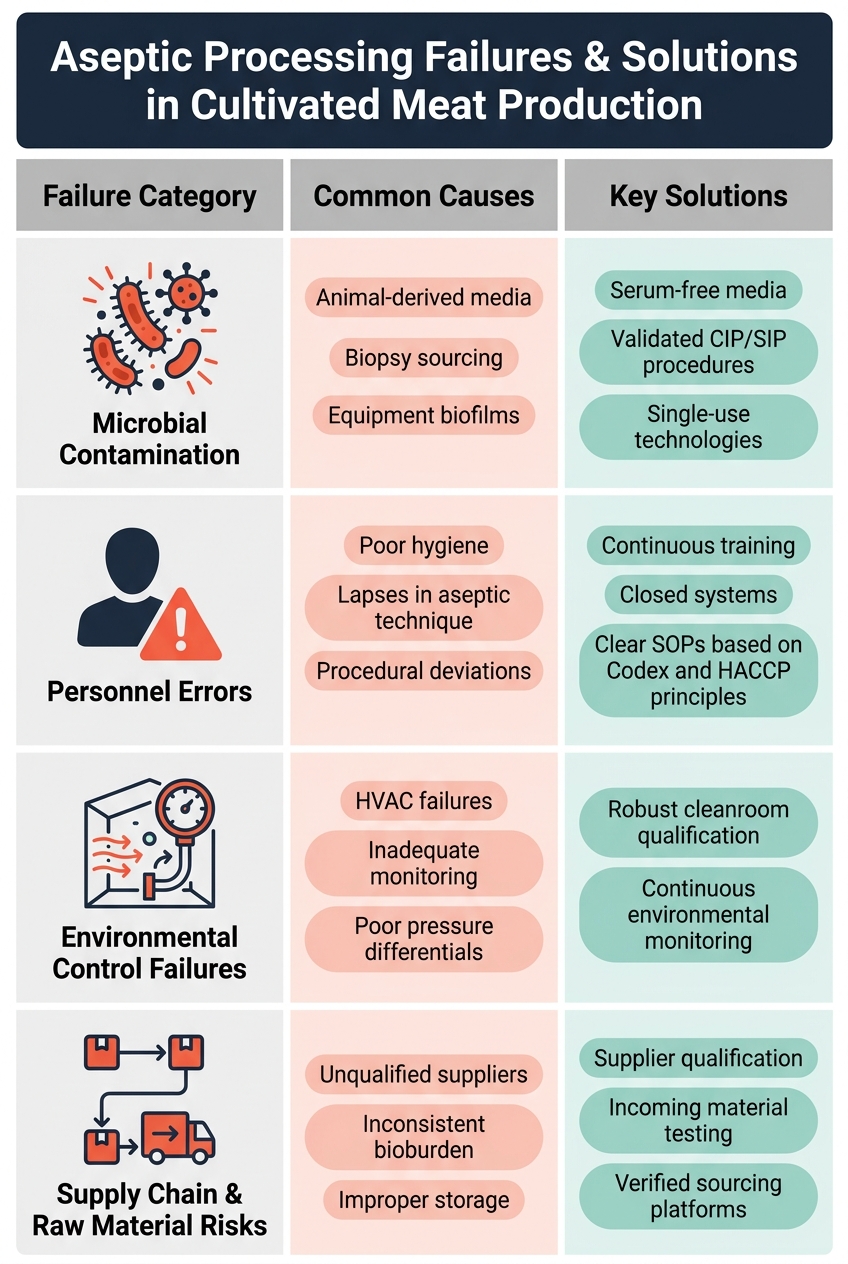
Aseptic Processing Failures & Solutions in Cultivated Meat Production
Aseptic process failures in cultivated meat production can arise from a mix of biological, human, environmental, and supply chain issues. Regulatory frameworks provide a foundation for addressing these challenges. Here's an overview of common failures and practical ways to tackle them.
Microbial Contamination of Cultures
Microbial contamination can occur at any stage of production. According to the FSA:
"Microbial hazards can be introduced at any stage of production. In CCPs, the initial phase of cell sourcing is a major risk, since the process generally involves isolating cells or tissue from an animal in a slaughterhouse." [1]
Animal-derived media ingredients, such as bovine serum, are particularly prone to contamination. To mitigate this, producers can:
- Transition to serum-free, non-animal-derived media.
- Validate Cleaning-in-Place (CIP) and Steaming-in-Place (SIP) protocols for reusable equipment.
- Opt for single-use bioreactors, tubing, and filters to reduce cross-contamination risks, while weighing their environmental impact.
Personnel and Procedural Errors
Human errors can be minimised with continuous training in aseptic techniques and strict adherence to protocols. Key strategies include:
- Implementing closed fermentation systems and automated liquid handling to limit manual interventions.
- Developing and enforcing clear Standard Operating Procedures (SOPs) based on Codex and HACCP principles to reduce procedural deviations.
A controlled cleanroom environment is also crucial to complement these efforts.
Cleanroom and Environmental Control Failures
Failures in cleanroom and environmental controls can compromise aseptic conditions. To address this, producers should:
- Establish robust cleanroom qualification programmes.
- Conduct continuous environmental monitoring, including air sampling and surface testing.
- Prevent issues like HVAC malfunctions, inadequate pressure differentials, and insufficient particulate monitoring, which can allow airborne fungi and waterborne bacteria to infiltrate cultures.
Supply Chain and Raw Material Quality Issues
Contamination risks can originate from raw materials before they even reach the facility. Variability in the bioburden of growth media components, cell lines, and biological reagents, as well as improper storage or unqualified suppliers, are common culprits. Solutions include:
- Implementing supplier qualification programmes to ensure materials meet required standards.
- Performing thorough incoming material testing, such as bioburden assessments and mycoplasma screening.
- Leveraging platforms like Cellbase to source verified suppliers who adhere to stringent technical requirements.
By addressing these critical areas, cultivated meat producers can strengthen their aseptic processes and maintain a high level of control over production.
Summary Table of Failures and Solutions
| Failure Category | Common Causes | Key Solutions |
|---|---|---|
| Microbial contamination | Animal-derived media, biopsy sourcing, equipment biofilms | Serum-free media, validated CIP/SIP procedures, single-use technologies |
| Personnel errors | Poor hygiene, lapses in aseptic technique, procedural deviations | Continuous training, closed systems, clear SOPs based on Codex and HACCP principles |
| Environmental control | HVAC failures, inadequate monitoring, poor pressure differentials | Robust cleanroom qualification and continuous environmental monitoring |
| Supply chain risks | Unqualified suppliers, inconsistent bioburden, improper storage | Supplier qualification, incoming material testing, verified sourcing platforms |
Monitoring, Investigations, and Continuous Improvement
Developing Monitoring Strategies
Ensuring aseptic conditions means keeping a close eye on the entire production environment - not just the bioreactor. A well-rounded monitoring programme should address environmental conditions, in-process parameters, biological inputs, and even how personnel interact with the environment.
To design such programmes, rely on established frameworks like Codex and HACCP [1].
Practically, this involves combining continuous environmental monitoring - such as tracking air particulates, conducting surface swabs, and testing water quality - with in-line, real-time sensing of critical parameters like pH and dissolved oxygen. These parameters often shift when microbial growth begins. Since visual inspections can't catch invisible threats like viruses, mycoplasma, or mycobacteria, molecular assays (e.g., PCR or LAL tests) are crucial for checking incoming materials. Additionally, cultivated meat's unique properties mean that standard microbiological methods used for conventional food or pharmaceuticals must undergo rigorous validation and accreditation before they can be trusted for product release.
These monitoring strategies are essential for identifying and managing deviations, as outlined below.
Root Cause Analysis and Deviation Management
When monitoring uncovers anomalies, a structured investigation is essential. Start by verifying whether the issue represents genuine contamination or a sampling error. From there, systematically examine potential sources, including raw materials, personnel practices, equipment, and the environment. Corrective and Preventive Actions (CAPAs) should be clearly defined, time-bound, and their effectiveness thoroughly verified. Over time, analysing deviation records can uncover recurring patterns, which may point to deeper systemic issues that need addressing.
Using Data Analysis to Drive Continuous Improvement
Continuous data analysis plays a key role in maintaining aseptic conditions across all stages of production. Trend analysis turns routine monitoring data into a powerful tool. Instead of viewing environmental results in isolation, aggregate weekly or monthly data to identify trends in contamination indicators, such as airborne particulate levels or endotoxin presence in incoming media. Advanced bioprocess control software using AI and machine learning can support real-time monitoring and metabolic sensing, enabling early detection of microbial activity [1].
Additionally, sharing data across the industry is becoming an effective way to set benchmarks and proactively identify emerging microbial threats. Don’t overlook spent media and production waste as valuable data sources - they can help prevent environmental contamination and track antimicrobial resistance markers, a growing area of regulatory concern.
Conclusion and Key Takeaways
Failures in aseptic processing during cultivated meat production are rarely due to a single issue. Instead, they often arise from a combination of factors - such as lapses in environmental monitoring, inconsistent personnel practices, or insufficient quality checks on raw materials. Successfully addressing these challenges requires viewing aseptic integrity as a comprehensive, system-wide effort rather than relying on isolated fixes.
The solutions discussed in this article emphasise prevention by design. Technologies like closed fermentation systems, single-use equipment (SUTs), and non-animal-derived ingredients limit potential contamination pathways. As highlighted by FSA Research and Evidence:
"The use of alternative non-animal derived ingredients is expected to reduce the risk of zoonotic disease greatly." [1]
Additionally, real-time in-line monitoring - tracking parameters like pH and dissolved oxygen - offers early detection capabilities that surpass traditional end-of-batch testing. These preventive strategies work best when paired with stringent sourcing protocols.
Sourcing decisions play a critical role in maintaining aseptic conditions. Materials without proper certification, viral testing, or defined microbial thresholds introduce risks that even the most robust downstream protocols cannot fully address. For example, Cellbase, a B2B marketplace tailored to cultivated meat, helps procurement teams find verified suppliers offering GMP-compatible equipment and materials. Their platform includes options like SUTs, growth media, and closed-system bioreactors, all clearly designated for cultivated meat applications. Such verified sourcing practices strengthen aseptic integrity, reinforcing the controls implemented earlier in the production process.
FAQs
Which production steps in cultivated meat are most contamination-prone?
In cultivated meat production, certain steps are particularly vulnerable to contamination. These include breaches in bioreactor ports, failures in gas filters, contamination of growth media, incorrect sensor installation, and microplastic contamination caused by equipment wear. Recognising and mitigating these risks is crucial to maintaining sterility and achieving reliable production outcomes.
How do you choose between single-use and reusable equipment for sterility?
Choosing between single-use and reusable equipment hinges on factors like contamination risks, operational demands, and sterility protocols.
Single-use components are particularly useful in reducing cross-contamination risks and eliminating the need for complex sterilisation steps. This makes them a smart choice for high-risk environments or when handling smaller production batches.
On the other hand, reusable equipment offers potential cost savings over time. However, it demands rigorous sterilisation procedures and regular maintenance to ensure contamination is kept in check.
For critical processes, many facilities lean towards single-use systems due to their ability to lower contamination risks and simplify validation workflows.
What tests should be run on incoming media and reagents to prevent contamination?
To maintain a contamination-free environment in cultivated meat production, sterility testing of incoming media and reagents is essential. Common methods include microbiological assessments such as:
- Membrane filtration: Ideal for detecting microbial contaminants in liquid samples.
- Direct inoculation: Involves introducing samples directly into growth media to check for contamination.
- Bioburden testing: Measures the total microbial load in a sample.
In addition to these, media fill tests are highly recommended. These tests simulate the production process to validate aseptic techniques and confirm sterility under actual operating conditions.
By conducting these tests regularly, contamination can be detected at an early stage, ensuring the integrity and safety of the production process.


