

CRISPR is transforming cultivated meat production by addressing a major challenge: cell stress in industrial bioreactors. This tool allows precise genetic edits to improve cell survival, extend proliferation, and reduce senescence under harsh conditions. For instance, knocking out genes like TP53 and PTEN has extended primary vs immortalised cell line culture durations from 100 to 200 days and boosted cell abundance 1,000-fold in 30 days. However, these modifications can impact differentiation, requiring careful optimisation.
Key insights from the article include:
- Stress Factors in Bioreactors: Shear forces, nutrient imbalances, and oxidative stress reduce cell viability.
- CRISPR Strategies: Gene knockouts (TP53, PTEN) and activations (HIF1A) target specific stress responses.
- Validation: Edited cells undergo genomic, proteomic, and functional testing to ensure performance and differentiation potential.
- Scaling Up: Transitioning to bioreactor conditions involves optimised media and equipment, with platforms like Cellbase providing tailored resources.
CRISPR's precision enables stress-resistant cell line development, but balancing growth and differentiation remains critical for scalable cultivated meat production.
Mapping Bioreactor Stress Profiles for Genetic Design
Identifying Key Bioreactor Stress Factors
Before initiating CRISPR editing, it’s essential to map bioreactor stress profiles to guide genetic design. Stress factors in bioreactors provoke specific cellular responses that need to be well-understood to select appropriate genetic targets.
Mechanical and hydrodynamic stress is one of the most immediate challenges. Stirred-tank bioreactors create shear forces that can damage cell membranes and interfere with cellular signalling pathways [5][2]. Nutritional and metabolic stresses also play a major role, often stemming from uneven nutrient uptake. Nutrient gradients in 3D scaffolds and the accumulation of ammonia contribute to metabolic strain [3][5][6]. Additionally, pH fluctuations and elevated temperatures can reduce cell proliferation rates and even push cells towards premature differentiation [3][2].
Other stressors, including oxidative, mitochondrial, and ER stresses, further challenge cell viability. Oxidative stress becomes particularly severe during the transition to serum-free media, as the absence of natural antioxidants leaves cells more vulnerable to reactive oxygen species [4]. On a cellular level, mitochondrial stress and endoplasmic reticulum (ER) stress arise when bioprocess conditions deviate from their optimal ranges [6]. Xiaoyan Guo from the Institute for Neurodegenerative Diseases at UCSF highlights this dynamic:
"In the presence of different physiological and environmental stresses, cells rapidly initiate stress responses to re-establish cellular homeostasis." [6]
By proactively mapping these stress factors, rather than reacting to issues as they arise, researchers can define precise genetic engineering objectives. This systematic approach ensures that CRISPR strategies target stress-resilient cell line development effectively.
Using Omics Data to Find Stress-Responsive Genes
After characterising the stress environment, the next step is identifying the genes that respond to these conditions. Tools like transcriptomics (RNA-seq) and proteomics are invaluable for tracking changes in gene expression and protein abundance as cells move from healthy, early-passage states to stressed, late-passage conditions [1][6]. However, while these methods capture downstream effects, they often fail to identify the upstream regulators driving these changes [6].
Pooled CRISPR knockout screens bridge this gap. By systematically disrupting thousands of genes across a large cell population, these screens reveal which gene perturbations confer a growth advantage under stress, uncovering critical regulatory hubs [1][6]. For instance, targeting genes such as TP53 and PTEN has been shown to reverse molecular ageing signatures caused by prolonged culture stress. This allows late-passage cells to maintain a transcriptomic profile similar to early-passage wild-type cells [1].
Using hierarchical clustering, researchers can group genes based on their expression changes over time, isolating modules related to processes like cell-cycle progression and protein synthesis. These processes typically decline as bioreactor-induced senescence takes hold [1]. When combined with pathway enrichment analysis (via tools like gprofiler2), these modules can be linked to specific biological pathways, such as TGFβ signalling or chondrogenic differentiation, which may actively limit cell expansion [1].
The table below outlines the contributions of each method to constructing a comprehensive stress map:
| Method | Primary Use | Key Output |
|---|---|---|
| Transcriptomics (RNA-seq) | Measuring mRNA expression changes | Differentially expressed genes (DEGs) between stressed and unstressed cells [1] |
| Proteomics | Measuring protein abundance | Translational outputs mapped to specific stressors [6] |
| Pooled CRISPR Screen | Functional gene perturbation | Upstream regulatory hubs and fitness-critical genes [1][6] |
| PCA & Hierarchical Clustering | Data visualisation and grouping | Cellular state shifts and co-regulated stress-response pathways [1] |
sbb-itb-ffee270
Cell line engineering with CRISPR-Cas9 - Tips and tricks to maximize success
CRISPR Strategies for Engineering Stress-Resistant Cell Lines
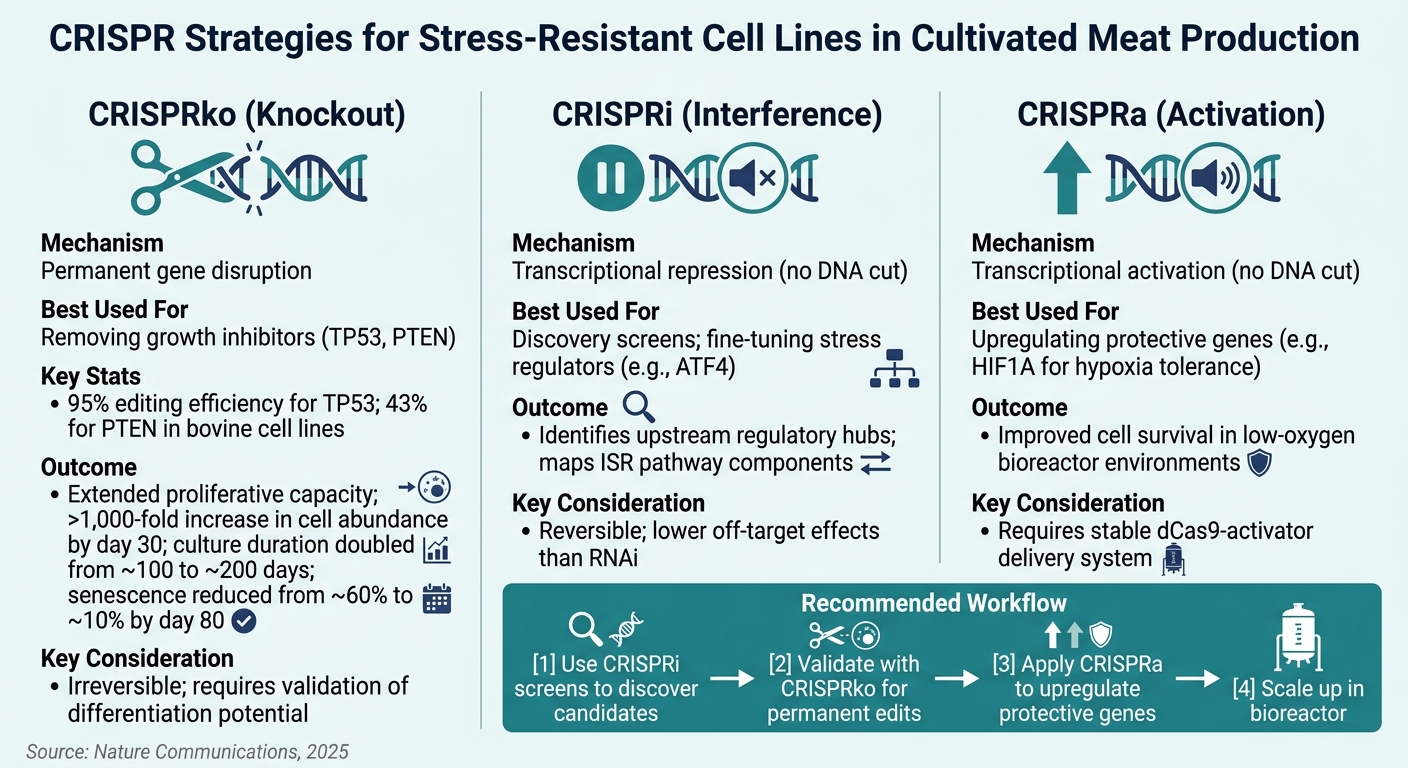
CRISPR Techniques for Stress-Resistant Cell Lines in Cultivated Meat
Key Genes and Pathways for Stress Resistance
With a detailed stress map in hand, the next step is to pinpoint target genes for editing. The choice of targets depends on the primary stressor affecting cell performance.
Replicative senescence is a major hurdle in cultivated meat production, as it limits cell proliferation. Around 25% of cell sources in this field are mesenchymal stem cells (MSCs), which face irreversible growth arrest after repeated passaging [1]. Knocking out TP53, the gene encoding the p53 tumour suppressor protein, directly addresses this issue. Research in bovine MSCs shows that TP53 knockout significantly extends the cells' proliferative capacity, allowing them to divide far beyond the limits of unedited lines [1]. Similarly, knocking out PTEN enhances the PI3K/AKT/mTOR pathway, boosting stress resilience [1].
For tackling metabolic and mitochondrial stresses, the Integrated Stress Response (ISR) is a critical pathway. The transcription factor ATF4 plays a central role in coordinating mitochondrial stress responses, and CRISPR screens have been instrumental in mapping its upstream regulators [6]. As Xiaoyan Guo and Martin Kampmann from the University of California, San Francisco, explain:
"Unbiased genetic screens based on a transcriptional or translational reporter are powerful approaches to identify regulatory factors of a specific stress response." [6]
The TGFβ pathway also warrants attention, especially for expanding bovine MSCs. CRISPR screens have shown that TGFβ-driven chondrogenic differentiation suppresses cell proliferation. Repressing this pathway helps maintain cells in an undifferentiated, expandable state [1]. For hypoxic conditions often found in the dense cores of 3D scaffolds, activating HIF1A using CRISPRa improves cell survival in low-oxygen environments. These modifications equip cells to thrive under the dynamic conditions of industrial-scale bioreactors.
However, it's important to note that edits maximising cell proliferation - such as TP53 knockouts - can reduce the cells' ability to differentiate into muscle or fat tissue. This trade-off between growth and differentiation potential must be carefully balanced when designing an engineering strategy [1].
| Stress Factor | Key Gene Target | CRISPR Strategy | Outcome |
|---|---|---|---|
| Replicative senescence | TP53 | Knockout | Extended proliferative capacity; increased cell abundance |
| Nutrient/growth stress | PTEN | Knockout | Enhanced PI3K/AKT/mTOR signalling; improved survival |
| Mitochondrial stress | ATF4 | CRISPRi / reporter | Identification of upstream regulatory pathways |
| Hypoxia | HIF1A | CRISPRa (activation) | Increased survival in low-oxygen bioreactor environments |
| Chondrogenic drift | TGFβ pathway | Knockout / repression | Maintenance of undifferentiated, proliferative state in bovine MSCs |
Once the key genes are identified, selecting the right CRISPR technique becomes the next critical step.
Comparing CRISPR Editing Techniques
The choice of CRISPR method determines the precision and permanence of genetic modifications. Each approach has unique strengths depending on whether the goal is a permanent change, a reversible adjustment, or exploratory screening.
CRISPR knockout (CRISPRko) is the go-to method for permanently disabling genes. It’s ideal for targets like TP53 and PTEN, where complete loss of function is needed. Validation studies have shown CRISPRko achieves 95% editing efficiency for TP53 and 43% for PTEN in bovine cell lines [1]. These variations underline the importance of testing target-specific efficiency before proceeding with large-scale editing.
CRISPR interference (CRISPRi) offers reversible gene repression, making it ideal for discovery phases. It also reduces off-target effects compared to RNAi [6]. On the other hand, CRISPR activation (CRISPRa) works by overexpressing protective genes, such as those involved in hypoxia tolerance (HIF1A) or antioxidant defence, to enhance stress resistance.
Here’s a quick comparison of the techniques:
| Technique | Mechanism | Best Used For | Key Consideration |
|---|---|---|---|
| CRISPRko | Permanent gene disruption | Removing growth inhibitors (TP53, PTEN) | Irreversible; requires validation of differentiation potential |
| CRISPRi | Transcriptional repression (no DNA cut) | Discovery screens; fine-tuning regulators | Reversible; lower off-target effects than RNAi |
| CRISPRa | Transcriptional activation (no DNA cut) | Upregulating protective genes (HIF1A) | Needs stable dCas9-activator delivery system |
For teams in the early stages of identifying targets, pooled CRISPRi screens provide a cost-efficient way to discover stress-resistance genes on a large scale. Once promising candidates are validated, CRISPRko can be used for permanent edits suited to production. These approaches complement each other, and using them in sequence is increasingly seen as a best practice in the field [1][6].
For sourcing CRISPR reagents and bioreactor supplies tailored to cultivated meat research, platforms like Cellbase offer verified materials to support your work effectively.
Implementing and Validating CRISPR-Edited Cell Lines
Designing and Delivering CRISPR Edits
Once you've identified the target genes, the next step is designing and delivering the CRISPR edits. To ensure effective gene disruption, focus on creating single-guide RNAs (sgRNAs) that target essential exons. This approach increases the likelihood of fully knocking out the gene rather than producing a truncated, partially functional protein. Using a dual-guide RNA strategy can significantly enhance knockout efficiency, raising it from around 55% to over 95% [8].
The delivery method you choose will depend on the specific cell type. For cultivated meat cell lines, pre-assembled Cas9 ribonucleoproteins (RNPs) are often the best option. These RNPs are transient, meaning they degrade quickly after delivery, which helps minimise off-target effects and avoids the risk of plasmid DNA integration [8]. In cases where pooled screens or difficult-to-transfect primary cell lines are involved, lentiviral transduction is a reliable alternative. When using lentiviral systems, researchers typically maintain a low multiplicity of infection (MOI) of about 0.3 to avoid multiple integrations, which could complicate downstream analysis [1].
For optimal results, ensure the cells are in the logarithmic growth phase and at 70–90% confluence before transfection. After delivery, isolate individual clones using methods like limiting dilution or fluorescence-activated cell sorting (FACS) to ensure clear, unambiguous validation. Finally, edits must be verified at the genomic, proteomic, and functional levels to confirm success.
Screening and Validating Edited Cell Lines
Thorough validation is essential when transitioning edited cell lines to bioreactor conditions. This process involves screening at three levels: genomic, proteomic, and functional. Skipping any of these steps increases the risk of selecting cell lines that may fail under production conditions.
At the genomic level, initial screening can be performed using mismatch assays like T7E1 or Surveyor, which provide a quick estimate of editing frequency in the cell pool. For precise confirmation, follow up with Sanger sequencing or next-generation sequencing (NGS) to identify clones with biallelic disruptive indels [7][8]. Proteomic validation, typically performed using Western blot analysis, ensures the complete absence of the target protein. For example, a study conducted in 2025 demonstrated that knocking out TP53 led to over a 1,000-fold increase in cell abundance by day 30 of a competitive screen, effectively doubling culture duration from 100 to approximately 200 days [1].
Functional validation is equally important. Metabolic viability and proliferation rates can be assessed using Alamar Blue assays, while tracking population doubling time (PDT) over extended periods - up to 200 days - helps identify cell lines that have overcome replicative senescence [1]. For cell lines engineered to endure hypoxic or mitochondrial stress, FACS-based reporter assays can confirm that the cells respond correctly under low-oxygen or nutrient-limited conditions [6]. Additionally, cell lines with TP53 or PTEN knockouts should be tested for their ability to retain differentiation potential. Flow cytometry for mesenchymal stem cell (MSC) markers such as CD29 and CD44 can verify that these cells maintain their stemness [1].
| Validation Level | Method | Purpose |
|---|---|---|
| Genomic | Sanger Sequencing / NGS | Confirm biallelic disruptive indels [7][8] |
| Proteomic | Western Blot | Verify the complete absence of the target protein [7][8] |
| Phenotypic | Flow Cytometry (CD29/CD44) | Check for retention of MSC markers and stemness [1] |
| Functional | Alamar Blue / PDT Tracking | Evaluate growth kinetics and metabolic health [1] |
| Stress | FACS-based Reporter Assays | Test stress-response behaviour under challenging conditions [6] |
Before scaling up an edited cell line, perform STR profiling to confirm cell identity and conduct mycoplasma testing to rule out contamination [7]. Creating a validated knockout cell line typically requires about three months, with the possibility of repeating certain steps in the workflow.
Scaling Up: Moving Stress-Resistant Cell Lines into Production
Transitioning Edited Cell Lines to Bioreactor Conditions
Once validated, edited cell lines must shift from lab-scale adherent cultures to suspension systems like stirred-tank bioreactors, air-lift reactors, or rotating-wall vessels - each capable of supporting industrial-scale cultivated meat production [2].
For adherent-dependent cells such as bovine mesenchymal stem cells (bMSCs), using laminin-511-coated microcarriers offers a practical pathway to suspension culture [3]. During this transition, it's crucial to monitor MSC markers like CD29 and CD44 to ensure the cells retain their differentiation potential [1].
A critical step in scaling up involves reformulating the media. Serum-based media should be replaced with chemically defined, serum-free formulations enriched with lipids, non-essential amino acids, and antioxidants to maintain cell viability under large-scale conditions [4]. Notably, CRISPR-edited cell lines with TP53 and PTEN knockouts are better equipped for this transition. Research published in Nature Communications (2025) demonstrated that these edits extended the proliferative lifespan of bMSCs from approximately 100 days to over 200 days, while reducing senescence from around 60% to just 10% by day 80 [1].
"Knockouts of TP53 and PTEN significantly increased proliferation rates and delayed senescence." - Nature Communications [1]
During the transition, tools like Alamar Blue assays and qRT-PCR are essential for tracking cell viability and ensuring the stability of genetic modifications. These CRISPR-edited bovine cell lines have shown an average 12% improvement in doubling rates, with some reaching a 50% increase by day 50 [1]. Once cells demonstrate stable performance in bioreactor conditions, the focus can shift to sourcing the specialised equipment needed for scaling up.
Sourcing Equipment and Materials for Scale-Up
Scaling up to production-level bioreactor runs introduces significant challenges in procurement. After confirming cell adaptation, acquiring the necessary materials and equipment becomes a priority. Items like single-use stirred-tank bioreactors, validated microcarriers, serum-free media components, and FACS systems for ongoing clone monitoring are highly specialised and often unavailable from general laboratory suppliers.
Platforms like Cellbase are designed specifically for the cultivated meat industry, connecting R&D teams with verified suppliers. This curated B2B marketplace offers a streamlined way to source bioreactors, growth media, scaffolds, cell lines, and analytical tools. Listings include detailed specifications - such as scaffold compatibility, serum-free formulations, or GMP compliance - making it easier to identify materials that meet the technical demands of scale-up programmes. For teams transitioning from clonal validation to pilot bioreactor runs, having access to such a targeted resource reduces both procurement delays and the risk of sourcing incompatible materials.
Conclusion
CRISPR technology has transitioned from a research tool to a practical method for engineering cell lines in cultivated meat production. By targeting key regulators like TP53 and PTEN, researchers have significantly extended cell proliferation, effectively doubling the typical culture duration [1]. This progress pushes the boundaries of scalable production for cultivated meat.
However, the journey from edited cell lines to full-scale production requires thorough validation at every step. Ensuring that engineered cells maintain their ability to differentiate into muscle and fat tissue is just as critical as achieving rapid proliferation. Without this, even the fastest-growing cell lines would lack commercial viability [1]. This highlights the need for stringent validation processes to confirm that improved proliferation translates into meaningful production outcomes.
Nature Communications reinforces this approach, stating:
"These findings demonstrate the utility of CRISPR screening for optimizing bovine stem cell traits and offer a path toward more scalable cultured meat production in the future." [1]
Despite these advancements, practical challenges like procurement can hinder progress. Dependence on generalist suppliers for sgRNA libraries, single-use bioreactors, and serum-free media often introduces compatibility issues and delays. Platforms like Cellbase provide a specialised solution, connecting cultivated meat R&D teams with verified suppliers. By tagging listings with precise use-case specifications, Cellbase simplifies the process of sourcing materials tailored to the technical demands of scale-up.
The availability of suitable materials is just as important as the genetic engineering itself. As noted by Nature Communications, while cultivated meat presents a promising alternative to conventional meat, scalability and cost efficiency remain significant hurdles. CRISPR-based engineering, when combined with disciplined bioprocess design and streamlined procurement through platforms like Cellbase, offers a practical path to overcoming these challenges [1]. Together, these elements bring the industry closer to achieving scalable and efficient cultivated meat production.
FAQs
Which bioreactor stresses should I profile before choosing CRISPR targets?
When selecting CRISPR targets for developing stress-resistant cell lines in cultivated meat production, it's crucial to assess the primary bioreactor stresses that impact cell growth and survival. These stresses include:
- Shear stress: Cells in bioreactors are often exposed to mechanical forces from mixing and aeration. Prolonged shear stress can damage cell membranes and impair growth.
- Oxygen levels: Maintaining optimal oxygen concentrations is vital. Too little oxygen can limit energy production, while excessive oxygen may lead to oxidative stress.
- Nutrient availability: Cells require a consistent supply of nutrients. Any imbalance or depletion can hinder proliferation and productivity.
- pH fluctuations: Cells thrive within a narrow pH range. Deviations can disrupt metabolic processes and enzyme activity.
- Temperature variations: Even slight changes in temperature can affect cellular functions, leading to stress or reduced viability.
- Waste accumulation: Metabolic by-products, if not removed efficiently, can become toxic and inhibit cell growth.
By thoroughly understanding these stress factors, researchers can pinpoint critical stress-response pathways. This knowledge enables targeted genetic modifications using CRISPR, improving cell line resilience and ensuring more robust performance in bioreactor conditions.
How do I balance faster growth edits with muscle and fat differentiation?
Balancing rapid growth with the differentiation of muscle and fat in cultivated meat production demands careful control of genetics and culture conditions. CRISPR technology plays a central role here, enabling targeted modifications of genes such as TP53 and PTEN. These adjustments can promote cell proliferation while preserving the cells' ability to differentiate into muscle and fat tissue.
Fine-tuning culture conditions and regulating gene expression are equally critical to achieving the desired balance. Resources like Cellbase offer the tools and materials needed to implement these advanced strategies, supporting the development of high-quality cultivated meat.
What’s the minimum validation needed before bioreactor scale-up?
Before moving to bioreactors, it's crucial to confirm that genetically modified cell lines maintain stable and desirable traits, such as improved growth rates, stress tolerance, and differentiation ability. This validation process should assess genetic stability and ensure consistent performance under bioprocess conditions. Supporting data from multi-omics analysis and stress response profiling is key to this evaluation. Using high-throughput CRISPR screening can pinpoint genetic edits that enhance cell proliferation and lifespan, making these cell lines more suitable for scalable cultivated meat production.


