

Mitochondrial gene editing is transforming cultivated meat production by directly improving cellular energy output. By targeting mitochondrial DNA (mtDNA), researchers can enhance ATP production, a critical factor for cell growth and scalability in bioprocessing. Key advancements include:
- Precise tools like DdCBEs and TALEDs: These enable targeted base pair edits to optimise oxidative phosphorylation (OXPHOS), the process driving ATP synthesis.
- Energy gains: Studies show a 25% increase in oxygen consumption and a 50% improvement in ATP-linked respiration through mtDNA corrections.
- Improved cell performance: Enhanced mitochondrial function supports faster proliferation, reduced metabolic by-products, and better differentiation in bioreactors.
However, challenges persist, such as achieving high editing efficiency across thousands of mtDNA copies per cell and addressing regulatory hurdles. New delivery methods, like mRNA and compact base editors, are helping overcome these barriers. For R&D teams, integrating mitochondrial optimisation early in cell line development is key to achieving reliable, energy-efficient production at scale.
Foundations of Mitochondrial Genome Editing
Key Editing Platforms
The mitochondrial membrane's impermeability to guide RNA presents a challenge for traditional CRISPR-Cas9 systems to access mitochondrial DNA (mtDNA). To address this, tools like DdCBEs (DddA-derived cytosine base editors) and TALEDs (TALE-linked deaminases) have been developed, alongside MitoTALENs and zinc finger nucleases (ZFNs), which degrade mutant mtDNA [6][7]. These methods are effective for shifting heteroplasmy in cells with mixed genetic mutations but are less useful in cases where only mutant genomes are present.
A newer class of tools, nickase-based mitochondrial editors (mitoBEs), combines a TALE-fused nickase with a deaminase, enabling single-strand DNA targeting. These editors achieve up to 77% efficiency while minimising off-target mutations [6]. Additionally, engineered MutH variants have expanded the targeting range to cover approximately 71% of the human mitochondrial genome [6], significantly advancing the potential for practical applications.
| Platform | Primary Function | Key Advantage | Key Limitation |
|---|---|---|---|
| DdCBE | C•G to T•A conversion | First CRISPR-free MBE; works on heteroplasmic and homoplasmic mutations | Requires a 5'-TC sequence context [1] |
| TALED / mtABE | A•T to G•C conversion | No strict sequence-context requirements | - |
| mitoBE (Nickase) | Strand-selective C or A editing | High precision; low bystander mutations | Complex architecture [6] |
| MitoTALEN / ZFN | mtDNA degradation | Effective heteroplasmy shifting | Cannot correct homoplasmic mutations [8] |
These tools not only expand the range of editing possibilities but also hold direct implications for improving the energy efficiency of cultivated meat cell lines. By enabling precise manipulation of mtDNA, these platforms pave the way for better control over cellular energy dynamics.
Heteroplasmy and Energy Output
The balance between edited and unedited mtDNA - known as heteroplasmy - is a critical factor in cellular ATP production. Heteroplasmy levels directly influence energy output, as pathogenic effects typically emerge when mutant mtDNA surpasses a certain threshold. This makes heteroplasmy shifting a crucial strategy for addressing mitochondrial dysfunction.
"A specific threshold must be reached to correct pathogenic mutations in enough mitochondria for a phenotypic effect." - Nature Biotechnology [7]
This concept was demonstrated in a 2023 study published in Communications Biology. Researchers used a screened DdCBE pair to correct a homoplasmic m.A4300G mutation in induced pluripotent stem cells (iPSCs) from a patient with hypertrophic cardiomyopathy. The correction restored steady-state levels of mitochondrial tRNA^Ile and increased protein expression across 11 mitochondrial genes, ultimately recovering the basal rate of oxidative phosphorylation [8].
For cultivated meat production, maintaining optimal ATP levels is essential for cell proliferation and differentiation. By fine-tuning heteroplasmy through precise mtDNA editing, researchers can enhance energy output, ensuring cells meet the high energy demands of this process.
Gene editing the powerhouse of the cell
What Recent Studies Show
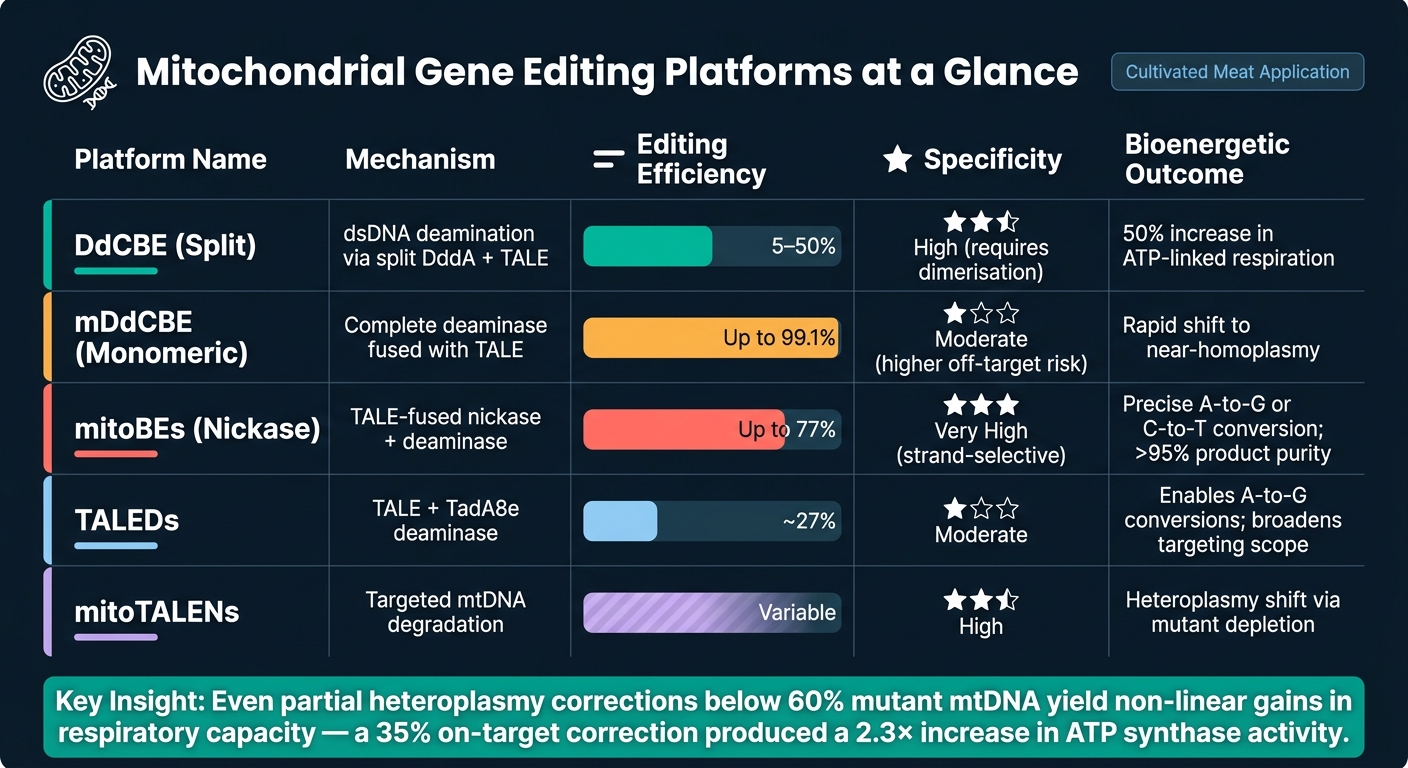
Mitochondrial Gene Editing Platforms: Efficiency, Specificity & Bioenergetic Outcomes
Findings from Disease‐Model and Preclinical Studies
Recent studies have provided more precise data on the bioenergetic improvements achievable through mitochondrial editing, particularly in disease-model systems. For instance, a 2025 study by Luke Yin, Angel Yin, and Marjorie Jones, published in MDPI Genes, used a split DdCBE system to address the m.8993T>G mutation in NARP patient-derived iPSCs. Their findings included a 35% on-target correction, which reduced mutant heteroplasmy from 80% to 45%. This resulted in a 2.3-fold increase in ATP synthase activity and a 50% boost in ATP-linked respiration [3]. Edited mitochondria produced 90 ± 2 nmol/min/mg of ATP, compared to 40 ± 2 nmol/min/mg in unedited controls [3].
"These results establish mitochondrial base editing as a durable strategy to ameliorate biochemical and cellular defects." - Luke Yin et al. [3]
For cultivated meat production, these edits demonstrated long-term stability over a 30-day culture period, ensuring that bioenergetically enhanced cell lines maintain their performance throughout extended bioprocessing. Importantly, even partial shifts in heteroplasmy significantly improved respiratory function, highlighting the potential of modest corrections to achieve functional thresholds [3].
Further evidence comes from a 2025 study by Zhang et al., published in Nature. This research focused on optimising mitochondrial base editors to target 70 different mouse mtDNA mutations. The study achieved editing efficiencies of up to 82% in vivo and 100% in the F1 generation. It also successfully modelled and mitigated phenotypes of Leigh disease and Leber's hereditary optic neuropathy, reinforcing the potential of these tools for translational applications [9]. These advancements underline the importance of effective delivery systems, discussed next.
Advances in Delivery and Editing Methods
High editing efficiency depends on the ability to deliver tools effectively into cells. Monomeric DdCBEs (mDdCBEs), which are single-chain versions of the traditional dimeric editor, address previous challenges by being compact enough to fit into adeno-associated virus (AAV) vectors. Using AAV delivery, mDdCBEs have achieved near-homoplasmic editing efficiencies as high as 99.1% in mammalian tissues [1]. This capability is crucial for developing master cell lines with uniform mitochondrial genomes tailored for bioprocessing.
Non-plasmid RNA delivery methods, such as circular RNA and mRNA formats, are gaining favour due to their ability to enhance transient expression, minimise integration risks, and simplify regulatory approval processes for cultivated meat cell lines [5][9]. For example, in June 2025, researchers Liang Chen and Dali Li from East China Normal University used an adenine base editor (eTd-mtABE) to create Leigh syndrome rat models. They achieved editing efficiencies of up to 74% in the F0 generation and restored wild-type alleles to an average of 53%, effectively alleviating disease symptoms [10]. These delivery innovations are critical for building reliable and energy-efficient cell lines for industrial applications.
Comparing Editing Platforms
Selecting the right platform for mitochondrial editing is essential to meet the energy demands of cultivated meat production while maintaining genomic stability. Below is a comparison of key platforms based on their mechanisms, efficiency, specificity, and bioenergetic outcomes:
| Platform | Mechanism | Efficiency | Specificity | Bioenergetic Outcome |
|---|---|---|---|---|
| DdCBE (Split) | dsDNA deamination via split DddA + TALE | 5–50% [1] | High (requires dimerisation) | 50% increase in ATP-linked respiration [3] |
| mDdCBE (Monomeric) | Complete deaminase fused with TALE | Up to 99.1% [1] | Moderate (higher off-target risk) | Rapid shift to near-homoplasmy [1] |
| mitoBEs (Nickase) | TALE-fused nickase + deaminase | Up to 77% [5] | Very high (strand-selective) | Precise A-to-G or C-to-T conversion [5] |
| TALEDs | TALE + TadA8e deaminase | ~27% [1] | Moderate | Enables A-to-G conversions; broadens targeting scope [1] |
| mitoTALENs | Targeted mtDNA degradation | Variable | High | Heteroplasmy shift via mutant depletion [5] |
Each platform offers distinct advantages and trade-offs. Split DdCBEs deliver proven bioenergetic improvements but face delivery challenges due to their dimeric structure. mDdCBEs resolve these delivery issues but at the cost of reduced specificity. Meanwhile, mitoBEs push the boundaries of precision, achieving efficiencies of up to 77% with strand-selective control and product purity exceeding 95% [5]. For cultivated meat production, where stability over numerous population doublings is critical, the specificity of mitoBEs makes them particularly appealing for scalable and stable bioprocessing.
sbb-itb-ffee270
Applying Mitochondrial Editing to Cultivated Meat Production
Target Traits for Energy Efficiency
Mitochondrial editing, initially developed for addressing diseases, has found a promising application in cultivated meat production by enhancing energy traits in production cell lines. Three key traits stand out when aiming to improve energy efficiency:
- Oxidative phosphorylation (OXPHOS) capacity: This is a critical focus area. Correcting MT-ATP6 mutations has been shown to increase oxygen consumption rate (OCR) by 25% and ATP-linked respiration by 50% [3]. These improvements accelerate cell growth in bioreactors, which is a significant advantage for large-scale production.
- Reduction of reactive oxygen species (ROS): High ROS levels cause oxidative damage, such as 8-oxoguanine lesions in mitochondrial DNA (mtDNA), which can hinder replication and affect cellular health over multiple passages. By optimising mtDNA to lower ROS levels, it’s possible to maintain genomic stability during the extended cell expansion phases required for commercial-scale production.
- Differentiation efficiency: Enhanced mitochondrial function directly improves myogenic differentiation efficiency, which has a positive impact on both yield and the quality of the final product.
These traits form the core focus for mitochondrial DNA (mtDNA) optimisation in production cell lines.
Strategies for mtDNA Optimisation
One effective approach to mtDNA optimisation involves targeting heteroplasmy thresholds. Studies show that lowering mutant mtDNA heteroplasmy below 60% can lead to substantial biochemical improvements [3]. This is a practical takeaway for production teams, as achieving near-complete editing isn’t always necessary - partial corrections can still result in significant gains in respiratory efficiency.
"Partial heteroplasmy shifts yield non-linear gains in respiratory capacity." - Luke Yin, Center of Student Inquiry and Research [3]
For cultivated meat production, the process begins with identifying energy-critical loci, such as MT-ATP6 and MT-ND subunits, and selecting haplotypes with favourable bioenergetic properties. Editing tools such as split DdCBEs or mitoBEs are then employed to modify specific positions. For C•G-to-T•A conversions, DdCBEs are typically used, while A•T-to-G•C corrections - such as those required in MT-ND subunits - are better handled by TALEDs or newer systems like eTd-mtABE, which have demonstrated up to 87% editing efficiency in human cells with minimal off-target effects [2].
The use of mRNA delivery systems further reduces the risk of off-target effects [1][5], making the process more precise and scalable.
Linking Mitochondrial Optimisation to Bioprocessing
Improvements in mitochondrial function directly translate into better bioprocessing outcomes. Edited cell lines have been shown to produce 90 ± 2 nmol/min/mg ATP - an increase of 125% compared to unedited controls [3]. This enhanced energy production supports faster cell proliferation and reduces the metabolic stress experienced by cells in suspension cultures or scaffold-based systems.
Another significant benefit is improved glucose utilisation. Cells with higher OXPHOS capacity extract more energy per unit of glucose, which reduces overall glucose consumption while maintaining biomass production. This is particularly beneficial in serum-free media, where the accumulation of metabolic by-products like lactate can inhibit growth. Optimised cell lines are better equipped to sustain favourable NAD⁺:NADH ratios and maintain energy balance under these demanding conditions [4].
Stability studies further underscore the industrial potential of mitochondrial editing. On-target corrections have been shown to remain stable for at least 30 days in culture [3], covering the typical expansion phases required for cultivated meat production. For R&D teams seeking reliable cell lines and materials, platforms like Cellbase offer access to verified suppliers of bioreactors, growth media, and cell line infrastructure, streamlining the path to scaling these optimised systems.
Challenges and Future Directions
Building on the observed bioenergetic advancements, several hurdles - both technical and regulatory - must be overcome for mitochondrial editing to be successfully integrated into cultivated meat production.
Technical and Biological Constraints
Despite progress, mitochondrial editing comes with significant challenges, particularly when scaling for cultivated meat. Unlike nuclear editing, which involves just two copies of DNA per cell, mitochondrial editing must target hundreds or even thousands of mtDNA copies per cell. This complexity is compounded by mitochondria's resistance to nucleic acid import, meaning editing relies exclusively on protein-based tools like TALENs, zinc finger nucleases, and DddA-derived base editors. These tools are more challenging to deliver using viral vectors like AAV, which limits their scalability in industrial applications [1][11].
"Unlike nuclear editing, where only two copies exist, mitochondrial editing must target hundreds or thousands of genomes per cell." - Nature Biotechnology [9]
Another hurdle is the high copy number of mtDNA and the phenomenon of heteroplasmy, where edited and unedited mitochondrial genomes coexist. Editing efficiencies often plateau at around 35% due to these dynamics [3][9]. Processes like fission, fusion, and mitophagy further complicate matters by selectively removing edited mitochondria [3]. These biological constraints have a direct impact on the optimisation of energy traits crucial for cultivated meat production.
Off-target effects also remain a significant concern. For instance, DdCBE variants have been shown to induce 1,000–1,500 single-nucleotide off-target mutations in nuclear DNA [11], and highly active editors like DddA11 can lead to toxicity [12]. Advances in high-fidelity DdCBEs have reduced off-target activity to below 0.5% at predicted loci, but further refinement is necessary for commercial applications [3].
Regulatory and Ethical Considerations
The regulatory landscape for mitochondrial editing lags behind that of nuclear genome editing [9]. In the UK and EU, cultivated meat products derived from genetically modified cell lines must comply with strict novel food regulations. These regulations demand comprehensive safety dossiers addressing genomic stability, traceability, and long-term consistency. However, mitochondrial editing introduces unique challenges.
For instance, there is currently no standardised protocol for tracking mtDNA edits throughout the food supply chain, a requirement for regulatory approval. The coexistence of edited and unedited mitochondrial genomes (heteroplasmy) within cell lines further complicates safety assessments, as ensuring batch-to-batch consistency becomes analytically demanding.
Off-target effects are another critical regulatory concern. Techniques like Detect-seq and GOTI (genome-wide off-target analysis by two-cell embryo injection) are increasingly recommended to evaluate both mitochondrial and nuclear specificity [11]. Additionally, incorporating nuclear export signals (NES) into editor designs has shown promise in reducing nuclear off-target risks [1][11].
To address these challenges, further research into alternative delivery systems and improved editor designs will be essential.
Areas for Further Research
Alternative delivery methods, such as lipid nanoparticles (LNPs) and engineered virus-like particles (eVLPs), are gaining attention as potential substitutes for AAV. These systems offer advantages like lower immunogenicity and the ability to bypass the cargo-size limitations that hinder delivery of dimeric editors [3][11]. Developing more compact mitochondrial base editors (mDdCBEs) is another priority to overcome current delivery challenges [1][6].
Another pressing question is whether the edited traits can remain stable over the extended cell doublings required for commercial-scale production. While current data indicates stability over 30 days [3], longer-term studies across a variety of cell lines commonly used in cultivated meat production are still needed. Addressing these issues will be key to advancing mitochondrial editing from a promising concept to a practical tool for the industry.
Conclusion: Moving Cultivated Meat Forward with Mitochondrial Editing
Mitochondrial gene editing is now showing quantifiable improvements. Correcting mtDNA mutations in cell lines has led to a 25% increase in basal oxygen consumption, a 50% boost in ATP-linked respiration, and a 2.3-fold restoration of ATP synthase activity [3].
CRISPR-free base editors, like DdCBEs and TALEDs, are emerging as powerful tools for mitochondrial optimisation. Advanced adenine base editors have achieved up to 87% efficiency in human cells [2], with edits remaining stable in culture for over 30 days [3]. These advancements highlight the potential for addressing the next set of challenges.
Scaling this technology for commercial use will require tackling key hurdles: controlling heteroplasmy, ensuring edits remain stable through extended cell divisions, and navigating regulatory requirements. While preclinical studies have shown functional improvements, maintaining consistent results across varied cell lines and large-scale production is a separate and critical challenge.
To address these issues, cultivated meat producers must integrate mitochondrial optimisation into their bioprocess design from the start, rather than attempting to adjust after scaling up. Research shows that aligning editing targets with specific production needs - such as improving cell proliferation, minimising metabolic by-products, or enhancing differentiation - can yield measurable benefits. Tools like Cellbase provide essential support by linking R&D teams with specialised resources, including cell lines, growth media, and bioprocessing equipment, to validate mitochondrial editing strategies throughout development.
Ultimately, bridging the gap between laboratory breakthroughs and large-scale, regulatory-compliant production will rely on collaboration. Researchers, bioprocess engineers, and regulators must work together to turn precise scientific advancements into scalable, commercially practical solutions.
FAQs
Which mtDNA edits best improve ATP output in cultivated meat cells?
To increase ATP output in cells used for cultivated meat, researchers turn to advanced base editing technologies such as DdCBEs, TALEDs, and eTd-mtABEs. These tools allow for precise edits at the molecular level, specifically converting C-to-T or A-to-G in the DNA sequence. This precision is crucial for correcting mutations that disrupt the mitochondrial respiratory chain.
By addressing these mutations, scientists can restore mitochondrial function, optimise heteroplasmy ratios, and enhance key cellular processes like oxygen consumption and ATP synthase activity. These improvements are essential for efficient energy production, which is critical for the growth and development of cultivated meat cells.
To support the scaling of these advanced techniques, Cellbase provides essential resources. This includes access to specialised cell lines, state-of-the-art bioreactors, and tailored growth media, ensuring researchers have the tools needed to push this technology forward.
How much heteroplasmy shift is needed to see real bioreactor gains?
Studies indicate that noticeable metabolic changes in mitochondrial function happen when heteroplasmy levels are adjusted past specific thresholds. For example, lowering mutant heteroplasmy from 80% to 45% resulted in a 25% increase in basal oxygen consumption and a 50% improvement in ATP-linked respiration. Researchers and cultivated meat developers can turn to Cellbase for specialised materials and equipment to investigate these energy efficiency improvements further.
How can teams prove mtDNA edits are stable and safe for regulators?
To validate mitochondrial DNA (mtDNA) edits for regulatory purposes, teams should rely on deep amplicon sequencing. This method ensures precise confirmation of on-target editing efficiency while assessing minimal off-target effects. Additionally, functional assays such as Seahorse analysis or ATP measurements are crucial for verifying the restoration of energy metabolism. Demonstrating long-term stability is equally important and involves monitoring cell lines over extended culture durations. Cellbase facilitates this process by linking researchers with the necessary tools and materials for cultivated meat production.


