

Epigenetic silencing is transforming how we approach cultivated meat production. For R&D professionals, it offers a way to control gene expression without permanently altering DNA, addressing key challenges like cell proliferation, differentiation, and quality control. Here's what you need to know:
- What It Is: Suppression of gene activity via DNA methylation, histone modification, or RNA interference - reversible and precise methods that leave the genetic sequence intact.
- Why It Matters: Extends cell lifespans, enhances muscle cell differentiation, and improves scalability while avoiding risks like oncogenesis from permanent gene edits.
- Key Tools: CRISPR-dCas9 systems (like KRAB or DNMT3A) and TALE-based editors achieve high silencing efficiency, with some effects lasting over 300 days.
- Challenges: Delivering these tools at scale, especially in bioreactors, and tailoring approaches to species-specific pathways remain hurdles.
For bioprocess engineers and cell culture scientists, the focus is on precise control of cell behaviour to improve productivity and product quality. Epigenetic silencing could be the key to overcoming the bottlenecks in cultivated meat production.
Core Mechanisms of Epigenetic Silencing in Livestock Cells
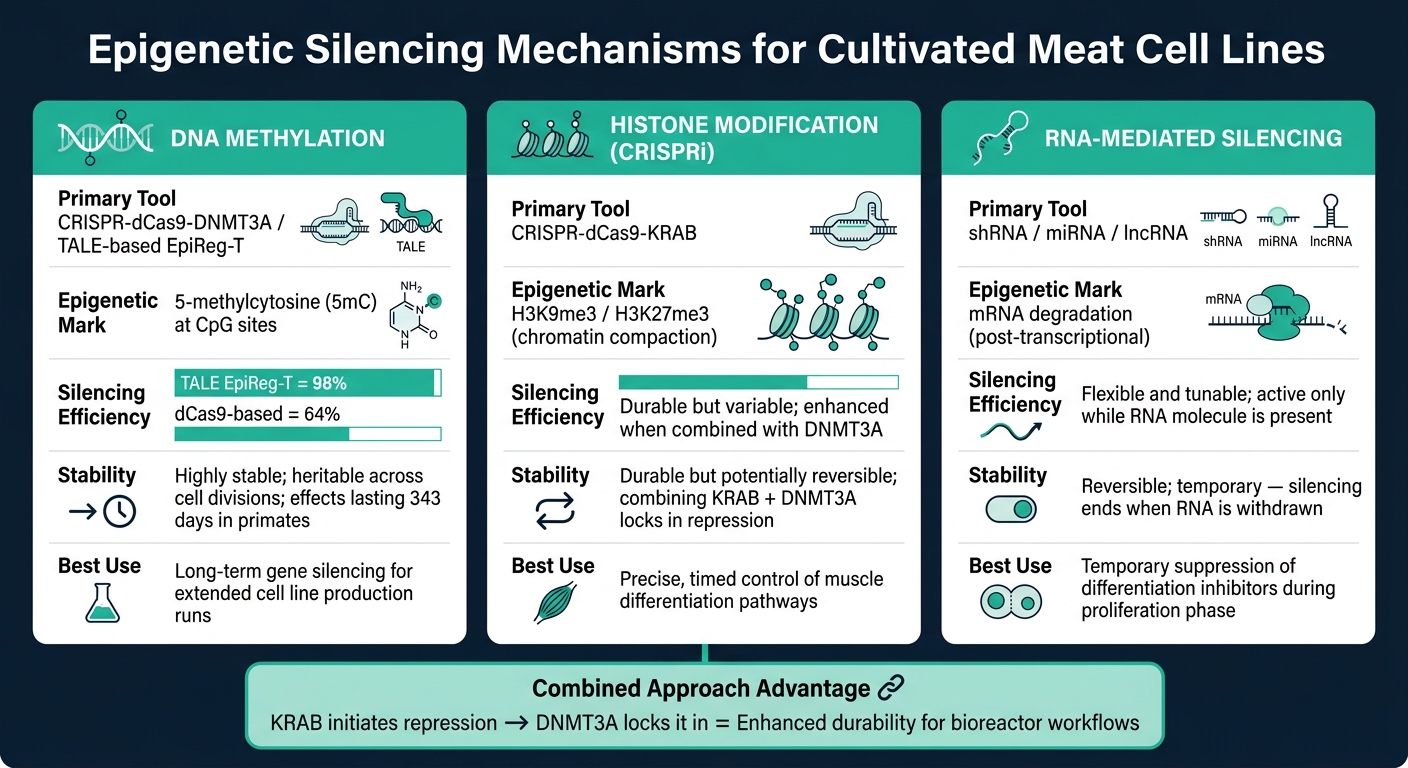
Epigenetic Silencing Tools for Cultivated Meat: Mechanisms, Efficiency & Stability
Improving the performance of cultivated meat cell lines relies heavily on precise control of epigenetic mechanisms. Below is an overview of the primary methods used in livestock cells.
DNA Methylation-Based Silencing
DNA methylation involves the addition of methyl groups to CpG sites, a process driven by DNA methyltransferases (DNMTs). When this occurs at gene promoter regions, it prevents transcription machinery from accessing the gene, effectively turning it off [6]. This silencing is heritable, with DNMT1 maintaining the methylation pattern across cell divisions [7].
One advanced tool, CRISPR-dCas9-DNMT3A, combines the catalytically inactive dCas9 protein with the DNMT3A enzyme to guide methylation to specific genomic locations. This method achieves high silencing efficiency without cutting the DNA. A more refined approach, TALE-based epigenetic regulators (EpiReg-T), has shown 98% silencing efficiency in mice, compared to 64% in earlier dCas9-based systems [5]. In studies with nonhuman primates, a single dose of this system maintained gene silencing for up to 343 days [5].
Following the establishment of DNA methylation, histone modifications provide a secondary, dynamic layer of gene regulation.
Histone Modification and CRISPRi
Histone modifications alter chromatin structure by targeting histone proteins, making genes more or less accessible. Marks like H3K9me3 and H3K27me3 compact chromatin, preventing transcription factors from accessing the DNA [6].
CRISPR interference (CRISPRi) utilises dCas9 fused to a KRAB repressor domain. This complex is directed to specific gene promoters, where it recruits repressive proteins that deposit inhibitory histone marks. Research in sheep has highlighted H3K27me3 as a key repressive signal during muscle development, while active enhancers are linked to genes promoting superior growth performance [8]. By understanding the histone states that regulate muscle differentiation in livestock, scientists can fine-tune cell behaviour with precision.
"Epigenetic editing is a promising strategy for modifying gene expression while avoiding the permanent alterations and potential genotoxicity of genome-editing technologies." - Nature Biotechnology [5]
Histone modifications are often more dynamic than DNA methylation, requiring sustained or timed interventions to maintain their effects. Combining KRAB with DNMT3A in a single construct can enhance durability: histone marks initiate repression, while methylation locks it in place [5].
In addition to these DNA-based methods, RNA-mediated silencing offers a flexible and temporary alternative.
RNA-Mediated Silencing
RNA-mediated silencing focuses on reducing mRNA levels directly. MicroRNAs (miRNAs) and short hairpin RNAs (shRNAs) bind to complementary mRNA sequences, leading to their degradation before translation [6]. Meanwhile, long non-coding RNAs (lncRNAs) act earlier by recruiting chromatin-modifying complexes to specific genomic regions [6].
For cultivated meat applications, RNA-mediated silencing offers a major advantage: reversibility and flexibility. Silencing remains active only while the RNA molecule is present, making it ideal for temporary interventions. For example, differentiation inhibitors can be suppressed during a proliferation phase, then removed to allow normal muscle development. However, maintaining continuous delivery of RNA molecules can add complexity when scaling cell lines for bioreactor cultivation.
The table below summarises the key features of these mechanisms:
| Mechanism | Primary Tool | Epigenetic Mark | Stability |
|---|---|---|---|
| DNA Methylation | CRISPR-dCas9-DNMT3A | 5-methylcytosine (5mC) | Highly stable; heritable across divisions [5][7] |
| Histone Repression (CRISPRi) | CRISPR-dCas9-KRAB | H3K9me3 / H3K27me3 | Durable but potentially reversible [5][8] |
| RNA Interference | shRNA / miRNA | mRNA degradation | Reversible and tunable [6] |
sbb-itb-ffee270
Target Genes and Pathways for Better Cell Line Performance
Building on earlier discussions about epigenetic mechanisms, selecting the right gene targets is crucial for improving cell line performance. The success of these interventions hinges not just on identifying the targets but also on choosing the appropriate silencing methods. Research has pinpointed a core set of gene targets that, when suppressed, enhance key aspects of cultivated meat cell lines, including proliferation, differentiation, and metabolic stability.
Proliferation and Immortalisation
Improving proliferative capacity often involves targeting genes like CDKN2A and TP53. CDKN2A encodes p16^INK4A and p14^ARF, proteins that limit the cell cycle and drive senescence. Silencing CDKN2A prevents G1/S arrest, enabling robust cell expansion. For instance, porcine cells with CDKN2A silencing maintained their myogenic properties across 18–30 passages, while wild-type cells lost these properties by passage 10. Furthermore, CDKN2A depletion caused a ~194-fold increase in PAX7 expression at passage 20, a critical factor for muscle stem cell identity [9].
"Targeting the CDKN2A gene locus is essential for preventing ageing or inducing cell immortalization." - Food Materials Research [9]
TP53 is another key target. A CRISPR screen of 600 genes in bovine mesenchymal stem cells identified TP53 as the most effective target for enhancing proliferation. Knockout of TP53 resulted in a 1,000-fold increase in cell abundance over 30 days, with consistent performance in long-term expansion [1]. In addition, silencing PTEN, a negative regulator of the PI3K/AKT/mTOR pathway, boosts cell doubling rates and mTOR activity. However, this approach requires careful monitoring, as it may reduce differentiation efficiency [1].
These advancements in proliferation set the stage for optimising differentiation, the next critical step.
Controlling Differentiation
Balancing cell expansion with tissue formation is a complex challenge in cultivated meat production. One well-studied target is myostatin (MSTN), a negative regulator of myogenesis. Silencing MSTN enhances muscle fibre formation, similar to the "double-muscling" trait in certain cattle breeds [4]. When combined with MYOD1 activation and advanced techniques like digital light processing (DLP) 3D bioprinting on groove-patterned hydrogels, muscle cell alignment and differentiation are significantly improved through surface functionalization [4].
Another critical aspect is managing pluripotency regulators like SOX2 and OCT4. Reversible silencing of SOX2 using CRISPR/dCas9-KRAB platforms achieves up to 85% repression within 72 hours, with baseline expression recovering to approximately 90% after the editing construct is withdrawn [3]. This reversibility allows for controlled suppression during cell expansion and timely release to support proper tissue development.
Stress and Metabolism Pathways
Maintaining cell quality over extended production cycles involves addressing stress and metabolic challenges. TP53 plays a dual role as a tumour suppressor and stress sensor. Under culture conditions, it can prematurely trigger senescence, even without significant genomic damage [1]. By silencing TP53, cells retain the gene expression profiles of early-passage cells, preserving critical functions like protein synthesis and DNA replication [1].
The table below summarises the primary gene targets and their functional roles:
| Target Gene | Pathway | Effect of Silencing | Species Context |
|---|---|---|---|
| CDKN2A | Cell cycle repression | Prevents senescence; ~194× PAX7 upregulation at passage 20 [9] | Porcine |
| TP53 | Stress response / tumour suppressor | 1,000× increase in cell abundance over 30 days; consistent long-term expansion [1] | Bovine |
| PTEN | PI3K/AKT/mTOR | Increases doubling rate; enhances mTOR activity [1] | Bovine |
| MSTN | Myogenesis regulation | Enhances muscle fibre formation and differentiation efficiency [4] | Bovine |
| SOX2 | Pluripotency maintenance | Manages stemness-to-differentiation transition; 85% repression in 72 hrs [3] | Multiple |
A promising approach gaining traction is multiplexed targeting, which involves silencing multiple genes simultaneously. For instance, combining CDKN2A suppression with GATA4 activation has shown synergistic effects that outperform individual interventions [9][10]. This systems-level strategy highlights the importance of specialised platforms like Cellbase, which support cutting-edge R&D in cultivated meat.
Epigenetic Tools and Delivery Methods
To make use of specific gene targets, researchers rely on specialised epigenetic tools and efficient delivery systems.
Synthetic Epigenetic Platforms
Pinpointing the right gene targets is only part of the equation - the tools used to silence these genes are equally critical. Two programmable systems stand out for their relevance to cultivated meat research: CRISPRoff and TALE-based epigenetic regulators (EpiReg-T).
CRISPRoff utilises a dCas9 scaffold combined with KRAB and DNMT3A/3L domains to establish heritable repressive marks, such as DNA methylation and H3K9me3, without introducing DNA breaks. This approach ensures persistent gene silencing, making it particularly useful for maintaining cell lines over extended periods - a key factor in addressing the scalability and consistency challenges in cultivated meat production. In contrast, TALE-based EpiReg-T has demonstrated superior silencing efficiency, achieving 98% compared to the 64% seen with similar dCas9-based systems [5].
A pivotal study published in Nature Biotechnology in October 2025 highlighted the potential of TALE-based editors. Researchers, including those from Epigenic Therapeutics and the Chinese Academy of Sciences, showed that a single dose of EpiReg-T delivered via lipid nanoparticles (LNPs) silenced the PCSK9 gene in macaques with over 90% efficiency for 343 days. This was achieved with minimal off-target effects, as confirmed through multi-omic analyses [5]. Such results are setting TALE-based systems apart when durability and potency are critical.
Delivery Challenges
Delivering these tools effectively into livestock cells - particularly at scale - remains a major technical challenge. While epigenetic editors avoid the risks of double-strand DNA breaks, they still require a reliable delivery mechanism. Lipid nanoparticles (LNPs) have emerged as the leading non-viral option. They transiently deliver mRNA encoding the epigenetic editor, enabling a "hit-and-run" approach that establishes lasting gene silencing without DNA integration [5]. This transient nature is especially important for cultivated meat, where regulatory concerns around genetic modifications remain a key issue.
However, LNP efficiency can vary significantly depending on the cell type. Optimising formulations for primary bovine or porcine myosatellite cells, particularly in bioreactor-scale settings, is still an area of active research. Delivery methods that work well in small-scale experiments often fail to perform consistently in stirred-tank bioreactors. Solving these delivery challenges is essential for advancing research and scaling up production, a process increasingly supported by specialised platforms.
How Cellbase Supports Epigenetic R&D
Epigenetically modified cell lines require precisely validated reagents. Researchers need access to well-characterised cell lines that are compatible with epigenetic modifications, defined media formulations that maintain epigenetic stability, and analytical tools capable of confirming gene silencing at the chromatin level. General lab suppliers often lack the expertise to ensure compatibility with cultivated meat applications.
Cellbase fills this gap. As a specialised B2B marketplace for the cultivated meat industry, it connects R&D teams with verified suppliers of cell lines, growth media, scaffolds, and analytical tools. Each product listing includes details tailored to cultivated meat applications, ensuring compatibility and reducing the risks associated with adapting general-purpose reagents. For researchers working on epigenetic silencing protocols, this translates into faster access to validated materials, enhancing cell line performance and minimising technical hurdles in this highly specialised field.
What Epigenetic Silencing Means for Cultivated Meat Bioprocessing
Measurable Cell Line Improvements
Epigenetic silencing offers practical advantages that are becoming increasingly evident, especially in extending the productive lifespan of cell lines. By employing a transient, "hit-and-run" strategy, researchers can temporarily suppress genes responsible for senescence without permanently modifying the genome [2]. This approach has shown success in bovine and porcine myosatellite cells, enabling significantly more cell doublings and addressing common bioprocessing bottlenecks. Importantly, this method is reversible - once the construct is withdrawn, gene expression nearly returns to baseline levels [3]. This reversible control is ideal for bioreactor workflows, as it ensures cells continue proliferating during the expansion phase and allows for differentiation to be triggered at the appropriate time. Enhanced cell expansion directly translates to more efficient tissue differentiation and improved product quality.
Tissue Formation and Product Quality
The gains in cell proliferation create the foundation for better tissue formation. Controlled differentiation is where epigenetic silencing directly influences the final product's quality. For example, in bovine cell reprogramming, silencing pluripotency markers like OCT4, SOX2, and NANOG facilitates the transition to the myogenic lineage. This process results in the formation of elongated, multinucleated myotubes by Day 30 of the differentiation protocol [11].
"The silencing of mOSKM and pluripotency markers... is crucial for the transition from pluripotency to the myogenic lineage." - Frontiers in Nutrition [11]
Beyond muscle fibre development, precise epigenetic control over fat cell differentiation pathways plays a critical role in achieving marbling. Marbling is a key factor that influences both flavour and mouthfeel, and these improvements can be achieved without making permanent changes to the genome.
Regulatory and Consumer Considerations
The advancements in cell proliferation and tissue formation also bring regulatory and consumer perspectives into focus. Regulatory bodies generally support epigenetic silencing due to its non-permanent impact on the genome. Tools like dCas9-KRAB and TALE-based EpiReg-T avoid the risks linked to double-strand DNA breaks, making them suitable for food-grade cell lines that must demonstrate genetic stability throughout production [5].
However, maintaining a transgene-free status remains a challenge. A study published in May 2025 by researchers from the University of São Paulo and the University of Copenhagen, including Kaiana Recchia and Kristine Freude, explored this issue. They reprogrammed bovine fetal fibroblasts using non-integrating episomal vectors, finding that while colonies remained stable for over 33 passages, episomal plasmids were still detectable at passages 12 and 17 [11].
On the consumer side, transparency about the methods used is crucial. Clear communication that epigenetic silencing does not permanently alter DNA will be key to building public trust as cultivated meat products move closer to commercialisation.
Future Directions and Research Gaps
Species-Specific Challenges
One of the biggest hurdles in the field is the lack of detailed understanding of myogenic pathways in livestock species. While pathways like IGF-1, MAPK/Erk, and Wnt/β-catenin are well-documented in humans and mice, their roles in cattle and pigs are only partially understood [11]. Without a complete map, pinpointing specific gene targets for epigenetic silencing becomes a significant challenge.
Muscle fibre composition adds another layer of complexity. For example, pig Longissimus muscle contains around 55% Type IIb fast-twitch fibres, but these fibres are absent in species like sheep and horses. When you combine this with region-specific HOX gene expression, it becomes clear that silencing strategies need to be tailored for each species [13]. Satellite cells, which retain positional HOX gene expression (e.g., HOXA11 and HOXA13 in hindlimb muscles), further complicate matters. These patterns can influence whether cells are more inclined towards rapid proliferation or robust differentiation [14].
"Because SCs can retain these positional signatures, their proliferative and differentiation capacities may differ by muscle of origin." - npj Science of Food [14]
In practical terms, this means researchers should screen cell lines for HOX gene expression before applying epigenetic silencing. These gene signatures can act as biological barcodes, helping to verify the regional identity of cells and align them with the desired characteristics of the final product.
Such species-specific challenges highlight the importance of considering alternative cell sources, such as iPSCs, in the development of cell banking strategies.
Links to iPSC Development and Cell Banking
Induced pluripotent stem cells (iPSCs) present a promising alternative to satellite cells, which are prone to senescence and require repeated biopsies. In May 2025, researchers from the University of São Paulo and the University of Copenhagen - including Kaiana Recchia and Kristine Freude - successfully developed bovine iPSC lines using non-integrating episomal vectors. These cells maintained stability for over 33 passages and differentiated into multinucleated myotubes by Day 30 [11]. However, confirming their transgene-free status through rigorous genomic PCR remains a critical step.
A related issue is epigenetic memory. iPSCs often retain traces of their original somatic tissue, which can skew differentiation away from the intended lineage [12]. For cell banking, it’s crucial to select donor tissues with epigenetic profiles already geared towards muscle or fat formation. Additionally, ensuring the effective silencing of residual pluripotency markers is vital for creating reliable, long-term cell banks.
The development of robust iPSC protocols also underscores the need for standardised assays and consistent data-sharing practices across research efforts.
Standardisation and Missing Data
To fully harness the potential of epigenetic interventions in cultivated meat, standardisation issues must be addressed. Currently, there is no universal framework for monitoring epigenetic stability during the extensive cell doublings required for industrial-scale production [12]. Without standardised methods, comparing results across laboratories is difficult, and decisions about scaling up production often rely on incomplete data.
Practical steps could help address this gap. For instance, adopting consistent FACS purification protocols - targeting markers like CD31⁻/CD45⁻/CD29⁺/CD56⁺ - would make satellite cell populations more comparable across species and anatomical sources [14]. Switching from serum-based to chemically defined media could also reduce variability between batches, creating more consistent epigenetic environments [12].
Looking ahead, integrating AI-driven in silico modelling could revolutionise the optimisation of epigenetic protocols. However, for these models to be effective, harmonising data across the cultivated meat research community is essential. Standardised data-sharing practices would enable researchers to predict the outcomes of epigenetic manipulations more accurately, accelerating progress in the field.
FAQs
How is epigenetic silencing different from permanent gene editing in cultivated meat cells?
Epigenetic silencing regulates gene activity without making permanent changes to the DNA sequence, unlike gene editing, which involves physically altering the genome. Because epigenetic approaches do not involve breaking or modifying DNA, they are often viewed as safer options for use in cultivated meat production. Techniques such as CRISPR-based tools offer the advantage of flexible and, in some cases, reversible gene regulation. For researchers working with these methods, Cellbase offers a B2B marketplace tailored to sourcing specialised equipment and materials.
Which genes should be silenced first to boost proliferation without harming differentiation?
To encourage cell proliferation while maintaining their ability to differentiate, it's crucial to silence genes that either block the cell cycle or lead to undesirable cell fates. For instance, suppressing CDKN2A has been shown to markedly increase proliferation in porcine satellite cells without compromising their differentiation potential. Similarly, targeting tumour suppressor genes such as TP53 and PTEN can enhance growth, though these interventions demand careful oversight. Cellbase offers tools and resources tailored to support your cultivated meat research efforts.
How can epigenetic editors be delivered reliably at bioreactor scale?
Delivering epigenetic editors on a large scale for cultivated meat production presents a significant challenge. This is largely due to the substantial size of CRISPR tools and the constraints of conventional delivery methods like electroporation or viral vectors. However, some promising strategies are emerging. For instance, transient delivery systems using lipid nanoparticles or engineered virus-like particles show potential. These methods can encapsulate large CRISPR cargos, allowing efficient entry into cells without causing genome integration. To support such advanced initiatives, Cellbase provides researchers access to the specialised materials and infrastructure required to push these projects forward.


