

Bioreactor contamination can derail cultivated meat production, wasting time and resources. The challenge? Contaminants like bacteria grow exponentially faster than animal cells, consuming nutrients and oxygen before traditional methods detect them. With contamination risks tied to nutrient-rich media and regulatory compliance, early detection isn't optional - it's critical.
Key Takeaways for Early Detection:
- Common Contaminants: Bacteria, fungi, yeast, mycoplasma, and viruses each require specific detection approaches.
- Early Signs: Sudden pH drops, rapid oxygen depletion, increased turbidity, foaming, or stalled growth are key indicators.
- Real-Time Monitoring: Sensors tracking pH, dissolved oxygen, and temperature can flag issues before visible signs appear.
- Advanced Tools: Machine learning models, biosensors, and qPCR outperform older methods like agar plating in speed and accuracy.
- Response Protocols: Isolate affected batches immediately, trace contamination sources, and prioritise rapid confirmatory testing.
For cultivated meat R&D teams, integrating real-time monitoring tools and robust sampling protocols into bioreactor design ensures quicker detection and effective containment. This approach safeguards both production quality and operational timelines.
Common Contamination Types and Early Warning Signs
Types of Bioreactor Contamination
Bioreactors are vulnerable to several types of contamination, including bacterial, fungal, yeast, mycoplasma, viral, and cross-contamination. Each type requires specific detection and management strategies.
- Bacteria, fungi, and yeast: These are the most noticeable contaminants due to their rapid growth and visible changes in the culture environment. Common signs include increased turbidity or colour changes. Some strains, particularly spore-forming bacteria and fungi, are highly resilient, with spores that can withstand standard sterilisation protocols (121°C for 30 minutes). If contamination reappears shortly after sterilisation, it often indicates spores survived due to incomplete steam penetration [1].
- Mycoplasma and viruses: These contaminants are far more elusive. They do not produce visible changes in the culture, making them difficult to detect without specialised testing. Their presence is usually inferred from a gradual decline in cell growth, which can easily be mistaken for minor process variations [1].
- Cross-contamination: Aggressive cell lines, such as HeLa cells, can outcompete the target culture. This type of contamination often goes unnoticed without genetic or immunological testing. By the time it is identified, it may have already compromised product quality [1].
Early Process Change Indicators
"A bacterial contaminant in a cell culture... doubling time could be a few minutes for bacteria compared to a day or more for cell culture." - Tony Allman, Product Manager, INFORS HT [1]
Detecting changes in process variables before visible signs of contamination appear is critical. The table below highlights some key indicators, their potential causes, and detection methods:
| Indicator | Potential Cause | Detection Method |
|---|---|---|
| Sudden pH drop | Acid-producing bacteria (e.g., lactic acid) | Online pH probe / phenol red indicator |
| Rapid DO depletion | Aerobic microbial contamination consuming oxygen | Online dissolved oxygen sensor |
| Increased turbidity | High-density bacterial or yeast growth | Optical density sensors or visual inspection |
| Foaming | Protein release from cell lysis or microbial metabolism | Visual observation or foam probes |
| Stalled growth | Mycoplasma or viral infection | Microscopic evaluation or PCR test kits |
A sudden drop in pH is often the first chemical clue. For instance, in phenol red-based media, a colour shift from pink to yellow indicates acid production by bacteria [1]. Similarly, unexpected changes in dissolved oxygen (DO) levels - whether depletion or spikes - can signal microbial activity before any visible signs emerge. When paired with turbidity changes, these fluctuations serve as reliable early warnings [1][2]. For less obvious contaminants like mycoplasma and viruses, reduced cell growth and declining culture performance may be the only early signs [1].
For cultivated meat producers, tools like Cellbase provide a curated selection of sensors and bioreactor equipment tailored to detect contamination early. Advanced real-time monitoring systems can help identify these indicators promptly, enabling swift corrective action.
sbb-itb-ffee270
Real-Time Monitoring Tools for Contamination Detection
Key Monitoring Signals to Track
Understanding which parameters to monitor can make or break contamination detection efforts. Studies consistently highlight dissolved oxygen (DO), pH, fermenter pressure, and temperature as the most critical real-time indicators of microbial contamination in bioreactors [2].
DO is often the first parameter to shift unexpectedly. A sudden drop or spike may suggest aerobic contaminants rapidly consuming nutrients intended for cultivated meat cells. Fermenter pressure, on the other hand, can signal gas production from anaerobic bacteria. Acidification, seen as pH drifts, often indicates metabolic byproducts from foreign microbes. Temperature changes tend to occur later and may reflect the heat generated by dense contaminant growth.
To improve detection, use 5-step moving averages and 1-step lag features. These statistical tools help filter noise and highlight subtle, delayed shifts in these parameters [2].
"Contaminants can cause gradual drifts in parameters, which are easily detected via rolling statistics." - Springer Nature, Bioprocess and Biosystems Engineering [2]
Next, let’s look at how traditional and advanced tools utilise these signals to identify contamination early.
Monitoring Tools Compared
With these key signals in mind, monitoring methods can be divided into traditional and advanced approaches. Traditional systems often rely on the mean ± 3σ rule, which flags deviations when a parameter exceeds three standard deviations from its historical mean. While widely used in industrial settings for its simplicity, this univariate approach struggles to detect the multivariate and time-dependent changes that often mark early contamination [2].
Machine learning-based methods offer a more nuanced approach. In a 2025 study published in Bioprocess and Biosystems Engineering, researchers evaluated 246 fermentation batches (23 contaminated, 223 healthy) from Novonesis Biological Inc. They used a One-Class Support Vector Machine (OCSVM), trained exclusively on healthy batch data and optimised with the Optuna platform. The OCSVM achieved a recall of 1.0 (detecting all contaminated batches), precision of 0.96, and specificity of 0.99, correctly identifying 222 out of 223 healthy batches. SHAP (Shapley Additive Explanations) analysis confirmed that DO, fermenter pressure, and temperature were the most critical features for contamination alerts [2].
Here’s a comparison of the main monitoring methods:
| Monitoring Method | Signal Type | Strengths | Limitations |
|---|---|---|---|
| 3σ Threshold Rule | Univariate (single variable) | Easy to implement; widely used in industry | Misses multivariate and temporal trends; less effective for gradual drifts |
| One-Class SVM (OCSVM) | Multivariate (DO, pH, pressure, temp) | High precision (0.96) and specificity (0.99); low false-positive rate | Requires careful optimisation of hyperparameters |
| Autoencoders (AE) | Reconstruction error | Detects non-linear patterns; excellent recall (1.0) | Lower precision and specificity compared to OCSVM; prone to more false positives |
For cultivated meat producers in search of reliable monitoring equipment, Cellbase offers a catalogue of verified sensors and bioreactor tools tailored to real-time detection needs. This resource simplifies procurement by focusing on industry-specific requirements, sparing teams the hassle of navigating general supply options.
Sampling Protocols for Early Contamination Detection
How to Design Sampling Procedures
While real-time monitoring can flag potential issues, structured sampling is necessary to determine exactly when and how contamination occurs. A reliable sampling protocol starts with consistent data collection by resampling critical process variables - like dissolved oxygen (DO), fermenter pressure, and pH - at short, regular intervals (e.g., every 5 seconds). This ensures data streams remain aligned. Use linear interpolation or forward-filling sparingly and only when needed to preserve data continuity.
To identify subtle changes, applying a 5-step moving average can smooth high-frequency noise, making it easier to spot the gradual drifts often associated with early microbial contamination. Combining this with 1-step lagged values for variables like pH and temperature can help account for the delayed effects that occur as contaminants begin to establish themselves.
For physical sampling in cultivated meat bioreactors, closed-loop systems are preferred over open-port methods. Manual interventions increase the risk of introducing contaminants, so aseptic techniques are critical. This includes using pre-sterilised sampling lines, validated connectors, and maintaining strict procedural discipline. Additionally, monitoring the surrounding environment - such as air quality or surface swabs near sampling ports - helps confirm that any detected contamination originates from within the bioreactor. To support these efforts, professionals can turn to platforms like Cellbase, which offer aseptic sampling equipment tailored for these applications.
Incorporating min/max feature tracking into your sampling routine can also be invaluable. It helps capture sudden changes in variables like pressure or temperature that exceed normal operating limits, acting as early warning signals even before longer-term trends emerge [2].
Once sampling identifies potential anomalies, immediate confirmatory testing is essential to verify contamination.
Testing Methods for Confirming Contamination
When anomalies are detected in process data, confirmatory testing is required to distinguish genuine contamination from process artefacts. Speed is critical here - quickly identifying a contaminated batch allows for faster containment and minimises risks.
Microscopy provides an immediate visual assessment, often revealing microbial morphology within minutes. While it’s a useful triage tool, it cannot identify specific organisms and is dependent on operator expertise. Agar plating remains the gold standard for detecting viable microbial growth, but its 24–72-hour incubation period makes it unsuitable for urgent decision-making. For faster results, quantitative PCR (qPCR) offers high specificity and can identify microbial DNA within a few hours, though it requires validated primers and specialised equipment. Metabolite analysis, which tracks changes in compounds like lactate, acetate, or ethanol, provides indirect confirmation of contamination by highlighting the metabolic activity of foreign organisms. This method integrates well with bioprocess control software and offers non-invasive testing, though it requires baseline data for accurate interpretation.
Given the high stakes of missing a contaminated batch, prioritising recall - avoiding false negatives - is essential [2]. As highlighted by Springer Nature:
"Recognising the critical importance of recall in contamination detection, we adopt the F2-score as the primary evaluation metric... to prioritise minimising false negatives."
The table below outlines the key confirmatory methods along with their strengths and limitations:
| Testing Method | Turnaround Time | Strengths | Limitations |
|---|---|---|---|
| Microscopy | Minutes | Quick; no specialised equipment needed | Cannot identify organism type; operator-dependent |
| Agar Plating | 24–72 hours | Reliable; detects viable organisms | Too slow for real-time decisions |
| qPCR (Molecular) | 2–4 hours | Fast; highly specific; no culture needed | Requires validated primers; higher equipment cost |
| Metabolite Analysis | Hours (inline) | Non-invasive; integrates with process data | Indirect evidence; needs baseline data |
How to Detect Cell Culture Contamination
Advanced Technologies for Rapid Contamination Detection
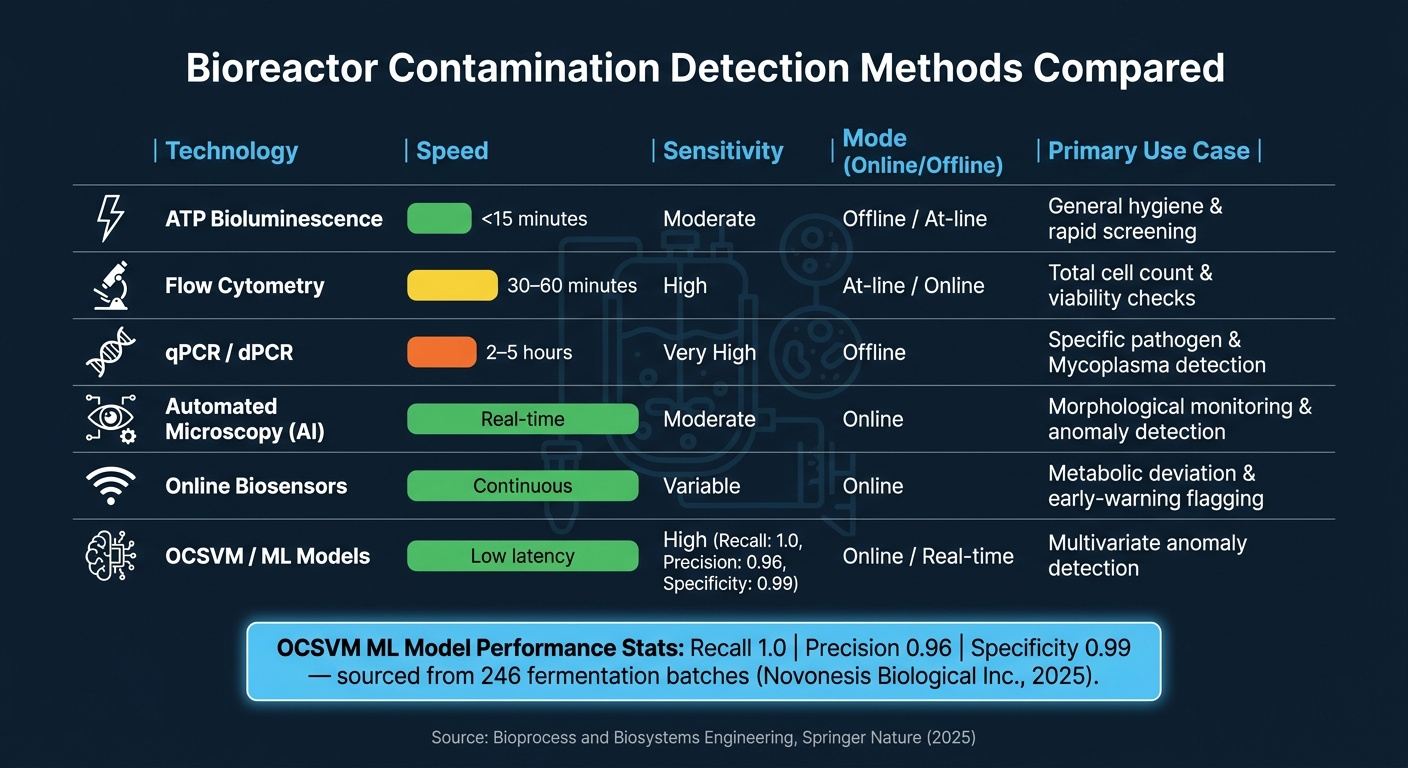
Bioreactor Contamination Detection Methods Compared
Rapid Detection Methods
Modern contamination detection methods build on refined sampling and real-time monitoring to identify issues faster and more effectively. Traditional techniques, like microscopy, typically confirm contamination only after sampling. In contrast, advanced technologies now enable quicker detection, sometimes even before sampling becomes necessary.
ATP bioluminescence provides results in under 15 minutes by detecting microbial ATP using luciferase. While this method is effective for rapid checks on surfaces and liquids in cultivated meat bioreactors, it requires a high microbial load and cannot differentiate between species.
Flow cytometry employs laser-based analysis to distinguish viable cells from non-viable ones based on size, granularity, and fluorescence. Results are available within 30–60 minutes.
AI-driven automated microscopy offers continuous in situ monitoring of cell morphology. It flags anomalies, such as rod-shaped bacteria or budding yeast, without needing to open the bioreactor.
Online biosensors monitor metabolic changes - like drops in dissolved oxygen (DO) or spikes in lactic acid - in real time. These changes can signal early contamination, prompting rapid qPCR confirmation for species-level identification. Platforms such as Cellbase provide access to verified suppliers offering biosensors tailored to cultivated meat production environments.
Emerging machine learning techniques, like unsupervised OCSVM models, enhance online monitoring by analysing key parameters with high accuracy. These models, which utilise 5-step rolling means and 1-step lag values, have shown impressive recall (1.0), precision (0.96), and specificity (0.99) for detecting contamination [2]. This integration strengthens the overall framework for contamination detection.
Detection Technologies Compared
Below is a comparison of the performance and applications of various rapid detection technologies:
| Technology | Speed | Sensitivity | Online / Offline | Primary Use Case |
|---|---|---|---|---|
| ATP Bioluminescence | <15 minutes | Moderate | Offline / At-line | General hygiene and rapid screening |
| Flow Cytometry | 30–60 minutes | High | At-line / Online | Total cell count and viability checks |
| qPCR / dPCR | 2–5 hours | Very High | Offline | Specific pathogen and Mycoplasma detection |
| Automated Microscopy (AI) | Real-time | Moderate | Online | Morphological monitoring and anomaly detection |
| Online Biosensors | Continuous | Variable | Online | Metabolic deviation and early-warning flagging |
| OCSVM / ML Models | Low latency | High (up to 1.0) [2] | Online / Real-time | Multivariate anomaly detection across process variables |
Each technology has its strengths and limitations. Online tools like biosensors, automated microscopy, and machine learning models enable continuous monitoring without opening the bioreactor, reducing contamination risks. Offline tools, such as qPCR, offer the precision needed to confirm and identify specific contaminants once an alert is triggered.
For cultivated meat production, detecting Mycoplasma is especially critical. Traditional culture-based methods for Mycoplasma testing can take up to 28 days, which is far too slow for timely decision-making. Validated qPCR protocols, which target Mycoplasma DNA, can deliver results in just 2–5 hours, offering a significant improvement in operational efficiency for production teams.
Building Contamination Monitoring into Bioreactor Design
Preventive Process Monitoring Strategies
Integrating preventive monitoring directly into bioreactor design enhances the ability to detect contamination early. High-frequency data acquisition plays a pivotal role here. Sampling critical parameters every five seconds provides the resolution needed to calculate engineered features. By embedding these features into the system, gradual process drifts can be seamlessly incorporated into routine monitoring [2]. This approach transforms monitoring from a reactive task into a predictive tool.
Using Monitoring Data for Root-Cause Analysis
When contamination signals emerge, historical monitoring data becomes indispensable. A well-designed control system should automate the preprocessing of this data, addressing missing values and filtering out invalid readings. This ensures the data is clean and ready for immediate analysis [2].
A study published in Bioprocess and Biosystems Engineering (2025) demonstrates this method effectively. Researchers analysed data from 246 fermentation batches at Novonesis Biological Inc. in Salem, Virginia. Out of these, 23 batches were contaminated, while 223 remained healthy. Using OCSVM models applied to engineered features like rolling means and one-step lag values, the study achieved a recall of 1.0, precision of 0.96, and specificity of 0.99 for contamination detection [2]. SHAP (Shapley Additive Explanations) values further highlighted the most influential variables, with DO setpoints, fermenter pressure, and temperature emerging as key contributors to anomalies [2].
Engineered features serve dual purposes, aiding both early detection and root-cause analysis. The table below highlights their roles:
| Feature Type | Purpose in Detection | Benefit for Root-Cause Analysis |
|---|---|---|
| Rolling Mean | Filters short-term noise | Identifies gradual drifts in parameters like pH or DO [2] |
| Lag Features | Tracks time dependencies | Detects slow-reacting contamination indicators [2] |
| Static Stats (Min/Max) | Captures extreme spikes | Pinpoints sudden mechanical failures or breaches [2] |
| SHAP Values | Quantifies feature importance | Ranks variables contributing to anomalies [2] |
This integration of design and analytics ensures rapid detection while enabling precise corrective measures in real time.
For cultivated meat production teams looking for sensors and monitoring systems, Cellbase connects users with verified suppliers offering equipment designed to meet these advanced monitoring needs.
How to Respond When Contamination Signals Are Detected
Isolation and Escalation Protocols
When monitoring data detects an anomaly - such as a pH drop or a turbidity shift - immediate containment is essential. Delays, even by hours, increase the risk of contamination spreading to nearby equipment, shared media lines, or downstream processes.
The first step is to physically isolate the affected vessel. Disconnect it from shared tubing manifolds and stop any media exchange with other bioreactors. Replace any flexible tubing that came into contact with the contaminated culture, as microbial residues can linger even after cleaning [1]. For stainless-steel vessels, complete disassembly is necessary, followed by repeated autoclaving cycles. If spore-forming organisms are suspected, include pauses between autoclaving cycles to allow spore germination before subsequent sterilisation [1].
"If the source of contamination is not identified and treated immediately, contamination may spread throughout the facility, causing loss of product and significant disruptions to the production and supply chain." - Jade Hall, Kraken Sense [4]
If the contamination source cannot be quickly identified, it might be necessary to halt production across the facility to prevent further spread. Isolation protocols should also include tracing the contamination back through the seed train. Re-plating inoculum samples and reviewing upstream preparation records can help determine whether the issue originated before inoculation, which would require extending the response upstream [1].
Swift isolation is critical to making informed decisions about whether to proceed with the batch.
Batch Management and Decision-Making
Once the affected vessel is isolated, the next step is to decide whether to continue or terminate the batch. This decision depends on how early the contamination was detected and its severity.
In most cases of microbial contamination, the best course of action is a "quick kill" - terminating the culture immediately to minimise wasted time, media, and downstream resources [1]. Attempting to salvage a contaminated batch is rarely successful and often leads to greater losses. However, viral contamination poses a different challenge in cultivated meat cell cultures. For example, in a simulated Mouse Minute Virus (MVM) contamination, cell viability did not significantly decline until Day 4. This delay means that by the time visible signs of cell health deterioration appear, the contamination may already be widespread [3].
The table below summarises key decision points based on contamination type and detection timing:
| Scenario | Recommended Action | Rationale |
|---|---|---|
| Microbial contamination confirmed early | Terminate batch immediately | Minimises resource loss and prevents facility-wide spread [1] |
| Viral contamination suspected, cells still viable | Isolate, increase sampling frequency, assess downstream clearance capacity | Cell viability may not immediately reflect contamination severity [3] |
| Source unidentified after initial investigation | Halt facility-wide production | Prevents contamination from spreading through shared infrastructure [4] |
| Contamination traced to seed train | Investigate and discard affected downstream batches | Seed train contamination invalidates the entire production chain [1] |
Timely detection and prompt action are essential to reduce losses and contain the contamination before it spreads further.
Following any contamination event, a thorough root-cause analysis is critical. This involves reviewing media preparation records, sterility testing logs, and operator notes to identify how the contamination entered and to address any vulnerabilities [1].
Conclusion: Building Stronger Contamination Detection Systems
Controlling contamination in cultivated meat bioreactors demands a multi-layered approach. This includes strategically placed sensors to monitor pH, dissolved oxygen, CO₂ evolution, and nutrient uptake in real time, alongside aseptic sampling protocols to verify sensor alerts. Rapid confirmatory methods - such as ATP bioluminescence, flow cytometry, or PCR-based assays - can drastically cut detection times, often saving batches from complete loss. These time savings are crucial, as they can mean the difference between containing contamination and losing an entire production run.
Incorporating these rapid detection methods into bioreactor design enhances monitoring effectiveness. By integrating sensors and monitoring systems directly into the bioreactor, blind spots are minimised, and data quality improves, making detection and root-cause analysis more efficient.
Equally critical is the response to contamination incidents. Each event, whether a full contamination or a near miss, offers valuable lessons. Analysing sensor data, sampling records, and response logs after each production run allows teams to adjust thresholds, optimise sampling schedules, and address procedural weaknesses. Over time, this iterative process strengthens contamination control, shifting it from a reactive to a proactive strategy. This highlights the importance of selecting the right monitoring tools from the outset.
For cultivated meat producers scaling operations, having access to reliable equipment is essential. Cellbase provides procurement teams with a network of verified suppliers offering bioreactors, sensors, single-use components, and growth media designed for high-density, food-grade production. This access supports the establishment of robust monitoring systems as outlined above.
Ultimately, early detection does more than prevent losses - it empowers teams. With early detection, teams can isolate issues faster, make informed batch decisions, protect equipment, and maintain the consistency required for large-scale cultivated meat production. Integrated monitoring and early detection not only safeguard production but also drive improvements in bioreactor performance and operational efficiency.
FAQs
Which sensor readings change first when contamination starts?
In bioreactors, shifts in dissolved oxygen (DO) levels and pH are the earliest signs of contamination. Microbial activity rapidly consumes oxygen while generating acids, causing DO levels to drop and pH to decrease. These measurable changes serve as critical warning signs, allowing for early detection of contamination and timely intervention.
How often should we sample without increasing contamination risk?
To reduce the risk of contamination in cultivated meat bioreactors, sampling should be conducted at intervals of 1 to 5 minutes at key points. Implement systems that support continuous and auditable monitoring while preserving sterility. This approach ensures thorough oversight without jeopardising the cleanliness of the environment.
When should we rely on machine learning alerts versus qPCR confirmation?
Machine learning alerts play a crucial role in spotting contamination early by analysing real-time data like pH levels, dissolved oxygen, and microbial metabolites. However, these alerts should be followed up with qPCR confirmation to validate the findings and pinpoint the exact pathogens involved once an issue has been identified. Together, these methods complement each other to maintain bioreactor sterility effectively.


