

For cultivated meat R&D teams, producing structured whole-cuts like steaks or fillets requires more than just growing cells. The key lies in chassis cells - muscle, fat, and connective tissue cells designed to mimic the structure and texture of traditional meat. These cells must:
- Multiply efficiently, then differentiate into mature tissues.
- Align with scaffolds to form anisotropic muscle fibres.
- Interact with co-cultures (e.g., fat and fibroblast cells) for realistic composition.
- Remodel extracellular matrix (ECM) for structural integrity.
Each chassis cell type - myoblasts, stem cells, or engineered lines - offers unique benefits and limitations. For example, myoblasts excel at forming muscle fibres but struggle with scalability, while stem cells provide flexibility for creating complex tissue blends. Scaffold compatibility is equally critical, as stiffness, adhesion, and alignment directly impact cell behaviour and final product quality.
The right combination of chassis cells and scaffolds ensures the desired texture, structure, and sensory experience. Whether you're developing marbled steaks, flaky fish fillets, or hybrid products, tailoring cell strategies to product goals is essential for success.
Key Traits Chassis Cells Need for Cultivated Meat
Core Traits for Chassis Cells
Not all cell types are suited for the intricate demands of three-dimensional cultivated meat production. To succeed, chassis cells must exhibit several interconnected biological properties.
A key requirement is robust proliferation capacity. These cells need to multiply rapidly while staying undifferentiated until a sufficient cell mass is achieved. Afterward, they must differentiate efficiently. For instance, myoblasts must fuse into multinucleated myotubes to form mature muscle fibres. These fibres can contain up to 100 nuclei per cell. The success of this fusion process is often assessed using markers like Myosin Heavy Chain (MHC) expression and Creatine Kinase activity [2]. These capabilities directly contribute to the fibrous texture and structural integrity essential for high-quality structured products.
Adhesion behaviour is another critical trait. Chassis cells, being anchorage-dependent, rely on integrin receptors to bind specific motifs, particularly the RGD sequence (arginyl-glycyl-aspartic acid), for attachment. When working with plant-based scaffolds, functionalisation with RGD peptides or protein coatings becomes necessary [1].
Additionally, these cells must secrete and remodel the extracellular matrix (ECM). This involves producing components like collagen, proteoglycans, and matrix metalloproteinases (MMPs) to transform scaffolds into structures resembling natural muscle tissue. The ability to remodel the ECM is vital for achieving the mechanical and sensory qualities consumers anticipate in cultivated meat.
While these traits are fundamental, structured cultivated meat demands an even higher level of performance from chassis cells.
Why Structured Meat Products Demand More from Chassis Cells
Although the core traits are crucial, producing structured cultivated meat - like whole-cut products - requires specialised cell behaviours. In contrast, unstructured formats, such as minced meat, are more forgiving. For these, cells can be harvested as undifferentiated biomass and combined with binders to achieve the desired texture. Whole-cut products, however, demand that cells align with the scaffold architecture, necessitating mechanosensing - the ability to detect and respond to mechanical cues in the environment. Studies suggest that a stiffness range of 2–12 kPa is optimal for muscle progenitor expansion, closely matching the natural stiffness of skeletal muscle tissue [1][3]. Exceeding this range often drives cells toward differentiation instead of proliferation, underscoring the importance of scaffold design in influencing cell behaviour.
Structured formats also require co-culture compatibility. A realistic whole-cut product typically consists of around 90% mature muscle fibres, with the remainder being fat and connective tissue [3]. This means chassis cells must grow alongside adipocytes and fibroblasts without disrupting each other. This adds complexity to media formulations, scaffold chemistry, and overall culture conditions. In three-dimensional environments, these interactions occur across the entire cell membrane, mimicking in vivo behaviour and facilitating the signalling gradients needed for proper tissue organisation.
"The majority of muscle's load-bearing ability arises from this dense ECM and not the muscle fibers themselves, revealing the importance of a strong support structure for mature muscle cells." - Claire Bomkamp, Senior Scientist, The Good Food Institute [3]
If chassis cells fail to secrete and remodel ECM effectively, the resulting tissue will lack the mechanical strength needed, regardless of how well the cells differentiate. In structured cultivated meat, the ECM is not just a scaffold but an essential functional component of the final product. Chassis cells that excel in these traits are critical for achieving the structural precision and sensory attributes that define a successful whole-cut cultivated meat product.
sbb-itb-ffee270
Chassis Cell Strategies and Sources
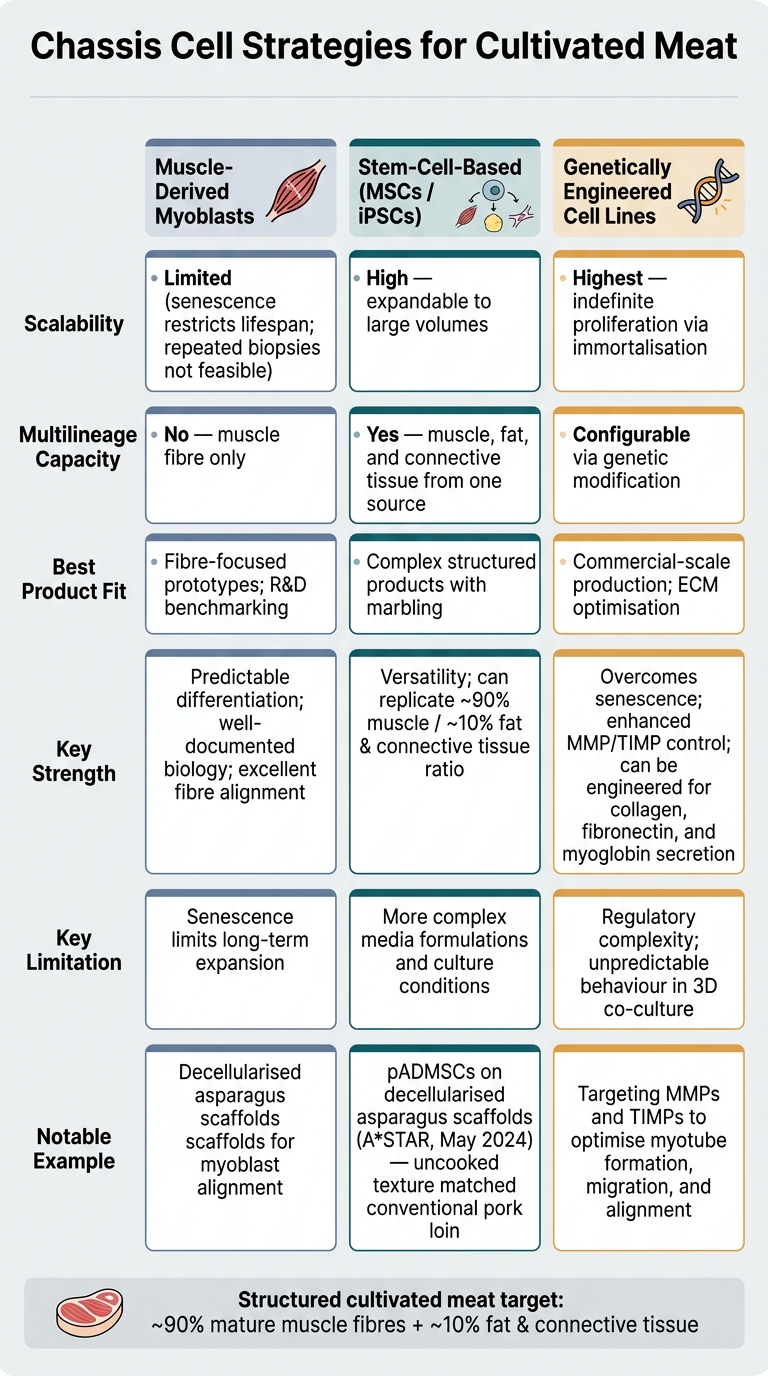
Chassis Cell Strategies for Cultivated Meat: A Side-by-Side Comparison
Selecting the right cell source is a cornerstone of tackling both scalability and functionality challenges in cultivated meat production. The three main strategies - muscle-derived myoblasts, stem-cell-based systems, and genetically engineered cell lines - each come with their own set of strengths and limitations, depending on the product being developed.
Muscle-Derived Myoblasts
Myoblasts, the precursors to skeletal muscle cells, are harvested from tissue biopsies and expanded in culture. They are then guided to differentiate, fuse, and form the multinucleated myotubes that create muscle's fibrous structure. Their well-documented biology makes them an excellent choice for applications where fibre alignment and texture are key, such as steaks or fillets.
However, scalability is a significant hurdle. Primary myoblasts have a limited lifespan due to senescence, and repeated biopsies are not feasible for large-scale production. Despite this, their predictable differentiation is advantageous for research and early-stage prototyping. For example, plant-derived scaffolds like decellularised asparagus have been used to provide alignment cues for myoblast seeding, partially compensating for the lack of a native extracellular matrix (ECM) environment [2]. Still, stem-cell-based systems and genetic engineering approaches offer solutions to scalability issues and bring additional functional benefits.
Stem-Cell-Based Approaches
Stem cells, including satellite cells, mesenchymal stem cells (MSCs), and induced pluripotent stem cells (iPSCs), address the scalability limitations of myoblasts. These cells can be expanded to much larger volumes and are capable of differentiating into multiple cell types from a single source [1][3].
This versatility is crucial for creating the balanced composition of muscle, fat, and connective tissue required for structured products. For instance, replicating the approximate 90% muscle fibre to 10% fat and connective tissue ratio found in conventional meat involves combining myocytes, adipocytes, and fibroblasts. Stem-cell-based systems manage this complexity more effectively than pure myoblast cultures. A notable example comes from researchers at the Bioprocessing Technology Institute (A*STAR) in Singapore. In May 2024, they used porcine adipose-derived mesenchymal stem cells (pADMSCs) on decellularised asparagus scaffolds to produce a co-culture of muscle fibres and adipocytes. The uncooked texture of this product matched conventional pork loin, as confirmed by texture profile analysis [2].
Stem-cell-based methods often incorporate fibroblast co-cultures or engineered ECM secretion to ensure the matrix's mechanical functionality. This integration underlines the importance of ECM dynamics in co-culture design [3].
Genetically Engineered Chassis Cells
Genetic engineering offers tools to overcome natural limitations, such as senescence, by creating immortalised cell lines that can proliferate indefinitely [1]. This approach is particularly suited for scaling up production and refining ECM interactions.
For example, precise genetic modifications can enhance ECM remodelling by targeting matrix metalloproteinases (MMPs) and their inhibitors (TIMPs). These enzymes play a pivotal role in tissue maturation, influencing myotube formation, migration, and alignment [3].
"Given the critical role of MMPs and TIMPs in cellular differentiation, migration, and proliferation, these enzymes may serve as attractive cell line engineering targets to optimize downstream CM manufacturing processes." - Claire Bomkamp et al., The Good Food Institute [3]
Additionally, cells can be engineered to improve scaffold adhesion by enhancing integrin-RGD interactions or to secrete structural proteins like collagen and fibronectin autonomously. There is growing interest in tailoring nutritional profiles, such as increasing myoglobin expression to boost iron content and improve colour [3].
The downside of genetically engineered cell lines lies in their regulatory and biological complexity. Immortalised or modified cells require rigorous characterisation, and their behaviour in three-dimensional co-culture systems can sometimes deviate unpredictably from primary cells. For sourcing verified cell lines and compatible scaffolding materials, platforms like Cellbase provide curated suppliers to streamline procurement for these advanced systems.
| Approach | Scalability | Multilineage Capacity | Product Focus |
|---|---|---|---|
| Muscle-Derived Myoblasts | Limited by senescence | No | Fibre-focused prototypes; R&D benchmarking |
| Stem-Cell-Based (MSCs/iPSCs) | High | Yes | Complex structured products with marbling |
| Genetically Engineered Lines | Highest | Configurable | Commercial-scale production; ECM optimisation |
Scaffold Compatibility and Tissue Formation
The scaffold environment is pivotal in shaping cell behaviour during cultivated meat production. While choosing the right chassis cell strategy is essential, the interaction between these cells and the scaffold largely determines the tissue's functionality. Factors like adhesion, alignment, and the ability to mature into functional tissue are deeply influenced by the relationship between the cell type and the scaffold material. This interplay requires careful fine-tuning.
One major challenge with plant-derived and synthetic scaffolds is their lack of natural cell-binding domains, which are critical for animal cell adhesion. Specifically, they often lack RGD sequences, which are essential for integrin binding. As highlighted in npj Science of Food, "non-animal-derived biomaterials typically lack cell-binding domains essential for cell adherence and growth in culture, necessitating further chemical or structural modifications" [1]. To address this, surface functionalisation with fibronectin, laminin, or RGD peptides is often necessary to enhance adhesion and support cell growth on these scaffolds.
Scaffold stiffness plays a key role. Muscle-like mechanical properties typically fall within the range of 2–12 kPa [1][3]. Softer scaffolds at the lower end of this range promote progenitor cell expansion, while increased stiffness encourages differentiation into mature myofibres. Hydrogels with time-adjustable stiffness offer a practical solution by supporting cell expansion initially and then promoting differentiation, all within a single scaffold system. This stiffness control is crucial for creating the aligned fibre structure that gives cultivated meat its authentic texture.
Anisotropy is equally important. The characteristic grain and resistance to bite in meat result from aligned muscle fibres. Scaffolds produced using techniques like electrospinning, rotary jet spinning, or 3D bioprinting can create the necessary oriented topography for guiding myoblasts into parallel myotubes. Misaligned fibres, on the other hand, lead to significantly higher transverse stress - over seven times that of aligned fibres [3] - highlighting how essential structural directionality is for replicating meat texture.
How Different Chassis Cell Types Perform on Scaffolds
Different chassis cell types have unique requirements when interacting with scaffolds. For instance, fibroblasts thrive on fungal polysaccharide scaffolds derived from species like Grifola, which actively stimulate collagen synthesis. This turns fibroblasts into ECM builders rather than passive cells. Adipocytes, on the other hand, are typically grown on edible microcarriers that support lipid droplet accumulation before integration into the muscle construct. Meanwhile, endothelial cells perform well on bacterial cellulose hydrogels, such as those produced by Gluconacetobacter hansenii, which facilitate the formation of vascular-like networks. These networks are critical for addressing nutrient transport in thicker tissue constructs.
Matching edible scaffolds to each cell type's adhesion and maturation needs is vital for consistent tissue formation.
| Chassis Cell Type | Compatible Scaffold Materials | Performance Metrics |
|---|---|---|
| Myoblasts | Soy protein, wheat gluten, alginate (RGD-modified), PLA | Adhesion, alignment, differentiation efficiency |
| Fibroblasts | Fungal polysaccharides, PCL, collagen-coated polymers | ECM organisation, collagen synthesis stimulation |
| Adipocytes | Edible microcarriers, porous plant-based scaffolds | Lipid accumulation, structural integration |
| Endothelial Cells | Bacterial cellulose, polyurethane | Biocompatibility, vascular-like network formation |
Finding scaffold materials that meet these cell-specific needs - particularly those that are food-safe and have well-documented surface properties - remains a challenge for many R&D teams. Platforms like Cellbase offer curated lists of scaffold suppliers and compatible cell lines, streamlining the process of matching materials to specific cell requirements and avoiding the complexities of fragmented supplier networks.
Matching Chassis Cell Selection to Product Goals
Once the scaffold environment is set, the next critical step is selecting the right chassis cell to achieve the desired meat structure. There’s no universal chassis cell type that fits every product format. The choice depends on the product's specific requirements: whether it’s the fibrous texture of a whole muscle cut, the rich marbling of a premium steak, or the uniform consistency of a processed hybrid format. Making these decisions early can save time and costs by avoiding major reformulations later. This process ensures the chosen chassis cells align with the structural and sensory goals of the final product.
As Claire Bomkamp and colleagues at The Good Food Institute highlight, determining the optimal ratio of mature muscle fibres to fat and connective tissue provides a valuable framework for prioritising cell types and proportions during development [3].
Choosing the Right Chassis Cell for Different Structured Products
For whole muscle cuts, myoblasts combined with fibroblasts offer the most straightforward solution. Myoblasts contribute the essential fibrous structure - terrestrial muscle fibres typically measure between 1–40 mm in length and 10–100 µm in diameter [3]. Fibroblasts, meanwhile, organise the extracellular matrix (ECM), which is essential for mechanical strength and structural integrity. Without a robust ECM, even well-differentiated myotubes won’t achieve the texture required for whole cuts.
Marbled products call for a different focus. Intramuscular fat is key to delivering juiciness, flavour, and tenderness. Adipocytes from high-marbling breeds, like Japanese Black cattle, often exceed 100 µm in diameter [3]. Adipose-derived stem cells or mesenchymal stem cells (MSCs) are ideal for these products, as they can be directed toward lipid accumulation within the tissue. MSCs also provide flexibility, as they can differentiate into muscle or fat cells depending on the product’s needs.
Fish fillets require a tailored approach. Fish myoblasts form shorter fibres than terrestrial muscle, and fish collagen has lower thermal stability, which contributes to the flaky texture during cooking. For fish fillets, it’s essential to use fish-derived myoblasts and scaffolds designed for lower thermal thresholds. Using scaffolds optimised for mammalian cells or higher-temperature conditions would compromise the desired texture.
For hybrid and processed formats - such as burgers, sausages, or plant-based hybrids - scalability and suspension compatibility matter more than replicating native tissue architecture. Myoblasts grown on microcarriers can be harvested and blended with plant-based proteins, leveraging standard food-processing equipment. In these formats, cultivated adipocytes often play a crucial role, as fat provides the flavour and mouthfeel that plant proteins alone cannot replicate.
| Product Goal | Primary Chassis Cell Strategy | Key Selection Factor |
|---|---|---|
| Whole Muscle Cut | Myoblasts + Fibroblasts | Alignment potential and ECM organisation [1][3] |
| Marbled Texture | Adipocytes / MSCs | Lipid accumulation and flavour profile [3] |
| Fish Fillet | Fish-derived myoblasts | Short fibre formation and thermal sensitivity [3] |
| Processed / Hybrid | Myoblasts + microcarriers | Scalability in suspension and doubling time [1][4] |
This table summarises the strategies for matching chassis cells to specific product goals, offering a quick reference for researchers. However, sourcing the right cell lines and compatible scaffolds can be a complex task, especially as product requirements evolve. Platforms like Cellbase simplify this process by connecting R&D teams with a curated marketplace of verified cell line and scaffold suppliers, ensuring materials align with the unique demands of cultivated meat production.
Conclusion
Customising chassis cells is central to producing structured cultivated meat, influencing everything from fibre alignment and fat distribution to scaffold compatibility and scalability. No single cell type can fulfil all requirements. Instead, myoblasts, adipocytes, fibroblasts, stem cells, and genetically engineered lines each bring distinct advantages, and the most effective approaches combine these elements strategically.
To replicate the composition of conventional meat, structured cultivated meat must achieve a tissue balance of roughly 90% mature muscle fibres and 10% fat and connective tissue [3]. Scaling cultivated meat demands chassis cells that are serum-free, robust, scaffold-compatible, and optimised for industrial bioreactors [4][5].
"Significant technological challenges must be solved for this field to reach its full potential, such as establishing standardised cell lines, optimising culture media, bioprocessing design, and scaffold technology." - npj Science of Food [1]
One major hurdle remains: sourcing reliable materials. Cellbase tackles this issue head-on. As a dedicated B2B marketplace for the cultivated meat industry, it connects R&D teams and procurement specialists with vetted suppliers of cell lines, scaffolds, growth media, bioreactors, and other essential tools. This streamlined access to trusted, industry-specific resources can help drive the field forward.
FAQs
What makes a good chassis cell for whole-cut cultivated meat?
A strong chassis cell plays a pivotal role in cultivated meat production, as it needs to support tissue growth while imitating the structure of natural meat. Important characteristics include high proliferative capacity, genetic stability, and the ability to differentiate into desired cell types.
Equally important is its compatibility with scaffolds, which allows muscle cells to attach and align properly - key for achieving the fibrous texture associated with whole cuts of meat.
Other essential traits include:
- Rapid proliferation in cost-effective culture media.
- Metabolic efficiency, ensuring optimal resource use during growth.
- The ability to co-culture with fat cells, which contributes to realistic flavour, texture, and scalability.
Together, these features ensure the production of cultivated meat that closely resembles its conventional counterpart in both structure and sensory qualities.
How do you select scaffold stiffness and alignment for muscle fibres?
Scaffold stiffness and alignment play a critical role in cultivated meat production. To support proper cell differentiation and tissue organisation, the scaffold’s stiffness should closely resemble that of natural muscle tissue - typically in the range of 2–12 kPa.
For alignment, techniques like stretching are effective, as they encourage cells to orient uniformly. Additional approaches, including the use of micro-patterned scaffolds and topographical cues, further refine tissue structure. These methods are essential for achieving realistic, meat-like textures in the final product.
When should you use myoblasts vs stem cells vs engineered cell lines?
The choice of cell type hinges on your specific goals in cultivated meat production:
- Myoblasts: Best suited for creating muscle tissue, such as steak-like products, thanks to their direct differentiation into muscle fibres.
- Stem cells: Offer versatility for generating various tissue types but often involve more intricate protocols.
- Engineered cell lines: Designed for scalability and optimised for high yields and bioprocess efficiency, making them a strong candidate for large-scale production.


