

Scaffold costs are one of the biggest obstacles to making cultivated meat affordable. Currently, scaffolds often account for a large portion of production costs, with cultivated meat priced at around £50/kg compared to just a few pounds per kilogram for conventional beef. This article explores ways to cut scaffold expenses, focusing on material choices, production processes, and smarter procurement methods.
Key Takeaways:
- High Costs: Scaffolds need to be edible, food-safe, and mechanically suitable, which limits affordable material options.
- Material Innovations: Agricultural by-products like corn husks and jackfruit rinds show promise, costing under £1/kg compared to £63/kg for biomedical-grade scaffolds.
- Efficient Production: Techniques like simplified decellularisation and optimised electrospinning can reduce waste and energy use.
- Procurement Platforms: Tools like Cellbase streamline sourcing, offering cost-effective, food-grade scaffold materials.
By focusing on cheaper materials, improving manufacturing methods, and centralising procurement, companies can lower scaffold costs and bring cultivated meat closer to price parity with conventional meat.
Dr. Glenn Gaudette: Using decellularized spinach as a scaffold for cultivated meat
What Drives Scaffold Material Costs

Scaffold Cost Comparison: Traditional vs. Plant-Based Materials for Cultivated Meat
Material Composition and Biocompatibility Requirements
Creating scaffolds for cultivated meat comes with unique challenges that significantly influence material costs. Unlike scaffolds used in biomedical fields, these must meet a trifecta of requirements: they need to be edible, safe for consumption, and capable of supporting cell adhesion, growth, and differentiation. On top of that, they must degrade into harmless by-products. This combination of demands narrows material options compared to the broader range available in other industries [1].
The emphasis on food-grade purity and traceability adds another layer of expense. Animal-derived materials, such as collagen and gelatin, are highly effective for cell adhesion but come with higher costs due to complex extraction and purification processes, alongside strict regulatory requirements. These materials also require rigorous traceability systems to mitigate pathogen risks, further driving up quality assurance costs [5][11]. On the other hand, plant-based alternatives - like proteins from cereals, algae, or fungi - are often more affordable, especially when sourced from agricultural or food-processing by-products. However, these materials may need additional treatments, such as surface coatings or functionalisation, to achieve the same bioactivity as animal-derived options [3][6][11].
Meeting the mechanical property requirements for cultivated meat adds yet another layer of complexity. Scaffolds must offer specific characteristics like stiffness, porosity, and controlled degradation rates. For whole-cut products, they also need to replicate muscle-like textures and may require anisotropic fibre alignment to guide cell orientation. Achieving these technical standards often involves intricate and costly fabrication methods. As a result, more affordable, less advanced materials typically fail to deliver the sensory qualities consumers expect from meat [1][6].
These strict material requirements not only limit the range of choices but also contribute to higher production costs, as discussed below.
High Production Costs of Scaffolds
The manufacturing processes used to produce high-performance scaffolds are a major factor in their cost. Electrospinning, a widely used method for creating nanofibrous scaffolds, requires high-voltage equipment, precise environmental controls, and slow deposition rates. Additionally, the process involves solvent handling and recovery systems, which add to both capital and operational expenses [5][6].
Similarly, 3D printing and bioprinting technologies come with their own cost challenges. These include expensive printer hardware, proprietary bioinks, limited throughput for intricate designs, and significant labour requirements [5][6].
Another promising but still costly method is decellularisation, which involves removing cellular material from plant or animal tissues. Materials like corn husks or jackfruit rinds can be used, but the process requires washing, chemical treatments, and lengthy processing times. While plant-based decellularisation can be relatively affordable when using simple detergent protocols, scaling up involves investments in equipment such as stirred tanks, filtration systems, and waste-treatment facilities. Labour costs for monitoring and maintaining food-grade or HACCP-compliant systems also add significantly to production expenses [3][5].
These manufacturing complexities highlight why scaffold production remains a costly endeavour.
Practical Strategies for Reducing Scaffold Costs
Bulk Purchasing and Supplier Negotiations
Buying scaffold materials in large quantities can significantly cut costs thanks to economies of scale. Bulk orders often reduce per-unit prices by 20–50% for sizeable purchases, all while maintaining the biocompatibility required for cultivated meat production [2][4]. Building long-term relationships with suppliers and committing to volume-based contracts can further enhance savings.
When negotiating, it’s worth asking for tiered pricing - such as a 10% discount for orders above 100 kg - or bundling scaffold materials with other essentials like growth media [2][4]. Direct partnerships with suppliers can also lead to custom formulations tailored to specific needs, often at a lower cost than standard off-the-shelf options. These negotiated savings create a solid foundation for further cost reductions through improved production processes.
Process Optimisation in Scaffold Production
Streamlining production processes can lower costs by reducing material waste and energy use. For instance, optimised electrospinning techniques can cut production times by 30–40%, enhance fibre uniformity, and lower expenses [2][7]. Practical steps include automating controls like voltage and flow rate, recycling solvents during production, and using computational modelling to identify efficiency gains before scaling up from lab to full-scale manufacturing.
For plant-based scaffolds, simplified decellularisation methods offer even more savings. Using common detergents like SDS for 24–48 hours, materials such as corn husks or jackfruit rinds can be processed for less than £1 per kg, compared to approximately £63 per kg for standard biomedical scaffolds [3]. These detergents are already approved for food and pharmaceutical use, which keeps validation costs low while producing edible scaffolds that support bovine muscle cell growth and bead-to-bead cell transfer in bioreactors [3]. Cost savings also come from using innovative, low-cost materials that align with sustainable practices.
Material Innovations for Low-Cost Scaffolds
New materials are unlocking dramatic cost savings in scaffold production. One promising area is the use of agricultural waste streams. Decellularised corn husks and jackfruit rinds, for example, offer anisotropic structures that closely resemble muscle tissue. Jackfruit, in particular, has mechanical properties similar to bovine tissue and supports strong cell growth. Trials have shown protein yields of 11.45 ± 2.24 µg/µL lysate per gramme for bovine satellite cells and 12.90 ± 1.99 µg/µL lysate per gramme for avian cells on jackfruit scaffolds [3]. At under £1 per kg, these materials bring cultivated meat closer to the £2 per kg target needed to compete with conventional beef [3].
Beyond plant-based options, 3D-printable inks made from cereal waste are enabling the direct printing of edible scaffolds [9]. This approach turns low-value by-products into high-value materials while enhancing the sustainability of cultivated meat production. Shifting from animal-derived biomaterials to plant, fungal, or algal biopolymers also improves scalability and addresses regulatory challenges [10][11]. For instance, Gelatex, a nanofibre scaffold manufacturer, has already reduced production costs to less than €1,000 per kg, with projections of €40 per kg within five years and €20 per kg within ten years [8]. At €20 per kg, scaffold costs would contribute less than €1 per kg to the final price of cultivated meat [8]. These advancements, combined with smart procurement strategies, are making cost-effective scaffold sourcing a reality in specialised marketplaces like Cellbase.
sbb-itb-ffee270
Using Specialised Marketplaces for Cost Efficiency
Specialised marketplaces are becoming a critical tool for improving cost efficiency, complementing advancements in production methods and material choices.
How Cellbase Supports Scaffold Procurement
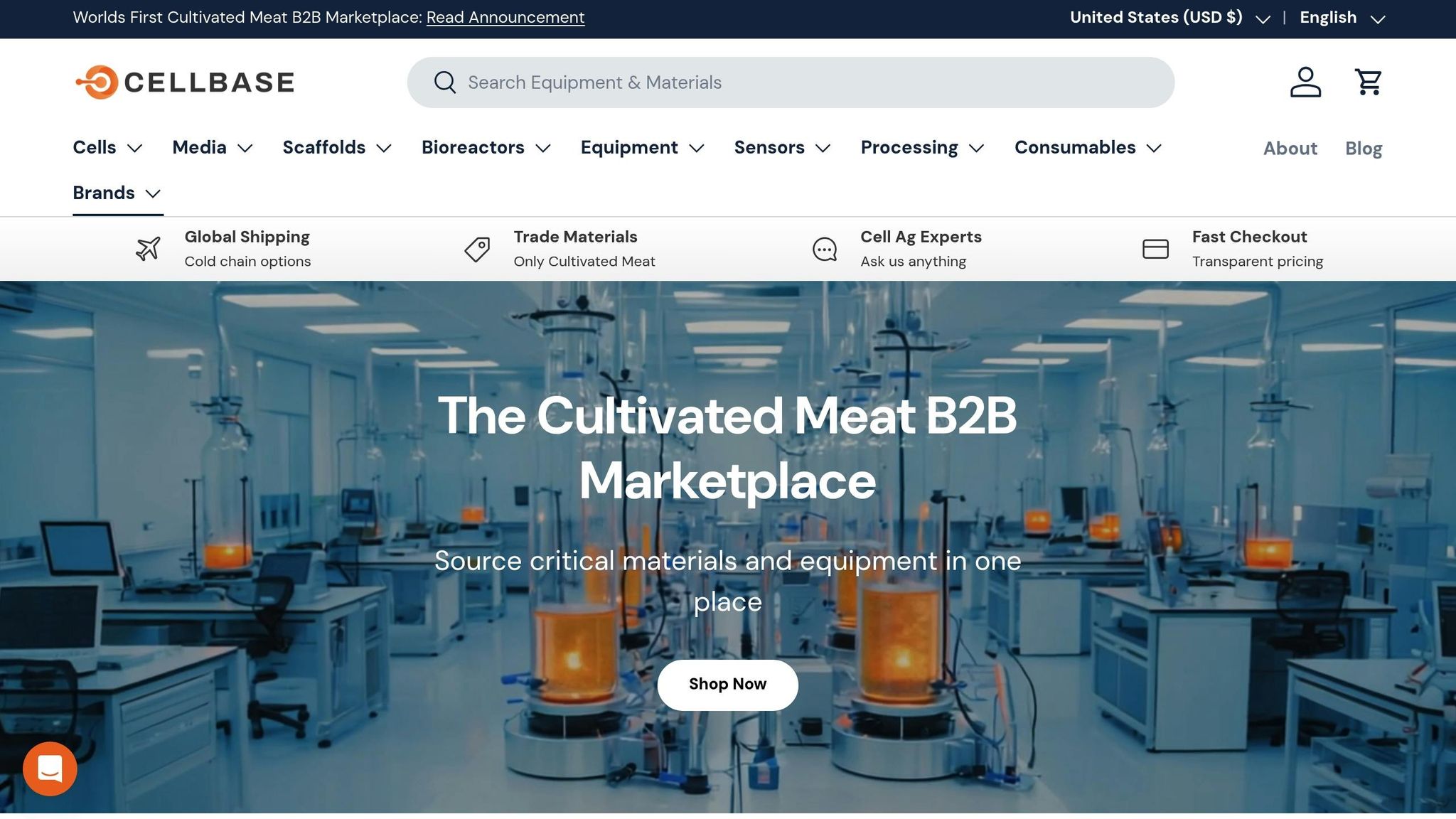
Cultivated meat companies in the UK often face challenges with fragmented supply chains and the high costs of biomedical-grade scaffolds, which are not designed for food production. Standard lab catalogues rarely provide the essential details these companies need, such as food-grade certification, edibility, and regulatory compliance. This forces procurement teams to spend significant time comparing prices and negotiating with multiple vendors - an inefficient and resource-intensive process.
Cellbase simplifies this by acting as a curated platform tailored specifically to the needs of cultivated meat producers. It allows R&D and procurement teams to search for scaffold materials that are compatible with muscle and fat cell lines. Suppliers on the platform list food-grade scaffolds, microcarriers, and related biomaterials with detailed specifications, application guidance, and upfront pricing. Since Cellbase is exclusively B2B and focused on cultivated meat, buyers can easily request quotes, sample packs, or pilot-scale batches from multiple verified suppliers, all in one place. This streamlines the often-complex vendor onboarding process.
By centralising these procurement activities, companies can shift from relying on boutique, low-volume products to adopting food-grade scaffold lines or plant-derived options, which are more cost-effective at scale. The ability to compare multiple offers side by side ensures buyers can secure better pricing, whether measured per kilogramme or per square metre. Additionally, pooling demand across various stages - R&D, pilot projects, and early commercial production - makes it easier to negotiate volume discounts and framework agreements, which might be difficult to achieve when dealing with suppliers individually. This streamlined approach helps companies achieve clear cost savings.
Benefits of Using a Specialised Marketplace
Beyond the cost advantages, Cellbase provides transparent pricing and filtering tools that allow buyers to compare materials based on area, volume, or mass. This functionality simplifies the decision-making process, reducing the need for lengthy negotiations with sales teams. For lean startups in the UK operating on tight R&D budgets, this is a major benefit, as it saves time and internal resources while enabling better material choices.
The platform’s focus on cultivated meat also means it highlights innovative and food-oriented materials such as plant-based, agricultural-waste-derived, or textured edible scaffolds. For example, an R&D team developing structured beef analogues can use Cellbase to compare traditional collagen-based scaffolds with plant-based or agro-waste-derived options. They can source small evaluation batches from multiple vendors simultaneously, speeding up the transition from expensive biomedical materials to cost-efficient solutions designed for food production.
Over time, the purchasing data and market insights available through the platform can help companies track price trends across different scaffold types, allowing them to predict when certain technologies might become more affordable for commercial scaling. Additionally, monitoring supplier performance - such as delivery reliability, quality consistency, and responsiveness - enables producers to prioritise vendors that minimise risks and hidden costs, such as delays or quality issues. This level of efficiency is key to reducing overall production costs in the cultivated meat sector.
Conclusion
Cutting down scaffold costs in cultivated meat production hinges on three main strategies: material innovation, process optimisation, and smarter procurement methods. One promising approach is the shift from costly biomedical-grade materials to edible, plant-based scaffolds made from agricultural by-products like corn husks or jackfruit rind. These alternatives not only cost significantly less than traditional collagen scaffolds but also simplify production by eliminating the need for removal steps, reducing processing expenses along the way[3][10].
Advances in production processes are equally vital. Optimising decellularisation methods, employing growth factors with controlled release, and scaling production through efficient bioreactor systems can lead to dramatic cost savings - some methods have achieved reductions of up to 95%[2][3]. Suppliers are already making strides, with projections showing that scaffold costs could drop to below €1 per kilogram of cultivated meat[8].
Additionally, streamlined procurement platforms like Cellbase are helping companies save time and money. These platforms simplify supplier access, enable price comparisons, and facilitate bulk purchasing. For UK startups operating within tight budgets, this centralised approach reduces vendor fragmentation and provides access to emerging low-cost materials, making procurement more efficient and cost-effective.
FAQs
How can using plant-based materials like corn husks help lower scaffold costs in cultivated meat production?
Plant-based materials like corn husks offer a cost-effective, biodegradable, and easily accessible alternative to synthetic or animal-derived scaffolds. Using these materials can significantly cut down scaffold expenses while supporting environmentally friendly practices.
By incorporating plant-based options, cultivated meat producers can streamline their production processes and lower material costs - all without sacrificing quality or functionality.
How does process optimisation help reduce scaffold costs in cultivated meat production?
Reducing scaffold costs starts with improving manufacturing efficiency. By refining processes, production expenses can be lowered significantly. Additionally, optimised methods help cut down on material waste while enhancing scaffold designs, ensuring they support better cell growth using fewer resources. This makes the entire process much more economical.
Producers who streamline workflows and embrace new techniques can save a great deal without compromising on the quality of scaffolds designed specifically for cultivated meat production.
How does Cellbase help reduce scaffold costs for cultivated meat production?
Cellbase streamlines the process of obtaining scaffolds for cultivated meat by providing a specialised marketplace designed specifically for this sector. It allows professionals to find verified scaffolds and biomaterials, compare clear pricing, and directly engage with reliable suppliers - all within a single platform.
By bringing everything together in one place, Cellbase helps cut costs, save valuable time, and boost overall efficiency. This makes it simpler for researchers and businesses to secure the materials essential for advancing their production methods.


