

If you run a mammalian cell bioreactor for up to 28 days, weak alarm design can cost you the batch. In this case, I’d boil the article down to one point: linking alarm signals to batch phase, CIP/SIP status, and a single data view gave the site tighter control of pH, DO, temperature, and pressure, cut manual checks, and shortened QA review through release-by-exception.
For bioprocess engineers, cell culture scientists, and cultivated meat R&D teams, the message is simple. Point alarms on their own were not enough. The site had a mixed-vendor setup, siloed data, and no central historian view. After a bolt-on data layer mapped 100+ PLC/HMI tags, operators could review live trends, respond with more context, and keep a cleaner audit trail without changing validated equipment.
What changed most:
- Alarm logic moved from fixed points to context-based rules
- Batch phase and CIP/SIP status were logged with each event
- A full 28-day run set the baseline before go-live
- Remote trend review cut the need for on-site checks
- QA spent less time on manual record review
- The same data layer now supports later soft-sensor work
A second takeaway is just as important: threshold alarms and multivariate detection do different jobs. Thresholds are the first layer for viability-critical limits. Multivariate methods come later, once you have clean batch history and enough runs to support model building.
| Area | Before | After |
|---|---|---|
| Data visibility | Split across controls | One review layer |
| Alarm meaning | Isolated point alarms | Context tied to process state |
| Operator response | Slower, less clear | More direct event review |
| QA review | Manual and time-heavy | Release-by-exception |
| Validation impact | Plant changes would add work | Bolt-on layer avoided that |
If I were taking one lesson from this case, it would be this: sort alarm priority early, keep viability-critical tags separate from utility noise, and bring QA into the alarm philosophy from day one.
Baseline facility setup and pre-upgrade alarm problems
Bioreactor configuration, sensors and control architecture
Those risks exposed a second issue: the plant’s control layer couldn’t show everything in one place.
The pilot plant was running a mixed-vendor automation stack. Its control hierarchy used a Siemens PLC and proprietary HMI software, while the sensor set covered temperature, pH, dissolved oxygen (DO), pressure, and gas-flow rates. As part of the upgrade, the team mapped more than 100 PLC and HMI tags to build a single real-time view [1].
Observed issues: delayed response and weak prioritisation
The main issue wasn’t one failed asset. It was poor visibility. Batch growth had moved ahead of what the mixed-vendor control layer could show clearly [1].
Data sat in separate silos, which meant there was no single batch view. And without a central historian, engineers lacked live dashboards and batch trend data. That made deviation review slower and dragged out batch release decisions. QA also had to rely on manual review, which slowed decisions further and increased inventory holding time [1].
These visibility gaps set up the alarm redesign in the next stage.
sbb-itb-ffee270
Alarm system redesign and implementation
Alarm philosophy for pH, dissolved oxygen, temperature, pressure and contamination signals
The team rebuilt the alarm framework to fix two common problems on the plant floor: fragmented visibility and slow response. Instead of relying on simple point alarms in isolation, they moved to context-based alarm logic. pH, dissolved oxygen (DO), temperature, pressure and gas flow were set as the main alarm inputs, while batch phase and CIP/SIP status were logged with each alarm [1].
That matters in practice. A low DO alarm during an aeration shift does not mean the same thing as a low DO alarm during another batch phase. By tying process signals to operating context, the alarm system gave operators a clearer read on what was happening and when it needed action [1]. This alarm philosophy then shaped the integration work that came next.
System integration, soft sensors and operator workflows
The rollout centred on pulling existing control data into a single review layer. To do that, the team added a bolt-on data layer that mapped more than 100 PLC and HMI tags, without revalidating the equipment [1]. That choice kept the implementation light while still pulling in the signals needed for alarm review and batch analysis.
A full 28-day run was used to set the baseline for review [1]. Operators were then trained, and the system went live in under a week [1]. Authorised users could access live trends and batch reports remotely [1], which made it easier to review events without waiting for manual data pulls or local HMI access.
The same data layer also set up the system for future soft-sensor use [1]. In other words, it did more than support alarm handling; it created a path for model-based process visibility later on. That gave the team a stable basis for measuring the effect of the new alarm framework [1].
Results: measured impact after deployment
Before-and-after performance metrics
After deployment, pH, dissolved oxygen, temperature and pressure stayed within tighter limits across a full 28-day production run [1]. Manual interventions dropped, and authorised engineers could use VPN access to review live trends and batch data off-site [1].
The main post-deployment changes were:
| Metric | Before Upgrade | After Upgrade | Operational Comment |
|---|---|---|---|
| Critical parameter control | Limited visibility across separate controls | Tighter control of pH, dissolved oxygen, temperature and pressure | Better visibility across the batch cycle |
| Manual interventions | Manual checks during runs | Fewer interventions required | Remote monitoring reduced the need for on-site presence [1] |
| QA review time | Lengthy manual review | Reduced through release-by-exception | QA focused on batches with confirmed deviations [1] |
Effects on operator workload, quality records and audit readiness
The release-by-exception protocol was especially useful for QA teams. Instead of reviewing every data point from a 28-day run, engineers only needed to look at batches where parameters moved outside predefined limits [1]. That shifts effort away from routine checking and towards actual deviations.
Automated data collection replaced manual logging for batch records covering critical parameters such as pH, temperature and dissolved oxygen [1]. In practice, that meant fewer hand-entered records and a cleaner data trail.
The bolt-on approach also preserved equipment validation status. The site did not need to re-architect the plant network or modify existing commercial-off-the-shelf production systems [1].
These gains came from tighter alarm context, faster deviation review and a cleaner batch record.
Key lessons and conclusion
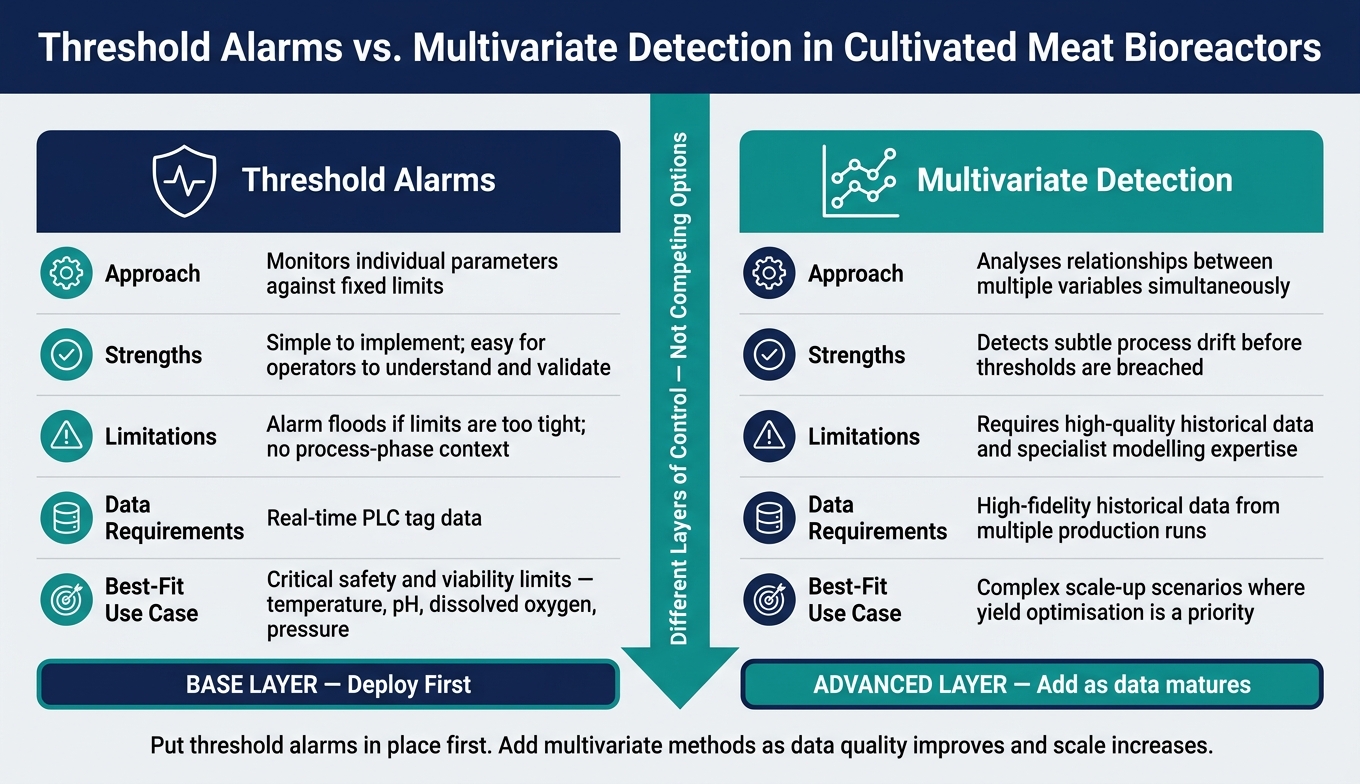
Threshold Alarms vs. Multivariate Detection in Cultivated Meat Bioreactors
What this case suggests for scale-up and future deployments
Building on the alarm redesign above, the main takeaway is straightforward: alarm strategy needs to be part of process design from the start.
The team identified the most critical tags early and split viability-critical variables - pH, dissolved oxygen, temperature and pressure - from lower-priority utility signals.
That early sorting matters more than it might seem. If every signal is treated as urgent, operators stop trusting the system. But when the alarm layer reflects actual process risk, people can act faster and with more confidence.
Input from process development, engineering and QA helped the team make decisions faster and made release-by-exception easier to support. For teams moving from pilot to pre-commercial scale, that points to a clear priority: bring QA into alarm philosophy discussions early, and make sure response procedures are checked across all shifts.
The same data layer can also support automated feeding, adaptive control and automatic sampling later on. In plain terms, it sets up the control backbone for a more automated factory.
Alarm rationalisation, then, is best viewed as the base layer for more automated cultivated meat production, not the end point.
Threshold alarms versus multivariate detection: a comparison
Threshold alarms are the first line of defence in cultivated meat bioreactors. They are simple to set up, easy to interpret and straightforward to validate. The catch is context: a fixed limit tells you when a variable has crossed a boundary, but it does not tell you what that means for a given process phase.
That is why threshold alarms should sit at the base layer, with multivariate detection added later.
Multivariate detection deals with that gap, but it comes with a higher bar. It needs good historical data across multiple batches, plus specialist analytics expertise to build and maintain the models. It starts to make more sense as operations grow and process optimisation begins to matter more for yield and consistency.
| Feature | Threshold Alarms | Multivariate Detection |
|---|---|---|
| Approach | Monitors individual parameters against fixed limits | Analyses relationships between multiple variables simultaneously |
| Strengths | Simple to implement; easy for operators to understand and validate | Detects subtle process drift before thresholds are breached |
| Limitations | Alarm floods if limits are too tight; no process-phase context | Requires high-quality historical data and specialist modelling expertise |
| Data requirements | Real-time PLC tag data | High-fidelity historical data from multiple production runs |
| Best-fit use case | Critical safety and viability limits such as temperature, pH, dissolved oxygen and pressure | Complex scale-up scenarios where yield optimisation is a priority |
The practical point is simple: basic alarms and advanced analytics are different layers of control, not competing options. Put the threshold layer in place first. Then add multivariate methods as data quality improves and scale increases.
FAQs
Why are context-based alarms better than fixed alarm limits?
Fixed alarm limits are static. In practice, they usually track one parameter at a time, which means they can miss slow drift or connected shifts in dissolved oxygen, pH, and temperature that may point to early contamination.
Context-based systems take a different approach. They use machine learning and multivariate analysis to read patterns across several parameters at the same time, so teams can get earlier, more precise alerts before the batch is compromised.
How does release-by-exception help QA teams?
Release-by-exception helps QA teams shift from checking entire datasets to dealing only with data points that fall outside set normal ranges.
With automated monitoring of critical parameters, the system flags teams only when a deviation occurs. That cuts down review time, supports regulatory compliance, and helps keep batch-to-batch consistency without constant manual sampling.
When should a site add multivariate detection?
A site should move to multivariate detection when univariate methods, such as simple standard deviation thresholds, stop picking up the complex, time-dependent changes that can point to early contamination.
As production scales, univariate systems can miss slow drifts and cross-effects between process variables. Multivariate methods are better suited to these cases because they assess dissolved oxygen, pressure, pH and temperature together, rather than treating each signal in isolation.


