

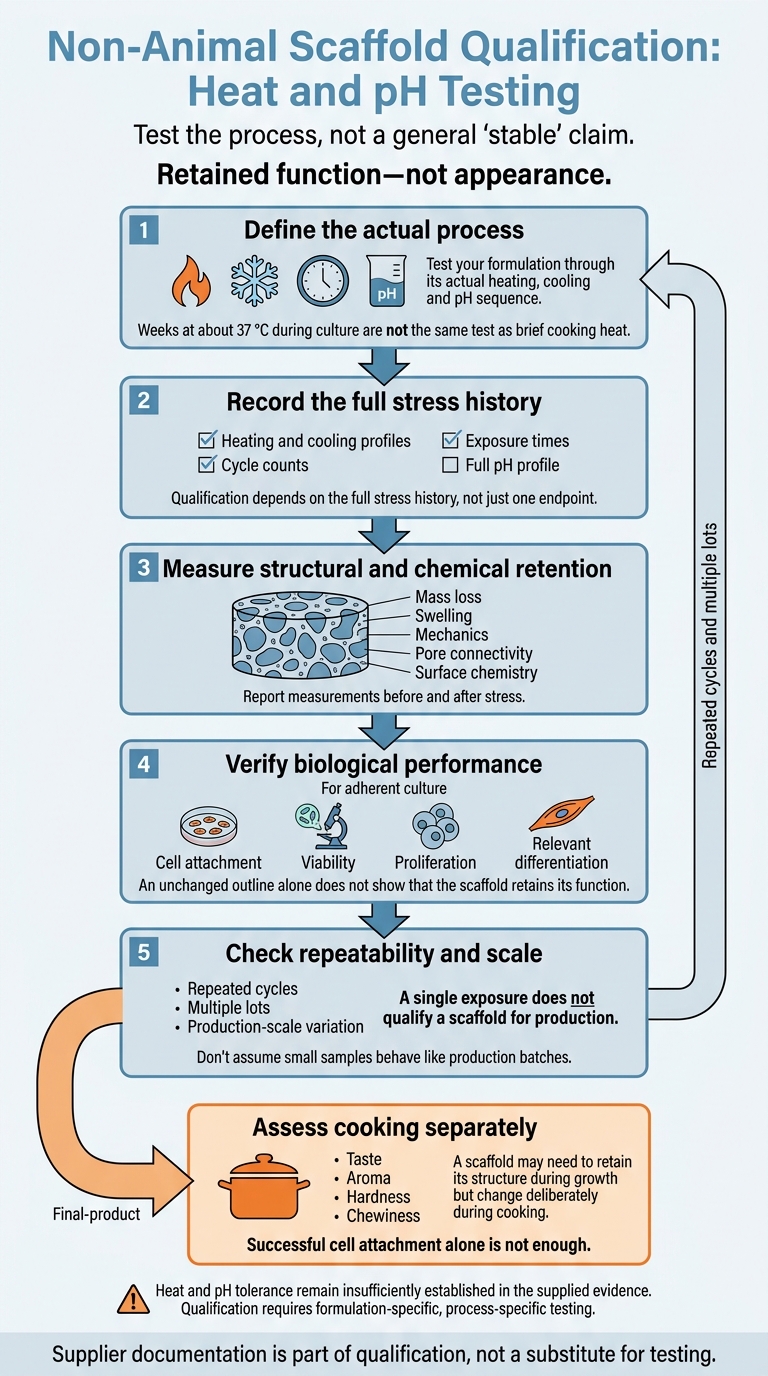
For cultivated meat R&D teams, I assess scaffold stability by retained function - not appearance. Test your formulation through its actual heating, cooling and pH sequence. For adherent culture, check pore connectivity and surface chemistry alongside cell attachment, viability and proliferation.
Weeks at about 37 °C during culture are not the same test as brief cooking heat. I separate those requirements and compare:
- Plant proteins: textured soy has cell-support and cooking results, but heat and pH limits remain poorly defined.
- Mycelium and cellulose: the supplied mycelium data are absent; bacterial cellulose results address attachment and texture, not heat or pH tolerance.
- Alginate, carrageenan and blends: formulation-specific pH ranges and repeated thermal-cycle limits are missing.
My qualification rule is simple: <u>test the process, not a general “stable” claim</u>. Measure swelling, mass loss, mechanics and biological performance across repeated cycles and multiple lots, then assess cooking texture separately. Small-scale results and supplier documents alone do not establish production performance.
Non-Animal Scaffold Qualification: Heat and pH Testing
Plant Proteins, Mycelium and Plant Fibres
Heat and pH Responses of Soy, Pea and Gluten
Textured soy protein supported bovine blood vessel and muscle cell growth, and baked or fried prototypes reportedly reproduced a meat-like bite.[6]
Soy has evidence for both cell support and cooking performance. However, quantified heat and pH response data remain insufficient for scaffold qualification. The supplied evidence is thinner for pea protein, gluten and mycelium: this set contains no verified heat or pH response data for them.
### MyoWorks MyoScaff 2D Scaffold and Cellulose Network Retention
For cellulose networks, the supplied evidence is structural rather than thermal: in January 2026, UCL researchers reported that bacterial cellulose grown using spent brewer’s yeast supported fibroblast attachment and showed lower hardness and chewiness than standard cellulose.[1]
These results provide a structure and texture benchmark, but do not establish heat or pH resilience. Before qualifying a batch, request data on hydrated pore connectivity, wet-state texture and post-treatment cell attachment. An unchanged outline alone does not show that the scaffold retains its function.
sbb-itb-ffee270
Beer waste turned into edible scaffolds for lab-grown meat
Algal and Polysaccharide Hydrogel Stability
Alginate, carrageenan and related hydrogels are discussed more often than their stability is measured. Evidence for alginate and carrageenan is sparse: the supplied sources report no pH ranges, thermal-cycle limits or measurements of structure retained after exposure.
Alginate and Carrageenan: pH and Heat Responses
Retained gel function cannot be claimed without formulation-specific test data.
Hydrogel Blends, Thermal Cycles and Surface Chemistry
Related hydrogel and fibre systems show attachment or porous structure.[1][4][5] However, the supplied sources lack pH-shift data specific to alginate, carrageenan and their blends. Stability under combined heat and pH exposure therefore remains unproven.
It is also unclear whether these responses persist under repeated stress and production-scale variation.
Scale-Up Gaps and Scaffold Testing
Repeated Stress and Production-Scale Variation
The remaining question is whether these materials retain their function through full process cycles.
A single exposure does not qualify a scaffold for production. Test the actual process sequence and document the conditions. Don't assume small samples behave like production batches.
Brewery-waste-derived bacterial cellulose can vary with feedstock source, so request results from multiple lots.[1]
Microtissue-based assembly reduces reliance on large pre-formed scaffolds. Any edible scaffolds or microcarriers used during expansion still need testing.[7]
Minimum Data for Scaffold Qualification
Qualification depends on the full stress history, not just one endpoint.
Record heating and cooling profiles, cycle counts, exposure times and the full pH profile. Report mass loss, swelling, mechanics, pore connectivity and surface chemistry before and after stress.[2] For adherent culture, pair these measurements with tests of attachment, viability, proliferation and relevant differentiation.
Separate cultivation requirements from cooking requirements. A scaffold may need to retain its structure during growth but change deliberately during cooking. Assess taste, aroma, hardness and chewiness in the final product; successful cell attachment alone is not enough.[1][2]
Material Selection and Supplier Data
| Scaffold category | Processing stages to test | Required evidence | Qualification issue |
|---|---|---|---|
| Plant protein networks | Preparation, sterilisation and cultivation | Lot-level mass loss and pore-connectivity data across repeated sterilisation cycles[4] | Loss of pore connectivity |
| Bacterial cellulose | Fermentation, drying, rehydration and cultivation | Feedstock-linked mechanical uniformity and attachment data across drying gradients[1][3] | Uneven mechanics after drying |
| Ionic hydrogels | Crosslinking, storage and cultivation | Swelling data across the full pH profile and thermal cycles | Loss of gel function under combined stress |
| Hybrids: biopolymer nanofibres | Fibre formation, sterilisation and cultivation | Scale-dependent fibre size, porosity, surface chemistry and long-term differentiation data[5] | Loss of biological performance at scale |
Supplier documentation is part of qualification, not a substitute for testing.
Ask suppliers for formulation details, lot-consistency results and process-specific stress data - not a general “stable” claim. Cellbase helps cultivated meat teams source scaffold materials and processing equipment. It is neither a manufacturer nor a performance validator; the team selecting the material remains responsible for qualification.
Conclusion: Stability Means Retained Scaffold Function
Stability depends on formulation and exposure history - not appearance alone. After heat and pH stress, pore structure and surface chemistry must still support nutrient delivery and cell attachment. This is the standard used throughout this review.
The processing stage matters more than heat alone. Tolerance to fabrication heat does not establish stability during sterilisation or cooking. Cultivation requires sustained cell performance; cooking may deliberately alter texture or chemistry.
Select non-animal scaffolds for structural retention, cell performance and production reproducibility. Scaling cultivated meat processes exposes variation that bench tests do not reveal. A laboratory result does not prove production performance: qualification requires repeated testing under process-specific conditions.
FAQs
How do I set scaffold stability acceptance criteria?
Set benchmarks for scaffold resistance to physical, chemical and mechanical stresses in the bioreactor [1][2]. Verify that scaffolds retain their porosity and alignment under fluid shear during continuous culture [1]. Assess biocompatibility, biodegradability and support for cell adhesion, proliferation and differentiation [2].
For cultivated meat procurement, Cellbase’s curated marketplace connects researchers with suppliers of specialised scaffolds and infrastructure suited to these technical requirements.
How can I separate heat damage from pH effects?
Run controlled experiments that vary temperature or pH, keeping the other constant. Heat damage typically involves protein denaturation or damage to structural polymers. Changes in pH often alter surface chemistry or scaffold solubility. Use microscopy to assess structural integrity and spectroscopy to track surface chemistry under each test condition.
Cellbase offers a curated marketplace for sourcing materials and specialised equipment for these cultivated meat scaffold stability tests.
How can I predict scaffold performance at scale?
Align scaffold design with bioreactor fluid dynamics and cell behaviour. Model porosity, fibre alignment and surface-to-volume ratios to assess mass transfer, nutrient diffusion and bioreactor sizing. Test how fabrication methods - such as 3D printing, spinning and porogen leaching - affect structural integrity under culture conditions, including fluid shear stresses during continuous culture.
For sourcing, Cellbase connects buyers with suppliers of scaffolds and specialised equipment through its curated B2B marketplace.


