

If I design from the species reference instead of the founder line, I can miss the target before I even order guides.
For bioprocess engineers, cell culture scientists, and cultivated meat R&D teams, the core point is simple: edit success depends on the exact cell line in front of me, not the species name on the label. In this article, I narrow the decision path to six checks: genome assembly quality, ploidy, allele variation, PAM access, repair bias, and donor design. That matters for both edit classes: knockouts can tolerate more repair variability, while knock-ins depend far more on locus sequence and donor matching.
A few practical points stand out straight away:
- Sequence the founder line first, then design guides from that sequence.
- Count all alleles at the locus before calling a knockout complete.
- Check PAM access on each allele, not just on the reference genome.
- Expect species differences in repair, with NHEJ often dominating in bovine and porcine somatic lines.
- Match donor templates to founder haplotypes for knock-ins.
- Re-sequence passaged lines if drift could affect guide binding or edit readout.
One result in the article gives this immediate process relevance: NF2 knockout was reported to reduce doubling time by 5%–100% in porcine and bovine myoblasts and ADSCs, while also supporting suspension adaptation. But that sort of result does not mean one CRISPR plan carries across cattle, pigs, birds, and fish without rework.
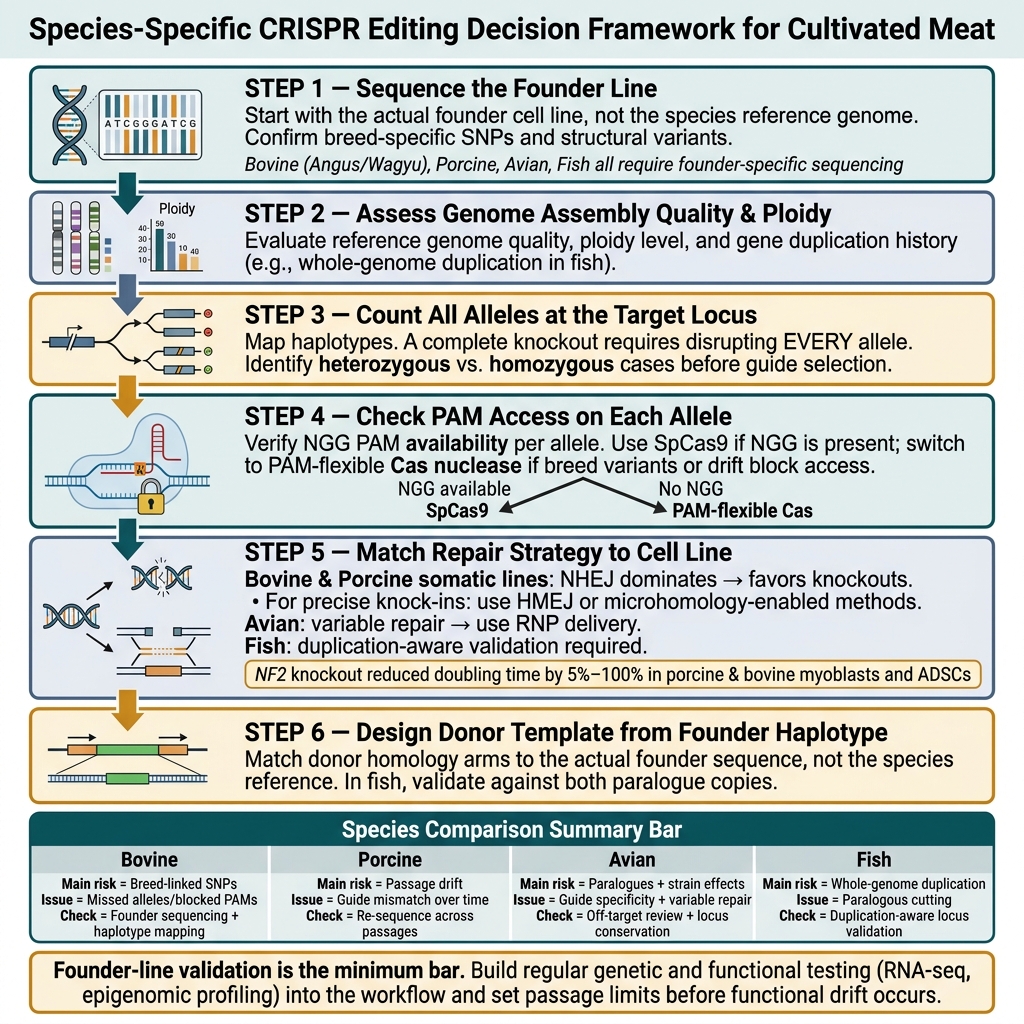
Species-Specific CRISPR Editing Workflow for Cultivated Meat
Quick comparison
| Species | Main design risk | Main editing issue | What I would check first |
|---|---|---|---|
| Bovine | Breed-linked SNPs and structural variants | Missed alleles and blocked PAMs | Founder-line sequencing and haplotype mapping |
| Porcine | Drift across passages | Guide mismatch over time | Re-sequencing across passages |
| Avian | Paralogues and strain effects | Guide specificity and variable repair | Locus conservation and off-target review |
| Fish | Whole-genome duplication | Paralogous cutting and hard-to-read outcomes | Duplication-aware locus validation |
So, if I want a clean editing plan for cultivated meat cells, I start with the founder genome, verify allele structure, choose a nuclease that can reach the site, and only then decide whether the cell line is better suited to a knockout or a precise insertion.
sbb-itb-ffee270
Reference genomes, ploidy and gene duplication set the starting constraints
Start with the founder line sequence, not the species reference. That sounds like a small distinction, but in practice it changes the whole editing plan.
Allele count and local sequence variation tell you whether a knockout is editable in the first place. Count the alleles before you pick guides: a functional knockout means disrupting every allele at the target locus, so you need to separate heterozygous from homozygous cases before guide selection [1]. That step shrinks the guide search space before you even get to PAM availability.
Bovine and porcine genomes: heterozygosity, pangenomes and breed-linked structural variation
In cattle, breed-linked variation is a serious constraint. Angus and Wagyu lines can carry different SNP patterns and structural variants, so one species reference genome may miss the sequence that is actually present in the founder pool. Ivy Farm Technologies dealt with this by sequencing the founder line and confirming the edit in Angus and Wagyu pools [1].
For porcine lines, the safest route is to sequence the founder line directly, then re-sequence it across passages. Line-specific variation and drift in culture can both disrupt guide design and make later edit verification messy [1] [4].
Once the founder sequence is confirmed, the next check is simple: does the target site have a usable PAM?
Avian and fish genomes: paralogues, selective sweeps and whole-genome duplication
In avian species, strain-linked selective sweeps can remove sequence diversity at target loci. On top of that, paralogue copies inherited from older duplication events mean guide specificity has to be checked before design moves ahead.
Fish add another layer. Whole-genome duplication has left retained duplicate gene copies across many genomes, so a guide aimed at one copy may also cut other loci unless off-target screening accounts for that duplication history.
When to resequence the founder cell line before designing guides
Resequencing is needed when the starting material is heterogeneous or when the line has spent time in continuous culture. Whole-genome or exome sequencing gives the clearest view, and donor homology arms need to match the actual founder sequence before any knock-in programme [2] [4].
| Species | Primary genomic challenge | Recommended sequencing action |
|---|---|---|
| Bovine (Angus/Wagyu) | Breed-specific SNPs and structural variants | Targeted sequencing or WGS of the founder line to confirm gRNA match [1] |
| Porcine myoblasts | High SNP density and rapid doubling drift | Re-sequence across passages with NGS [1] [4] |
| Fish / marine species | Whole-genome duplication and retained duplicate copies | De novo assembly or deep resequencing of the founder line [2] |
After the founder sequence is locked down, allele variation and PAM availability decide what is targetable. In plain terms, allele-specific mismatches and PAM frequency set which loci can be cut at all.
Allele variation and PAM availability determine which edits are realistically targetable
Once the founder sequence is fixed, the next question is simple: can every allele still be edited at that site, and is there a usable PAM? In practice, guide design comes down to two checks: haplotype conservation and PAM access.
Avoiding allele-specific cutting in cattle, pigs, chickens and fish
A polymorphism anywhere in the 20-nucleotide protospacer, or right at the PAM, can stop one allele from being cut. That can leave you with a mixed cell pool where partial cutting looks like poor editing efficiency, when the actual problem is allele dropout during cutting.
The fix is straightforward. Sequence the target locus in the founder line, map the haplotypes, and only lock guides in regions that are fully conserved across all identified alleles. Then recheck the locus after extended passaging.
If the site is not conserved across haplotypes, PAM choice does not matter.
When SpCas9 is sufficient and when PAM-flexible nucleases are needed
If an NGG PAM is present, SpCas9 is the default choice. If it is absent, you either redesign the target or move to a PAM-flexible Cas nuclease. That decision should come from the founder sequence, not the reference genome.
Species comparison: targetability and nuclease fit at a glance
| Species | Common cell types for editing | Targetability constraint | Best nuclease fit |
|---|---|---|---|
| Bovine | Myoblasts, ADSCs, iPSCs | Breed-linked SNPs (e.g., Angus vs. Wagyu) [1] | SpCas9 where NGG is available; PAM-flexible Cas where breed variants block access |
| Porcine | Myoblasts, Fibroblasts | Rapid culture drift across passages [1] | SpCas9; switch to PAM-flexible Cas if drift alters the PAM site |
| Avian | Satellite cells, Embryonic Stem Cells | Genetic drift in continuous culture [4] | PAM-flexible Cas preferred where paralogue overlap limits SpCas9 specificity |
| Fish | Myoblasts (Trout, Carp, Mackerel) | Whole-genome duplication and paralogues [3] | PAM-flexible Cas to navigate duplicated loci |
Once a site is targetable, repair bias determines whether the edit becomes a knockout or a knock-in.
Repair pathway bias and donor design drive knockout and knock-in outcomes
A guide can cut cleanly and still miss the goal if the cell repairs the break in the wrong way. That repair bias often decides whether you end up with a knockout, a mixed indel profile, or a precise knock-in. In cultivated meat work, where somatic lines such as myoblasts and adipose-derived stem cells (ADSCs) are the day-to-day material, that bias can decide whether an edit programme moves forward or stalls.
NHEJ, HDR and HMEJ bias across mammalian, avian and fish cell lines
After cleavage, the main issue is which repair pathway dominates in the production cell line. In bovine and porcine somatic lines, Non-Homologous End Joining (NHEJ) is usually the main route. That makes simple knockouts more achievable than precise insertions, especially when the aim is to disrupt a gene to reduce doubling time or help suspension adaptation. Ivy Farm Technologies showed this directly: CRISPR/Cas9 knockouts of the endogenous NF2 gene in porcine and bovine myoblasts and ADSCs decreased doubling times and supported suspension adaptation, a critical step for scaling cultivated meat [1].
Homology-Directed Repair (HDR) can work in these lines, but efficiency is often low unless the system is tuned carefully. When you need a precise insertion, Homology-Mediated End Joining (HMEJ) or other microhomology-enabled methods can give better integration rates. The main point is simple: test repair behaviour in the actual production cell type. Passaging and suspension adaptation can shift editing outcomes over time [1][4].
Avian cells can edit well, but repair outcomes tend to vary more from run to run. Fish lines also often edit well, but duplication-aware validation matters because paralogues can hide the true edit [3].
Donor template design by species: format and allele matching
For knock-ins, donor design should follow the repair pathway, not just the reference genome. Match the donor to the founder haplotype rather than the species reference. In heterozygous bovine and porcine lines, a donor built only from the reference sequence can miss one allele [1].
In fish, duplication-aware design is a must because paralogues can complicate readout of the edit. Check both guide and donor against the exact locus you want to change instead of assuming one reference sequence tells the whole story.
Repair bias and knock-in design by species: comparison table
The table below turns those repair differences into species-level design choices.
| Species | Dominant repair tendency | Main challenge for precise insertion | Preferred donor or repair strategy | Key optimisation lever |
|---|---|---|---|---|
| Bovine | NHEJ | Low HDR efficiency in somatic myoblasts and ADSCs | dsDNA or ssODN; HMEJ for precise insertion | Founder haplotype matching |
| Porcine | NHEJ | Allele-specific matching; limited in vitro lifespan | Allele-matched donor or knockout, depending on the edit goal | Allele-matched donor design |
| Avian | Mechanism-dependent | Variable repair outcomes | RNP delivery for controlled repair | RNP delivery for tighter timing control |
| Fish | Efficient editing, pathway variable | Whole-genome duplication; paralogue interference | Duplication-aware guide and donor design | Validate both paralogue copies |
Conclusion: a decision framework for species-specific CRISPR editing in cultivated meat
The practical decision rule is straightforward: sequence the founder line, confirm locus structure, check allele variation, pick a PAM-compatible nuclease, then match the repair strategy to the cell line.
That workflow works at the species level, but founder-line variation still shifts the result. In plain terms, species-level defaults don’t reliably carry over from one founder line to another. Founder-line validation is the minimum bar [1].
There’s another point teams can’t treat lightly. Continuous culture can introduce genetic drift over time, which means the edit plan that worked at an earlier passage may not behave the same way later on. Because of that, teams should build regular genetic and functional testing into the workflow, including RNA sequencing and epigenomic profiling, and set a passage limit before function starts to drift [4].
Key takeaways for R&D, production and procurement teams
For teams putting this workflow into practice, the priorities are pretty clear.
- R&D teams should sequence early and design from the founder line.
- Production teams should match donor design to the cell line’s repair bias.
FAQs
Why isn’t the species reference genome enough?
A species reference genome isn’t enough for cultivated meat gene editing. It gives you a general map, but not the actual biology of the cell line you’re working with.
That gap matters. In agricultural species, key regulatory elements such as promoters, enhancers and untranslated regions are still often poorly characterised. So even if a reference genome looks complete on paper, it may not tell you how a given locus behaves in your cells.
It also leaves out cell-line-specific differences that directly affect editing results, including ploidy, allele patterns and repair pathway bias. Without that information, researchers can’t reliably predict edit outcomes or tune traits such as suspension growth and efficient proliferation.
How do I know if every allele was actually edited?
To confirm that every allele was edited in your cultivated meat cell lines, run genetic monitoring at regular intervals. Whole-genome sequencing gives you a broad view of sequence changes across each locus, which helps you check whether editing occurred where you expected and whether anything else changed along the way.
Exome sequencing can then help determine zygosity, showing whether the edit is homozygous or heterozygous.
When should I choose a knockout over a knock-in?
Choose a knockout when your main goal is to switch off a gene and improve a cell trait. In cultivated meat, teams often use this to support faster growth, immortalisation, or lower input needs by shifting cellular metabolism.
Choose a knock-in when you need to add new genetic information or boost expression of a useful protein. Put simply, the choice comes down to this: are you removing a barrier, or adding a new function?


