

If you run perfusion for cultivated meat, the setup choice usually comes down to one question: where do you want the main burden to sit - in disposable flow paths or in cleaning and revalidation?
I see the split like this:
- Single-use often suits R&D, pilot work, and short runs
- Reusable glass or stainless steel often suits stable campaigns and shared plant use
- In both cases, cell retention is still the main pressure point, especially with ATF or TFF
- The choice is not just about the vessel; it also changes tubing layout, fouling control, sterility steps, and turnaround time
- If retention is built into the culture format, such as packed-bed systems, the decision shifts more towards handling, cleaning, and batch-to-batch reset time
One detail stands out. Ever After Foods says its edible packed-bed system can match the output of a 20,000 L stirred-tank setup with less than 2,000 L [1]. That is a 10x vessel-volume difference, but only for that retention approach. So I would not treat vessel format and retention strategy as separate decisions.
Perfusion bioreactors
sbb-itb-ffee270
Quick comparison
| Factor | Single-use | Reusable |
|---|---|---|
| Sterility control | Pre-sterilised closed path | Autoclave or CIP/SIP |
| Main reset step | Replace disposable path | Clean, sterilise, revalidate |
| Retention layout | Often external ATF/TFF on disposable tubing | Often external ATF/TFF on fixed hardware |
| Fouling response | Replace membrane/path | Clean and verify |
| Best fit | Process development, pilot, multi-use suites | Stable campaigns, shared capacity |
| Main drawback | Consumables cost and parts supply | Cleaning burden and slower turnaround |
So if you are choosing a perfusion setup, I would start with development stage, then culture mode, then retention method. That usually gets you to the right shortlist fast, without over-focusing on the vessel type alone.
Single-use perfusion setup: strengths, limits and typical bottlenecks
Cell retention, tubing layout and pump configuration
In single-use systems, the main challenge moves away from keeping the vessel sterile and onto the disposable fluid path, especially the retention loop.
These setups arrive pre-sterilised and pre-assembled, so there’s less manual setup and fewer open handling steps. In cultivated meat workflows, they’re often paired with external ATF or TFF retention modules linked through sterile, pre-validated tubing sets.
As Yuki Hanyu, CEO of IntegriCulture, has noted:
"This process involves complicated tube connections, which increases the risk of bacterial contamination." [3]
That point lands. Pre-configured disposable paths can cut that risk, but the connection points still need careful handling.
Fouling risk and sterility management in closed disposable paths
Single-use systems lower contamination risk and speed up changeover because the fluid path is disposable. That makes them well suited to early-stage development, pilot runs and short campaigns.
The main bottleneck is still the retention hardware. Many systems rely on external ATF or TFF modules, even in a closed disposable path. Some single-use designs now integrate retention, or use packed-bed formats to reduce reliance on external modules [1]. In practice, That single-use vs reusable trade-off often decides where single-use fits best.
When single-use is the right fit
Single-use tends to work best when fast commissioning and simpler operation matter more than infrastructure built for long campaigns.
That makes it a good fit for:
- early-stage process development
- pilot runs
- multiproduct environments
In those settings, pre-validated assemblies reduce troubleshooting and help teams spend more time on process learning.
Reusable perfusion setup: strengths, limits and typical bottlenecks
Cell retention hardware, manifolds and pump choices
Reusable perfusion systems are usually built around fixed-vessel stirred-tank infrastructure. In many setups, cell retention sits outside the bioreactor and is handled by ATF or TFF devices. That works, but it adds extra tubing, connectors and control points. It also makes scale-up harder to manage. Some stirred-tank layouts also need much larger working volumes than compact systems to deliver the same output [1].
Because these systems depend on fixed manifolds and recirculation loops, small hardware decisions, such as selecting sensors for bioreactors, can have a big effect on day-to-day performance. Pump choice and line routing directly shape pressure stability, shear exposure and maintenance load. Those trade-offs become much more important once cleaning and revalidation are part of the production cycle.
Fouling control, cleaning cycles and sterility assurance
With fixed hardware, the bottleneck often moves away from disposables and onto validated cleaning. Heat-resistant vessels can be autoclave sterilised between campaigns, but turnaround is still governed by cleaning validation.
For cultivated meat production, reusable infrastructure also needs to meet food-grade requirements such as HACCP, GMP and ISO 22000 [4]. If equipment is bought, transferred or repurposed, it has to go through full revalidation to confirm that it remains fit for repeated production runs [4].
When reusable is the right fit
The main upside is repeat use across campaigns and clients. Reusable infrastructure makes sense when the process is built for steady output and shared use, rather than one-off runs. This is often a good fit for CDMOs working with multiple cultivated meat clients, where shared and revalidated infrastructure can support repeated production campaigns [4].
Single-use vs reusable perfusion: direct comparison across process-critical factors
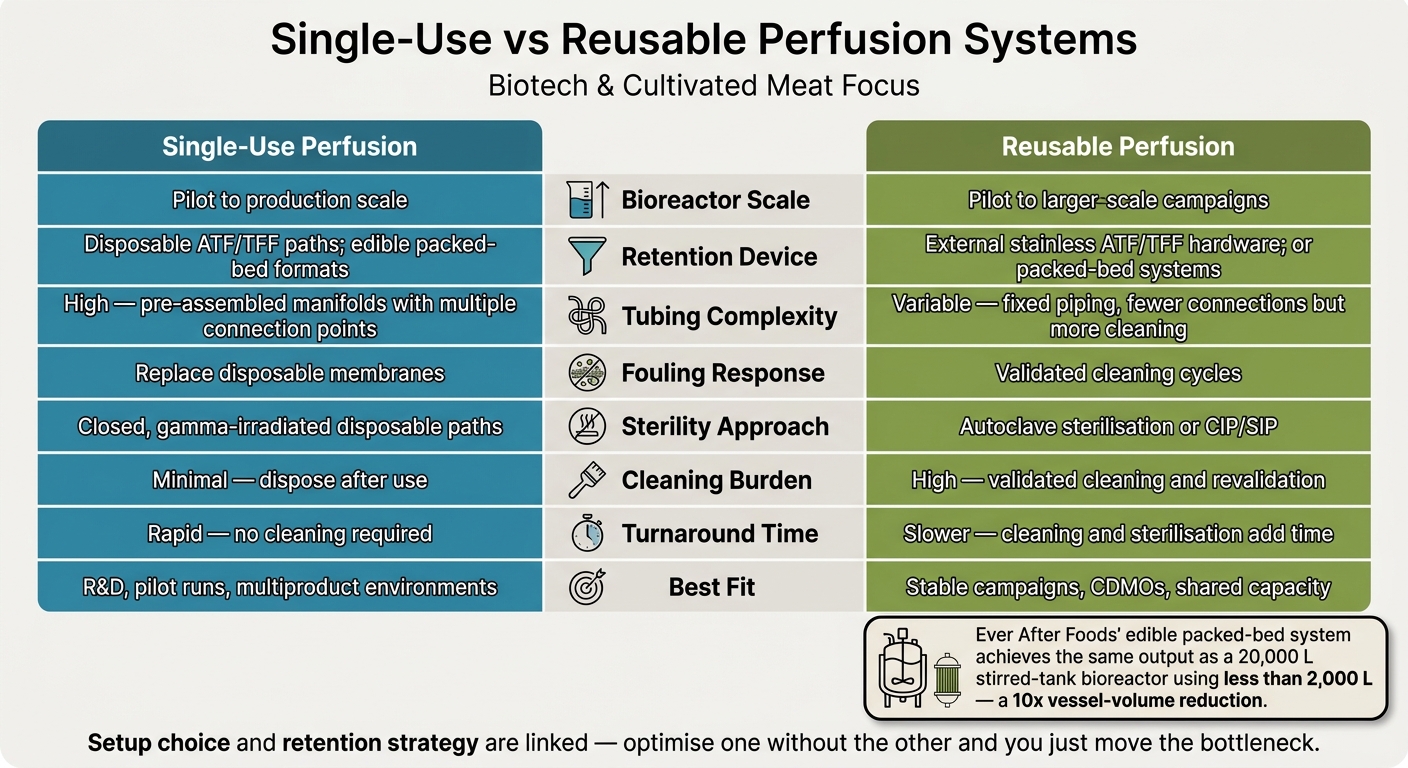
Single-Use vs Reusable Perfusion Systems: Key Differences at a Glance
Comparison table: setup fit by retention device, fouling, sterility and scale
The differences between single-use and reusable perfusion setups are easiest to see when you line them up against the main bottlenecks already discussed: retention, fouling, sterility and turnaround. The table below pulls those constraints into the decisions that tend to shape process design most.
| Factor | Single-Use Perfusion | Reusable Perfusion |
|---|---|---|
| Bioreactor scale range | Pilot to production scale | Pilot to larger-scale campaigns |
| Retention device fit | Disposable ATF/TFF paths; edible packed-bed formats [1] | External stainless ATF/TFF hardware; or packed-bed systems [1] |
| Tubing complexity | High - pre-assembled manifolds with multiple connection points [3] | Variable - fixed piping can reduce connection points, but cleaning is more involved |
| Fouling susceptibility | Disposable membranes replaced rather than cleaned | Managed through validated cleaning cycles |
| Sterility approach | Closed, gamma-irradiated disposable paths | Autoclave sterilisation or CIP/SIP |
| Cleaning burden | Minimal - dispose after use | High - validated cleaning and revalidation between campaigns |
| Turnaround time | Rapid - no cleaning required | Slower - cleaning and sterilisation add time |
| Typical bottlenecks | Consumable costs and supply chain friction for specialised components | Fixed infrastructure requirements and cleaning validation |
Fewer connection points reduce contamination risk and make validation simpler.
When the less obvious option is still the better choice
The better option can change fast when process change rate or installed infrastructure matters more than what is most common on paper.
Reusable infrastructure works well for repeated campaigns when the process is stable and shared capacity matters. Single-use tends to win when the process is still moving. If membrane selection, retention device configuration or media composition is still under active development, locking yourself into fixed manifolds and bioprocess control software for validated cleaning procedures can freeze decisions too early. Single-use keeps iteration cycles short because turnaround is faster.
The decision can also flip based on retention strategy. Ever After Foods' edible packed-bed (EPB) system, developed in partnership with Bühler Group and announced in February 2025, removes ATF and TFF devices entirely, producing the same output in under 2,000 L that a conventional stirred-tank system would require 20,000 L to achieve [1]. As CEO Eyal Rosenthal put it:
"Where others need an absolutely enormous 20,000-litre bioreactor, our system produces the same volume with less than 2,000 litres, making it more efficient and viable." [1]
If retention is built into the culture format, the single-use versus reusable choice becomes much more about vessel handling, cleaning and turnaround. Setup choice and retention strategy are linked. Optimising one while ignoring the other often just moves the bottleneck somewhere else.
Use these trade-offs to shortlist the setup that best fits your process in the next section.
Selecting the right perfusion setup for cultivated meat operations
How to shortlist the right setup for your process
Use the bottlenecks above to cut the choice down to three filters: development stage, culture mode and retention strategy. For early R&D and pilot work, single-use systems usually make iteration faster and sterility simpler. In practice, that makes single-use a good fit when speed matters more than fixed plant infrastructure.
Then check the process constraints in order:
- Development stage - single-use suits active process development; reusable suits stable, validated campaigns
- Culture mode - suspension or adherent culture shapes vessel format and retention hardware needs [1][2]
- Retention strategy - if ATF or TFF is still in use, account for the added tubing and cleaning demands; if retention is built into the culture format, the choice shifts to vessel handling and turnaround [1]
For reusable systems, make sure the facility can support cleaning and sterilisation cycles [4].
Key takeaways
The best choice is the one that removes the main bottleneck. If retention is still unresolved, changing vessel format or cleaning strategy just moves the problem somewhere else. Start with stage, then culture mode, then retention, and treat each one as a filter rather than a preference.
FAQs
How do I choose between single-use and reusable perfusion?
It mainly comes down to production scale and batch frequency.
Single-use setups often make more sense when batch numbers are lower or the process needs more flexibility. They can cut upfront capital spend and reduce labour.
For high-volume, steady-state production, reusable stainless-steel systems often deliver better long-term economics.
Cellbase can help you connect with verified industry suppliers for perfusion equipment and materials.
Why is cell retention the main bottleneck in perfusion?
Cell retention is one of the main bottlenecks in perfusion. In cultivated meat, the process has to support high cell densities while continuously removing waste like ammonia and lactate without losing cells.
That sounds simple on paper. In practice, it puts a lot of pressure on the retention step. The device has to hold cells in the bioreactor, let spent medium pass through, and do it all without hurting viability as scale goes up.
This is where many systems start to struggle. A lot of retention designs came from the pharmaceutical sector, where process goals and cell behaviour can be quite different. As a result, those setups are often not tuned for cultivated meat, which can lead to lower process efficiency or the need for more complex retention arrangements.
When does a packed-bed system change the setup decision?
A packed-bed system changes the setup decision when the main goal is far higher process efficiency and lower capital spend than a stirred-tank bioreactor.
Its 3D growth environment can support higher protein and lipid output per unit volume. It can also remove the need for separate cell-retention hardware such as tangential flow filtration.
Cellbase can help teams source bioreactors and related equipment for these production needs.


