

If you compare kLa values without matching the method, medium, temperature, and probe response, you can make the wrong scale-up call.
For bioprocess engineers, cell culture scientists, and cultivated meat R&D teams, the short answer is simple: static gassing-out is best for vessel benchmarking, while dynamic and off-gas oxygen-balance methods are more useful when you want process-facing data under live broth conditions. Water-based kLa numbers can mislead, probe lag can distort fast transfer rates, and media additives such as Pluronic F-68 can cut kLa by 50% or more in some setups.
Here’s the article in one pass:
- kLa is not a stand-alone target. I’d use it alongside P/V, shear limits, gas flow, and mixing time.
- Static gassing-out gives a clean hardware comparison, but it ignores OUR and does not reflect active culture.
- Dynamic methods track oxygen transfer during culture and are closer to what you run at scale, though a pause in aeration can stress cells.
- Oxygen-balance methods use inlet and outlet gas data and suit larger vessels, but they need tight gas analysis.
- Sulfite oxidation and pressure-step methods are mainly for equipment characterisation, not for live cultivated meat broth.
- Probe response time matters: optical DO probes often respond in 3-10 s, while polarographic probes are often 8-30 s.
- Temperature and medium matter: a kLa measured in water at 20°C does not map cleanly to culture medium at 37°C.
- Typical reported ranges in the article are 50-200 h⁻¹ at 2-10 L and 80-300 h⁻¹ at 50-500 L, but only if the full test basis matches.
H.E.L Explains | Achieving Consistent Oxygen Transfer: The Impact of kLa on Fermentation Scale-Up
sbb-itb-ffee270
Quick Comparison
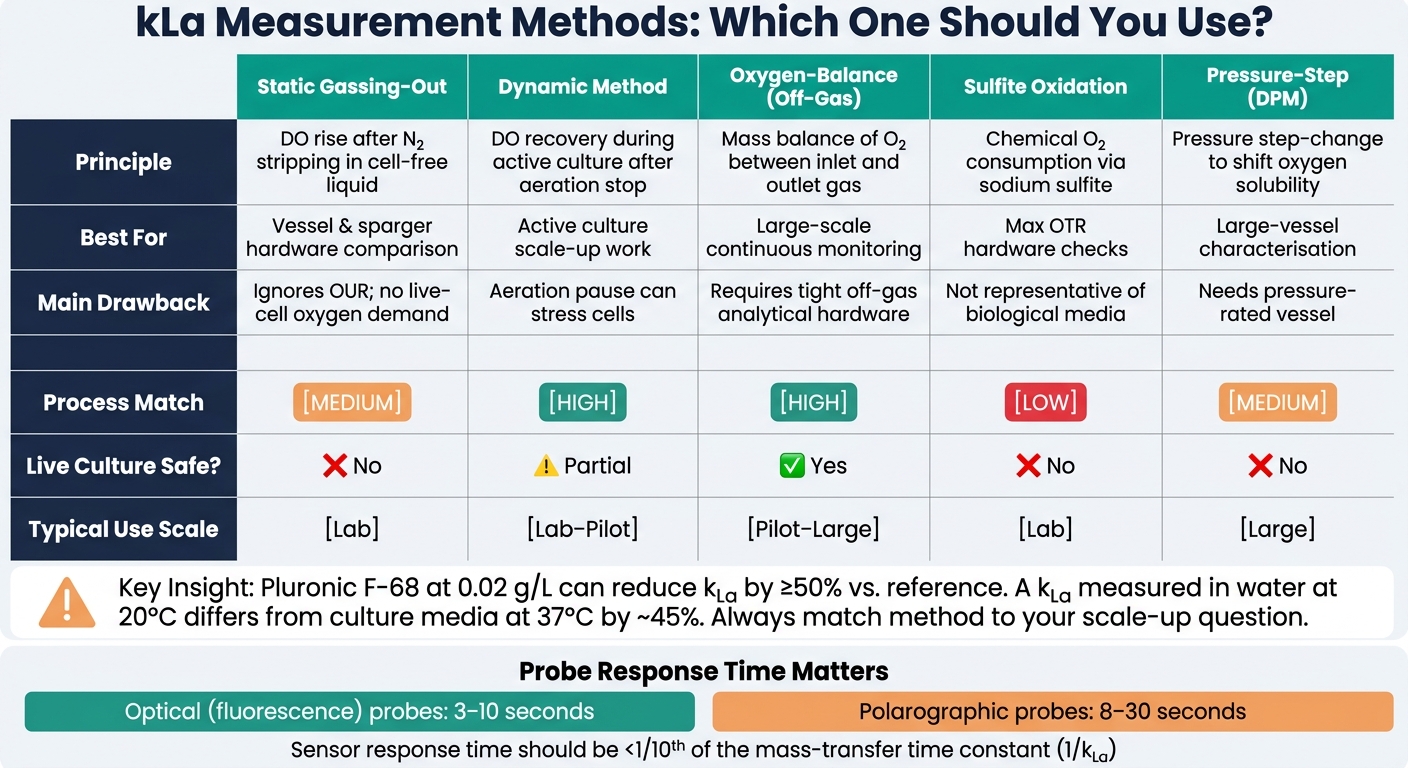
kLa Measurement Methods for Bioreactor Scale-Up: Side-by-Side Comparison
| Method | Best for | Main drawback | Process match |
|---|---|---|---|
| Static gassing-out | Vessel and sparger comparison | No live-cell oxygen demand | Low to medium |
| Dynamic method | Active culture scale-up work | Aeration stop can disturb cells | High |
| Oxygen-balance | Larger-scale monitoring | Needs tight off-gas data | High |
| Sulfite oxidation | Max transfer hardware checks | Not like process media | Low |
| Pressure-step | Large-vessel characterisation | Needs pressure-rated setup | Medium |
If I were setting a scale-up plan, particularly when transitioning to pilot-scale systems, I’d treat method selection as part of the data quality check, not as an afterthought.
2. The main kLa measurement methods used in bioreactor studies
The literature tends to group kLa measurement into three main method families: static gassing-out, dynamic and oxygen-balance methods, and chemical or pressure-based techniques. Each one looks at oxygen transfer from a slightly different angle. That matters, because the method itself can shape how scale-up data is read.
2.1 Static gassing-out
Static gassing-out starts by deoxygenating the liquid, most often with nitrogen. Aeration is then switched back on, and the dissolved oxygen (DO) recovery is tracked over time. kLa is calculated from the rate of that DO rise.
Because it does not need living cells or hazardous reagents, this method is a straightforward way to benchmark a bioreactor. The catch is that it does not reflect cell respiration or the way broth properties shift during culture growth. Results also depend on the medium, impeller design, sparger design, gas flow, temperature, and antifoam use. In a 400 L stirred tank, for example, adding Pluronic F-68 at 0.02 g/L can reduce kLa by at least 50% compared with a reference without the additive [2].
One practical issue is probe dynamics. If the sensor response is too slow, the measured kLa is skewed and needs correction [1].
2.2 Dynamic and oxygen-balance methods under process conditions
If the aim is process relevance rather than a clean-water benchmark, dynamic methods usually tell you more. In the most common version, aeration is stopped briefly so that cell respiration pulls DO down. Aeration is then restored, and the recovery transient is analysed. That makes the measurement much closer to what the broth is doing during an actual run.
The oxygen-balance method takes a different route. Instead of interrupting aeration, it estimates kLa from OTR minus OUR, usually with off-gas analysis such as mass spectrometry [2]. It is non-invasive and particularly useful in larger vessels. But there is a price: you need bioprocess control software and off-gas analytical hardware and dependable OUR data.
For cultivated meat work, these methods are useful because they reflect oxygen transfer under the same broth and cell conditions seen during scale-up. The trade-off is fairly plain. In the dynamic method, DO drops during the aeration pause, and that can stress the culture if the interruption goes on too long.
Chemical and pressure-step methods are used more for equipment characterisation than for live process readout.
2.3 Sulfite oxidation and pressure-step methods
For non-biological benchmarking, two other methods show up often. They are good for characterising hardware, but they do not directly represent living cultivated meat broth.
Sulfite oxidation uses sodium sulfite, oxidised in the presence of a catalyst, to consume dissolved oxygen at a rate from which kLa can be calculated. The problem is simple: the liquid is not representative of biological media, so the result does not translate directly to cultivated meat broth [2].
The pressure-step method changes vessel pressure in a stepwise way to shift the oxygen saturation concentration (C*) under Henry's law. That creates a mass transfer driving force without changing agitation speed or gas flow rate [2]. It is handy when pressure is easier to control than agitation or aeration. Still, it needs pressure-rated vessels and tightly controlled pressure changes, which limits day-to-day use. Even so, it remains a useful research method for equipment characterisation.
3. Strengths, limits, and comparability across methods
Published kLa values are only comparable when the test setup and the underlying assumptions are the same. Even temperature can move the result by a meaningful amount. And if one paper corrects for dissolved oxygen probe response time while another does not, those values should not be treated as equivalent, even when the rest of the setup looks the same.
That gap matters most when you're deciding what the number is for. Is it a hardware benchmark? Or is it a process-facing metric that reflects what happens in culture?
3.1 Where static gassing-out remains the reference method
Static gassing-out is still the go-to method for hardware comparison. If the aim is to compare sparger designs, impeller geometries, or vessel configurations under controlled conditions, it does the job well. It is simple, reproducible, and does not need live cells.
The downside is just as plain: kLa measured in water is a poor predictor of oxygen transfer in cultivated meat media. A value from deionised water tells you something useful about the vessel itself, but much less about performance once a real medium is in play.
That is where dynamic methods start to matter more. Once the work shifts from vessel characterisation to live culture, process relevance starts to outweigh clean-system control.
3.2 Where dynamic and dissolved oxygen profile methods add process relevance
Dynamic methods are closer to real process conditions because they measure oxygen transfer during active culture. That means they capture both oxygen demand and the actual properties of the broth. For scale-up work, that makes the result far more useful than a clean-water estimate.
The oxygen-balance approach adds a continuous, non-invasive readout under operating conditions, though it depends on accurate off-gas analysis and steady operation [2].
The differences are easier to see when the methods are set next to each other.
3.3 Comparison table: method fit for cultivated meat scale-up
| Method | Principle | Data required | Main assumptions | Strengths | Limitations | Best use |
|---|---|---|---|---|---|---|
| Static gassing-out | DO rise after N₂ stripping in cell-free liquid | DO time-course, probe response time | Well-mixed liquid; no OUR | Simple; reproducible; no cells needed | Ignores OUR; sensitive to media composition and probe lag | Initial vessel characterisation; hardware comparison |
| Dynamic method | DO recovery during active culture after brief aeration stop | DO time-course, OUR estimate | Quasi-steady-state culture; sensor correction applied | Reflects actual broth and cell conditions | Aeration pause can stress the culture; sensitive to sensor lag | Process optimisation and scale-up during active growth |
| Oxygen-balance (gas-phase analysis) | Mass balance of O₂ between inlet and outlet gas | Accurate gas flow rates and O₂ concentrations | Steady operation | Non-invasive; continuous; no culture perturbation | Requires highly accurate off-gas analysis | Large-scale production monitoring |
| Sulfite oxidation | Chemical oxidation of sodium sulfite consumes O₂ | Sulfite consumption rate | Reaction rate limited by mass transfer | Useful for maximum OTR capacity | Not representative of biological media; can overestimate kLa | Equipment benchmarking only; not for live culture work |
| Dynamic pressure method (DPM) | Pressure step-change to alter oxygen solubility | Pressure and DO time-course | Pressure equilibrates faster than gas composition | Avoids gas-phase lag; suited to large vessels | Requires pressure-rated vessel and precise pressure control | Large-scale characterisation |
These method choices affect how kLa data should be turned into scale-up targets and equipment selection.
4. Using kLa data in scale-up and equipment selection
4.1 Setting scale-up targets from laboratory to pilot scale
Once you’ve measured kLa, the next job is to turn that number into operating limits for agitation, gas flow and mixing. kLa should be treated as one constraint, not the whole decision. It needs to be high enough to meet oxygen demand, but not so high that the process drifts into a shear regime your cells won’t tolerate.
That balance matters in cultivated meat. Holding kLa constant at larger scale can push you towards higher impeller tip speeds and, with that, higher shear [4]. In mammalian cell culture, impeller tip speeds of 0.1-0.5 m/s are often used to balance oxygen transfer against shear stress [5]. So in practice, kLa sits inside a broader operating window that also includes power input per unit volume (P/V), superficial gas velocity and mixing time [4][5].
A useful benchmark helps here. In a 2-10 L lab-scale stirred-tank reactor, kLa often falls in the 50-200 h⁻¹ range. In a 50-500 L pilot-scale vessel, a typical range is 80-300 h⁻¹ [4]. The key step is to find the overlap that all vessels can hit. That’s what turns a scale-up target from a nice idea on paper into something you can run.
4.2 Choosing sensors and hardware for reliable kLa work
Good scale-up data start with instruments and gas hardware that don’t skew the result.
Sensor response time has a direct effect on kLa accuracy. In high-kLa systems, use fast-response DO probes. Slow polarographic probes need correction and can under-read kLa. Polarographic probes usually have response times of 8-30 seconds, while optical fluorescence-based probes respond in 3-10 seconds [4]. A good rule is that sensor response time should be less than one-tenth of the mass-transfer time constant (1/kLa) [1]. If you can’t meet that condition, optical probes are usually the safer option.
Gas delivery matters just as much. Thermal mass flow controllers help keep gas flow stable, which makes measurements more repeatable. Sparger choice also has a direct effect on the kLa you can reach [2][3]. Smaller bubbles give more gas-liquid interfacial area, but there’s a catch: media additives can cut kLa sharply [2].
5. Key takeaways for interpreting kLa measurements
Taken together, the method you choose should match the scale-up question you’re trying to answer. In practice, that means being clear on whether you need hardware characterisation or process-facing scale-up data.
A kLa value measured in water at 20°C cannot be carried straight across to culture media at 37°C. The temperature correction alone creates roughly a 45% difference [4]. And kLa is not something you can predict with theory alone. Each bioreactor needs its own measured kLa [1].
This matters even more when you move from bench to pilot scale. Static gassing-out in a salt-matched buffer such as PBS gives you a clean equipment benchmark. But as scale increases, dynamic measurements in the actual culture medium tell you more about what the process will do in practice, because media additives can shift kLa by a large margin [4]. If you rely on water-based values, you can end up over-specifying oxygen transfer capacity at scale.
The last check is whether the kLa sits inside the full operating window. Treat kLa as one process constraint, not a target on its own. Use it alongside P/V and shear limits when choosing the best bioreactor system and the agitation strategy [4].
FAQs
Which kLa method should I use for scale-up?
The dynamic gassing-out method is the most widely used way to determine kLa in stirred-tank bioreactors, and it’s the method most teams recommend in practice. It’s fairly quick, and it avoids the need for hazardous chemicals or live organisms.
For cultivated meat scale-up, it’s best to measure without cells so cell metabolism doesn’t distort the result. Use PBS buffer at 37 °C to better match the process medium. And if the dissolved oxygen probe has a slow response time, apply a correction. If you don’t, you can end up underestimating kLa.
Why are water-based kLa values often misleading?
Water-based kLa values can be misleading because they don’t reflect the physicochemical behaviour of actual cell-culture media. Real media are not just water with nutrients mixed in. Salt concentration, viscosity, surface tension, and antifoam all shift oxygen mass transfer in ways that water tests won’t show.
That gap matters. If you ignore media effects, your oxygen delivery estimates can drift far from what the bioreactor is doing in practice. A good example is antifoam: it can increase bubble coalescence, cut interfacial area, and lower kLa by up to 50%. In cultivated meat production, that’s not a small detail. It can change whether a process has enough oxygen transfer headroom or runs closer to its limit.
How do probe lag and media additives affect kLa?
Probe lag can distort kLa measurements. If the dissolved oxygen sensor responds too slowly relative to the oxygen transfer rate, the result can be off and may need non-linear correction.
Media additives can also shift oxygen transfer in ways that matter. Electrolytes and salts can suppress bubble coalescence. Pluronic F68 may reduce bubble size. Antifoams often increase bubble coalescence, which cuts the effective interfacial area and lowers kLa.


