

If you buy the wrong bioreactor, you do not just lose capex - you can lose months of scale-up and review work.
If I were shortlisting a reactor for cultivated meat in the UK today, I would check four things first: process fit, reactor performance, plant fit, and supplier records. That means fixing the biology up front, checking kLa, mixing, shear, and controls against the cell line, making sure utilities and cleaning routes work in the plant, and confirming that the supplier can provide the records needed for HACCP work and UK/EU review.
In plain terms, I would not start with catalogues. I would start with the process:
- Cell line and format: suspension vs adherent, microcarriers or scaffold use, doubling time, shear limit
- Process targets: VCD, OUR, pH, dissolved oxygen, temperature, run length, comparing batch, fed-batch, and perfusion systems
- Reactor performance: vessel geometry, impeller type, aeration, mixing time, selecting sensors for coverage, audit trails
- Plant fit: utilities, drain/exhaust links, footprint, cleaning/sterilisation route, single-use waste or stainless CIP/SIP burden
- Supplier checks: P&IDs, material certs, weld records, calibration records, change-control history, post-install support
A few facts shape nearly every purchase decision here. Mammalian cell culture will often sit around 37 °C. A quoted kLa figure is not enough on its own unless the supplier also states gas flow, agitation, medium, and fill volume. And reactor choices made at pilot scale often carry forward into later scale because geometry, sensor location, and hydrodynamics affect run-to-run consistency.
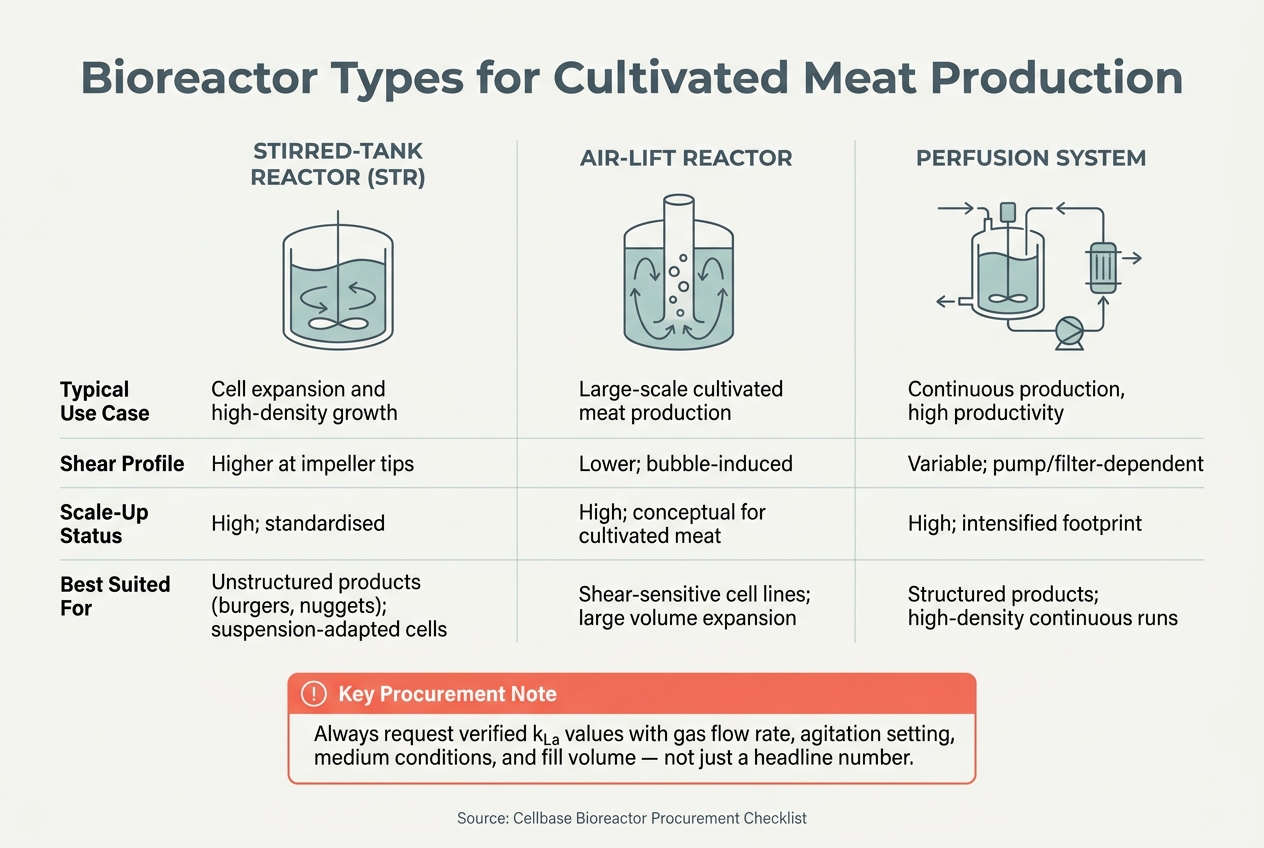
Bioreactor Types for Cultivated Meat: STR vs Air-Lift vs Perfusion
Dr. Marianne Ellis: Designing large-scale bioreactors and bioprocesses for cultivated meat
sbb-itb-ffee270
Quick comparison
| Area to check | What I would confirm before buying | What can go wrong if missed |
|---|---|---|
| Process fit | Cell type, culture mode, VCD, OUR, shear limit | Poor growth, cell damage, weak scale-up fit |
| Reactor performance | kLa, mixing time, tip speed, control stability | Oxygen limits, gradients, off-spec runs |
| Plant fit | Utilities, footprint, line tie-ins, cleaning route | Install delays, layout clashes, hard changeovers |
| Supplier records | Drawings, certs, validation records, change control | Gaps during qualification and review |
This checklist is a way to cut purchase risk before a PO is placed through a dedicated procurement layer - not a comparison of bioreactor types, but a short list of what I would verify before committing budget.
1. Define process requirements before comparing equipment
A common procurement mistake is starting with the vessel. Teams scan reactor catalogues, ask for quotes, and only then try to make the biology fit the hardware. That usually sends the whole process backwards.
Start somewhere less flashy but far more useful: write down the process requirements first. Those requirements should narrow the shortlist before any side-by-side equipment review starts.
Cell type, culture mode, and shear sensitivity
Start with the biology. Record the species and cell type - for example, bovine satellite cells, porcine myoblasts, or adipose-derived stem cells (ADSCs) - along with expected doubling time and whether the cells are suspension-adapted or attachment-dependent.
The attachment requirement tells you, early on, whether the process needs microcarriers, scaffolds, or a vessel suited to suspension culture.
You also need a defined upper shear limit for the cell line. Then match that limit against agitation and aeration constraints. Put that beside your viable cell density (VCD) target and oxygen uptake rate (OUR). Taken together, those numbers set the oxygen transfer and mixing window the reactor has to hit without pushing the cells into damage [1][3].
| Specification | What to document |
|---|---|
| Species and cell type | e.g., bovine satellite cell, porcine ADSC |
| Culture format | Adherent (microcarriers/scaffolds) or suspension-adapted |
| Doubling time | Hours; note if genetically modified |
| Shear sensitivity | Maximum allowable shear stress |
| VCD target | Cells per mL at harvest |
| Operating temperature | 37 °C for mammalian cells |
| pH and dissolved oxygen control | Setpoint ranges and control tolerances |
Once the biology is pinned down, the next step is simple: can the reactor support it without harming the cells?
Product format, scale, and operating mode
Final product format narrows the reactor class before you even look at detailed specifications. Unstructured cultivated meat - such as burgers or nuggets - is usually made through high-volume cell expansion in stirred-tank or air-lift reactors using suspension-adapted cells. Structured products more often need scaffold-based or perfusion systems [3].
After that, turn your annual output target into working volume. To do that properly, you need clear seed-train assumptions and a defined operating mode. Batch is the simplest to validate. Fed-batch can extend yield. Perfusion can support high-density runs, but it also adds more control complexity [3].
At this stage, record:
- target working volume
- annual run count
- seed-train inoculation density
If those inputs are off, the error ripples through every decision that follows.
Next, check whether the reactor design and control package can meet these requirements at the scale you need.
2. Check bioreactor design, control, and scale-up fit
Once process requirements are on paper, the next job is simple: check that the hardware can hit them in practice. This is where the technical review needs to be strict. It’s also where supplier claims should be tied to measured performance, not brochure language.
Reactor type, vessel geometry, and mass transfer
Start by matching the reactor type to the culture format. Then check whether the quoted system geometry and hydrodynamics make sense at the stated working volume. That means looking at vessel geometry, impeller design, tip speed limit, aeration, kLa, and mixing time.
The table below links the three main reactor classes to the traits that matter during procurement:
| Reactor Type | Typical Use Case | Shear Profile | Scale-Up Status |
|---|---|---|---|
| Stirred-Tank (STR) | Cell expansion and high-density growth [3] | Higher at impeller tips | High; standardised |
| Air-Lift | Large-scale cultivated meat production [3] | Lower; bubble-induced | High; conceptual for cultivated meat |
| Perfusion System | Continuous production, high productivity [3] | Variable; pump/filter-dependent | High; intensified footprint |
Ask suppliers for verified kLa values, mixing time, and the working volume range used to generate the quoted data [1].
That point matters. A kLa value without the gas flow rate, agitation setting, medium conditions, and fill volume behind it doesn’t tell you much. The same goes for mixing time. Numbers that look fine on a data sheet can fall apart once you look at how they were measured.
After you’ve checked that the vessel can meet mass-transfer targets, move on to the controls. The vessel may be sound, but if the control layer can’t hold the setpoints, the process still won’t run well.
Sensors, automation, and data integrity
Once mass transfer is defined, check whether the control package can maintain those conditions from run to run.
Confirm that the system supports real-time monitoring of pH, dissolved oxygen, and temperature. Also confirm sterile operation, contamination alarms, and validated cleaning or sterilisation controls [5].
Then go a step further. For cultivated meat work, the standard sensor set is only part of the picture. You also need to check whether the control system has specific functionality for differentiation control. Specialised control programmes are being developed for this purpose, so standard bioprocessing software may not handle this transition well [3].
Data handling needs the same level of scrutiny. Confirm that the control system supports data logging and audit trails that can be used for HACCP alignment and inspection readiness [4]. Apply the same standard when you review the system for internal use: complete logging, audit trails, and documented control of process transitions [4].
3. Confirm materials, facility integration, and single-use versus stainless steel
Once you've defined control performance, the next step is practical: make sure the reactor will actually fit the facility and the way the plant runs.
A reactor can look fine on paper and still cause trouble later. Materials, cleanability, utility loads, and line tie-ins all need a close check before anything moves to supplier review.
Materials of construction and hygienic design
Check all product-contact parts against hygienic-design and cleaning requirements. That includes bioreactor components like seals, ports, welds, and internal surfaces, not just the vessel shell.
In practice, this means looking closely at:
- Product-contact materials
- Seal and gasket compatibility
- Port design and accessibility
- Weld finish and consistency
- Internal surface condition
Small details matter here. A poorly finished weld, an awkward port, or a seal that does not hold up to the cleaning regime can turn into a contamination or cleaning headache very fast.
Single-use versus stainless steel: operational trade-offs
Single-use and stainless steel each come with trade-offs, and the right choice depends on how the process will be run day to day.
Compare:
- Cleaning validation burden
- Changeover time
- Contamination risk
- Waste handling
- Run length
- Batch frequency
For example, if the process has short runs and frequent changeovers, single-use may ease plant operations. If runs are long and batch cadence is steady, stainless steel may make more sense. The point is not to pick a format on preference alone. Match it to the operating pattern.
Utilities, footprint, and line integration
Confirm that power, gas, water, drainage, exhaust, and control-system connections fit the available space and the plant layout.
This sounds basic, but it is often where projects get stuck. A reactor may meet process needs yet still create line bottlenecks if utility access is poor, the footprint is too tight, or control-system integration is awkward.
This leads directly to supplier qualification and compliance checks in the next section.
4. Verify suppliers, documentation, and readiness for review
Equipment fit gets you to a shortlist. Supplier checks cut procurement risk before you buy.
Supplier qualification and technical documentation
Ask for the full documentation pack before commercial talks move forward. That gives you a clean way to check that the reactor still fits your process.
You’ll want the key documents up front: engineering drawings, P&IDs, material certificates for all food-contact surfaces, weld records where relevant, and performance data for mixing, temperature control, and gas transfer (kLa).
You should also confirm what support the supplier will provide after the order is placed and delivered, including:
- Installation
- Commissioning
- Training
- Maintenance
- Spare parts
- Change control
With those core documents in hand, you can narrow your shortlist to suppliers that are ready for an evidence-based technical review.
Using Cellbase to shortlist cultivated meat-relevant suppliers
Cellbase helps procurement teams find bioreactor suppliers that are relevant to cultivated meat in one place, review verified listings, and contact suppliers during technical evaluation. It is a sourcing tool, not a manufacturer.
Use it to cut down the long list first. Then run the same documentation checks across each supplier on your shortlist.
Qualification, HACCP alignment, and UK/EU compliance checks
Before purchase, confirm that the supplier can provide traceable records for the reactor. That includes material declarations, calibration certificates, cleaning or sterilisation validation, change-control history, and any UK/EU compliance records needed for your review.
If anything is missing, sort it out before purchase.
Once those checks are done, compare the remaining options against your final purchase criteria.
Conclusion: final procurement checklist for cultivated meat bioreactors
After the technical review and supplier screening, use this last pass to catch anything that could cause trouble after purchase.
Key checks to complete before placing the order
- Process targets confirmed: fix the cell type, culture mode, and scale assumptions before moving to any other check.
- Reactor fit verified: confirm mass transfer, shear profile, sterility, and control performance against the intended process.
- Cleaning and sterilisation strategy confirmed: make sure the approach fits the reactor type, whether single-use or stainless steel. The consumables supply plan and disposal route also need to be in place.
- Facility integration checked: verify that utilities and downstream tie-ins match the bioreactor’s operating requirements.
- Supplier documentation and compliance complete: confirm the technical file, qualification pack, HACCP plan, and UK/EU compliance documents are complete before placing the order. For UK operations, review current UK approval requirements from the Food Standards Agency [2]. For EU market access, check alignment with Novel Food Regulation (EU) 2015/2283.
If any item fails, halt the purchase until it is closed.
FAQs
How do I choose the right reactor type?
Choose the right bioreactor for your cultivated meat process based on production scale and cell line needs. The main things to look at are tight control of culture conditions, sterility, and compliance with food safety standards.
For larger-scale production, stirred-tank bioreactors are often the go-to option. They’re commonly used for precursor muscle cells grown on microcarrier scaffolds or as cell aggregates. Cellbase can help you assess suitable bioreactor options and connect with expert suppliers.
What supplier documents matter most before purchase?
Prioritise documents that confirm compliance with food safety and production standards. Start with technical specification sheets. They tell you whether a system fits your cell line, process conditions, and operating window.
You’ll also want supplier verification and clear proof that the bioreactor design meets the rules in your target market. That part matters more than many teams expect. A reactor that looks fine on paper can still create headaches later if the documentation doesn’t line up with local requirements.
Cellbase can help streamline this process by giving buyers access to suppliers with transparent documentation.
When should I choose single-use over stainless steel?
Choose based on cost, scale, day-to-day demands, and regulatory compliance. Single-use bioreactors are often picked when teams want lower upfront spend. Multi-use stainless steel systems are more often used for long-term production, where repeated batches and plant lifespan matter more than initial capital outlay.
Cellbase can help you compare verified equipment listings and technical specifications to find a bioreactor that fits your facility’s production and regulatory goals.


