

When deciding between single-use systems (SUS) and stainless steel systems for cultivated meat production, the choice hinges on scale, cost, and operational needs. Here's a quick summary:
- Single-Use Systems: Pre-sterilised, disposable components reduce cleaning time and contamination risks. They cost less upfront (up to 40% lower) and cut operating costs by around 20%. However, they are limited to 2,000–5,000 litres and generate plastic waste.
- Stainless Steel Systems: Handle volumes over 20,000 litres, making them suitable for large-scale production. Though they require intensive cleaning (CIP/SIP), they are more cost-efficient at scale despite higher initial investment and resource consumption.
Key Takeaway: Single-use systems are ideal for smaller-scale operations or early-stage production, while stainless steel systems are better for high-volume, long-term production. A hybrid approach can balance costs and scalability as production grows.
1. Single-Use Systems
Sterility Assurance
Single-use systems come pre-sterilised from the manufacturer, and all components that come into contact with the product are replaced after each batch. This eliminates the risk of cross-contamination and removes the need for laborious manual cleaning and sterilisation processes, which can often lead to human error [1]. Dr Adam Ostrowski, Technical Application Lead at Cellexus, highlights this advantage:
"By avoiding the cleaning of equipment between batches, we also save on staff work time, who can focus on the production instead of equipment maintenance" [1].
This streamlined approach to sterility also translates into notable cost reductions, which are explored further below.
Cost Implications
Single-use systems can significantly lower costs. Capital expenditure can be reduced by up to 40% when compared with traditional stainless steel setups [1]. Operating costs are typically about 20% lower, and labour expenses can drop by roughly 10%, as less time is spent on cleaning and maintaining equipment [1]. For instance, a 2,000-litre production process costs approximately €70 per gramme with single-use systems, compared to €102 per gramme for stainless steel [1]. Additionally, eliminating Clean-in-Place (CIP) and Sterilise-in-Place (SIP) processes - which can account for around 13% of total production costs at a scale of 3,000 kilogrammes annually - further boosts savings, despite the higher ongoing costs for disposable components [1].
Scalability
While single-use systems excel in sterility and cost-efficiency, their capacity is a limiting factor. Current systems typically max out at 2,000–5,000 litres, whereas stainless steel fermenters can handle volumes exceeding 20,000 litres [1]. This poses a challenge for cultivated meat production, where large-scale bioreactors - often 20,000 litres or more - are critical for achieving price parity with conventional meat [3]. However, single-use systems do offer advantages for specific applications, such as cultivating shear-sensitive cells. Their mixing methods, like rocking or orbital shaking, generate lower shear forces, which are particularly beneficial for cultivated meat stem cells [2].
Environmental Impact
Despite their operational benefits, single-use systems come with environmental trade-offs. They generate visible plastic waste, which is typically incinerated to recover energy as heat. On the other hand, stainless steel systems require large amounts of deionised water and cleaning chemicals, leading to substantial, though less obvious, environmental costs [1]. Producers must weigh these factors carefully, balancing the challenges of plastic waste management with the resource demands of traditional systems.
For cultivated meat producers navigating these complexities, platforms like Cellbase - a dedicated B2B marketplace - can connect industry professionals with verified suppliers offering pre-sterilised, single-use components designed for the specific needs of cultivated meat production.
2. Multi-Use (Stainless Steel) Systems
Sterility Assurance
Stainless steel bioreactors demand thorough cleaning and sterilisation between production batches, which relies on Cleaning-in-Place (CIP) and Sterilisation-in-Place (SIP) processes. The responsibility for validating and certifying these procedures lies entirely with the facility operator, not the manufacturer.
One of the biggest risks with stainless steel systems is batch-to-batch contamination. If cleaning protocols are not executed flawlessly, "soil carry-over" can compromise the quality of subsequent batches. This challenge stands in stark contrast to the simplified sterility offered by single-use systems.
Cost Implications
Stainless steel systems come with high upfront installation costs but remain the preferred choice for large-scale production. John Puglia, PhD, Senior Director of R&D at Thermo Fisher Scientific, highlights their economic advantage:
"For the largest commercial-scale manufacturers, the economic benefits of SSBs [stainless steel bioreactors] outweigh those of SUTs" [4].
This is especially relevant in cultivated meat production, where profit margins are considerably tighter than in biopharmaceuticals.
Operational costs for these systems are also significant. Cleaning agents, sterilisation chemicals, and deionised water can contribute to 13% of total production costs for facilities producing 3,000 kilogrammes annually [1]. However, when scaling up to volumes of 20,000 litres or more - critical for achieving price parity with conventional meat - stainless steel systems remain the most cost-effective option, despite these recurring expenses.
Scalability
While sterility and cost remain challenges, scalability is where stainless steel systems excel. Traditional stirred-tank reactors can handle volumes exceeding 20,000 litres, and airlift reactor designs can theoretically reach capacities between 300,000 and 1,500,000 litres [5]. This scalability is essential when you consider that producing just 1% of the global protein market would require an estimated 220 million to 440 million litres of bioreactor capacity [5]. In comparison, the current global capacity is only 10–20 million litres, most of which is dedicated to the life sciences sector rather than food production [6].
Environmental Impact
Stainless steel systems have a heavy resource footprint, requiring large amounts of energy and chemicals for cleaning and sterilisation. The CIP/SIP processes, along with the production of deionised water, contribute to hidden costs. Disposal of chemical-laden wastewater and the energy demands for HVAC systems and environmental controls add to the environmental burden [1].
John Puglia comments on the comparison:
"SUBs [Single-Use Bioreactors] have been shown to greatly reduce water consumption and facility energy use when compared to SSBs [Stainless Steel Bioreactors]" [4].
While stainless steel systems do not generate plastic waste like single-use systems, their continuous consumption of resources presents its own set of environmental challenges. Life cycle assessments show that both systems have trade-offs, with stainless steel's impact stemming from ongoing resource use rather than waste generation. Balancing these considerations is key when evaluating long-term sustainability.
Intro to Single-Use Systems
sbb-itb-ffee270
Advantages and Disadvantages
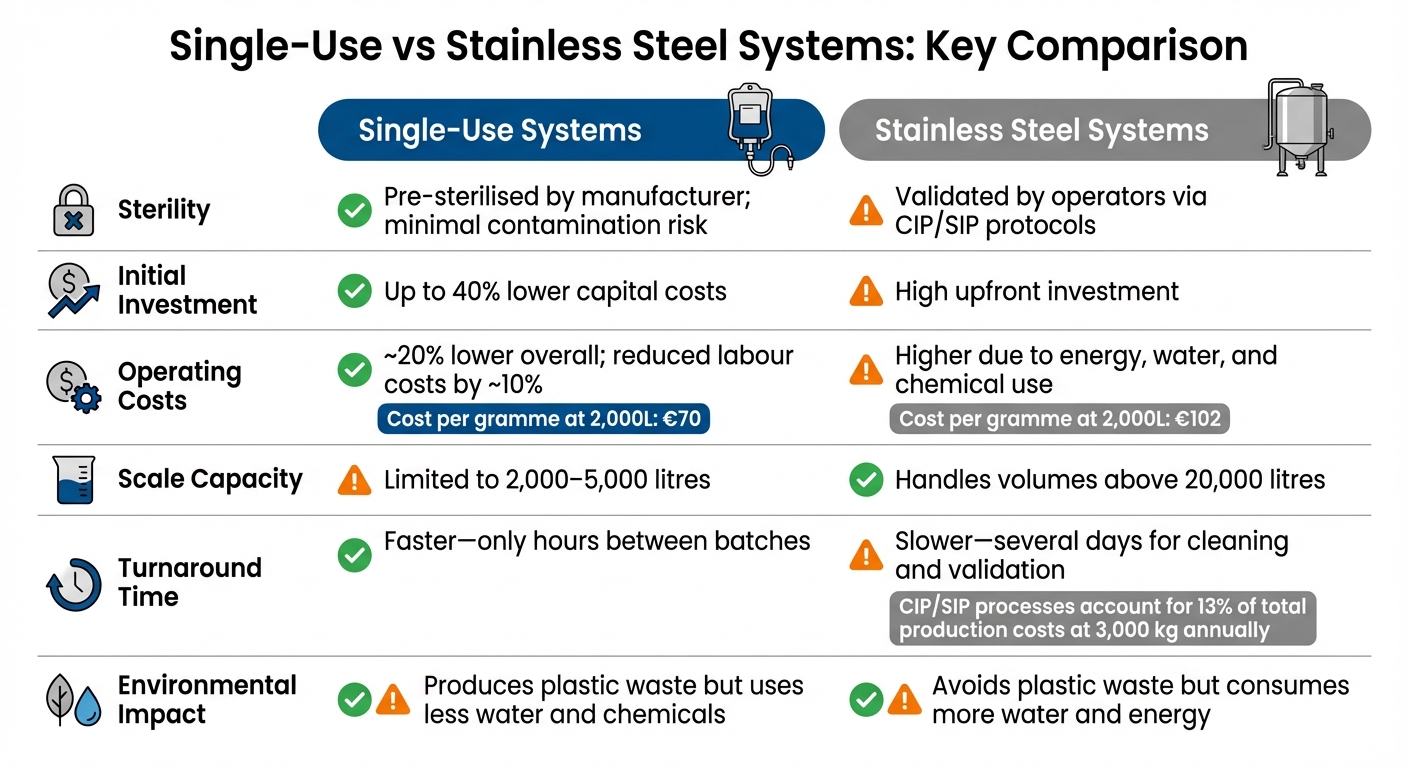
Single-Use vs Stainless Steel Systems for Cultivated Meat Production Comparison
When considering the operational trade-offs between single-use and stainless steel systems, it’s clear that each has its own strengths and weaknesses. The choice largely depends on the production scale and specific operational needs.
Single-use systems are known for their flexibility and quick turnaround times. These systems significantly reduce downtime associated with cleaning and sterilisation, making them ideal for facilities handling multiple products. As Dr Adam Ostrowski, Technical Application Lead at Cellexus, explains:
"Using SU technologies we can completely replace all components of the production line, which come in contact with the process, with new ones, and thus completely separate the processes despite using the same equipment" [1].
However, their capacity is limited - typically ranging from 2,000 to 5,000 litres [1][2]. This makes them less suitable for large-scale, commercial production of cultivated meat.
Stainless steel systems, on the other hand, are designed for high-volume production. They can handle volumes exceeding 20,000 litres [1][2], making them the go-to option for large-scale operations. But this comes with a cost: maintaining sterility requires rigorous Cleaning-in-Place (CIP) and Sterilisation-in-Place (SIP) processes. These protocols involve significant use of energy, chemicals, and deionised water, which can account for 13% of total production costs when producing 3,000 kg of product annually [1]. For instance, in monoclonal antibody production, the costs per gramme were €102 for stainless steel systems compared to €70 for single-use alternatives [1].
Here’s a side-by-side comparison of the two systems:
| Factor | Single-Use Systems | Stainless Steel Systems |
|---|---|---|
| Sterility | Pre-sterilised by the manufacturer; minimal contamination risk [1] | Validated by operators via CIP/SIP protocols [1] |
| Initial Investment | Up to 40% lower capital costs [1] | High upfront investment |
| Operating Costs | About 20% lower overall; reduced labour costs by ~10% [1] | Higher due to energy, water, and chemical use [1] |
| Scale Capacity | Limited to 2,000–5,000 litres [1][2] | Handles volumes above 20,000 litres [1][2] |
| Turnaround Time | Faster - only hours between batches [1] | Slower - several days for cleaning and validation [1] |
| Environmental Impact | Produces plastic waste but uses less water and chemicals [1] | Avoids plastic waste but consumes more water and energy [1] |
Environmental considerations also differ significantly. Single-use systems generate plastic waste, while stainless steel systems rely heavily on water, energy, and chemicals. As Dr Ostrowski points out:
"The cost of energy, highly toxic chemicals necessary for CIP/SIP processes, their disposal and production of deionized water necessary for cleaning of the machinery, is often hidden in indirect costs" [1].
For facilities prioritising rapid changes or multi-product capabilities, single-use systems are a practical choice. Conversely, stainless steel systems are better suited for dedicated, large-scale production, despite their higher operational demands and resource usage.
Conclusion
Producing cultivated meat effectively often calls for a hybrid strategy, combining the best of single-use and stainless steel systems at different stages of production.
For early research and development, single-use systems shine. They offer lower upfront costs, quicker setup times, and reduced contamination risks, making them ideal for smaller-scale operations or startups[1]. However, when production scales beyond 5,000 litres, stainless steel systems become indispensable[1]. These systems are better suited for large-scale output, offering durability and efficiency at higher volumes.
The choice between these technologies largely depends on your current production scale and future growth plans. Startups tend to benefit from the flexibility of single-use systems, while larger, more established operations gravitate towards stainless steel for their long-term scalability. A common approach is to use single-use bioreactors for upstream processes and switch to stainless steel for the later stages of production.
Once your process requirements are clear, the next step is sourcing the right equipment. Platforms like Cellbase can help you compare verified suppliers and find equipment tailored to your needs. As Dr. Adam Ostrowski, Technical Application Lead at Cellexus, explains:
"When choosing an SU technology provider, we choose not only a contractor, but also a partner for a long period"[1].
Choosing the right supplier ensures you have a partner who understands the technical challenges of cultivated meat production and can provide long-term support as your operations grow.
Finally, it’s crucial to assess the total cost of ownership. This includes comparing the hidden costs of cleaning and sterilisation (CIP/SIP), energy consumption, and labour for stainless steel systems against the consumable costs of single-use alternatives. Generally, single-use systems are more cost-effective for production under 5,000 litres, while stainless steel systems become the better choice as volumes increase[1]. A hybrid approach - starting with single-use systems and transitioning to stainless steel - can help balance performance and cost as your production scales.
FAQs
When should I switch from single-use to stainless steel?
When deciding whether to make the switch, it all comes down to scale, cost, and operational needs.
Single-use systems are a great fit for smaller-scale or pilot operations. Why? They come with lower upfront costs, offer flexibility, and eliminate the hassle of cleaning. On the other hand, stainless steel bioreactors shine in large-scale, stable production. They’re more economical over time, handle higher volumes, and generate less waste.
The right time to transition is when the long-term savings and reliability of stainless steel systems start to outweigh the perks of single-use systems - usually for bigger or more sustainable operations.
What hidden costs matter most when scaling up?
Scaling up cultivated meat production comes with several hidden costs that can strain budgets if not carefully managed. One major recurring expense is the reliance on single-use systems. While these systems can simplify processes, they generate plastic waste and lead to continuous material costs, adding a financial and environmental burden.
On the other hand, reusable systems bring their own challenges. The infrastructure required for cleaning and sterilising these systems can be costly, both in terms of equipment and operational expenses. Additionally, waste management - whether dealing with by-products from production or managing system waste - can further increase costs.
Recognising and planning for these expenses is essential for scaling up efficiently and avoiding unexpected financial setbacks.
How can I reduce waste with single-use systems?
Single-use systems simplify operations by cutting out the need for cleaning and sterilisation, which in turn reduces the consumption of plastic and other materials. They also come with the added benefits of quicker setup times and lower maintenance expenses, making them a practical choice for small-scale or adaptable cultivated meat production setups.


