

If I had to cut the article down to one point, it would be this: shelf life for cultivated meat is built as a multi-hurdle system, not from one fix. If microbiology is not controlled first, longer shelf life claims usually fail, even when oxidation, colour, or texture look fine.
For bioprocess engineers, cell culture scientists, and cultivated meat R&D teams, the article boils down to four linked jobs:
- Set the formulation first: control oxidation risk from PUFA-rich fats, then add pH, water activity, and antimicrobial hurdles.
- Match packaging to the spoilage route: use VP or MAP based on oxygen exposure, compression risk, and product structure.
- Lock down process and storage: validate heat or HPP against the actual scaffold and hold chilled products at 0 °C to 5 °C or frozen products at −18 °C or below.
- Prove it with data: run product-specific shelf life studies, challenge tests where needed, and set use-by or best before dates from evidence.
A few points stand out. Listeria monocytogenes is a main shelf life and safety pressure in chilled raw products. PV and TBARS are the core oxidation checks for fat stability. And if temperature drifts during storage or transport, the article says to trigger challenge testing before batch release.
This is not a generic packaging piece or a generic formulation piece. I see it as a short playbook for moving from cell-derived tissue to a product that can survive packing, distribution, and storage without losing safety, texture, or saleable life.
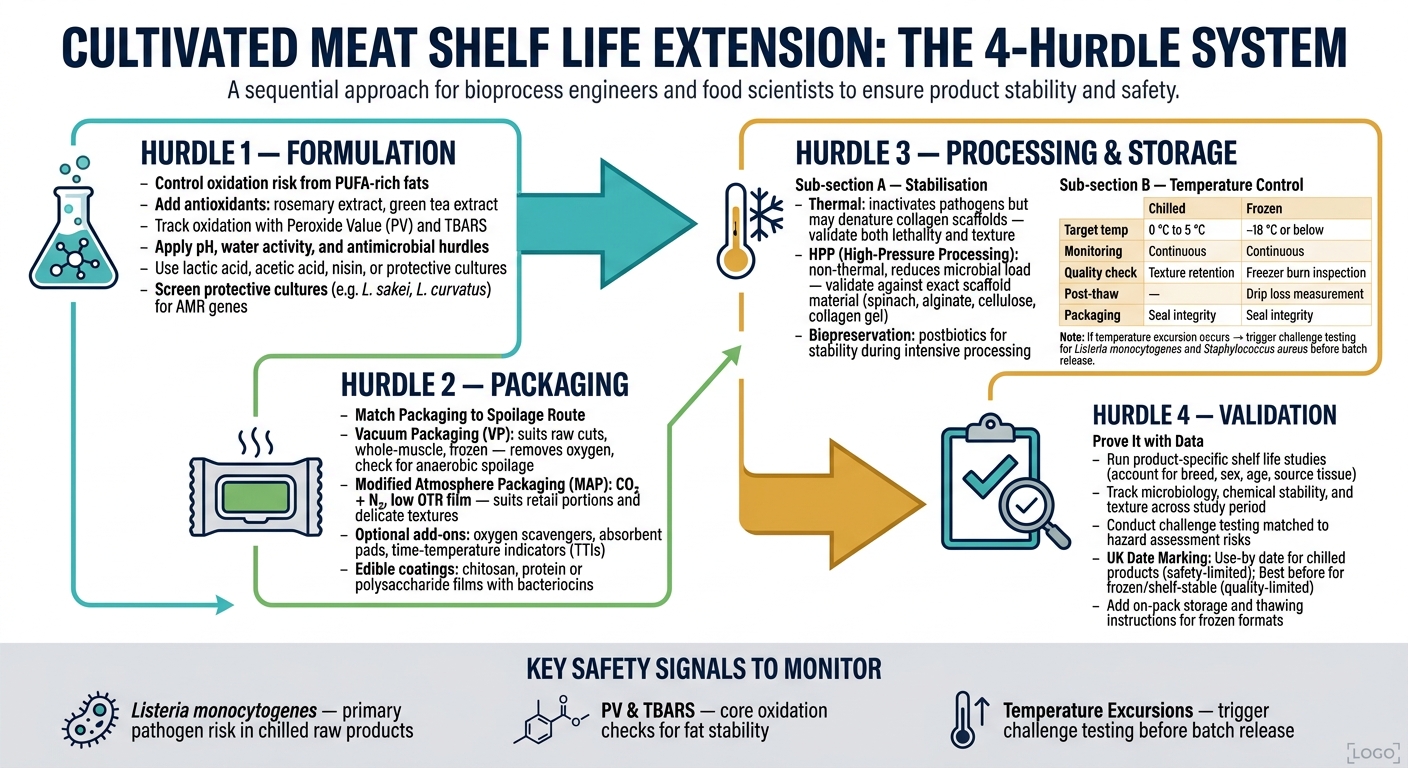
Cultivated Meat Shelf Life Extension: 4-Hurdle System
Checklist 1: adjust formulation to slow spoilage and oxidation
Formulation is the first control layer for shelf life. If you get it right early, every layer that follows has an easier job. Start with oxidative stability, then move to microbial control.
Antioxidants, fat profile, and oxidation testing
Cultivated meat production allows fatty acid profiles to be tuned. That can be useful, but there’s a trade-off: higher levels of polyunsaturated fatty acids (PUFAs) increase oxidative risk, so antioxidant protection needs to keep pace [2].
Rosemary extract and green tea extract can slow oxidation in meat systems. Track oxidation with Peroxide Value (PV) and TBARS across shelf life testing [2].
Once oxidation is under control, the next step is to limit microbial growth through pH, water activity, and preservative hurdles.
Antimicrobials, pH, and water activity controls
Use hurdle technology to combine pH, water activity, and antimicrobial hurdles [3].
Lactic acid and acetic acid can suppress growth, but dose matters. Match the addition rate to the product’s buffering capacity so you still get inhibition without pushing flavour too far off target [3].
Protective cultures can act as a targeted hurdle against spoilage and pathogen growth in raw or structured cultivated meat. In practice, that means assessing Latilactobacillus sakei or Latilactobacillus curvatus for inhibition of Listeria monocytogenes and spoilage organisms such as Brochothrix thermosphacta [3]. Before use, screen candidate strains by whole-genome sequencing for transferable antimicrobial resistance genes [3]. Nisin is the only EU-approved lantibiotic food additive, approved under Regulation (EC) No. 1333/2008 [3].
There’s one catch. Bacteriocins are generally less effective against Gram-negative bacteria such as Salmonella unless the outer membrane is disrupted first. Pairing them with reduced oxygen conditions or low pH helps close that gap [3]. These hurdles work best when they’re aligned with packaging and cold-chain control.
sbb-itb-ffee270
Checklist 2: choose packaging that matches the product risk profile
Once the formulation hurdles are set, packaging has to keep them working. The pack should protect the hurdles already built into the product, with barrier properties and pack atmosphere matched to the main spoilage route.
High water activity, moderate pH, and PUFA-rich formulations make cultivated meat prone to microbial growth and oxidation [3][2].
Start with the simplest pack format that fits the product’s oxygen exposure and compression risk.
Vacuum packaging and modified atmosphere packaging
Vacuum packaging (VP) removes oxygen, which helps slow aerobic spoilage microorganisms. It suits raw cultivated meat, whole-muscle cuts, and frozen products. But there’s a trade-off: compression can deform structured or fragile products, and VP will not suppress all anaerobes. Check seal integrity and monitor for anaerobic spoilage [3].
Modified atmosphere packaging (MAP) uses CO₂ for antimicrobial action and N₂ to displace oxygen. For high-PUFA cultivated meat, use a film with low oxygen transmission rate (OTR) to limit lipid oxidation. Gas mix stability matters here. So does OTR performance across the full storage period [3][2].
In practice, VP fits products where compression is not a concern. MAP fits retail-ready portions and delicate textures where headspace control matters more.
Active packaging, moisture control, and intelligent indicators
If the primary pack on its own won’t do the job, add secondary controls. Oxygen scavengers can cut residual oxygen. Absorbent pads can help manage drip. Time-temperature indicators (TTIs) can support chilled distribution.
Before using any of these, check labelling obligations under UK food information rules [2][3].
Edible coatings and biodegradable packaging trade-offs
For surface-sensitive products, coating-based barriers may be a better fit. Chitosan coatings can help with moisture control and antimicrobial activity. Protein or polysaccharide films can improve oxygen barrier performance and may also carry bacteriocins or essential oils. Biodegradable barrier films can work too, but they need validation under chilled, high-humidity storage conditions [2].
Checklist 3: apply processing and storage controls as part of a hurdle strategy
Once packaging is locked in, processing and storage determine how long that protection holds. At this point, shelf life stops being just a packaging problem and becomes a process control problem. Post-harvest handling, product format, stabilisation treatment, and temperature management need to work as one hurdle system, not as isolated steps.
Thermal and non-thermal stabilisation options
One of the first calls to make is whether the cultivated meat product will be sold raw or cooked. That decision shapes the most suitable stabilisation route.
Thermal stabilisation can inactivate pathogens, but it may also denature collagen-based scaffolds. That means you need to validate both microbial lethality and textural performance [2].
High-pressure processing (HPP) is a main non-thermal option. It reduces microbial load without heat, which makes it a better fit for raw products and scaffold-sensitive formats [2]. Scaffold response under pressure is not one-size-fits-all. Plant-based scaffolds such as decellularised spinach, alginate, and cellulose may behave differently from collagen gels, so HPP settings should be validated against the exact scaffold material in use.
Biopreservation adds another targeted hurdle. Postbiotics - inactivated microbial components - are more stable during intensive processing and do not increase total viable count, which can make them easier to fit into existing safety systems [1]. Protective cultures should be treated as one hurdle within a broader preservation plan, not as a single fix.
Once that biological hurdle is in place, temperature control has to keep it there.
Cold-chain control for chilled and frozen products
The final hurdle is temperature control. It keeps the earlier barriers - formulation, packaging, and biological controls - working as intended. Temperature control is the backbone of the hurdle system, but it has to be documented and actively monitored, not taken for granted.
For chilled products, maintain storage at 0 °C to 5 °C across processing, warehousing, and distribution. For frozen products, hold at −18 °C or below. The post-harvest cool-down window is a critical control point and should be logged from harvest onward [2].
In practice, the most commonly missed checkpoints are physical rather than microbial. Check for freezer burn, as this can point to packaging failure or temperature fluctuation. Measure drip loss after thawing; excess loss suggests cell or scaffold damage [1]. Also check packaging seal integrity at each stage, since vacuum and MAP seals can fail under distribution-related mechanical stress.
| Cold-chain checkpoint | Chilled (0 °C to 5 °C) | Frozen (−18 °C or below) |
|---|---|---|
| Temperature monitoring | Continuous | Continuous |
| Physical quality check | Texture retention | Freezer burn inspection |
| Post-thaw assessment | - | Drip loss measurement |
| Packaging | Seal integrity | Seal integrity |
| Microbial control | Pathogen inhibition | Metabolic suspension |
If a temperature excursion is recorded at any point, trigger challenge testing against Listeria monocytogenes and Staphylococcus aureus before the affected batch moves forward [1].
Checklist 4: validate shelf life and align procurement with implementation
Shelf life studies, challenge testing, and UK date marking
Validation shows whether the formulation, packaging, and cold-chain hurdles actually extend shelf life. In plain terms, this is the step where the shelf life plan stops being a theory and becomes evidence.
Design the shelf life study around source-animal variables such as breed, sex, age, and source tissue, because these factors can affect cell proliferation, differentiation capacity, and final tissue quality [2]. Track microbiology, chemical stability, and texture across the study period.
Shelf life data for cultivated meat are still limited, so validation needs to be product-specific. A scaffold-free mince, for example, should not be treated as if it will behave like a structured cut.
If challenge testing is part of the study, match it to the risks identified in the hazard assessment and document the results clearly. That link matters. A challenge test only helps if it answers the risk question you set out to test.
Once the study endpoints are set, convert the findings into date-marking decisions. For UK date marking, use a use-by date for chilled cultivated meat that becomes unsafe quickly. Use best before for frozen or shelf-stable formats where quality, not safety, sets shelf life. For frozen products, add on-pack storage and thawing instructions.
Procurement checklist for packaging, testing, and process infrastructure
Once the validation plan is fixed, source the equipment and tests needed to run it. In most cases, that means:
- Vacuum or MAP sealing systems
- Barrier films
- Cold storage and temperature-logging equipment
- Analytical tools for oxidation tracking, microbial enumeration, and texture analysis
Teams should also confirm access to any processing equipment required to support the chosen shelf life plan before studies begin. There's no point setting up a validation programme around a packaging or process step that isn't available at pilot or production scale.
Source these items through Cellbase, the dedicated B2B marketplace for cultivated meat.
Conclusion: a minimum shelf life extension plan
Shelf life extension works best when formulation, packaging, processing, and storage each contribute a separate hurdle, and the full system is then validated on the exact cultivated meat format.
FAQs
Why is shelf life a multi-hurdle system?
Shelf life for cultivated meat works as a multi-hurdle system. Quality and safety depend on controlling microbial growth, chemical oxidation, and environmental stressors at the same time.
So this isn't about one fix. It depends on an integrated approach that combines cold chain logistics, advanced packaging such as modified atmosphere or vacuum sealing, and processing techniques like high-pressure treatment across the supply chain.
When should I choose VP over MAP?
Choose vacuum packaging (VP) when you need tighter drip control, longer shelf life, and a strong barrier against contamination, especially if you want to avoid chemical preservatives. One trade-off: it can cause temporary darkening because the pack is deoxygenated.
Choose modified atmosphere packaging (MAP) when visual appearance matters most, such as maintaining a bright red bloom, while still extending shelf life.
What triggers challenge testing?
Challenge testing checks the safety and shelf life of cultivated meat by measuring how the product responds when exposed to possible microbial threats.
Cultivated meat is made in sterile production settings. That lowers many contamination risks during manufacturing, but it can also mean the product has less exposure to background microflora than conventional meat. As a result, it may be more vulnerable to new pathogens if contamination happens later in the process or during storage. Challenge testing helps teams assess that risk and confirm product integrity.
Relevant testing equipment, sensors and laboratory infrastructure can be sourced through Cellbase.


