

If flux drops, TMP climbs, and clean-water recovery stays low after cleaning, the membrane is not the root issue on its own - the feed, run window, and cleaning sequence are.
If I had to reduce the article to a few points, I’d put them like this:
- most fouling in cultivated meat streams starts with the feed. Cells, debris, albumin, transferrin, salts, and lysed material foul in different ways.
- The first job is to identify the fouling mode. Cake fouling, pore blocking, concentration polarisation, scaling, and biofouling do not show the same data pattern.
- The best control point is before the membrane. Centrifugation, depth filtration, or coarse prefiltration can cut the solids load before it hits the module.
- A stable run window matters. Low-to-moderate flux, controlled TMP, and enough recirculation shear help keep fouling in a recoverable range.
- Cleaning is still part of the plan, but it is not the whole plan. CIP comes first, SIP comes second, and clean-water recovery tells me whether the membrane has come back or is nearing replacement.
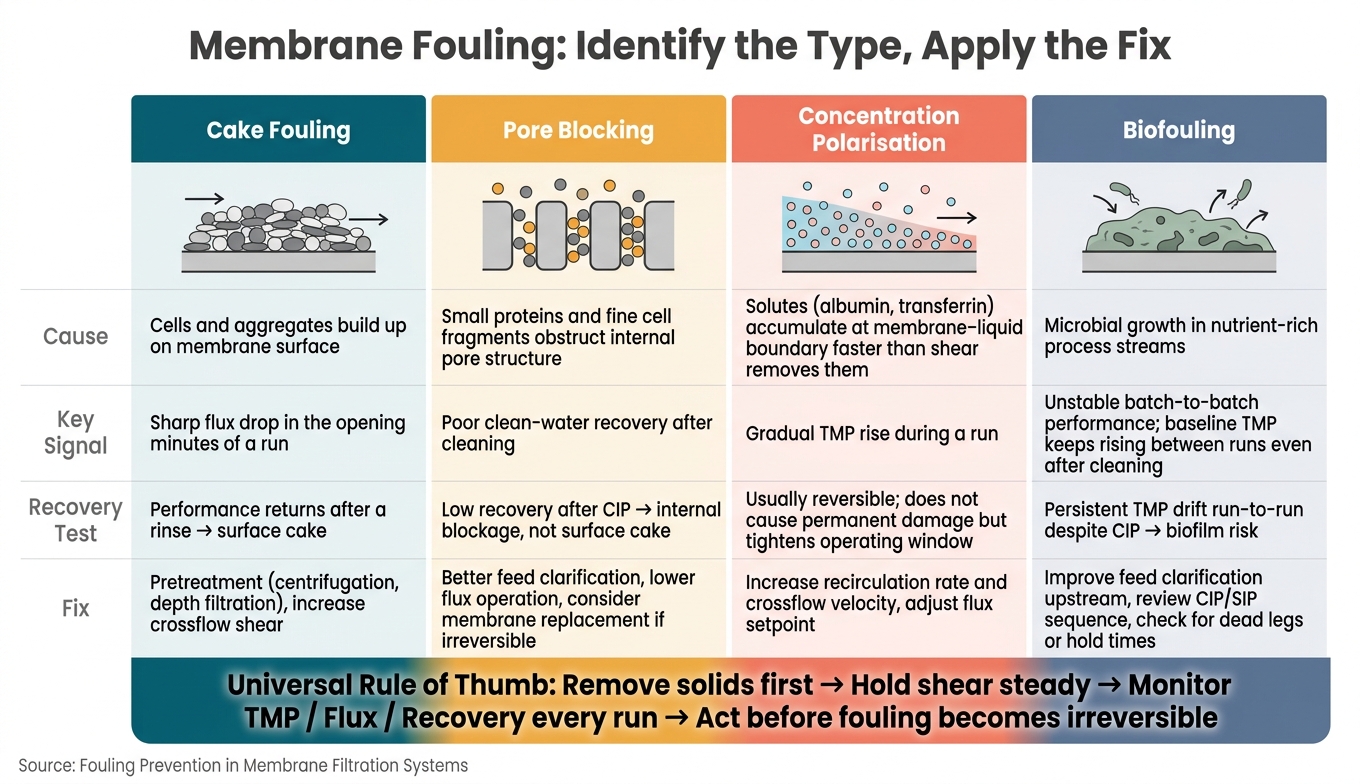
In simple terms: if I see a sharp early flux drop, I suspect surface cake. If I see poor recovery after cleaning, I think about pore blocking. If TMP drifts during the run, concentration polarisation is high on the list. And if baseline TMP keeps moving up between batches, I check for feed clarification gaps or biofilm risk.
A short rule of thumb helps here: remove solids first, hold shear steady, watch TMP/flux/recovery every run, and do not wait for heavy fouling before acting. In protein-rich, cell-containing streams, even small changes in harvest handling can shift the membrane from a recoverable state to one that costs more downtime, more product loss, and shorter membrane life.
That is the core of the article: fouling prevention is mostly upstream control, not just cleaning chemistry.
Membrane filtration: Fouling and cleaning (DRAFT video)
sbb-itb-ffee270
The main fouling mechanisms and how to recognise them
Membrane Fouling Types: How to Identify & Prevent Each
Fouling rarely shows up as just one thing. In most runs, you’re dealing with overlapping mechanisms, and each one leaves its own fingerprint in the process data. The most useful signals are flux, TMP, and clean-water recovery. Read together, they help you tell surface build-up from internal blockage.
Cake fouling and pore blocking
Cake fouling forms when retained cells and aggregates build up on the membrane surface, which increases hydraulic resistance [1]. One of the first signs is a sharp drop in flux in the opening minutes of a run. If performance comes back after a rinse, that usually points to surface cake rather than deeper fouling.
Pore blocking behaves differently. Small proteins and fine cell fragments move into the pore structure and partly or fully obstruct the flow paths. It’s the quieter problem of the two. If cleaning gives poor recovery, that usually points to internal blockage, not surface cake that can be rinsed off.
Concentration polarisation and biofouling
Concentration polarisation develops at the membrane–liquid boundary layer when solutes build up faster than shear or crossflow can remove them. Proteins such as albumin and transferrin can make this boundary-layer build-up worse [2]. In practice, the usual sign is a gradual rise in TMP during a run. That pattern suggests concentration polarisation more than cake formation. It does not usually cause permanent membrane damage, but it does tighten the stable operating window and can make other fouling modes worse.
Biofouling needs close attention in nutrient-rich process streams. A useful warning sign is unstable batch-to-batch performance, along with a baseline TMP that keeps rising between runs even after cleaning. Persistent TMP drift from run to run often means the feed needs better clarification before filtration.
These fingerprints point to the next control point: remove solids, aggregates, and unstable feed components through downstream processing before the membrane.
Feed pretreatment and clarification before the membrane
These fouling modes are much easier to manage when you remove solids and unstable feed components before filtration. Once the feed is clarified, the membrane sees a lower solids load and a broader stable operating window.
Staged clarification to reduce solids and aggregates
Poor harvest handling can increase debris, cut yield, and make downstream filtration more difficult. After harvest, use centrifugation, depth filtration, or coarse prefiltration to remove cells and larger debris ahead of membrane filtration. The right pretreatment step depends on product sensitivity and your recovery target.[1]
Feed conditioning to limit protein fouling and scaling
Control pH, ionic strength, and protein load to reduce precipitation and keep fouling behaviour more predictable. When the feed stays stable, membrane fouling is usually easier to anticipate and manage.
Sourcing pretreatment components through Cellbase
For clarification filters, depth media, and related process components, Cellbase helps cultivated meat teams source verified suppliers. That helps keep pretreatment choices aligned with the membrane system used downstream.
Membrane design, operating window and cleaning strategy
Once the feed is clarified, membrane design and operating control decide how long production systems remain in a recoverable fouling range.
Choose membrane materials with low-fouling surface chemistry and module geometries that are easy to clean. In cell-containing streams, hollow-fibre and tubular modules often give better hydrodynamic control than flat-sheet formats. Higher crossflow velocity increases wall shear, which helps limit cake build-up and slows the rate at which proteins move into the pore structure. The goal is simple: pick a module geometry that lets you hold that shear steadily for the full run.
Run at the lowest practical flux that still preserves throughput, and keep TMP within a narrow, stable band. If flux and TMP start climbing too fast, that's a clear sign the system has moved outside its recoverable range. Set the recirculation rate high enough to maintain shear at the membrane surface, then adjust it if TMP starts to drift upwards during the run. In practice, a stable operating window defined by TMP, flux, and recirculation rate is the most direct way to slow fouling build-up between cleaning cycles.
Track TMP drift, flux decline, and clean-water recovery across runs. Those three signals help you decide when to clean, check whether cleaning worked, and judge when membrane replacement is due. A CIP cycle that brings clean-water recovery back to baseline shows the membrane is fit for the next run. If recovery stays below baseline after cleaning, that points to irreversible fouling and suggests replacement is due. Looking at these three indicators together gives you a reliable view of membrane condition across its full service life.
Taken together, these controls - material selection, hydrodynamics, and disciplined cleaning cycles - turn the clarified feed from the previous section into consistent, stable filtration performance. The final section brings these elements into a practical fouling prevention plan.
Conclusion: building a practical fouling prevention plan
Once the operating window is defined, the job is to keep it steady. Good fouling prevention rests on three linked controls: pretreatment, membrane choice and operating discipline. None of them works on its own.
Next, work out whether proteins or harvest debris are behind the drop in performance. In cultivated meat streams, proteins and harvest debris are the main fouling drivers [2]. Proteins usually lead to pore blocking, while debris tends to cause cake fouling. That distinction shapes the whole filtration approach: what to prioritise in pretreatment, which membrane spec to choose, and how to set the cleaning strategy.
When the process spec is fixed, source the supporting filtration hardware through Cellbase. Cellbase can help teams source membranes and filters, sensors and pretreatment hardware as specifications shift during scale-up.
The last check is simple: can the system still be recovered as throughput goes up? Scale-up only works when filtration is stable before volume increases. In practice, a fouling prevention plan is a steady routine of monitoring, validation and refinement at each stage of scale-up.
FAQs
How do I tell which fouling mode is happening?
Identify the fouling mode by tracking how flux drops as filtered volume increases. Pore blocking, intermediate blocking, and cake formation each follow different mathematical trends as permeate flux falls over time.
That matters in practice. If you can see which fouling pattern is developing, you can spot the problem early and respond before filtration performance slips too far.
Cellbase can help you source the sensors and analytical equipment needed to measure these parameters accurately and diagnose fouling at an early stage.
What should I optimise before changing the membrane?
Before changing a membrane, first optimise your cultivation process for efficiency, service life, and performance. Review your culture medium requirements, proliferation methods, and how you manage the dry and wet mass of the cultivated meat.
Also check that your cell lines remain genetically and phenotypically stable over multiple divisions. Keeping these factors under control can help reduce fouling before you replace the membrane.
When does low recovery mean the membrane needs replacement?
Low recovery usually means the membrane is due for replacement once routine cleaning no longer brings performance back to an acceptable level.
If output stays low or pressure drop remains high despite proper maintenance, that usually points to irreversible fouling or membrane degradation.


