

If you damage cells at harvest, you lose yield, add debris, and make downstream work harder. For cultivated meat teams, the best fit depends on four things: culture format, scale, continuous vs batch mode, and how much shear the cells can take.
I’d boil the article down like this:
- Batch centrifugation suits gentle recovery, with reported 90% to 95% recovery, <5% viability loss, and <1% LDH release when tuned well.
- Disc-stack centrifugation fits high-throughput continuous harvest, but feed-zone shear needs close control.
- Depth filtration works best for smaller batch clarification or post-centrifuge polishing.
- TFF and ATF fit perfusion, media exchange, and cell retention, with ATF usually giving lower shear.
- Microcarrier and scaffold workflows depend on one early choice: detach cells or keep the carrier in the product.
- Acoustic separation is a low-shear option for continuous retention and clarification.
- Hydrocyclones and gravity settlers sit earlier in the train as pre-concentration or clarification steps, with a trade-off between footprint, shear, and processing time.
For bioprocess engineers and cell culture scientists, the short answer is simple: there is no default harvest method. Suspension cultures, aggregates, and microcarrier broths each narrow the field in different ways. At higher densities, fouling, solids load, and centrate quality start to matter just as much as recovery.
Centrifugation for Bioprocessing: Optimize Cell Harvesting and Workflow Efficiency
sbb-itb-ffee270
Quick comparison
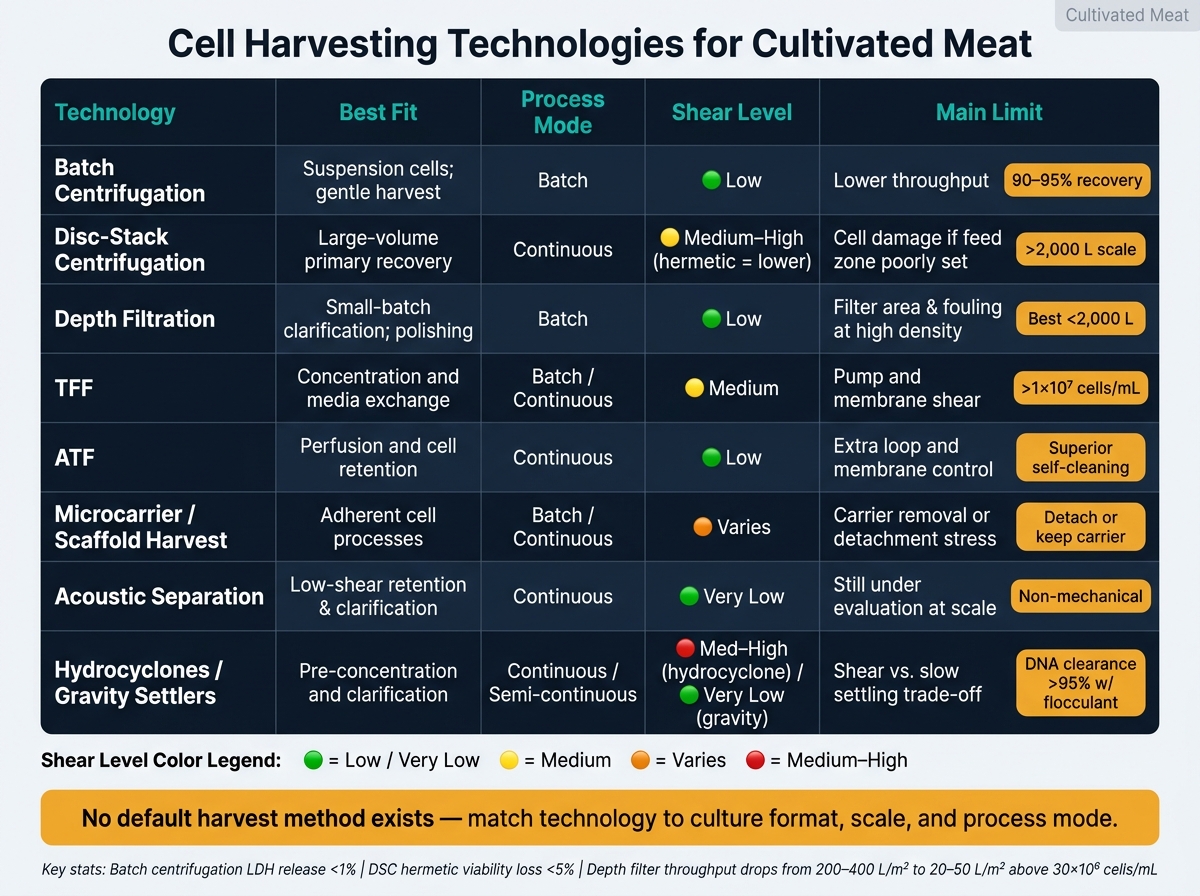
Cell Harvesting Technologies for Cultivated Meat: Side-by-Side Comparison
| Technology | Best fit | Process mode | Shear level | Main limit |
|---|---|---|---|---|
| Batch centrifugation | Suspension cells; gentle harvest | Batch | Low | Lower throughput |
| Disc-stack centrifugation | Large-volume primary recovery | Continuous | Medium to high, unless hermetic | Cell damage if feed zone is poorly set |
| Depth filtration | Small-batch clarification; polishing | Batch | Low | Filter area and fouling at high density |
| TFF | Concentration and media exchange | Batch / continuous | Medium | Pump and membrane shear |
| ATF | Perfusion and cell retention | Continuous | Low | Extra loop and membrane control |
| Microcarrier/scaffold harvest | Adherent cell processes | Batch / continuous | Varies by detachment step | Carrier removal or cell detachment stress |
| Acoustic separation | Low-shear retention and clarification | Continuous | Very low | Still under evaluation at scale |
| Hydrocyclones / gravity settlers | Pre-concentration and clarification | Continuous / semi-continuous | Medium to high / very low | Shear for hydrocyclones; slow settling for gravity |
If I were choosing a downstream processing harvest train, I’d start with the broth, not the hardware: single cells, aggregates, or carriers; batch or perfusion; viable-cell target or biomass target. That framing gets you to the right short-list fast. Understanding these scaling challenges is critical for long-term success.
What Makes a Good Cell Harvesting Technology for Cultivated Meat?
Not every separation method works for cultivated-meat cells. These cells are fragile, process formats vary, and harvest conditions can affect everything that comes next. The seven technologies in the next section should be judged against a small set of practical criteria.
Preserving Viability and Cell Function
Cultivated-meat cells do not tolerate rough handling well. Too much shear or compression during harvest can rupture cells, which then makes downstream processing messier and can hurt product quality.
A key way to measure this damage is lactate dehydrogenase (LDH) release. Low-shear systems such as tubular bowl centrifuges can keep LDH release below 1%, while standard disc-stack designs can reach as high as 12.5% [7]. With the right setup, viability loss can stay below 5% [2][7].
This matters beyond simple live-cell recovery. Post-harvest cell condition can shape how cells differentiate later, which feeds into texture, colour, and flavour.
Handling Suspension, Aggregate, and Microcarrier Cultures
Culture format has a direct effect on harvest choice. Single-cell suspensions are usually the easiest to process and are well suited to tubular bowl centrifugation. Microcarrier-based cultures are different because the process stream contains solid carriers as well as cells. That changes the solids load and often means adjusting g-force so cells can be recovered without excess damage.
In plain terms, the harvest step has to fit the biology and the reactor format. It cannot be bolted on at the end.
Managing Throughput and Cell Density
As culture volume and cell density increase, separation gets harder. Dense broths can foul membrane systems or push centrifuges beyond their sweet spot. So the main issue is not just whether a system works at bench scale, but whether it still performs well when volume goes up. Using a production scale planner can help anticipate these shifts in density and throughput.
Systems with adjustable feed rates and tunable g-forces give process teams more room to work during scale-up.
Batch vs Continuous Processing
Batch and continuous harvest place very different demands on equipment.
Single-use centrifuge platforms fit batch and fed-batch workflows well. They remove cleaning validation requirements, which makes them a good option for R&D and pilot-scale work [7]. Continuous or perfusion processes need equipment that can run without interruption, which usually points to stainless steel systems with integrated Clean-in-Place (CIP) and Steam-in-Place (SIP).
There is no one-size-fits-all answer here. At smaller scales, single-use systems tend to offer more flexibility. At steady, high-volume commercial output, reusable stainless steel systems are often the more practical choice.
Meeting Food-Grade Process Requirements
Cultivated meat is a food product, so the harvest step has to meet food-grade process expectations. Closed-system processing helps cut the risk of environmental ingress during transfers. For reusable equipment, CIP and SIP are needed so systems can be cleaned and sterilised between runs. Single-use platforms offer another route: a pre-sterilised disposable flow path that removes the cleaning validation burden.
The main requirements are straightforward:
| Criterion | Requirement | Why It Matters |
|---|---|---|
| Cell viability | High live-cell recovery | Seed train integrity and final product quality |
| Shear stress | Minimal (low LDH release) | Prevents lysis and downstream degradation |
| Sterility | Closed, aseptic systems | Prevents batch loss; supports food safety |
| Scalability | Bench to commercial volumes | Needed for cost-competitive production |
| Hygiene compliance | CIP/SIP or single-use | Food-grade manufacturing standards |
These criteria narrow the field. The next section compares the main harvesting technologies side by side.
1. Batch Centrifugation
Batch centrifugation is a practical harvest step for cultivated meat teams that need a closed system and a clear path to scale. The basic idea is simple: cells are spun at a controlled g-force until they form a pellet, and the clarified medium stays above it. What matters in practice is how gently that separation happens.
That point is especially important in cultivated meat. These cells are often more fragile than the cell types many older centrifuge systems were built around. Low-shear inlets and gentle discharge systems can help protect viability and cell state during harvest. When the process is tuned well, recovery rates can reach 90% to 95%, with viability loss kept below 5% and LDH release under 1% [2][4].
Single-use centrifuge platforms also cut the validation burden linked to CIP and SIP. Some systems scale from benchtop work to commercial volumes, which helps teams keep the same process logic from R&D into pilot production [4][3]. If you need continuous output more than batch flexibility, disc-stack centrifugation is usually the closer fit.
In day-to-day use, batch centrifugation works well for high-density suspension cultures and for shear-sensitive cells on microcarriers when cell integrity is the main priority. The trade-off is throughput. That’s the point where continuous centrifugation starts to make more sense.
2. Continuous Disc-Stack Centrifugation
For higher-throughput runs, continuous production systems often utilize disc-stack centrifugation as the primary option. Once you get above about 2,000 litres, DSC is widely used for primary recovery, with automated solids discharge every 3 to 10 minutes [6][9]. The system separates cells from medium by density, using centrifugal forces in the range of 5,000 to 12,000 × g. That sounds straightforward, but animal cells only sit at around 1.05 g/cm³, so they are only slightly denser than the medium. In practice, that means the separation window is tight and the process needs careful control [6].
The main limit is shear. Older inlet designs can damage 10% to 30% of cells at the feed zone [6]. Hermetic designs are much gentler. They accelerate the incoming fluid without air in the feed path, which helps keep viability loss below 5% and LDH release under 1% [2][7][9]. In January 2026, CARR Biosystems reported that its UniFuge platform, tested on chicken, salmon, and bovine cell types, delivered 90% to 95% cell recovery, with viability loss below 5% and LDH release under 1%, when feed rate and g-force were tuned for each cell line [2][4][7].
Suspension cultures are the clearest fit for DSC. Single-pass removal efficiency is typically 95% to 99% [6]. Microcarrier runs are more sensitive. They need a hydro-hermetic feed zone, and aggregates should be processed at 70% to 80% of maximum rated flow to reduce dissociation and limit debris formation [6][9][10]. For high-density cultures above 30 × 10⁶ cells/mL, a flocculation pretreatment step can help keep throughput up and improve centrate clarity [6].
There is also a practical plant-side trade-off. DSC needs dedicated CIP and SIP skids, plus cleaning validation. That adds work around setup, changeover, and documentation. For smaller-scale or R&D use, single-use systems can reduce that burden [7][11].
Centrate usually still needs polishing before downstream filtration.
3. Depth Filtration
When centrifugation is too harsh on the cells, or just too involved for a small batch, depth filtration is often the simpler option. The harvest stream passes through a porous filter medium that traps solids both on the surface and within the filter matrix. That’s why it can handle mixed particle sizes and shifts in solids load fairly well[8].
For batch processes below 2,000 litres, depth filtration is often a practical choice for primary harvest. It can also help lower residual DNA and endotoxins[8].
Once you get above 2,000 litres, things change. The filter area needed starts to become impractical, so depth filtration is usually moved into a secondary clarification role after centrifugation. At that point, it works more as a polishing step than a bulk harvest method[8].
In continuous processing, depth filtration generally gives way to tangential flow filtration and ATF[8].
In cultivated meat workflows, depth filtration fits best in batch-scale clarification or post-centrifuge polishing.
4. Tangential Flow Filtration and Alternating Tangential Flow
Where depth filtration starts to struggle at higher volumes, TFF and ATF become the go-to options for continuous harvest. Both are membrane-based cell retention systems used to remove spent media while keeping cells in the process stream.
TFF drives broth across the membrane surface, which helps limit cake build-up. ATF works differently: it reverses flow back and forth, which gives a gentler self-cleaning effect.
Both systems are a good fit for suspension cultures and can also be set up for microcarrier-based processes. In that case, the carriers and attached cells stay inside the bioreactor while spent media is exchanged continuously. Perfusion systems that use these retention devices can reach cell densities above 1×10⁷ cells/mL [10]. At scale, they allow continuous media exchange without losing cells from the reactor, often managed via bioprocess control software.
The comparison below shows how the two modes differ in day-to-day use.
| Feature | TFF | ATF |
|---|---|---|
| Primary use | Batch concentration and clarification | Continuous perfusion and cell retention |
| Fouling control | Unidirectional cross-flow sweeps membrane | Alternating flow provides superior self-cleaning |
| Shear stress | Moderate (depends on pump type) | Low (diaphragm pump is very gentle) |
| Integration | Often used as a standalone downstream unit | Run in a side-stream loop off the bioreactor |
One practical point matters here: aggregates are usually more shear-sensitive than single-cell suspensions. So pump speed and recirculation flow rate need to stay within the tolerance of the cell line [5]. If you stay inside those limits, both systems can scale from lab volumes to commercial production, as long as membrane surface area increases in step with bioreactor volume [3].
Microcarrier and scaffold-based cultures need a different recovery approach.
5. Microcarrier and Scaffold-Enabled Harvesting
Anchorage-dependent cells need a surface to attach and grow, which is why microcarriers and scaffolds make stirred-tank scale-up possible. From a harvest point of view, there are two clear paths: either release the cells from the support, or leave the support in the final product. That decision shapes the whole downstream step.
In a detachment-based process, cells are released from the carrier by enzymatic digestion, most often with trypsin or collagenase, and then separated from the beads by centrifugation or filtration [5][8]. If the process uses edible or degradable scaffolds, such as porous gelatin microcarriers or decellularised plant scaffolds, the scaffold stays with the cells and becomes part of the final product [12][5].
That distinction matters in practice. Detachment can hurt cells. After enzyme treatment, the recovery step needs to stay as gentle as possible. If shear climbs too high, lysis and debris go up as well.
In perfusion systems, ATF or TFF can keep microcarriers inside the bioreactor while fresh medium is exchanged. This supports higher cell densities than batch operation [4][8].
Carrier selection should match the product format:
- Edible or degradable scaffolds fit structured products, where the scaffold remains in place
- Synthetic microcarriers fit processes where cells are detached before final processing
For sourcing microcarriers and scaffold materials, Cellbase lists verified suppliers and use-case details.
Where carrier-free recovery is needed, low-shear separation methods become the next option.
6. Acoustic Wave-Based Cell Separation
For processes that need a gentler option than centrifugation or filtration, acoustic wave separation offers low-shear cell handling. Instead of relying on mechanical force, acoustic wave separation (AWS) uses sound waves to move and separate cells, which means less physical stress and less damage than methods such as centrifugation [13][6].
That matters for more than cell survival alone. AWS can reduce lysis and limit the release of DNA and host cell proteins, both of which can foul downstream equipment and hurt product quality [13][6].
AWS also fits well with continuous culture, often requiring specialized sensors for perfusion bioreactors. It can remove cells or inhibitory by-products while sending viable cells back to the bioreactor for media reuse [13]. In practice, that makes AWS a strong fit when clarification and cell retention need to happen at the same time.
Right now, AWS is being evaluated for continuous, low-shear harvest [13]. It is best suited to continuous or perfusion-based processes where cell integrity and media reuse are high priorities.
7. Hydrocyclones and Gravity Settlers
Hydrocyclones offer a faster, low-maintenance way to pre-concentrate dense broths. Gravity settlers sit at the opposite end: much gentler, but with lower throughput. That makes both useful at the pre-concentration and clarification stage, before tighter downstream separation steps.
Unlike acoustic systems, which still need active processing, gravity settling removes cells with very little mechanical stress. In practice, particles settle to the base of a vessel over time. For very shear-sensitive cultivated meat cultures, that can make gravity settlers a good fit for media exchange.
Settling rate increases with particle size and with the density gap between the particle and the liquid. So if cells are unflocculated, settling is usually slow. Flocculation changes that. A cationic polymer such as pDADMAC at 0.01–0.05% w/v can neutralise the negative surface charge that mammalian cells often carry. That drives aggregation of cells, debris, and DNA into flocs in the 50–500 μm range, which settle much more quickly. In reported use, this can push DNA clearance above 95% and make gravity-based harvesting workable at cell densities of 20–40 × 10⁶ cells/mL [6].
One practical point matters here: set the flocculant dose by jar testing. The best dose shifts with cell density [6].
They are most useful as a low-shear clarification step for dense, fragile broths, including:
- fragile suspension cultures
- flocculated microcarrier broths
- dense clarification streams
The trade-off is simple: gravity settlers give you gentleness, but you pay for it in processing speed. The comparison tables below show that balance clearly.
Comparison Tables
These tables lay out the main trade-offs in throughput, shear, system complexity, and operating mode. The goal is simple: match the harvest method to the culture format, process scale, and whether you're running batch or continuous operations.
Batch Centrifugation vs Disc-Stack Centrifugation
Centrifugation is often the first big process choice because it sits right at the tension point between gentle handling and throughput.
Batch systems tend to be easier on cells. Disc-stack systems are built for continuous processing and much higher throughput.
| Feature | Batch Centrifugation | Disc-Stack Centrifugation |
|---|---|---|
| Throughput | Low; limited by bowl capacity | High; continuous solids discharge |
| Shear impact | Very low in tubular bowl designs | Moderate to high in traditional designs; lower in hermetic models |
| Processing mode | Batch | Continuous |
| Scale fit | Bench to pilot (up to 20 L/min) [4] | Commercial scale (>2,000 L) [6] |
| Cleaning | Single-use (no CIP required) or manual cleaning | Automated CIP/SIP |
| Automation | Moderate | High; automated discharge and level control |
Depth Filtration vs Tangential Flow Filtration and ATF
With membrane-based systems, the decision shifts away from bulk recovery and towards clarification or cell retention.
Depth filtration is used to clarify broth. TFF and ATF are used to retain cells during concentration, media exchange, washing, and perfusion.
| Feature | Depth Filtration | TFF / ATF |
|---|---|---|
| Primary use | Clarification; removal of cells and debris | Concentration, media exchange, and perfusion |
| Fouling tendency | High; capacity drops sharply above 30 × 10⁶ cells/mL [6] | Moderate; cross-flow action limits surface fouling |
| Shear profile | Very low | Moderate (TFF); low (ATF) |
| Impurity removal | Excellent - DNA, HCP, lipids | Limited; primarily size-based separation |
| Processing mode | Batch / dead-end | Continuous or perfusion |
| Consumables | Single-use disposable filters | Reusable or single-use membranes |
A practical point on capacity: depth filter throughput can drop from 200–400 L/m² at low cell densities to as little as 20–50 L/m² once density goes above 30 × 10⁶ cells/mL [6]. That’s a steep fall, and it matters in high-density harvests. Pre-treatment with a flocculant such as pDADMAC can recover much of that lost capacity and, in some cases, remove the need for a centrifugation step altogether [6].
Hydrocyclones vs Gravity Settlers vs Acoustic Separation
The last comparison looks at low-shear pre-concentration options.
Here, the trade-off is mostly between throughput, shear, and footprint. If cell protection is the top priority, gravity settlers and acoustic separation are the gentler choices. Hydrocyclones take up less space, but they do so with a higher shear burden.
| Feature | Hydrocyclones | Gravity Settlers | Acoustic Separation |
|---|---|---|---|
| Hardware simplicity | High; no moving parts | Highest; simple tanks or inclined plates | Moderate; requires acoustic transducers and controllers |
| Continuous capability | Yes | Yes, but slow | Yes |
| Shear impact | Moderate to high | Lowest | Very low |
| Suitability for fragile cells | Low | High; ideal for shear-sensitive cultures | High; non-invasive separation |
| Footprint | Small | Large; requires significant space and time | Small to moderate |
How to Match Harvesting Technology to Your Process
No single harvesting technology works for every cultivated meat process. The right choice depends on scale, operating mode, culture format, and the final product target. A good harvest train starts by narrowing the seven main options to the one setup that can actually work in your process.
Start with the Culture Format
Culture format is the first and most obvious filter.
Single-cell suspension cultures are usually the easiest to harvest. Aggregate cultures need gentler handling to limit shear damage during recovery. Microcarrier-based cultures add another separation job, because the carrier has to be removed either before cell recovery or at the same time. In that case, decanter centrifuges are often a good fit because they can handle high solids loads [1].
Once the culture format is clear, the next step is to match the harvest method to either batch or continuous operation.
Align Harvesting with Bioreactor Mode
Bioreactor mode has a direct effect on which harvest technologies you can use.
In batch bioreactors, harvest happens as a single event. That makes disc-stack centrifugation or low-shear tubular bowl systems a sensible choice. Perfusion and continuous bioreactors need separation methods that keep running without interrupting the culture. In practice, that usually points to ATF and low-shear TFF, since both support continuous media exchange and cell retention while the run stays live [4][8]. Batch centrifugation is not a fit for perfusion.
After that, look closely at the broth itself. Even a good equipment match can struggle if the feed is difficult to separate.
Account for Media Composition and Solids Load
Medium viscosity, debris load, and foaming risk all affect separation efficiency. These factors need to be checked during process development, not patched in later at production scale.
If foaming is likely, closed-feed centrifugation is the safer option.
Sometimes one step will not hit both cell recovery and clarity targets. When that happens, a two-stage harvest train usually makes more sense than pushing one unit operation too far.
Plan for Combined Harvest Trains
Most real processes do not rely on one harvest step alone.
A common approach is to use centrifugation for bulk solids removal, then add depth filtration only if the stream still needs polishing. For high-solids feeds, flocculation pretreatment can help a lot. A cationic polymer such as pDADMAC at 0.01–0.05% w/v can increase depth filter throughput by five- to sevenfold, and in some cases it can remove the need for centrifugation altogether [6].
The key point is simple: the last step in the train should match the condition you need at discharge.
Connect Harvesting to Downstream Product Needs
Downstream needs should drive the final choice.
- If the target is viable cells, keep shear as low as possible.
- If the target is biomass, focus on recovery and throughput.
Conclusion
There’s no one-size-fits-all answer to cell harvesting in cultivated meat. The right method depends on the culture format, process scale, and the target product. In practice, that makes harvest selection a process design choice, not just a downstream step.
Centrifugation and filtration are still the most established options for commercial-scale cell recovery. If throughput matters less than gentle handling, lower-shear options start to make more sense.
Acoustic separation and gravity settling sit in that low-shear category, especially in perfusion and other process setups where cell integrity is the top concern. The main trade-off is still simple: gentleness versus throughput.
For teams building that train, Cellbase provides one place to source the equipment and materials involved.
FAQs
How do I choose the right harvest method?
Choose the right harvest method for cultivated meat based on your production goals, budget, and regulatory requirements. The aim is to balance cell viability, recovery, scalability, and cost.
For large-scale production, enzyme-based methods are often the better fit because they support fast, consistent, automated processing. If lower cost or premium product quality matters more, enzyme-free techniques may suit your process better.
Which option is best for fragile cells?
For fragile cells in cultivated meat production, low-shear harvesting methods are the better fit when viability and cell integrity matter. Tubular bowl centrifugation stands out here because it cuts shear stress and mechanical damage compared with standard disc stack systems.
Platforms such as the UniFuge are built for gentle cell collection and have shown high recovery with minimal viability loss. Cellbase can help connect buyers with suppliers of specialised harvesting technologies for cultivated meat production.
When should I use a combined harvest train?
Use a combined harvest train when you need to connect several downstream steps in a continuous, closed-loop process. It works well in runs with high cell density, media recycle, and selective removal of metabolic inhibitors.
By linking harvest, purification, and concentration with hygienic fluid handling, you can improve process efficiency, cut waste, and support cultivated meat production at scale.


