

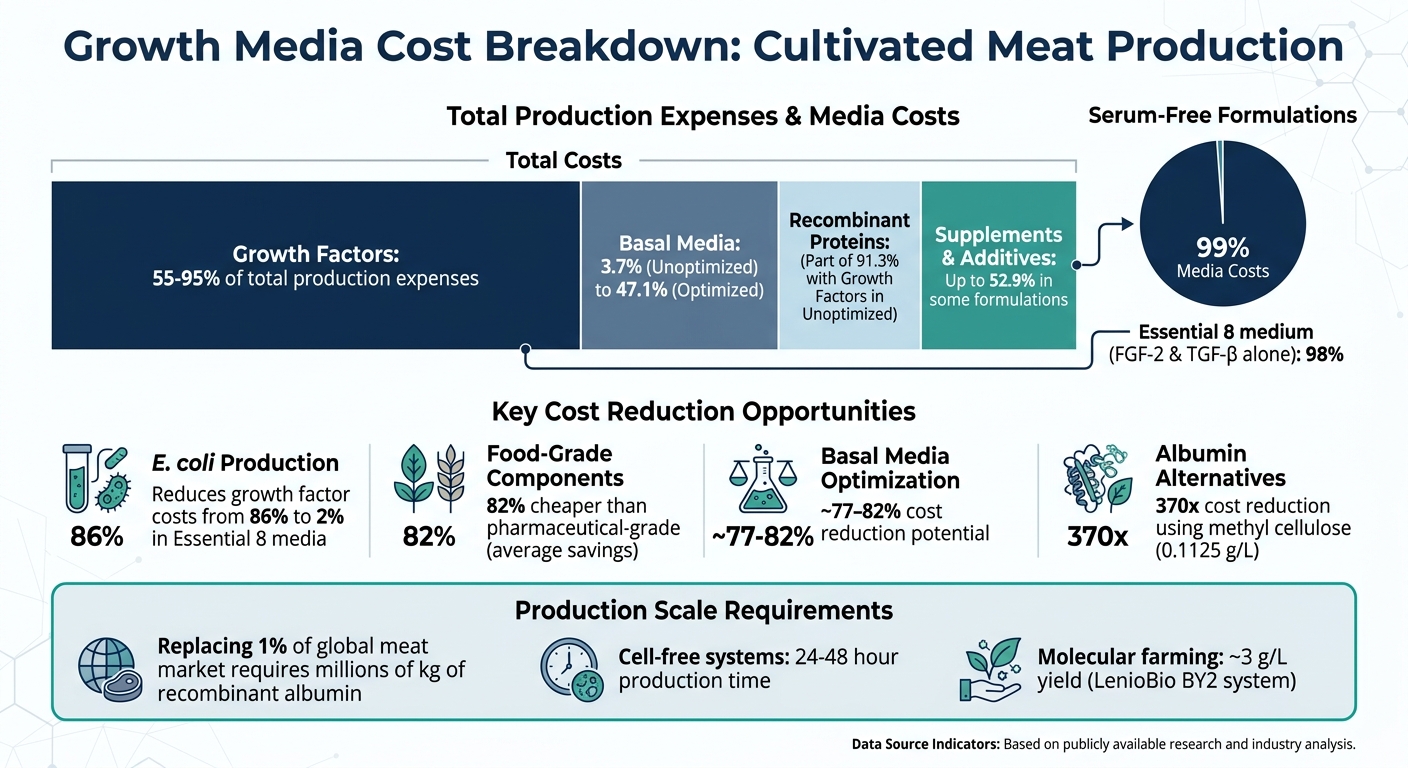
Growth media is the single largest cost in cultivated meat production, accounting for 55%–95% of total production expenses. The biggest contributors are growth factors like FGF-2 and TGF-β, which can make up 98% of media costs in some formulations. These proteins are expensive due to their complex production and short stability. Basal media, recombinant proteins, and supplements also add to costs, though to a lesser extent.
Key insights include:
- Growth factors dominate costs: Up to 99% of media expenses in serum-free formulations.
- Basal media savings: Switching to food-grade components can cut costs by ~82%.
- Production methods matter: Techniques like media recycling, nutrient recovery, and stabilised growth factors help reduce consumption.
- Cost-cutting strategies: Scaling growth factor production with E. coli, molecular farming, and cell-free systems are promising approaches.
Procurement tools like Cellbase simplify sourcing by offering cultivated meat-specific products, ensuring compatibility and reducing delays. Cost reduction will require a mix of optimised formulations, alternative sourcing, and improved production methods.
Growth Media Cost Breakdown for Cultivated Meat Production
Main Cost Components in Growth Media
Growth Factors: The Biggest Cost
Growth factors dominate the expenses in cultivated meat production, making up between 55% and 95% of manufacturing costs and as much as 99% of media costs in specific formulations. For instance, in Essential 8 medium, nearly 98% of the costs stem from FGF-2 and TGF-β[2].
The high cost of growth factors is tied to their complex production requirements. These proteins need precise folding and post-translational modifications - such as glycosylation, phosphorylation, and disulphide bond formation - to function correctly. Typically, this necessitates the use of costly mammalian cell systems like Chinese hamster ovary (CHO) cells[1]. Their instability adds another layer of difficulty; with half-lives ranging from minutes to days, high concentrations are often required to counteract rapid degradation in bioreactors[1].
While growth factors take the lion's share of costs, basal media and recombinant proteins also play a significant role in the overall cost structure.
Basal Media and Recombinant Proteins
Basal media provide the essential nutrients required for cellular metabolism, including amino acids, vitamins, glucose, and inorganic salts[2]. Compared to growth factors, these components contribute far less to total costs. For example, in unoptimised media formulations for bovine satellite cells, basal media accounts for just 3.7% of costs, while growth factors and recombinant proteins make up 91.3%[3]. However, in optimised formulations, basal media can represent up to 47.1% of total costs when growth factor expenses are reduced[3].
Recombinant proteins, such as albumin, insulin, and transferrin, are crucial for their roles as carriers and metabolic regulators. They are required in relatively high concentrations (milligrams per millilitre), making them a significant cost driver that is challenging to address through genetic engineering alone[2]. In January 2024, Mosa Meat, in collaboration with Nutreco, replaced 99.2% of their basal cell feed by weight with food-grade components while maintaining comparable cell growth rates[2]. Food-grade materials offer considerable savings, costing on average 82% less than pharmaceutical-grade alternatives[2].
Supplements and Additives
Supplements and additives are used to fine-tune the cellular environment. For example, HEPES helps maintain pH stability, lipids aid in membrane formation, and hydrocortisone supports adipogenesis[2][3]. In some formulations for chicken fibroblasts, supplements and additives can account for 52.9% of total media costs[3]. This highlights that while reducing growth factor expenses can lower costs, it may also shift the financial burden to other components instead of eliminating it entirely.
How Media Usage Affects Production Costs
Media Volume per Kilogram of Meat
The volume of growth media required per kilogram of meat is a critical factor in determining production costs. Growth factors and recombinant proteins alone can contribute up to 99% of media expenses, meaning that the total volume consumed per kilogram of cultivated meat has a direct impact on overall costs[1].
Metabolic byproducts like ammonia and lactate limit the usability of media by inhibiting cell growth, which often necessitates frequent media changes or replenishments[2]. Inefficient culture systems exacerbate this issue by consuming excessive amounts of media. Serum-free media, in particular, remains a major variable cost driver[2].
Improving media stability can significantly reduce consumption. For instance, stabilised growth factors with longer half-lives minimise the need for frequent replenishment. Similarly, slow-release formulations like PODS concentrate growth factors in approximately 1% of the culture system - specifically where the cells are growing - thereby cutting down the volume of costly components required[1].
Thus, optimising media usage is crucial, and the methods used for cell culture play a significant role in achieving this.
How Cell Culture Methods Affect Media Consumption
Different cell culture methods vary in their media consumption rates. Replacing traditional components with non-ammoniagenic alternatives - such as α-ketoglutarate, glutamate, or pyruvate - and substituting glucose with maltose can help reduce byproduct accumulation, improve cell productivity, and extend the functional lifespan of the media[2].
Emerging techniques like media recycling and nutrient recovery systems are also proving effective in optimising media use. These approaches focus on addressing the underlying causes of media degradation rather than compensating through increased media volumes. As a result, they offer a more efficient and sustainable way to reduce costs[2].
Cost drivers of cultivated meat production
sbb-itb-ffee270
Methods to Lower Growth Media Costs
Addressing the challenges of media consumption, these methods provide practical ways to cut down on growth media expenses.
Increasing Growth Factor Production Scale
One effective approach is scaling up the production of growth factors using alternative expression systems. While mammalian cell cultures are costly to maintain, switching to E. coli fermentation offers a more economical solution. For instance, producing growth factors in-house with E. coli can slash their cost contribution in Essential 8 media from 86% to just 2% [2].
Other innovative methods include molecular farming and plant-based cell-free platforms. Companies like BioBetter utilise transgenic tobacco plants to produce insulin, transferrin, and FGF2, while LenioBio's BY2 system achieves approximately 3 g/L of growth factors and recombinant proteins. These approaches are highly scalable and cost-efficient. Unlike traditional methods, cell-free protein expression systems synthesise proteins within 24–48 hours, bypassing the need for maintaining living cultures [2][4]. This scalability is crucial, especially when you consider that producing enough recombinant albumin to replace just 1% of the global cultivated meat market requires millions of kilogrammes [4].
Serum-Free and Protein-Free Media Development
Reformulating media components is another way to cut costs. Transitioning from pharmaceutical-grade to food-grade ingredients can lead to significant savings. For example, Mosa Meat, in collaboration with Nutreco, found that food-grade media components are, on average, 82% cheaper than reagent-grade alternatives at a 1 kg scale [2].
Replacing recombinant human serum albumin with food-grade stabilisers, such as methyl cellulose at 0.1125 g/L, can reduce stabilisation costs by a factor of 370 [4]. Believer Meats has also demonstrated the potential of serum-free media by carefully optimising component concentrations and substituting albumin with more affordable alternatives [2].
Alternative Sourcing and Synthetic Biology
Alternative sourcing strategies offer additional cost-saving opportunities. Engineering cultivated meat cell lines to produce their own growth factors via autocrine signalling removes the reliance on external supplementation. Upside Foods has even filed a patent for engineering chicken fibroblasts to express FGF2 and IGF1, enabling these cells to thrive without added growth factors [2].
Precision fermentation also plays a key role in reducing costs. Engineered microbial hosts like E. coli and Pichia pastoris produce recombinant proteins with greater consistency and fewer contamination risks compared to animal-derived versions [5][2]. Furthermore, plant-derived hydrolysates from soy, wheat, or rice - along with agricultural by-products like rapeseed protein - offer nutrient-rich, low-cost alternatives to pharmaceutical-grade basal media. These hydrolysates can significantly lower amino acid costs [2].
How Cellbase Supports Growth Media Procurement
A Specialised Marketplace for Growth Media
For cultivated meat producers, navigating pharmaceutical catalogues filled with hundreds of thousands of products - most of which are irrelevant - can be a frustrating and time-consuming task. David Bell, Founder of Cultigen Group, summed up the issue:
Every cultivated meat company we spoke to was wasting time on the same procurement headache... navigating catalogues with 300,000 products where 299,950 were irrelevant [6].
Cellbase addresses this challenge by providing the first B2B marketplace exclusively tailored for the cultivated meat industry. The platform organises growth media into categories such as basal media, growth factors, cytokines, supplements, and serum-free alternatives. Every product listed is specifically validated for cultivated meat applications, eliminating the need to sift through pharmaceutical-grade options designed for other fields.
Procurement teams can refine their searches based on crucial criteria like food-grade status, regulatory compliance, scalability, animal-origin-free formulations, and validation status. This ensures that components chosen during R&D can seamlessly transition into commercial-scale production. Suppliers like Multus Bio, BioBetter, and Gelatex now offer cultivated meat-specific products at commercial scales - an advancement that wasn't accessible just five years ago. By curating only relevant options, Cellbase makes the procurement process far more efficient.
Transparent Sourcing and Efficient Procurement
Cellbase doesn’t just simplify product discovery; it also enhances the overall procurement process, which is critical for reducing production costs. Traditional procurement methods often delay timelines, but Cellbase solves this with transparent pricing and a quick checkout system. This allows teams to immediately estimate costs and allocate budgets effectively. Additionally, the platform connects users with cultivated meat experts who provide technical guidance on media optimisation, cost reduction, and custom formulations.
For sensitive items like growth factors and cytokines, Cellbase handles complex logistics, including global shipping with cold chain solutions to maintain product quality. Each listing includes regulatory and compatibility details, helping producers match materials with specific production needs - whether for pilot studies or full-scale operations. By consolidating access to cells, media, scaffolds, and bioreactors, Cellbase streamlines the entire production workflow, saving time and minimising operational hurdles.
Conclusion
Growth media continues to dominate as the largest variable cost in cultivated meat production, primarily due to a handful of expensive components [1][2]. In serum-free formulations, growth factors and recombinant proteins can account for up to 99% of the total media expenditure [1]. For instance, in Essential 8 medium, nearly 98% of the cost is tied to just two components - FGF-2 and TGF-β [2]. Without a significant drop in these costs, achieving economic viability for cultivated meat remains a challenge.
Reducing costs will require a multi-pronged approach. Switching from pharmaceutical-grade to food-grade components could lower basal media costs by approximately 77% [2]. Additionally, advances in molecular farming and genetic engineering present potential solutions to bring down the high expenses associated with growth factors. Industry milestones have already shown that meaningful cost reductions are within reach [2].
Improved procurement strategies also play a critical role in cutting costs. Conventional procurement methods often provide non-specialised products, which can complicate scaling efforts. Platforms like Cellbase address this by offering a curated selection of products tailored specifically for cultivated meat applications. These include basal media, growth factors, cytokines, and serum-free formulations, all with transparent specifications for food-grade status, regulatory compliance, and scalability. By connecting producers directly with suppliers of animal-origin-free, commercial-scale formulations, Cellbase helps streamline procurement, minimise delays, and enable more efficient budget allocation.
FAQs
Why are growth factors so expensive in cultivated meat media?
Growth factors are a major expense in cultivated meat media, often accounting for up to 99% of the total media costs. Among these, essential growth factors like FGF2 (Fibroblast Growth Factor 2) are particularly pricey. This presents a significant hurdle for scaling up production in a way that is economically viable, making it a critical challenge for the cultivated meat industry to address.
Which media components can be switched to food-grade without affecting growth?
Switching basal media components and certain growth factors to food-grade options is relatively straightforward and does not significantly affect cell growth. Recent progress has centred on creating food-grade substitutes and fine-tuning their application to ensure they perform just as effectively.
How can companies reduce media usage per kilogram of cultivated meat?
Companies can cut down on media usage by fine-tuning growth media composition to make processes more efficient while reducing waste. By tailoring nutrients like glucose, amino acids, and growth factors to the specific needs of cell types and production phases, cell proliferation can be optimised. Additionally, recycling technologies such as Tangential Flow Filtration (TFF) and incorporating cost-effective, food-grade media components further reduce media consumption. These strategies contribute to more efficient and sustainable production of cultivated meat.


