

For cultivated meat professionals managing biosafety waste, here's the bottom line: proper disinfection reduces microbial risks, ensures compliance with UK regulations, and protects your equipment. From liquid biohazards like spent media to solid waste such as used PPE, selecting the right disinfectant is critical. Factors like microbial resistance, organic load, and material compatibility all play a role in effectiveness.
Key takeaways:
- Microbial targets: Choose disinfectants based on the type of microorganism. For example, spores require stronger agents than vegetative bacteria.
- Organic matter: High cell debris or protein content can reduce disinfectant performance. Always pre-clean surfaces before applying disinfectants.
- Material compatibility: Chlorine corrodes metals; alcohol evaporates quickly. Match disinfectants to your equipment and surfaces.
- Validation: Regularly test processes with biological indicators (Geobacillus stearothermophilus) to meet sterility assurance levels (10⁻⁶).
- Regulations: Follow UK standards, including moist heat autoclaving (121°C, 15 psi, 20–30 min) for waste disposal.
Quick tips for chemical choices:
- Bleach (Sodium Hypochlorite): Broad-spectrum but corrosive; good for spills but not for sensitive equipment.
- 70% Ethanol: Effective for surface cleaning but not for spores or large spills.
- Peracetic Acid: Broad-spectrum and less corrosive but flammable.
- Quaternary Ammonium Compounds (Quats): Safe for equipment but limited to vegetative bacteria.
- Phenolics: Work well with organic loads but can be toxic.
Pro tip: Always consult the Material Safety Data Sheet (MSDS) for chemical hazards and storage requirements. Never mix disinfectants without a risk assessment.
This guide dives into the specifics of disinfectant selection, application, and validation to help you maintain biosafety standards in your facility.
How to Select the Right Disinfectant
Effectiveness Against Biological Contaminants
The type of microorganism you're targeting dictates the strength of disinfection required. For instance, vegetative bacteria are relatively easy to neutralise, while bacterial spores demand more aggressive methods. Enveloped viruses are generally more susceptible, whereas non-enveloped viruses and some fungi show higher resistance [2].
Alcohol solutions (60–95%) are effective against vegetative bacteria but fall short against spores and non-enveloped viruses [2]. Chlorine-based disinfectants provide a broad spectrum of activity but are less effective in the presence of organic matter. This is a key consideration for cultivated meat facilities, where high cell densities and protein-rich media can significantly interfere with disinfection processes.
"Alcohol can be used for surface sterilisation, but surfaces must be cleaned before use. It can't be used for spills. It is ineffective against bacterial spores, fungi and non-enveloped viruses."
– UK Plant Health Information Portal [2]
To ensure your disinfectant meets the required lethality, validation testing such as filter paper diffusion tests can be an invaluable tool [2]. However, microbial resistance isn't the only challenge - organic material in the environment can further compromise effectiveness.
Organic Load Effects
The presence of organic material, such as cell debris and spent media, can drastically reduce the performance of disinfectants [3]. Standard testing protocols, which often use 3 g/L Bovine Serum Albumin, may underestimate the concentration needed in real-world production settings. For example, research on peracetic acid (PAA) showed that achieving a 5-log₁₀ reduction of Salmonella Typhimurium required a 15-fold increase in concentration - from 0.002% to 0.03% - when moving from standard conditions to actual process water with high organic loads [3].
"The effectiveness of disinfectants is reduced when organic matter is present; therefore before disinfectants are used the area to be disinfected needs to be thoroughly cleaned."
– UK Plant Health Information Portal [2]
Organic acids like formic and lactic acid also require higher concentrations in these environments. For instance, decontaminating Enterococcus hirae in practice-oriented conditions required lactic acid concentrations of up to 4.5%, compared to just 0.4% under standard test conditions [3].
When managing liquid biosafety waste with high cell concentrations, oxidising agents like PAA should be used at levels of 0.03%–0.1% to counteract the organic load. It's vital to conduct validation tests using actual growth media or process water from your facility rather than relying solely on generic laboratory benchmarks [3]. Always pre-clean surfaces to remove organic matter before applying disinfectants.
Material Compatibility
Once microbial and organic challenges are addressed, it's important to consider how disinfectants interact with the materials in your facility. Chlorine-based agents, for example, can corrode stainless steel, while aldehydes, though non-corrosive, pose toxicity risks [2]. Quaternary Ammonium Compounds (QACs) are safer for equipment as they are non-corrosive and non-irritant, but their efficacy is mainly limited to vegetative bacteria.
Alcohol (60–95%) is generally safe for most surfaces but evaporates quickly, which can prevent adequate contact time. At 100% concentration, alcohol acts as a fixative rather than a disinfectant [2]. Peracetic acid and active oxygen compounds offer broad-spectrum activity with less material damage, though PAA is flammable and must be stored carefully.
Always review the Material Safety Data Sheet (MSDS) and equipment guidelines before using any corrosive agents. Freshly prepared dilutions of aldehyde and chlorine are essential, as their potency diminishes within 24 hours [2]. Avoid mixing disinfectants without a proper hazard assessment - this can lead to toxic gas formation or reduced effectiveness.
Environmental and Operational Requirements
Environmental factors such as temperature, humidity, and water quality can significantly affect disinfectant performance. Elevated temperatures enhance disinfectant action but also accelerate the loss of chemical activity, requiring careful adjustments to contact times [2]. Hard water can cause precipitation of active ingredients in phenolic disinfectants, while pH levels can alter both stability and effectiveness [2].
Alcohol-based disinfectants face challenges due to rapid evaporation, making it difficult to maintain the required contact time. This limitation also renders alcohol unsuitable for handling large spills or killing spores. For high organism densities, higher disinfectant concentrations or extended contact times are necessary to achieve effective reduction [2].
When treating liquid waste streams with elevated cell counts, adjust both concentration and exposure times to meet biosafety standards. Environmental factors like temperature and humidity also influence chemical stability and decontamination times. Fine-tuning these parameters ensures compliance with biosafety protocols in cultivated meat production.
Choosing a Disinfectant: Pros and Cons | Train With Us
Types of Disinfectants for Biosafety Waste
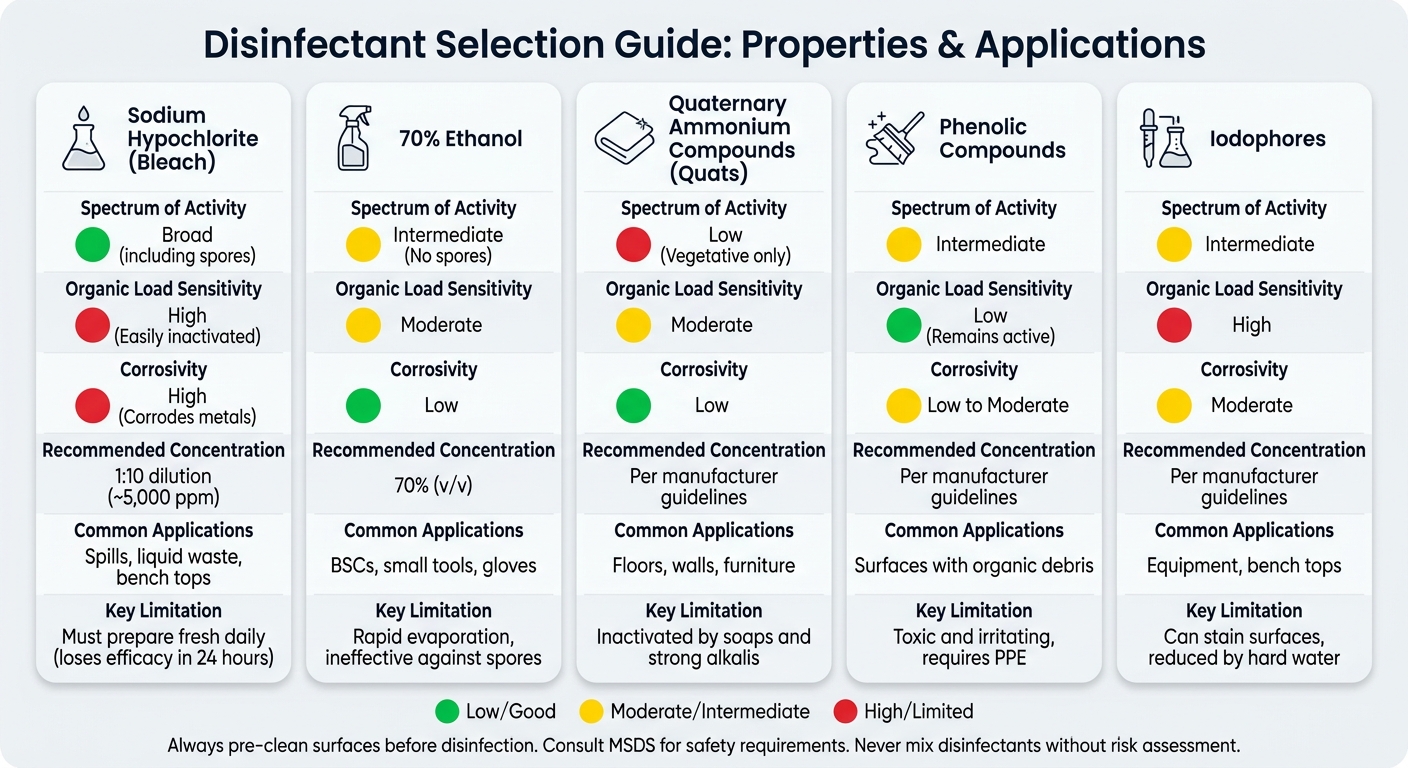
Disinfectant Selection Guide for Biosafety Waste Management
When it comes to biosafety waste management, different disinfectants serve specific purposes, each with its own strengths and limitations.
Sodium Hypochlorite (Bleach)
Sodium hypochlorite is a widely used disinfectant in cultivated meat facilities, offering fast and broad-spectrum action against bacteria, viruses, and spores when used at higher concentrations [4]. The standard recommendation is a 1:10 dilution of household bleach (around 5,000 ppm sodium hypochlorite) for spills or materials with high organic content [4]. However, bleach is highly corrosive to stainless steel and bioreactors, so it’s essential to rinse thoroughly after use to prevent damage [4].
"Due to the limitations of chlorine-based compounds these should never be the sole disinfectant used in a lab"
– UK Plant Health Information Portal [2]
Bleach isn’t ideal for wastewater with high sediment or concentrated microorganism cultures [2]. Additionally, fresh dilutions must be prepared, as its active chlorine loses efficacy within 24 hours [4].
70% Ethanol
Ethanol is most effective as a disinfectant at a 70% concentration (v/v) because the presence of water aids protein denaturation [4]. At concentrations of 95% or higher, it acts as a fixative rather than a disinfectant [2]. This makes 70% ethanol a go-to option for surface decontamination and biosafety cabinets [4]. However, it doesn’t kill spores and is ineffective against bacterial spores, fungi, and non-enveloped viruses [2].
"70% ethanol is generally more effective than 95% ethanol because the presence of water facilitates the denaturation of proteins."
– Biological Safety Manual [4]
Its rapid evaporation limits contact time, and its flammability makes it unsuitable for large spills or use near open flames [4].
"Alcohol can be used for surface sterilisation, but surfaces must be cleaned before use. It can't be used for spills"
– UK Plant Health Information Portal [2]
Quaternary Ammonium Compounds
Quaternary ammonium compounds (Quats) are cationic detergents that work well against vegetative bacteria and enveloped viruses [4]. They are non-toxic and non-corrosive, making them perfect for routine cleaning of floors, walls, and furniture [4]. However, they have a limited spectrum, being ineffective against spores and non-enveloped viruses [4].
Quats can be inactivated by anionic detergents (like soaps) or strong alkalis, so care must be taken to avoid mixing them with incompatible agents [2]. Their low volatility makes them particularly suited for large surface areas [4].
Phenolic Compounds and Iodophores
Phenolic compounds are effective against vegetative bacteria, fungi, and lipid-containing viruses, though they don’t work against bacterial spores [4]. They perform well in environments with high organic loads, making them useful for surfaces contaminated with protein or cellular debris [4]. However, they can be toxic and irritating, necessitating the use of proper personal protective equipment [4].
Iodophores, which are iodine-based surfactants, serve as both antiseptics and disinfectants [4]. They have a broad range of activity against bacteria and viruses but are less effective in the presence of organic matter and can stain surfaces [4]. Hard water can also reduce their effectiveness by precipitating the active ingredients [2].
Comparison Table
| Disinfectant | Spectrum of Activity | Organic Load Sensitivity | Corrosivity | Common Application |
|---|---|---|---|---|
| Sodium Hypochlorite | Broad (including spores) | High (Easily inactivated) | High (Corrodes metals) | Spills, liquid waste, bench tops |
| 70% Ethanol | Intermediate (No spores) | Moderate | Low | BSCs, small tools, gloves |
| Quaternary Ammonium | Low (Vegetative only) | Moderate | Low | Floors, walls, furniture |
| Phenolic Compounds | Intermediate | Low (Remains active) | Low to Moderate | Surfaces with organic debris |
| Iodophores | Intermediate | High | Moderate | Equipment, bench tops |
sbb-itb-ffee270
Disinfectant Application Procedures
Pre-cleaning is a critical step in disinfection because organic matter can shield microorganisms and reduce the effectiveness of disinfectants, particularly chlorine-based ones. Surfaces and equipment must be thoroughly cleaned with water and suitable detergents or enzymatic cleaners before applying any disinfectant. Below are detailed procedures for handling different waste types and equipment.
Surface Disinfection Methods
Start by removing debris manually or with mechanical tools. Apply the disinfectant, ensuring the surface is fully covered, and allow the recommended contact time to pass. For routine cleaning of benchtops and equipment, a 70% ethanol solution is effective for quick decontamination. For high-risk spills or materials with heavy organic contamination, a sodium hypochlorite solution diluted to approximately 1:10 (around 5,000 ppm) is commonly used. Always check material compatibility, as chlorine-based disinfectants can corrode certain surfaces.
Treating Liquid and Solid Waste
For liquid waste, collect it in a designated container, add disinfectant to the appropriate concentration, and allow the necessary contact time before disposal. Plumbing traps should be purged with disinfectant both before and after use to prevent microbial persistence.
For solid waste, contaminated items and PPE should be placed in leak-proof, sealed containers, ensuring the exterior of the containers is decontaminated before removal. Trained personnel wearing appropriate PPE should transport this waste to a decontamination facility, such as an autoclave or incinerator. When autoclaving, maintain a temperature of 121°C (15 psi) for at least 20–30 minutes. Ensure that autoclave bags are open to allow steam penetration, and add water to dry loads for effective sterilisation. Regularly use biological indicators, such as Geobacillus stearothermophilus, to confirm that the process achieves a sterility assurance level of 10⁻⁶ (fewer than one in one million microbial survivors) [1].
Biosafety Cabinet Disinfection
Disinfecting biosafety cabinets builds on standard surface disinfection practices but requires additional care. Disinfectants should be applied using non-aerosol methods to minimise the risk of spreading contaminants. While UV irradiation can be used as a supplementary measure, it should not replace chemical disinfection due to its limitations, such as shadowing and poor penetration. Allow sufficient contact time for the disinfectant before wiping down surfaces.
Personal Protective Equipment and Safety Protocols
The choice of personal protective equipment (PPE) should be guided by a formal risk assessment tailored to the biological agents and disinfectants being used. Refer to the Material Safety Data Sheet (MSDS) for each disinfectant to understand potential hazards, including toxicity and carcinogenicity. Never mix disinfectants, as combining substances like bleach and acids can produce toxic chlorine gas. Flammable disinfectants must be stored away from heat sources. Personnel handling spills should receive specialised training and undergo medical surveillance to ensure they are equipped to manage leaks or failures in decontamination systems.
Common Challenges and Solutions
Even the best protocols can fall short if common issues are overlooked. Addressing these challenges with practical measures is key to ensuring biosafety waste treatment is both effective and safe.
Reduced Effectiveness from Organic Matter
Organic debris - like soil, sediment, protein-rich solutions, or waste residue - can shield pathogens and chemically interfere with disinfectants. Chlorine-based compounds are particularly susceptible to this problem. To avoid this, always pre-clean surfaces to allow disinfectants to make proper contact.
Chemical Incompatibilities
Certain chemical combinations can be hazardous. For instance, mixing bleach with acids releases toxic chlorine gas. Similarly, anionic detergents (found in common soaps) can neutralise cationic disinfectants like Quaternary Ammonium Compounds (QACs), and hard water can cause phenolic disinfectants to precipitate. According to the UK Plant Health Information Portal:
"Different disinfectants must not be mixed together or used in combination unless the possibility of hazardous reactions or the formation of toxic products has been properly assessed" [2].
To ensure safety and effectiveness:
- Always consult the Material Safety Data Sheet (MSDS) for each chemical.
- Rinse surfaces thoroughly when switching cleaning agents.
- Standardise protocols to minimise the number of disinfectants used in your facility.
Managing these interactions is crucial for maintaining disinfection standards.
Storage and Shelf-Life Management
The stability of disinfectants can significantly impact their effectiveness. Diluted solutions, especially chlorine-based and aldehyde working solutions, degrade quickly and should be used within 24 hours [2]. Active oxygen compounds require weekly replacement. To preserve efficacy:
- Store chlorine-based and active oxygen disinfectants away from direct light.
- Keep flammable substances like peracetic acid away from heat sources.
- Prepare fresh solutions daily for critical tasks.
- Label containers with preparation dates and discard expired stock immediately.
While higher temperatures can improve disinfection efficiency, they also accelerate chemical degradation.
Non-Chemical Disinfection Methods
When chemical disinfection isn't sufficient, methods like autoclaving offer reliable alternatives for treating solid biosafety waste. Adhere to standard autoclave protocols to ensure effectiveness. Dry heat sterilisation, though less efficient, requires 180°C for one hour or 160°C for two hours [2]. Incineration, which oxidises waste to ash at around 1,000°C [2], is reserved for high-risk materials. It's essential to regularly validate these processes using biological indicators to confirm they meet sterility assurance levels required by regulations.
Conclusion: Effective Biosafety Waste Management
Summary for Cultivated Meat Professionals
Managing biosafety waste in cultivated meat facilities demands precision - every step, from cleaning to disinfection, must be validated. Success hinges on identifying microbial targets, such as lipid-enveloped viruses or bacterial spores, and tailoring disinfectants to neutralise them effectively. As noted by Cornell University Environment, Health and Safety:
"A quick spray or wipe with a disinfectant is useless; each disinfectant has its own contact time" [6].
Disinfectants only work when applied to clean surfaces. Organic residues like cell culture media or protein-rich solutions can protect pathogens and even deactivate certain disinfectants, including bleach and quaternary ammonium compounds [6][5]. Dr Gustavo M. Schuenemann from Ohio State University highlights:
"Most disinfectants won't work if the surface to be disinfected isn't clean (presence of organic matter such as dirt or manure) before applying the disinfectant" [5].
Chemical compatibility is equally important. Sodium hypochlorite, for example, corrodes stainless steel and must be followed by rinsing with water or 70% ethanol. Additionally, bleach solutions should be freshly prepared daily to maintain their effectiveness [6][5]. Facilities often validate their decontamination processes using biological indicators like Geobacillus stearothermophilus to meet regulatory standards [1]. These steps ensure biosafety protocols are robust before waste disposal.
Sourcing Disinfectants and Materials Through Cellbase
Equipping your facility with reliable disinfectants and biosafety materials is just as critical as implementing proper practices. The effectiveness of these materials depends on their verified concentrations, stability, and compatibility with bioprocessing environments. Cellbase offers a specialised marketplace tailored to the cultivated meat industry, connecting buyers with trusted suppliers of disinfectants, cleaning agents, and decontamination equipment.
Through its curated listings, Cellbase simplifies procurement by helping facilities source materials that comply with regulatory standards. This is particularly crucial for products like active oxygen compounds, which often have short shelf lives once diluted [2]. By providing access to verified suppliers, the platform reduces supply chain challenges, ensuring that cultivated meat facilities can maintain rigorous biosafety protocols without unnecessary delays or risks.
FAQs
How do I choose a disinfectant for spores versus vegetative microbes?
To choose the right disinfectant, it's crucial to assess the resistance level of the microorganisms you're targeting. Spores, such as Bacillus subtilis, are notoriously tough and require sporicidal agents like hydrogen peroxide or glutaraldehyde. Both the concentration and contact time must be carefully controlled to ensure effectiveness. On the other hand, vegetative microbes, like Staphylococcus aureus, are less resistant and can be managed with standard options such as alcohols or phenolic compounds. Always ensure that the disinfectant's efficacy is validated for your specific application.
What should I do if high organic load is reducing disinfectant performance?
To tackle the issue of reduced disinfectant effectiveness due to high organic loads, start by thoroughly cleaning surfaces or equipment to eliminate organic residues like fats, proteins, or cell debris. Use suitable detergents or degreasers for this step, followed by a thorough rinse to remove any cleaning agents. After cleaning, apply the disinfectant according to the manufacturer's guidelines, ensuring it remains in contact with the surface for the recommended duration. This approach helps restore the disinfectant's performance and maintains biosafety standards in cultivated meat production settings.
How can I validate that our disinfection or autoclave process is working?
To ensure your disinfection or autoclave process is effective, it's essential to carry out cleaning validation procedures. This involves choosing the right cleaning agents, testing them under worst-case conditions, and using swab sampling to assess residue levels - such as maintaining chemical residues below 10 ppm. Achieving consistency through three consecutive cleaning cycles is also crucial.
For autoclaves, the use of routine biological indicators or spore tests is necessary to verify sterilisation effectiveness. Regular validation and thorough documentation play a key role in complying with biosafety standards.


