

Biosafety inspections are critical for ensuring the safety of cultivated meat production in the UK and globally. These inspections focus on preventing contamination, verifying product safety, and maintaining hygiene standards. Since late 2025, the UK has classified cultivated meat as "Products of Animal Origin", subjecting it to the same strict safety regulations as traditional meat. Challenges include microbial contamination (e.g., mycoplasma affecting 5%-35% of cell lines), chemical residues, and genetic stability.
Key measures include:
- Facility Design: Use of HEPA filters, cleanrooms, and sterilisation protocols like CIP and SIP.
- Staff Training: HACCP Level 4 certification and aseptic techniques.
- Handling Materials: Traceable cell banking, genetic stability tests, and residue monitoring.
The UK Food Standards Agency (FSA) and Food Standards Scotland (FSS) oversee compliance, with initiatives like the Cultivated Meat Sandbox Programme launched in 2025 to guide businesses. Global approaches vary, with the US and EU employing different frameworks, but all aim to uphold safety. Maintaining detailed records, addressing non-compliance swiftly, and leveraging third-party audits are essential for meeting these standards.
Regulatory Authorities Responsible for Biosafety Inspections
Food Standards Agency (FSA) Responsibilities in the UK

In the UK, the Food Standards Agency (FSA) oversees food safety in England and Wales, while Food Standards Scotland (FSS) handles similar responsibilities in Scotland. Both organisations categorise cultivated meat products - those derived from animal cells - as Products of Animal Origin (POAO) under Regulation (EC) 853/2004. This classification means facilities producing such products must follow hygiene and safety standards similar to those for traditional meat production [5][7].
The FSA plays a key role in ensuring safety before these products reach the market. It conducts scientific risk assessments and requires food business operators to apply Hazard Analysis and Critical Control Point (HACCP) principles. These measures aim to prevent biological, chemical, and physical hazards. Additionally, the FSA enforces compliance through Official Controls under Regulation (EC) 2017/625 [5].
To address the specific challenges of cultivated meat, the FSA introduced its Cultivated Meat Sandbox Programme in February 2025. This initiative involves eight companies participating in monthly workshops, using real production data to address biosafety issues such as cell line identity, microbiology, and toxicology. The programme's goal is to create detailed guidance for the industry. By early 2026, the FSA anticipates receiving around 15 applications from cultivated meat businesses, with plans to complete safety assessments for at least two of these applications within a two-year timeframe [6][7][8].
In Northern Ireland, EU regulations remain in effect, ensuring alignment with broader European standards. However, products authorised in Great Britain can be transported to Northern Ireland under the Northern Ireland Retail Movement Scheme (NIRMS) [7].
These tailored UK measures highlight a distinct regulatory approach compared to other countries, reflecting the diverse strategies employed globally for biosafety oversight.
Global Regulatory Bodies
Biosafety regulations for cultivated meat vary widely across the globe, shaped by differing philosophies and risk management strategies. In the United States, the Food and Drug Administration (FDA) and the USDA Food Safety and Inspection Service (USDA-FSIS) share responsibilities under a 2019 agreement. The FDA oversees initial phases, such as cell collection and growth, while the USDA-FSIS takes over during harvesting, processing, and labelling. Notably, USDA-FSIS requires inspections at least once per shift, mirroring the process for traditional meat and poultry [9][10].
In the European Union, the European Food Safety Authority (EFSA) leads safety assessments for cultivated meat products. Meanwhile, organisations like the Food and Agriculture Organization (FAO) and the World Health Organization (WHO) provide broader safety guidance. Their April 2023 joint report on cultivated meat safety has influenced risk assessments in various countries, including the UK [7]. The FSA also collaborates with regulators in Singapore and Australia - two nations that have already approved cultivated meat products - to promote consistent biosafety practices globally [6].
Regulatory frameworks differ significantly between countries. For example, the USDA requires facilities to secure a "grant of inspection" and design approval before production begins. In contrast, the UK’s FSA uses its Regulatory Sandbox to develop industry-specific guidance in partnership with businesses [9][7]. Import rules also vary; the US mandates an "equivalence" process to ensure that foreign inspection systems meet its public health standards [9][10].
These international differences shape global best practices, balancing the need for regulatory consistency with respect for local approaches to biosafety.
Trends in cultivated meat scale-up and bioprocessing
Biosafety Standards and Inspection Requirements
UK Biosafety Inspection Requirements for Cultivated Meat Facilities
Facility Design and Infrastructure
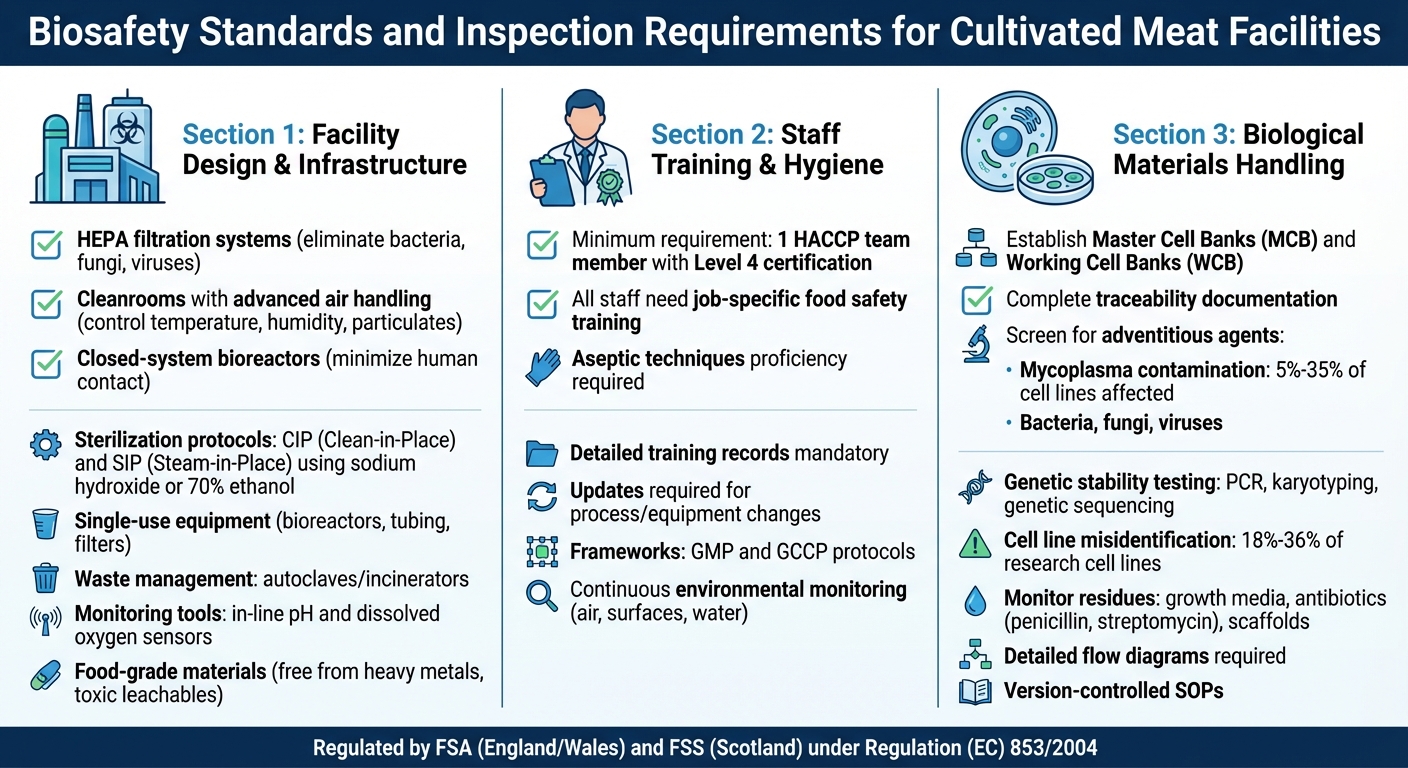
The design of a facility is fundamental to meeting biosafety inspection standards, as outlined in regulatory guidelines. Cultivated meat facilities must implement stringent structural measures to prevent contamination. For instance, HEPA filtration systems are required to eliminate bacteria, fungi, and viruses from the air [3]. Cleanrooms equipped with advanced air handling systems regulate temperature, humidity, and particulates, reducing microbial risks [4].
To limit human contact with cell cultures - a common source of contamination - facilities often rely on closed-system bioreactors and automated equipment [4][3]. Additionally, Clean-in-Place (CIP) and Steam-in-Place (SIP) protocols are essential for sterilising equipment between production runs, typically using sodium hydroxide or 70% ethanol [1][3]. The use of single-use bioreactors, tubing, and filters further minimises the risk of cross-contamination between batches [4].
Proper waste management and contamination monitoring are also critical. Facilities must include systems like autoclaves or incinerators for disposing of spent growth media and biological by-products. Monitoring tools, such as in-line pH and dissolved oxygen sensors, provide early warnings of potential contamination [1][4]. Moreover, all materials used - whether in bioreactor surfaces or piping - must meet food-grade standards and be free from harmful substances like heavy metals or toxic leachables that could compromise product safety [1][3].
Staff Training and Hygiene Requirements
While robust facility design is important, well-trained staff are equally crucial for maintaining controlled environments. According to UK hygiene regulations, at least one member of the HACCP team must have Level 4 training in HACCP principles. Additionally, all staff involved in monitoring and corrective actions need job-specific training in food safety protocols [5].
Personnel working with biological materials must be proficient in aseptic techniques to avoid introducing contaminants into cell cultures [4]. Facilities are required to keep detailed training records and update staff whenever there are changes to production processes, materials, or equipment [5]. Hygiene standards are further supported by frameworks like Good Manufacturing Practice (GMP) and Good Cell Culture Practice (GCCP), which set protocols for maintaining cleanliness. Continuous environmental monitoring of air, surfaces, and water ensures that microbial contamination is detected early [4].
Handling and Storage of Biological Materials
Handling biological materials requires meticulous protocols to ensure safety and compliance. Facilities must establish Master Cell Banks (MCB) and Working Cell Banks (WCB), with clear documentation for frozen storage and complete traceability of cell origins [2]. Screening for adventitious agents, such as bacteria, fungi, viruses, and mycoplasmas, is mandatory. Research findings indicate that 5% to 35% of cell lines may carry mycoplasma infections that evade standard filtration systems [1].
To monitor for genetic drift during extended production cycles, facilities conduct genetic stability testing using methods like PCR, karyotyping, or genetic sequencing [1][2]. Studies reveal that 18–36% of research cell lines suffer from misidentification or contamination, underscoring the need for rigorous checks [1]. Additionally, facilities must confirm that residues from growth media, antibiotics (e.g., penicillin and streptomycin), and scaffold materials remain within safe, food-grade limits [1][3].
Detailed flow diagrams are essential for tracking every step of the process, from cell sourcing to final packaging. Version control systems ensure that Standard Operating Procedures (SOPs) remain up-to-date, a requirement that facilitates smoother inspections [5]. These strict handling protocols form the backbone of compliance efforts, ensuring that facilities are prepared for thorough audits.
sbb-itb-ffee270
Audit Procedures and Compliance Verification
Inspection Checklists and Documentation
Audits in the UK food sector revolve around the seven HACCP principles, which all food business operators are legally required to follow. Inspectors typically focus on three key areas of documentation:
- The HACCP plan: This includes hazard analysis, process flow diagrams, and identified critical control points (CCPs).
- Policy documents: These outline hygiene procedures and related protocols.
- Operational records: These cover monitoring logs, calibration records, and other day-to-day compliance evidence.
To demonstrate ongoing compliance, facilities must maintain a well-organised safety folder. This should include monitoring results for critical limits, such as pH readings and temperature logs, alongside records of corrective actions taken when those limits are exceeded. Evidence of staff training is also crucial, with at least one member of the HACCP team required to hold a Level 4 certification. Additionally, all Standard Operating Procedures (SOPs) must be up-to-date, clearly dated, and version-controlled.
These records form the foundation for verification audits, which ensure continued compliance with safety protocols. Facilities should conduct verification audits annually, or more frequently if the nature of hazards, production volume, or past issues warrant it. Regulators distinguish between validation, which confirms the safety plan is theoretically effective before implementation, and verification, which involves regular checks to ensure the plan works in practice.
Managing Non-Compliance Issues
Failing to meet biosafety standards comes with immediate legal consequences. The Food Standards Agency (FSA) underscores this with the principle:
"Food must not be placed on the market if it is unsafe. This means that it is neither injurious to health nor unfit for human consumption."
When non-compliance occurs, facilities must follow a three-step response process:
- Restore immediate control: Address the issue promptly to minimise risks.
- Mitigate affected products: Take steps to manage and, if necessary, remove unsafe products from the market.
- Investigate root causes: Identify and rectify the underlying reasons for the breach.
Each corrective action must be clearly documented, including who is responsible and how the action’s effectiveness is verified.
Repeated non-compliance can lead to severe repercussions. According to FSA guidance:
"If corrective actions have to be taken repeatedly, it means there is a fundamental error with the food safety management system."
In such cases, regulators may launch thorough investigations, and operations could be suspended until the facility proves it has addressed systemic failures. Keeping detailed records of all corrective measures, including root cause analyses, is essential to demonstrate that long-term solutions have been implemented.
Industry Resources for Meeting Biosafety Standards
Ensuring biosafety compliance often requires more than just internal checks. External resources play a key role in helping facilities meet regulatory standards by providing access to verified tools and materials that align with inspection expectations.
Cellbase's Role in Biosafety Compliance
For cultivated meat producers, managing cell banks - the cornerstone of production - comes with its own set of challenges, especially since there aren’t standardised guidelines in place [2]. This makes sourcing compliant equipment and tracking the origins of cells particularly tricky.
Cellbase steps in to bridge this gap. It connects cultivated meat companies with trusted suppliers offering specialised equipment and materials tailored for biosafety needs. From bioreactors and growth media to scaffolds, sensors, and cell lines, the platform offers a range of products designed specifically for cultivated meat production. Each product listing includes detailed specifications, such as compatibility with scaffolds, serum-free formulations, or GMP compliance, making it easier for procurement teams to find materials that meet regulatory standards. By focusing on these specific needs, Cellbase helps reduce technical risks and ensures that facilities work with suppliers who truly understand the complexities of cultivated meat production.
Working with Third-Party Auditors
Third-party auditors bring an extra layer of assurance by verifying HACCP plans and boosting confidence in food safety management systems [5]. Their expertise includes conducting microbiological challenge studies, such as evaluating the growth potential of pathogens like Listeria in cultivated meat. These studies provide critical safety data, which is especially important given that the industry experiences an average microbiological contamination batch failure rate of 11.2% [11].
Engaging with third-party auditors early on can also help facilities prepare for FDA pre-market reviews and USDA inspections [12][9]. To streamline the compliance process, audit reports should be added to permanent HACCP folders, ensuring that facilities are ready to demonstrate adherence to safety standards during official inspections [5].
Conclusion
Biosafety inspections play a crucial role in safeguarding public health and maintaining industry trust within the cultivated meat sector. The UK's stringent hygiene regulations set a high bar for facilities, ensuring they tackle risks like mycoplasma contamination and cell line misidentification head-on [5][1].
Programmes like the CCP sandbox have helped clarify regulatory expectations, streamlining the path for emerging food technologies without compromising safety. To meet these standards, producers must implement robust measures, including authenticated cell banking, ensuring at least one team member holds Level 4 HACCP training, and conducting annual safety plan reviews [5][1][2]. The industry's gradual shift towards serum-free media and adoption of real-time monitoring technologies underscores its dedication to addressing both conventional food safety concerns and unique risks tied to cultivated meat production.
External support also bolsters compliance efforts. Platforms like Cellbase connect producers with trusted suppliers, ensuring access to reliable equipment and expertise. Independent third-party audits further validate safety systems, providing an additional layer of confidence. Together, these internal and external measures form a thorough biosafety framework that not only protects consumers but also supports progress in the industry.
Strong biosafety practices are essential - not just to gain market approval but also to uphold the industry's reputation and drive its future growth.
FAQs
What triggers a biosafety inspection in a cultivated meat facility?
Biosafety inspections in cultivated meat facilities play a crucial role in ensuring adherence to important standards such as ISO 14644-1, EU GMP Annex 1, and EN 17141. These inspections are usually conducted at key stages, including the design, construction, and certification phases. The primary goal is to prevent microbial contamination and uphold safety throughout the process.
How do producers ensure their cell lines remain authentic and stable over time?
Producers maintain the integrity and reliability of their cell lines by implementing strict cell banking procedures. These processes involve confirming the identity of cell lines, regularly assessing their stability, and adhering to established industry standards and guidelines. By following these protocols, they ensure consistent and dependable outcomes in cultivated meat production.
What happens if contamination is found during production?
Contamination during production can lead to serious issues, such as failing to meet safety standards, product recalls, and increased microbial risks. This highlights the need for rigorous hygiene practices and robust certification processes to protect both product safety and quality.


