

Cleaning validation ensures production equipment in cultivated meat facilities is thoroughly cleaned to remove residues like cell debris, growth media, and microbes. It's crucial for preventing cross-contamination, especially in multi-product setups.
Key points:
- Why It Matters: Without proper cleaning, residues from one batch can contaminate the next. Shared equipment like bioreactors and tools are high-risk areas.
- Regulatory Standards: Compliance with guidelines like HACCP, GMP, and UK-specific regulations is mandatory.
-
Steps to Validate Cleaning:
- Choose the right cleaning agents (e.g., alkaline for proteins, acidic for minerals).
- Test under "worst-case" conditions (e.g., sticky or high-protein residues).
- Use swab sampling and set measurable limits (e.g., 10 ppm for chemical residues).
- Perform three consecutive cleaning cycles to ensure effectiveness.
- Monitoring Tools: ATP swabs, TOC analysis, and microbiological plating help verify cleanliness.
Cleaning validation is not just about safety - it's about ensuring consistent, reliable production and maintaining trust in cultivated meat products.
Regulatory and Biosafety Requirements
Relevant Regulatory Guidelines
In the UK, cultivated meat falls under the oversight of the Food Standards Agency (FSA) and Food Standards Scotland (FSS). These agencies evaluate risks and establish requirements for such products within the Novel Foods framework. Additionally, certain products may need to comply with GMO or PBO regulations.
Compliance with these regulations relies on well-established quality assurance systems:
- HACCP (Hazard Analysis and Critical Control Points): Focuses on identifying and controlling microbial hazards.
- GMP (Good Manufacturing Practices): Ensures consistent production and quality control.
- GCCP (Good Cell Culture Practices): Addresses cell line handling to minimise contamination risks.
- GHPs (Good Hygiene Practices): Covers general operational and environmental standards.
The Codex Alimentarius principles form the foundation for crafting specific industry guidelines and quality control plans, taking cues from sectors like clinical and biopharmaceutical industries.
"The principles of Codex and HACCP provide a solid basis to build specific guidelines and quality control plans for this sector, and learnings can be drawn from the clinical / biopharmaceutical industry and adapted to novel food requirements."
– FSA Research and Evidence [1]
To ensure reliability, microbiology and cleaning validations should align with UKAS standards. Lessons from clinical and biopharmaceutical practices can be tailored for food production, addressing the unique challenges cultivated meat facilities face.
Biosafety Risks in Multi-Product Plants
Facilities producing multiple cultivated meat products encounter biosafety concerns that go beyond the typical risks of food manufacturing. These include:
- Traditional foodborne pathogens: Such as enterobacteria and animal viruses.
- Hidden contaminants: Like mycoplasma and mycobacteria, which evade detection in culture media as they do not cause visible turbidity and require specialised testing.
These risks are particularly heightened in shared equipment setups, where visual inspections alone cannot guarantee cleanliness. Effective cleaning validation is essential to eliminate harmful substances such as endotoxins, exotoxins, and mycotoxins, even in trace amounts.
Advanced monitoring techniques can help mitigate these risks. For instance, in-line monitoring of pH and dissolved oxygen levels can signal microbial growth early, indicating potential cleaning or sterilisation failures. Additionally, environmental monitoring of air, surfaces, and water within the facility can identify contamination threats before they affect production.
"As the industry continues to develop and adapt equipment and processes for CCP production, cleaning, sterilisation and other relevant procedures will require assessment and validation and national/international standards should be developed."
– FSA Research and Evidence [1]
These measures highlight the critical importance of rigorous cleaning and validation protocols to prevent cross-contamination and ensure the safety of every production batch.
sbb-itb-ffee270
Cleaning Validation in 10 Steps in Pharma | Cleaning Validation Complete Guideline
Creating a Cleaning Validation Protocol
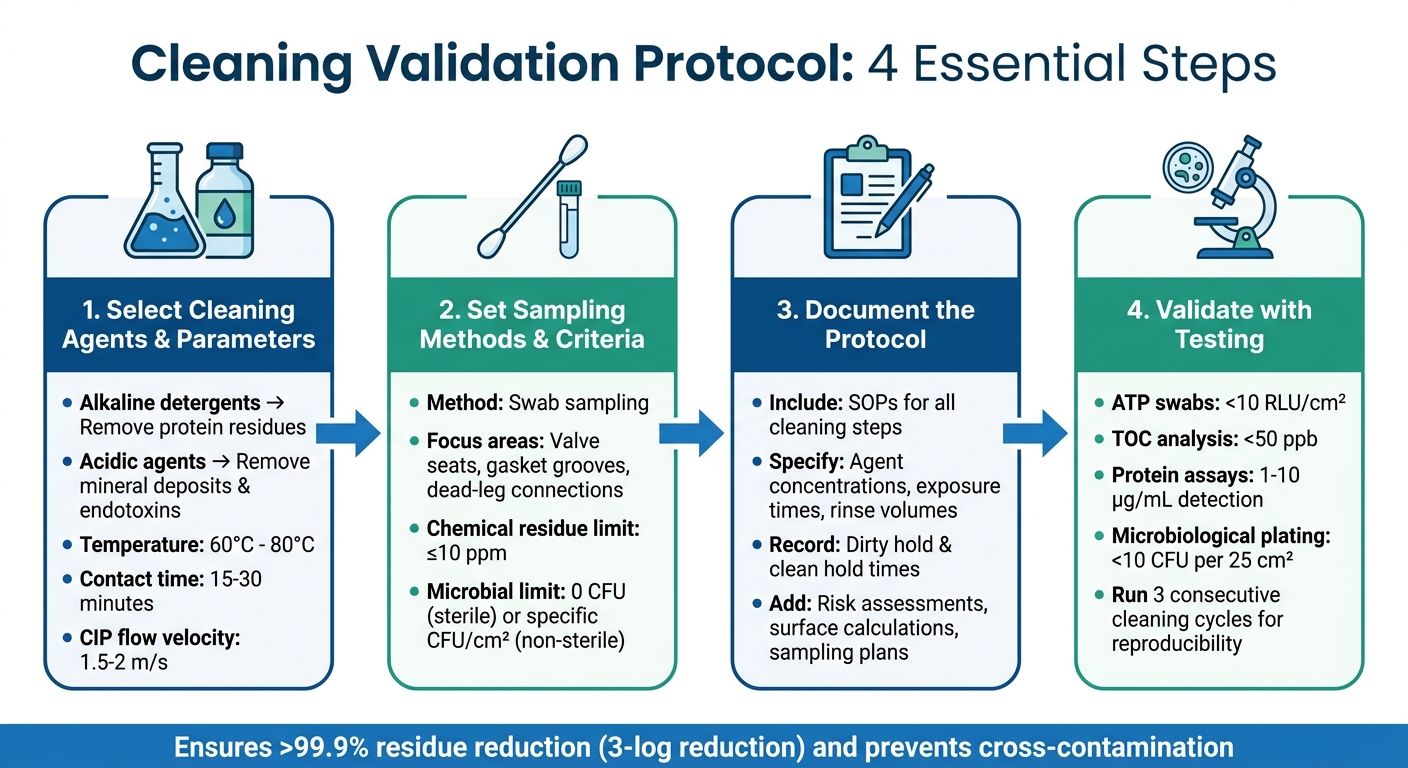
4-Step Cleaning Validation Protocol for Cultivated Meat Facilities
Selecting Cleaning Agents and Parameters
Choosing the right cleaning agents depends on the type of residue and the materials used in your equipment. For cultivated meat facilities, stainless steel bioreactors (usually 316L grade) are common. These require alkaline detergents to remove protein residues, while acidic agents are ideal for tackling mineral deposits and endotoxins. To maximise the effectiveness of detergents without harming seals or gaskets, maintain cleaning temperatures between 60°C and 80°C.
Allow cleaning agents to remain in contact for 15–30 minutes, especially in tricky areas like impeller blades and sensor ports. For clean-in-place (CIP) systems, ensure a flow velocity of 1.5–2 m/s to effectively remove biofilm. These parameters should be meticulously documented, as they form the backbone of your validation study.
Setting Sampling Methods and Acceptance Criteria
Swab sampling is the go-to method for detecting residues on equipment surfaces. Focus on areas that are hardest to clean, such as valve seats, gasket grooves, and dead-leg connections. These spots provide a robust test of how effective your cleaning process is.
Acceptance criteria must be grounded in scientific evidence. For chemical residues, a limit of 10 ppm is widely recognised, representing either 1/1000th of a therapeutic dose or a toxicologically safe level. For microbial bioburden, sterile products demand a complete absence of viable organisms, while non-sterile products may allow specific colony-forming unit (CFU) counts per square centimetre. When setting residue limits, consider the total surface area of the equipment and account for the most challenging product scenarios.
"A cleaning validation protocol is a detailed plan describing all the validation activities. It comprises a specific validation objective and grouping of products and equipment to validate." – Kazi, GMP Expert [3]
All sampling methods and acceptance criteria must be thoroughly recorded in the protocol.
Documenting the Protocol
Once cleaning parameters and sampling methods are established, compile the full cleaning process into a detailed protocol. This documentation must adhere to both regulatory and biosafety standards. Include standard operating procedures (SOPs) that outline every step of the cleaning process, from the initial pre-rinse to the final inspection. Specify cleaning agent concentrations, exposure times, rinse volumes, verification checks, and the durations for both "dirty hold" and "clean hold" times.
Also, include risk assessments, surface area calculations, sampling plans, and validations for analytical methods. The final validation report, once approved by management, will confirm whether your cleaning process meets all required criteria and complies with regulations [3].
Running Validation Studies
Choosing Worst-Case Scenarios
Identifying the toughest cleaning challenges is key to proving your cleaning process works effectively. In cultivated meat facilities, residues like high-protein growth media or sticky cultivated meat scaffolds that adhere to bioreactor walls are among the most difficult to remove.
Start by ranking your products based on factors like solubility, viscosity, protein content, and how long they remain in contact with surfaces. For example, growth media with a 20% protein concentration that has been in use for 72 hours increases the risk of denaturation and biofilm formation [4][5]. Pay special attention to equipment with intricate designs - like impeller blades, valve seats, and sensor ports - as these areas are notoriously hard to clean. Testing scenarios such as a high-fat medium versus a high-sugar medium can also help cover the spectrum of products you handle [6][7].
Once you've defined the worst-case scenarios, focus on validating the process by repeating cleaning cycles.
Conducting Consecutive Cleaning Cycles
Performing three consecutive cleaning cycles is an effective way to confirm both reproducibility and efficiency. This approach mimics actual production settings, ensuring no residue is carried over between batches - especially critical when switching from allergen-containing media.
To begin, soil the equipment with the identified worst-case product (e.g., 10% growth media in a bioreactor). Then, run a full cleaning cycle according to your protocol, sampling both before and after cleaning. Repeat this process twice more without re-soiling the equipment. Data show that by the third cycle, residue levels for protein soils are reduced by more than 99.9% (a 3-log reduction) [4][8]. Pilot plant trials have consistently shown ATP levels drop below 10 RLU/cm² after consecutive cycles [5][9].
Once you confirm consistent cleaning results, employ a variety of residue detection methods for thorough validation.
Testing Methods for Residue Detection
To ensure biosafety and meet regulatory standards, combine multiple residue detection methods. ATP swabs are a good starting point, offering rapid screening for organic residues and microbes, with detection limits as low as 100 RLU (equivalent to fewer than 1,000 CFU/cm²). Total organic carbon (TOC) analysis is another essential tool, measuring organic residues from growth media with acceptable limits typically set below 50 parts per billion. For protein-specific detection - critical in cultivated meat production - assays like Bradford or BCA can identify residues at concentrations as low as 1–10 µg/mL [6][7].
Microbiological plating adds another layer of precision by identifying viable cells that remain after cleaning. Use contact plates or swabs on cleaned surfaces, incubating samples at 30–35°C for 48–72 hours on tryptic soy agar. Sterile products generally require fewer than 10 CFU per 25 cm². Research conducted on stainless steel surfaces has demonstrated fewer than 1 CFU after three cleaning cycles [8][10]. For cultivated meat applications, combine ATP swabs for rapid checks with advanced methods like HPLC-MS to detect trace allergens, such as foetal bovine serum, at levels as low as 0.1 ppm [6][7].
For guidance on GMP-compliant testing equipment, consult Cellbase.
Sourcing Cleaning Validation Equipment via Cellbase
Once you’ve set up effective residue detection methods, the next step is ensuring you have the right equipment to maintain your cleaning validation processes.
GMP-Compliant Equipment and Supplies for Validation
Cellbase serves as a hub for connecting with trusted suppliers offering GMP-compliant cleaning validation equipment specifically designed for cultivated meat facilities. Through this marketplace, you can access tools like ATP metres, spectrophotometers, swabs, and sampling kits - all tailored to detect residues from growth media and cultivated meat production processes.
When sourcing swabs, ask suppliers for recovery data to confirm their effectiveness. Health Canada’s guidance [2] emphasises that cleaning processes should adhere to Quality Risk Management principles. To meet these standards, ensure your sampling tools have been validated through recovery studies. Additionally, verify that the sensitivity of your residue detection tools matches the Health Based Exposure Limits (HBEL) you’ve calculated.
Focus on suppliers on Cellbase who provide GMP documentation that aligns with standards such as Part C, Division 2 of the Food and Drug Regulations or PIC/S guidelines [2]. This ensures the equipment supports all three cleaning validation phases: design and development, qualification, and ongoing monitoring.
Solutions for Multi-Product Cultivated Meat Facilities
Multi-product facilities face unique challenges, particularly the risk of cross-contamination when switching between cell lines or media that might contain allergens. Cellbase offers equipment designed to minimise these risks, featuring sanitary designs with smooth welds, no dead legs, and surfaces that are easy to clean. These features help reduce residue build-up and microbial growth.
If you rely on automated CIP systems, look for equipment that tracks critical cleaning parameters such as temperature, pressure, and flow rate. Health Canada highlights that "The HBEL, such as the PDE or TTC, can then be used in risk identification and justification of maximum safe carryover limits into the next product" [2]. The CIP equipment available through Cellbase should support precise parameter monitoring to ensure consistent cleaning across cycles. Make sure components like timers, temperature probes, and dosing pumps are properly calibrated for reliable performance.
Conclusion
Cleaning validation plays a crucial role in ensuring the safety and reliability of multi-product cultivated meat production. It goes beyond meeting regulatory requirements - it's an investment in maintaining safety standards, operational efficiency, and consumer trust. By thoroughly validating that cleaning processes eliminate cross-product contamination and biosafety risks, facilities not only meet compliance but also minimise the chances of costly recalls or operational disruptions, while reinforcing confidence in cultivated meat products.
The key to effective cleaning validation lies in setting clear, measurable goals that align with regulatory expectations. For instance, replacing vague objectives with specific targets - like defining acceptable residue removal rates - ensures accountability and improves production outcomes. This approach not only satisfies regulatory demands but also provides a solid framework for the practical measures outlined earlier.
Consistency is vital. Conduct quarterly reviews to evaluate the effectiveness of cleaning protocols and make adjustments based on performance data. Use the recommended leading and lagging indicators to track progress, and update documentation regularly as new insights or regulatory changes emerge [4].
FAQs
How do I set residue limits for each product changeover?
To establish residue limits, begin with a thorough risk assessment to pinpoint critical residues that could pose a concern. Use advanced analytical techniques like HPLC (High-Performance Liquid Chromatography) or TOC (Total Organic Carbon) analysis during the validation process to measure residue levels accurately.
Once you've gathered data from cleaning runs, employ statistical methods - such as calculating the mean plus 2 or 3 standard deviations - to determine acceptable thresholds. These calculations help define limits that are both safe and compliant with industry standards.
It's essential to regularly revisit and refine these limits. Ongoing monitoring and validation ensure that the residue thresholds remain effective and aligned with safety requirements in the ever-evolving field of cultivated meat production.
What’s the best way to choose a “worst-case” soil in a multi-product plant?
When choosing a "worst-case" soil in a multi-product cultivated meat facility, focus on the residue that's the hardest to clean or poses the greatest risk for cross-contamination. This could include certain proteins, fats, or components of the media. By testing cleaning methods on this challenging residue, you can confirm that the process is thorough enough to manage all other residues, ensuring effective decontamination throughout the plant.
When should I revalidate cleaning after a process or recipe change?
Revalidating cleaning becomes essential whenever there are changes to processes, materials, or equipment that might affect the cleaning protocol’s efficiency or bring in new residues. This step ensures that residues such as proteins, fats, or cellular debris are effectively removed, reducing the risk of contamination. Additionally, regular revalidation should be part of routine procedures to uphold compliance and biosafety standards within cultivated meat production facilities.


