

If I had to reduce this choice to one rule, it would be this: use contact plates on flat, easy-to-reach surfaces, and use swabs on curved, recessed or awkward ones. In most cultivated meat cleanrooms, that single decision point matters more than anything else because the wrong tool can give poor recovery, uneven counts, or data you cannot trend with confidence.
For bioprocess engineers and cell culture teams, the article boils down to four points:
- Contact plates suit flat benches, worktops and other exposed smooth surfaces.
- Swabs suit seals, valves, tubing, joints, corners and other hard-to-reach points.
- Contact plates give more standardised results because the contact area stays fixed.
- Swabs need tighter technique control because stroke pressure, angle and handling can vary between operators.
The article also covers the support pieces that affect recovery just as much as the sampling device itself:
- TSA for routine broad-range recovery
- SDA when yeasts and moulds are the main concern
- Neutralisers matched to disinfectant chemistry, especially where quats or phenolics may leave residues
- 10 × 10 cm templates for swab area control where the surface allows it
SAMPLING | Contact Plate Sampling: How to Sample Surfaces Using Contact Plates
sbb-itb-ffee270
Quick Comparison
| Criteria | Contact plates | Swabs |
|---|---|---|
| Best surface type | Flat, smooth, accessible | Curved, recessed, uneven, tight-access |
| Main strength | Fixed sample area | Can reach awkward sites |
| Main weakness | Poor fit on irregular geometry | More operator-dependent |
| Typical use | Routine monitoring on flat critical surfaces | Complex equipment points, follow-up checks, cleaning checks |
| Handling steps | Fewer | More, including transfer and dilution |
| Recovery consistency | Usually more consistent | Often less consistent |
| Area control | Built into the plate format | Often needs a template |
I’d treat this as a surface-fit decision first, then a media and neutraliser decision second. That is the core point of the article, and it is the safest way to set up a routine sampling plan without leaving gaps.
Contact plates: standardised sampling for flat, accessible surfaces
A contact plate is a shallow plate with a raised agar surface made for direct sampling on flat surfaces. You press the plate onto the surface, incubate it, then count the colonies.
Where contact plates work well
Contact plates are best suited to exposed, flat areas where direct contact is consistent. In practice, that means flat, exposed surfaces such as worktops and bench tops.
Strengths and limitations of contact plates
The main upside is the fixed contact area. Because that area stays the same from sample to sample, results are easy to compare over time. They’re also simple to use, which is one reason they remain common in routine surface monitoring.
The limits mostly come down to surface shape and condition. Contact plates do not work well on curved, recessed or uneven surfaces because the rigid agar cannot make full contact. They’re also a poor choice for delicate surfaces if pressure, or contact with the agar itself, could cause damage. Another issue is residual disinfectant, which can suppress growth and distort colony counts.
| Aspect | Contact plates |
|---|---|
| Sampling fit | Best for flat, smooth, accessible surfaces |
| Standardisation | High - fixed contact area makes results easy to compare |
| Irregular geometries | Poor fit - rigid agar cannot conform |
| Delicate surfaces | Avoid if pressure may damage the surface |
| Disinfectant residues | Residual disinfectant can suppress growth and distort counts |
When the surface is curved, recessed or irregular, swabs are the better fit.
Swabs: flexible sampling for irregular and hard-to-reach areas
When contact plates can't reach a surface, swabs are the practical option. A swab picks up microorganisms from the surface and transfers them into transport medium or a diluent for plating. And when contact plates still don't give enough reach, sponge or cloth formats can cover larger areas.
If the surface allows it, use a sterile 10 × 10 cm template. Swab with horizontal strokes first, then vertical strokes, and place the swab into transport medium or diluent for enumeration.
Where swabs are the better fit
Cultivated meat facilities have plenty of awkward surfaces that flat contact plates can't sample properly. Think bioreactor seals, valves, joints and tubing. These are exactly the kinds of sites swabs are meant to monitor.
Swabs also work well in narrow recesses, tight corners and other hard-to-access parts of the facility where a contact plate can't make full surface contact. That makes them a good fit for cleaning validation and contamination investigations in more complex cultivated meat production settings.
Strengths and limitations of swabs
The main advantage of swab sampling is flexibility. Standard swabs suit small crevices and narrow features. Sponge or cloth formats make more sense for broader equipment surfaces where you need to sample a larger area.
But the downsides matter. Swab data are highly operator-dependent because stroke pressure and technique can vary from person to person. Swabs also involve more manual steps than contact plates, including transfer and dilution, which increases the chance of handling error and contamination. Recovery can also be less consistent than with contact plates, especially on some surface materials.
Put simply, the trade-off is reach versus standardisation.
| Aspect | Swabs |
|---|---|
| Sampling fit | Excellent for curved, recessed, irregular and hard-to-reach surfaces |
| Standardisation | Lower - pressure and technique can vary between operators |
| Larger surface coverage | Use sponge or cloth formats for wider equipment areas |
| Handling steps | More steps (transfer and dilution) than contact plates |
| Recovery consistency | Often less consistent than with contact plates |
That trade-off stands out most clearly when swabs are compared head-to-head with contact plates.
Contact plates vs swabs: side-by-side comparison for routine monitoring
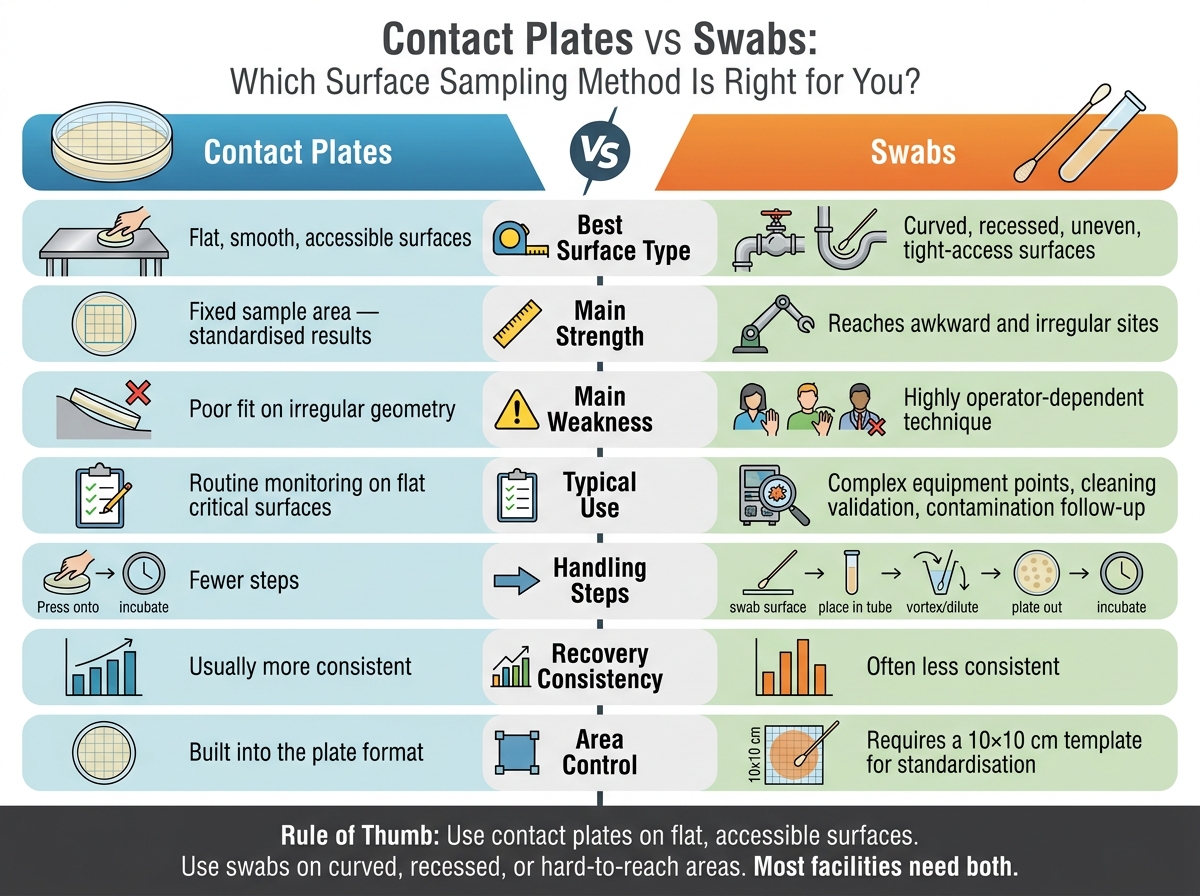
Contact Plates vs Swabs: Surface Sampling Method Comparison
Recovery, standardisation and handling trade-offs
In day-to-day cleanroom work for cultivated meat, the choice between contact plates and swabs is usually pretty simple: pick the method that fits the surface. Contact plates work best on flat, easy-to-access areas and give more standardised results. Swabs are better for uneven, awkward or tight spaces, but the method is less standardised in practice. In most cases, surface geometry is the main deciding factor.
Which method suits which monitoring need
For routine programmes, the practical approach is to match the method to the surface, not force the surface to fit the method. Use contact plates for routine monitoring of critical flat surfaces. Use swabs where the shape or access makes reliable plate contact hard or impossible.
Why most facilities need both methods
Most cultivated meat facilities need both methods. Contact plates cover flat surfaces well, while swabs deal with irregular ones. Used together, they help close monitoring gaps.
Building a practical sampling programme and sourcing the right tools
Match method, media and neutralisers to the surface
Once you've chosen the sampling method, build the programme around the media, neutralisers and tools that make that method work properly. The simplest way to do this is to map each monitored surface to a single method: use contact plates for flat, easy-to-access areas, and use swabs for irregular or awkward points.
Media choice matters. Use TSA for routine broad-range recovery. Use SDA when yeasts or moulds are the main concern.
Neutralisers matter just as much. The neutraliser needs to match the cleaning chemistry in use. Residues from quats, phenolics and similar disinfectants can suppress microbial growth and make counts look lower than they are. If the neutraliser doesn't fit the disinfectant chemistry, the result can be a falsely low recovery.
For swab sampling, use stainless-steel or plastic templates to define a consistent sampling area. This keeps the sampled area the same from one test point to the next. Flexible swabs work well on irregular or hard-to-reach surfaces, and templates help standardise both where and how you sample.
Using Cellbase to support procurement
Once the sampling list is set, it helps to source the required consumables in one place. Cellbase is a specialised B2B marketplace for cultivated meat that helps procurement and technical teams source environmental monitoring consumables, sampling templates and other cleanroom tools from verified suppliers. It supports sourcing for both contact plate and swab-based monitoring programmes, including contact plates, swab systems and sampling templates.
Key takeaways
- Contact plates are the best fit for routine monitoring of flat, accessible surfaces.
- Swabs are better for irregular or hard-to-reach areas.
- Procure both contact plate and swab consumables to cover all monitored surfaces.
- Match media, neutralisers and sampling tools to the surface type and cleaning chemistry in use.
FAQs
How do I choose between contact plates and swabs?
Choose the method based on the surface and what you need to measure. Contact plates work best on flat, non-porous surfaces because the agar makes direct contact with the test area and gives a quantitative result.
Swabs are a better fit for irregular, hard-to-reach, or complex equipment surfaces where a plate can’t sit flush. Cellbase helps cultivated meat teams source these monitoring tools for production.
When should I use neutralisers in surface sampling?
Use neutralisers when the sampled surface has been treated with chemical sanitisers or disinfectants. Residues can suppress microbial growth during testing and lead to inaccurate results.
Neutralisers stop these chemicals from carrying on their action, so any surviving micro-organisms stay viable and can be recovered for analysis.
How can I make swab results more consistent?
Standardise your sampling technique. Use a defined template so the same surface area is sampled each time, apply steady pressure, and follow the same swabbing pattern, such as horizontal and vertical passes.
For specialised swabs and sampling materials for cultivated meat cleanroom monitoring, Cellbase offers verified supplies through its dedicated B2B marketplace.


