

Microbial contamination is a critical challenge in cultivated meat production. Bioreactors provide ideal conditions for cell growth but also create opportunities for bacteria, fungi, and viruses to thrive. Detecting contamination early is essential to prevent production losses, ensure safety, and meet regulatory standards. Here’s a quick breakdown of the main detection methods:
- Culture-Based Techniques: Cost-effective and simple but slow and limited to visible contaminants like bacteria and fungi.
- PCR (Polymerase Chain Reaction): Highly sensitive and precise, ideal for detecting viruses and mycoplasma, but not suitable for real-time use.
- Immunoassays: Effective for identifying toxins and specific contaminants but require manual sampling and processing.
- Spectroscopic Sensors: Real-time, continuous monitoring of microbial by-products, though they only detect indirect indicators.
- Flow Cytometry: Offers detailed analysis of cell populations but is better suited for periodic checks rather than continuous monitoring.
Each method has strengths and weaknesses, and combining them often provides the best results. Advanced tools like AI-driven sensors and single-use systems are also helping to improve detection and reduce risks in large-scale operations. Below, we’ll dive into how these methods work and their role in cultivated meat production.
1. Culture-Based Techniques
Culture-based detection remains a classic method for spotting microbial contamination in cultivated meat bioreactors. The concept is simple: microorganisms multiply until they reach a point where they make the culture medium visibly cloudy. This turbidity serves as a clear indicator of contamination caused by most bacteria, yeast, and fungi [1].
But here's the catch - this method has its limitations. According to the FSA Research and Evidence: "Whilst most bacteria, yeast and fungi turn the culture medium turbid and thus are easy to detect in culture, viruses, mycobacteria and mycoplasma are too small and do not cause turbidity, which means that testing would be needed to detect them" [1]. Mycoplasma, in particular, is a notorious issue in cultivated meat production. It's not only common but also hard to eliminate, and it completely bypasses detection through visual inspection.
Detection Time
One of the biggest drawbacks of culture-based methods is the time it takes to detect contamination. The process relies on the growth rate of the contaminant, meaning detection only occurs once colonies have grown enough to become visible. This delay can range from several hours to multiple days. By the time turbidity is noticeable, the contamination may already have spread significantly. Compared to in-line real-time monitoring sensors, this approach is far slower.
Sensitivity
While these methods are great for identifying fast-growing aerobic bacteria, they fall short when dealing with contaminants that don't cause turbidity. Detection requires a substantial microbial load, which makes it less effective for identifying low levels of contamination. In contrast, molecular methods, like PCR, can pick up even trace amounts of contamination by targeting genetic material directly.
Suitability for Real-Time Use
Culture-based techniques are simply not designed for real-time monitoring. The FSA Research and Evidence highlights the importance of real-time tools, noting that "in-line real-time processing monitoring of parameters indicative of microbial growth (e.g., pH, dissolved oxygen) will help early detection of contamination" [1]. In the context of cultivated meat production - where both safety and cost efficiency are critical - this delay limits culture-based methods to a supporting role rather than a frontline defence.
Next, we’ll explore molecular techniques that provide faster and more sensitive detection.
sbb-itb-ffee270
2. Polymerase Chain Reaction (PCR) Methods
When it comes to speed and sensitivity, PCR steps in where culture-based techniques fall short. It's especially important for spotting contaminants like viruses, mycobacteria, and mycoplasma in cultivated meat bioreactors - organisms that often slip past traditional methods because they don't create the visible turbidity those techniques rely on. Mycoplasma, in particular, is a persistent problem in cultivated meat production, making PCR an essential tool. This section delves into PCR's ability to deliver both high sensitivity and precision, while also addressing the challenges of integrating it into real-time processes.
Sensitivity
PCR is unmatched in its ability to detect even the tiniest amounts of contaminant DNA, far beyond the capabilities of culture-based methods. Its sensitivity is crucial for identifying microbial risks, even when contamination levels are low. Unlike traditional approaches that demand significant microbial growth to detect issues, PCR picks up on trace amounts of genetic material. This makes it indispensable for screening inputs like medium components and animal-derived ingredients (e.g., bovine serum) before they enter the bioreactor. By catching potential threats early, PCR helps safeguard the production process.
Specificity
While PCR's sensitivity is impressive, its ability to precisely identify specific contaminants sets it apart. It allows teams to pinpoint and differentiate between various microbial species and strains, enabling more targeted responses to contamination. However, to fully harness this precision, validated protocols tailored to cultivated meat systems are necessary. At present, the lack of standardised microbial thresholds for this industry highlights the need for further research and method development. Customised testing solutions are still evolving to meet the unique demands of cultivated meat production.
Suitability for Real-Time Use
Despite its strengths, PCR isn't without its challenges - particularly when it comes to real-time monitoring. As a discrete method, PCR requires samples to be removed and processed, causing delays compared to in-line sensors that provide immediate feedback. According to FSA Research and Evidence [1], this limitation underscores the need for alternative technologies. Efforts to develop real-time microbial metabolite sensors and integrate artificial intelligence for enhanced monitoring are underway, but these innovations are not yet ready for widespread use in production settings.
3. Immunoassay Techniques
Immunoassays address a critical limitation of culture-based methods, especially when contaminants fail to cause visible turbidity. Research shows that many contaminants - such as viruses, mycobacteria, and mycoplasma - cannot be reliably detected through simple visual checks, highlighting the importance of immunoassays [1]. In the context of cultivated meat bioreactors, these tests are indispensable for screening animal-derived inputs like bovine serum or its alternatives for zoonotic viruses before they enter the production process. Immunoassays work alongside culture-based and PCR methods, targeting toxins and low-level contaminants that might otherwise go unnoticed. This combination allows for quicker and more precise contaminant detection.
Detection Time
Unlike nucleic acid detection methods, immunoassays provide a faster option for toxin screening. They deliver results much quicker than culture methods, which rely on microbial growth for detection. This speed is particularly beneficial for endotoxin testing, a routine measure that ensures bacterial toxins don't compromise cell cultures. However, immunoassays still require samples to be removed and processed, meaning they lack the immediate feedback offered by in-line sensors that monitor parameters like pH or dissolved oxygen.
Sensitivity and Specificity
Immunoassays are highly effective at detecting even small amounts of toxins, making them ideal for identifying endotoxins, exotoxins, mycotoxins, and cyanotoxins. That said, current endotoxin tests such as LAL (Limulus Amebocyte Lysate) and rFC (recombinant Factor C) need further refinement to perform accurately across the diverse and complex matrices found in cultivated meat production [1]. As noted by FSA Research and Evidence:
"To do this, the performance of existing methods in novel matrices must be investigated and validated, and new methods developed where needed" [1].
Until these methods are validated, their reliability in such applications remains uncertain.
Suitability for Real-Time Use
Immunoassays are not designed for continuous, real-time monitoring. They are typically used at regular intervals or at-line, rather than being integrated directly into the bioreactor. While in-line sensors can monitor indirect indicators of contamination, such as changes in pH or dissolved oxygen, developing real-time detection methods for specific pathogens and microbial by-products remains a significant challenge [1]. For now, immunoassays are best suited for targeted screening and serve as a valuable part of a broader contamination monitoring strategy. They provide critical insights but work most effectively when combined with other methods for comprehensive surveillance.
4. Spectroscopic and Real-Time Monitoring Sensors
Spectroscopic sensors are transforming how microbial contamination is monitored in cultivated meat bioreactors. Unlike traditional methods like immunoassays or culture-based techniques, which require stopping the process to remove samples, these sensors integrate directly into the bioreactors. This allows for continuous, non-invasive monitoring. Technologies such as Raman spectroscopy, near-infrared (NIR) spectroscopy, and fluorescence spectroscopy each work differently to detect microbial signatures. Raman spectroscopy uses laser light scattering to identify molecular vibrations, NIR measures infrared absorbance patterns, and fluorescence detects emitted wavelengths from excited cells. These sensors can pick up on metabolic byproducts and changes in biomass, providing early warnings of contamination while keeping the process uninterrupted.
Detection Time
One of the standout features of spectroscopic sensors is their speed. They deliver results in seconds or minutes. For example, Raman spectroscopy can complete a scan in under five minutes, while optical sensors like turbidity probes detect changes within 10–30 seconds. A notable case occurred in June 2023, when Upside Foods used Raman spectroscopy in their pilot-scale bioreactors. During a 500 L chicken cell production run, they identified Lactobacillus contamination at 150 CFU/mL within 12 minutes. This rapid detection triggered an automatic shutdown, preventing significant losses and maintaining an impressive 99.8% process uptime.
Sensitivity and Specificity
The sensitivity of spectroscopic sensors varies depending on the method and the environment. They typically detect microbial levels ranging from 10² to 10⁴ CFU/mL. Fluorescence-based sensors, for instance, can detect yeast at concentrations as low as 50 cells/mL in serum-containing media, with nanoparticle enhancements pushing this threshold down to 10 CFU/mL. This is particularly important for sterile environments in cultivated meat production. Specificity is another strength, often exceeding 90%, thanks to advanced techniques like multivariate spectral analysis and machine learning algorithms. For example, principal component analysis applied to Raman data achieves over 95% specificity in distinguishing bacterial from mammalian cells. However, complex growth media can reduce this specificity to 85–90% without further optimisation. Deep learning algorithms further enhance accuracy, with some models distinguishing E. coli from Staphylococcus with 98% precision, significantly reducing false positives.
Suitability for Real-Time Use
These sensors are a vital part of a comprehensive detection strategy, complementing traditional methods like culture tests, PCR, and immunoassays. Designed for 24/7 operation, they are particularly suited for large-scale bioreactors. Multi-parameter probes that combine pH, dissolved oxygen, and Raman spectroscopy ensure minimal downtime and help meet GMP compliance standards. For example, in September 2024, Mosa Meat adopted NIR spectroscopy sensors from Hach Lange in their bovine cell bioreactors. These sensors identified Escherichia coli contamination at 200 CFU/mL within five minutes across 10 batches. According to project head Dr Tom Collins, this resulted in a 40% reduction in contamination incidents, saving £150,000 in production costs.
However, practical challenges remain. Issues like biofouling and signal drift are being tackled with self-cleaning probes and automated calibration systems. Bioreactor engineers recommend hybrid setups that combine spectroscopy with impedance sensors for added reliability. Tests in 500 L vessels have demonstrated 99% uptime using these systems. Platforms like Cellbase are also helping producers by offering curated lists of spectroscopic sensors and real-time monitoring tools tailored for cultivated meat bioreactors, connecting them with trusted suppliers.
5. Flow Cytometry Analysis
Flow cytometry complements the real-time monitoring abilities of spectroscopic sensors by providing detailed, scheduled evaluations of microbial contamination. This technique examines individual cells using laser illumination. By employing fluorescent markers, it distinguishes microbial cells from cultivated meat cells based on traits like size and granularity. This allows for the quick analysis of large cell populations and helps detect even low levels of contamination in mixed cultures.
Detection Time
While flow cytometry delivers results more quickly than traditional culture methods, it doesn’t provide the continuous, real-time tracking that spectroscopic sensors offer. The process involves steps like sample collection, dye staining, and analysis, making it better suited for scheduled quality checks rather than ongoing monitoring. However, its ability to identify subtle cellular differences makes it a valuable tool for periodic assessments.
Sensitivity and Specificity
The accuracy of flow cytometry in detecting microbial contamination relies heavily on the fluorescent markers and staining protocols used. By analysing multiple parameters - such as forward scatter, side scatter, and various fluorescence channels - it can effectively separate microbial cells from cultivated meat cells in complex samples. To achieve reliable results, the selection and optimisation of fluorescent markers and staining methods are crucial.
Suitability for Real-Time Use
Due to its reliance on manual sampling and preparation, flow cytometry isn’t ideal for real-time monitoring. Instead, it serves best as a high-resolution tool for periodic validation of culture purity across different bioreactor systems. Real-time systems typically depend on indirect indicators like pH or dissolved oxygen levels to detect microbial growth [1]. Flow cytometry, on the other hand, excels in providing detailed insights during scheduled quality checks.
Advantages and Disadvantages
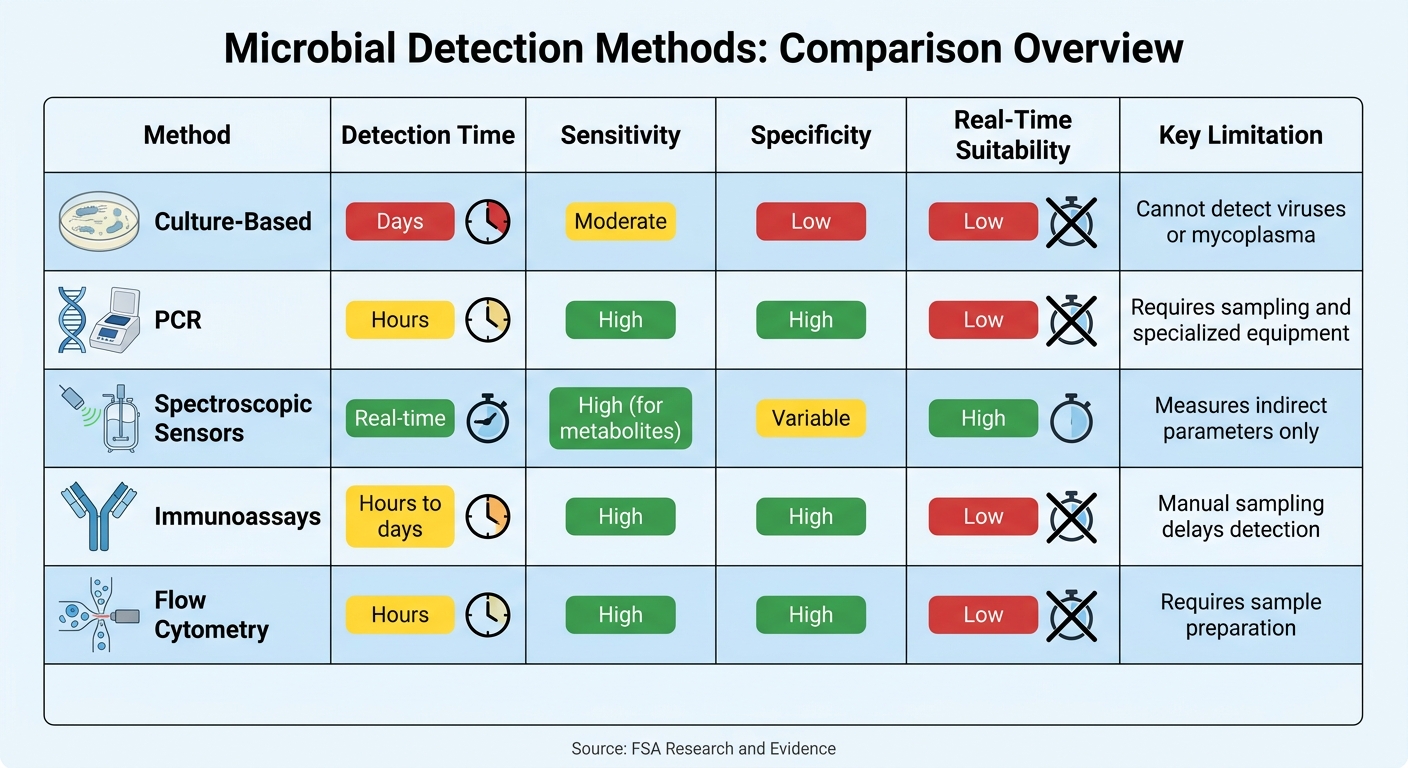
Comparison of Microbial Detection Methods for Cultivated Meat Bioreactors
Each method for microbial detection comes with its own strengths and weaknesses, making it important to weigh the trade-offs before deciding on the best approach. Culture-based techniques are straightforward and cost-efficient for identifying microbes like bacteria, yeast, and fungi that cause turbidity. However, they fall short when it comes to detecting viruses, mycobacteria, and mycoplasma, which are also potential contaminants in cultivated meat production [1].
PCR methods fill this gap by detecting genetic material from these harder-to-detect agents, including viruses and mycoplasma [1]. On the downside, they require specialised equipment and additional validation, especially when dealing with the unique matrices and small sample volumes typical of cultivated meat bioreactors. A review of 110 studies highlighted the need for further validation of both culture-based and PCR methods for these applications [1].
Spectroscopic and real-time sensors offer a different advantage: they continuously monitor parameters like pH and dissolved oxygen, providing instant alerts to potential contamination [1][2]. As noted in an FSA research report:
"In-line real-time processing monitoring of parameters indicative of microbial growth (e.g., pH, dissolved oxygen) will help early detection of contamination" [1].
These sensors can function continuously for weeks without recalibration [2]. However, they only measure indirect indicators and cannot identify specific pathogens.
Immunoassays and flow cytometry stand out for their high sensitivity and specificity in detecting targeted analytes. That said, both methods rely on manual sampling and laboratory processing, which can lead to delays and a higher risk of contamination [2]. Flow cytometry, for instance, is excellent at distinguishing microbial cells from cultivated meat cells based on size and granularity, but its need for sample preparation makes it unsuitable for continuous, real-time monitoring.
Here’s a quick comparison of these methods:
| Method | Detection Time | Sensitivity | Specificity | Suitability for Real-Time Use | Key Limitation |
|---|---|---|---|---|---|
| Culture-Based | Days | Moderate | Low | Low | Cannot detect viruses or mycoplasma [1] |
| PCR | Hours | High | High | Low | Requires sampling and specialised equipment [1] |
| Spectroscopic Sensors | Real-time | High (for metabolites) | Variable | High | Measures indirect parameters only [1][2] |
| Immunoassays | Hours to days | High | High | Low | Manual sampling delays detection [2] |
| Flow Cytometry | Hours | High | High | Low | Requires sample preparation |
To enhance reliability, producers are increasingly combining these methods. Real-time sensors are used for continuous monitoring, while periodic PCR and culture tests provide additional layers of confirmation [1].
New Technologies and Industry Applications
Artificial intelligence (AI) and machine learning (ML) are reshaping how contamination is detected in real time within cultivated meat bioreactors. According to the FSA Research and Evidence team:
"Artificial Intelligence and Machine Learning are being used to enhance the potential [of real-time monitoring]." [1]
AI-powered biosensors now analyse complex data from in-line sensors, monitoring factors like pH, dissolved oxygen, and microbial metabolites. These tools can detect subtle metabolic changes that signal contamination much earlier than traditional methods [1]. While conventional sensors focus on real-time measurements, AI adds a layer of advanced analytics, particularly for microbial metabolites. This capability is essential in cultivated meat production, where creating 10–100 kg of product demands cell counts in the range of 10¹² to 10¹³. Early detection is crucial to avoid significant losses [3]. Beyond these biosensors, large-scale platforms incorporate continuous monitoring of environmental conditions.
At commercial scales, multi-bioreactor setups now feature automated stirred-tank systems operating across several units in different modes. These facilities employ continuous environmental monitoring of air, surfaces, and water, allowing contamination risks to be identified before reaching the bioreactor [1]. Combining in-line sensors with facility-wide tracking reduces the need for manual sampling and lab-based testing, streamlining operations.
Additionally, the adoption of single-use technologies, such as disposable bioreactor bags and tubing, has become a key strategy to minimise cross-contamination between production runs [1]. While single-use systems come with higher material costs compared to reusable stainless-steel setups, they eliminate the need for rigorous cleaning and sterilisation protocols. This trade-off often makes single-use systems more practical for research and pilot-scale operations.
To support these advancements, procurement platforms are vital in connecting producers with dependable technology. Cellbase, for instance, offers access to trusted suppliers of in-line sensors, AI-driven analytical tools, and environmental monitoring systems tailored for cultivated meat production. Its specialised focus ensures that the equipment listed meets the specific requirements of this industry, such as compatibility with animal-component-free media and advanced microbial detection capabilities.
Conclusion
There isn’t a one-size-fits-all solution for detecting microbial safety issues in cultivated meat bioreactors. Traditional culture-based methods are reliable for identifying bacteria, yeast, and fungi that cause visible turbidity. However, they fall short when it comes to detecting viruses, mycoplasma, and mycobacteria, which don’t produce turbidity. For these pathogens, molecular tests are essential. Unfortunately, as noted by the FSA Research and Evidence team, such tests in the UK are currently "limited and expensive", with ISO 17025 accreditation adding further complexity and cost [1].
To address these gaps, advanced real-time monitoring offers a valuable complement. In-line monitoring of pH and dissolved oxygen levels allows for immediate adjustments, and with AI-driven analysis of microbial metabolites, subtle changes can be detected before traditional methods would raise alarms. That said, while these sensors are excellent for quick, indirect detection, they cannot replace validated tests required for regulatory compliance or the detection of low-level viral contamination.
For R&D and pilot-scale operations, single-use technologies combined with flow cytometry and immunoassays provide added flexibility and help reduce the risk of cross-contamination. At commercial production scales, the focus shifts to continuous environmental monitoring of air, surfaces, and water. Automated multi-bioreactor systems, combined with spectroscopic sensors and AI analytics, become more cost-efficient when deployed across larger production setups.
FAQs
Which detection method is best for mycoplasma in cultivated meat bioreactors?
PCR-based techniques, including quantitative PCR (qPCR) and digital PCR (dPCR), stand out as the most efficient and speedy tools for identifying mycoplasma in cultivated meat bioreactors. Compared to traditional culture methods, which tend to be slower and less precise, PCR approaches deliver quicker results with greater accuracy, particularly when focusing on the 16S rRNA gene. This makes them a perfect choice for routine monitoring and maintaining microbial safety throughout bioprocessing.
How can real-time sensors detect contamination without identifying the exact microbe?
Real-time sensors monitor contamination by tracking shifts in critical parameters like dissolved oxygen levels, off-gas composition, or metabolic activity. These changes serve as early indicators of microbial activity. The best part? This approach is non-invasive, meaning there's no need to pinpoint the exact microbe to detect contamination effectively.
What is a practical monitoring plan combining in-line sensors, PCR, and culture tests?
A practical approach integrates in-line sensors for real-time monitoring (such as measuring dissolved oxygen or analysing off-gas) to spot early microbial activity, PCR testing for quick DNA-based identification of contaminants, and culture tests to confirm sterility and pinpoint viable microorganisms. This multi-step strategy helps detect contamination early and respond effectively, protecting cultivated meat production processes.


