

If you need the short answer: batch feeding is simpler to run, while perfusion gives tighter control of nutrients and waste at high cell density.
For bioprocess engineers and cultivated meat R&D teams, the choice usually comes down to this:
- Batch or fed-batch is easier to set up, easier to trace lot-by-lot, and often a better fit for early R&D.
- Perfusion keeps substrate levels steadier, removes lactate, ammonia and dissolved CO₂ during the run, and supports much higher viable cell density.
- The trade-off is clear: more output per reactor volume versus more system burden.
- At larger scale, batch is often limited by by-product build-up and gas transfer, while perfusion is more often limited by media use, retention system reliability, and automation.
If I were screening media, checking cell behaviour, or running short development campaigns, I’d lean towards batch or fed-batch. If I were pushing for dense proliferation or trying to cut reactor footprint, I’d look at perfusion - but only if the retention hardware, sensors and media supply plan were already in place.
Quick comparison
| Criteria | Batch feeding / fed-batch | Perfusion |
|---|---|---|
| Nutrient supply | Added at start, or in planned feeds | Continuous medium exchange |
| Waste handling | Waste stays until harvest | Waste leaves during culture |
| Viable cell density | Lower | Higher |
| Volumetric productivity | Lower | Higher |
| Run length | Shorter | Longer |
| Media consumption | Lower | Higher |
| Process control | Simpler | More control loops and hardware |
| Cell retention | Not needed | Required |
| Contamination exposure | Lower | Higher over long runs |
| Traceability | Clear batch boundaries | Lot definition needs more work |
| Best fit | Early R&D, screening, line characterisation | High-density culture, smaller reactor footprint |
So the decision is not about which mode is “better” in the abstract. It is about which limit hits your process first: simplicity and traceability, or density and metabolite control.
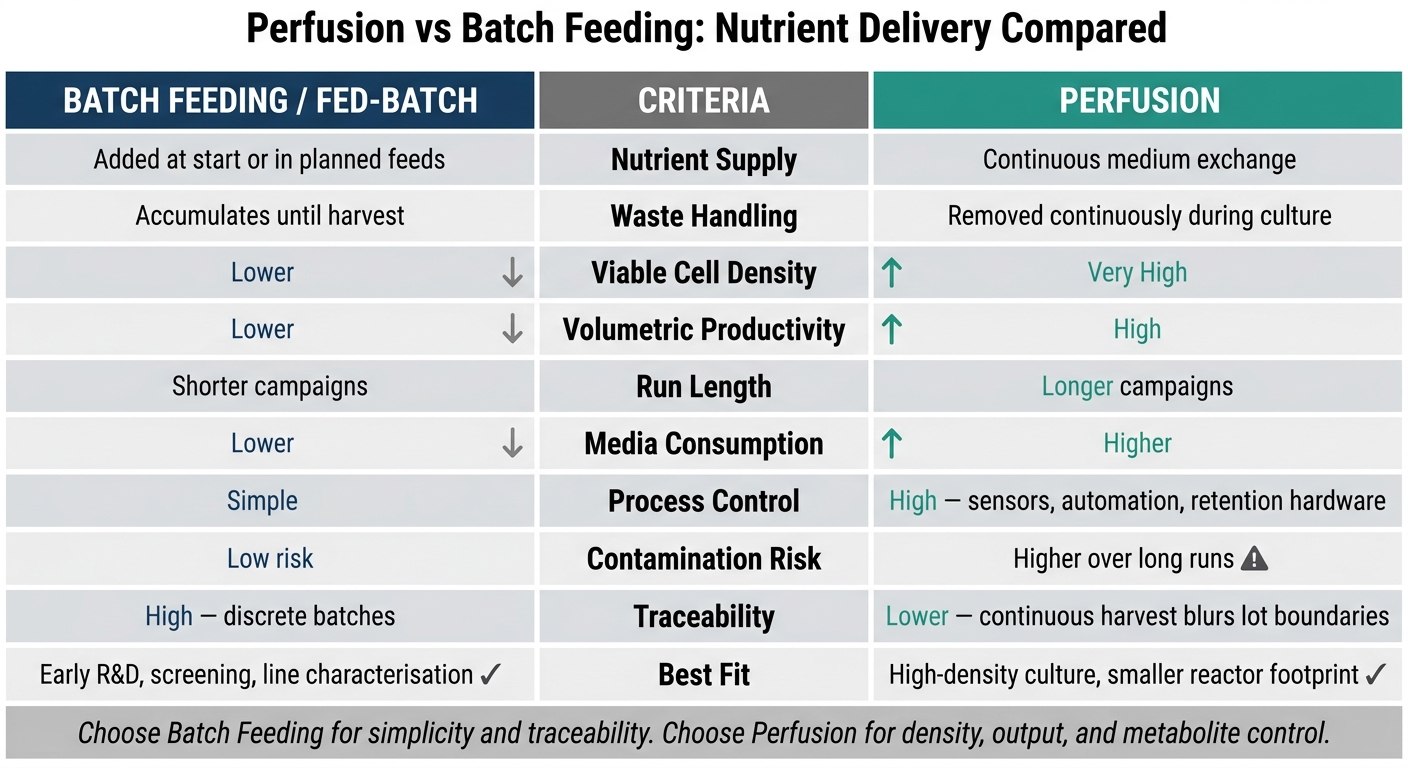
Perfusion vs Batch Feeding: Bioprocess Comparison Chart
Inside Bioprocessing: Continuous Perfusion Bioreactors and Cell Culture Design
sbb-itb-ffee270
Batch feeding: how it works and where it fits
Batch feeding puts simplicity first, not tight process control. In a batch run, you add nutrients at the start and let the culture proceed until harvest. Fed-batch takes a small step further: you add nutrients during the run on a set plan, but the vessel still stays closed between feed additions.
Nutrient delivery, control variables and by-product build-up
In fed-batch systems, feeds are usually scheduled in two main ways. Time-based feeding adds fixed volumes at set intervals. Sensor-based feeding uses live process signals such as glucose concentration, dissolved oxygen (DO) or respiratory quotient to trigger additions [1].
That said, the medium is not replaced. Spent medium remains in the vessel, so lactate, ammonia, dissolved CO₂ and osmolality increase over time, while oxygen transfer will, at some point, become limiting [2]. In dense muscle and fat cultures, that combination can reduce differentiation potential [3].
Strengths and scale-up limits of batch feeding
Even with those limits, batch and fed-batch are still useful because they are straightforward to run and carry a low contamination risk [1]. They also give clear traceability, with a defined start, end and harvest point for each run. That makes batch feeding a good fit for early-stage cultivated meat work, including media screening and cell line characterisation [1].
Fed-batch becomes more useful as teams move towards pilot scale. It can support higher cell densities and longer culture duration than a simple batch process [1]. But as scale goes up, the limits of by-product accumulation, gas transfer and process drift become harder to handle. That is where perfusion starts to give tighter control.
Perfusion: continuous nutrient delivery with cell retention
Perfusion stands out because it combines continuous medium exchange with cell retention. Cells stay inside the bioreactor through a retention device, while fresh medium flows in and spent medium flows out at the same rate. That steady exchange helps keep the process environment stable for weeks, and in some cases for several months [1][2]. In day-to-day operation, the retention system has a big effect on how well that exchange works.
Cell retention systems and process dynamics
Common retention options include spin filters, TFF, ATF, packed-bed systems for adherent cultures, and cell-lift systems for microcarrier runs [1]. Each comes with its own trade-offs. Some put more shear on cells. Some are more prone to fouling. Some are better suited to long run times than others. The right choice depends on the cell type and the culture format being used [1].
Across these setups, continuous medium exchange helps keep glucose and dissolved oxygen at set points, while lactate, ammonia and dissolved CO₂ are removed before they build up to inhibitory levels [1][2]. That matters because small drifts in metabolite control can snowball fast in dense cultures. Process sensors for glucose, dissolved oxygen or respiratory quotient can also be tied to automatic control of the perfusion rate, so the system tracks culture demand more closely [1][2].
Performance benefits and operational risks
Perfusion usually reaches higher viable cell density and higher volumetric productivity than batch or fed-batch. Put simply, a smaller bioreactor can deliver the same output as a much larger batch vessel [1]. For cultivated meat teams, that can change the economics and facility footprint in a big way.
The trade-off is more process complexity. Main operational risks include membrane fouling, contamination during long campaigns, and weaker traceability than batch processing [1][4]. A perfusion run isn't something you want to improvise halfway through. Teams planning perfusion campaigns for cultivated meat manufacturing need to think through media logistics, automation infrastructure, and validation of sterilisation methods across the full run window from the start [1][4]. That tension between output gains and operational burden is the main contrast with batch feeding.
Perfusion vs batch feeding: direct comparison across process performance
Put side by side, the trade-offs are easier to see.
Comparison table: nutrient control, productivity, media use and risk
| Metric | Batch feeding | Perfusion |
|---|---|---|
| Nutrient delivery | All at start; depletes over time | Continuous replenishment |
| Waste removal | None until harvest | Continuous removal of spent medium and by-products |
| Viable cell density | Relatively low | Very high |
| Volumetric productivity | Low | High |
| Process duration | Shorter campaigns | Longer campaigns |
| Media demand | Lower | Higher |
| Control complexity | Simple | High; requires sensors, bioprocess automation, and retention hardware |
| Contamination risk | Low risk | Higher contamination risk |
| Traceability | High - discrete batches | Lower - continuous harvest blurs lot boundaries |
| Equipment footprint | Large vessel for equivalent output | Smaller bioreactor footprint; more media-handling equipment |
Perfusion gives more product per unit bioreactor volume because it keeps viable cell density much higher than fed-batch.
How each mode behaves as scale increases
Batch feeding stays simpler as vessel volume increases, but the same core limit remains: by-products build up until harvest. That sets a cap on how far the culture can be pushed before lactate and ammonia reach inhibitory levels [1].
Perfusion deals with that limit in a different way. Because spent medium is removed continuously, the culture environment stays more stable even at very high cell densities. In practice, that means a smaller bioreactor can deliver output similar to a much larger batch vessel [1]. As scale goes up, the main constraint shifts. It becomes less about reactor volume and more about media handling capacity and the reliability of the cell retention system.
When to choose batch feeding and when to choose perfusion
Batch feeding fits early-stage work well. It is easier to set up and gives you discrete batches with clear traceability, which matters in experimental design and process validation [1]. For cultivated meat R&D, that simplicity is useful.
Perfusion fits better when the goal is high-density cell proliferation, when bioreactor footprint needs to stay small, or when dense muscle or fat tissue models need a steady supply of nutrients plus continuous waste removal [1][3]. But perfusion only works well if the support systems are in place. The team needs to handle retention hardware, media logistics, and automation over a long run. If that setup is missing, the gain in productivity does not turn into steady output [1].
That leads into the next decision: which mode suits R&D, pilot, or manufacturing scale. To help determine requirements, use a production scale planner to model capacity and costs.
Choosing a nutrient delivery strategy for cultivated meat scale-up
Once the trade-offs are clear, the next step is simpler than it sounds: pick the mode that fits your stage, your kit, and your supply chain.
Decision criteria for R&D, pilot and manufacturing teams
Choose based on development stage and process need, not on what sounds more advanced.
Batch feeding fits early R&D when simplicity and low contamination risk matter most [1].
Perfusion makes more sense when the process is limited by cell density, dense tissue formation, or a tight bioreactor footprint [1]. If you're working with shear-sensitive primary cells, cell retention systems like alternating tangential flow (ATF) filtration or packed-bed set-ups can help protect cells while still supporting mass transfer [1].
Perfusion also changes the paperwork. Because harvest is continuous, teams need to think through lot boundaries and documentation from the start [1].
Equipment and sourcing considerations with Cellbase
That choice then sets the equipment path.
Equipment follows process. Cellbase helps cultivated meat teams source verified bioreactors, retention hardware, sensors, media, scaffolds, and cell lines in one place [3][5].
Conclusion: control versus simplicity
Choose the mode that matches your primary or immortalised cells, tissue target, and automation capacity: batch feeding when simplicity and traceability come first, perfusion when density and output push the process there.
FAQs
How do I choose between fed-batch and perfusion?
It depends on your scale, regulatory requirements, and technical capability.
Fed-batch is a good fit for research, process development, and early-stage work. It’s simpler to run, carries a lower contamination risk, and gives you strong batch traceability.
Perfusion fits commercial-scale production better. It can support higher cell densities and higher productivity, but it also demands more advanced automation, cell retention, and process monitoring.
What makes perfusion harder to run in practice?
Perfusion is harder to implement than batch feeding because it depends on cell retention systems that keep cell density high while growth media is exchanged continuously. That adds mechanical and process complexity straight away.
It also needs tight automated control and real-time monitoring to stop the process drifting into instability. In practice, there’s less room for error than in batch systems.
The longer run times create extra pressure on aseptic operation too. A process that stays live for longer carries more contamination risk, and product traceability can be harder than in the discrete production cycles used in batch processes.
Which cell types benefit most from perfusion?
Perfusion is especially useful for high-density cultivated meat cultures, with cell densities of around 10^7 to 10^9 cells/mL.
It fits adherent cells particularly well. In practice, these cells are often grown in fixed-bed or packed-bed bioreactors, where constant medium exchange helps keep conditions stable.
That matters when a process needs continuous nutrient delivery and waste removal. With perfusion, cells can stay in an extended exponential growth phase instead of hitting the usual limits from nutrient depletion or metabolite build-up.


