

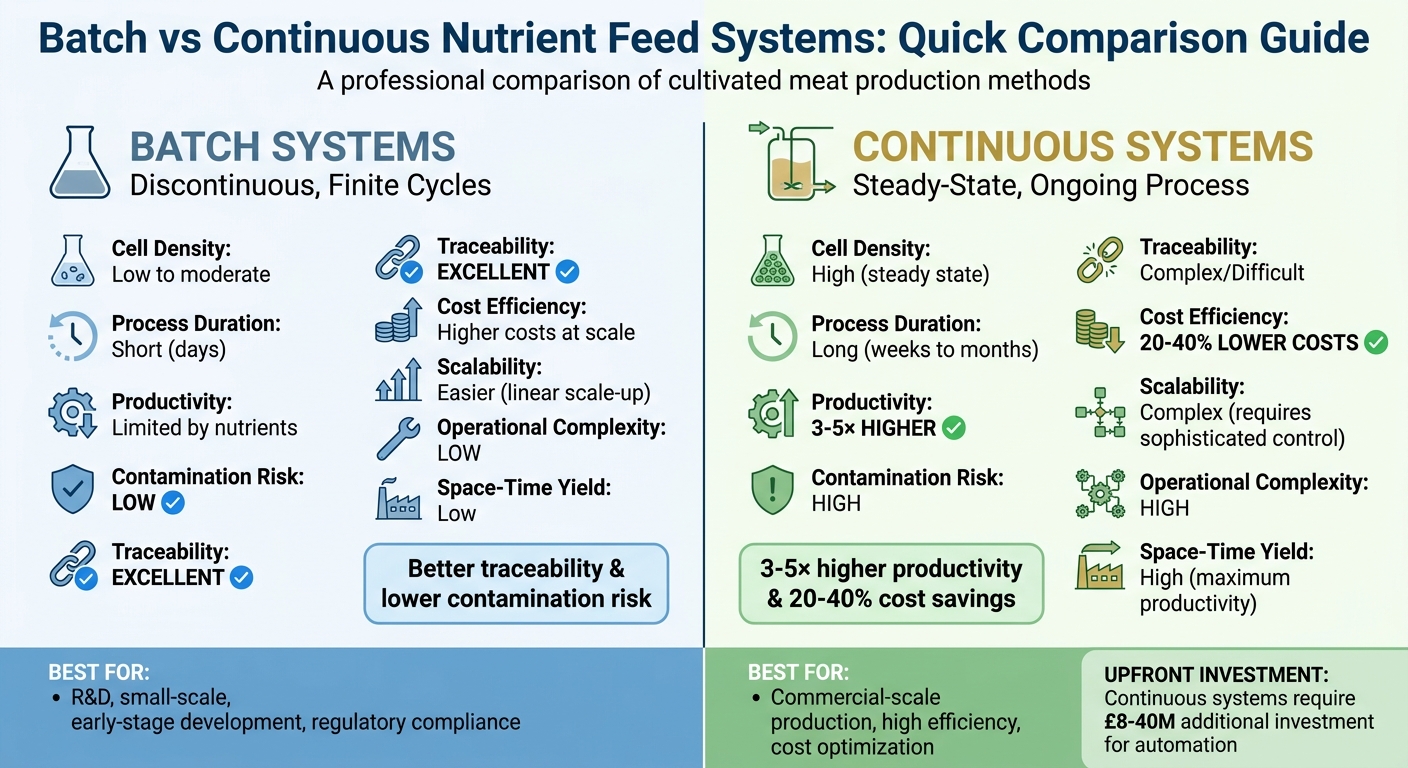
What's the best system for cultivated meat production? It depends on your production goals. Batch systems are simpler, easier to control, and better for small-scale R&D. Continuous systems, on the other hand, boost productivity by 3–5× and cut costs by 20–40% at scale but require advanced automation and come with higher risks of contamination and complexity.
Key Takeaways:
- Batch Systems: Add nutrients at the start, run until depletion, and are ideal for small-scale experiments or early-stage development. They are easier to manage, offer better traceability, and have lower contamination risks but limit productivity.
- Continuous Systems: Maintain a steady nutrient supply and waste removal, enabling higher cell densities and efficiency. Best for large-scale production but demand sophisticated equipment, higher upfront costs, and careful monitoring.
Quick Comparison:
| Metric | Batch Systems | Continuous Systems |
|---|---|---|
| Cell Density | Low to moderate | High |
| Duration | Short (days) | Long (weeks to months) |
| Productivity | Limited by nutrients | 3–5× higher |
| Contamination Risk | Low | High |
| Traceability | Excellent | Complex |
| Cost Efficiency | Higher costs at scale | 20–40% lower costs |
Choosing the right system hinges on your scale, regulatory needs, and technological readiness. Batch systems work best for early-stage or smaller operations, while continuous systems are better suited for commercial-scale efficiency.
Batch vs Continuous Nutrient Feed Systems for Cultivated Meat Production
Eppendorf Science Shorts | What is a Bioreactor? | The Basics and 3 Types of Operation
sbb-itb-ffee270
Batch Nutrient Feed Systems
In batch processes, all the nutrients are added at the start in a closed system. During the run, only gases, acids, and bases are adjusted to maintain the best conditions for cell growth [1][6]. The process continues until the cells use up the initial nutrients, after which the biomass or medium is collected [3][6].
Cells undergo four distinct growth phases in this system. First is the lag phase, where cells adapt to their environment and take up nutrients at a moderate rate. This is followed by the exponential phase, during which cells multiply rapidly, consuming nutrients at their highest rate and causing oxygen demand to peak. When the primary nutrient - often the carbon source - runs out, cells enter the stationary phase, where growth levels off. Finally, in the dead phase, the number of living cells drops sharply [6][8].
Modern batch systems are equipped with automated controls that adjust stirrer speed, gas flow, and oxygen levels to match the cells' needs as they grow [1][6]. Advanced software allows precise tracking of critical factors like pH and metabolite concentrations, reducing the need for manual sampling [7][8]. These innovations improve the efficiency of batch systems while highlighting their operational strengths and limitations.
Advantages of Batch Systems
Batch systems are particularly suited for quick experiments such as media testing, strain evaluation, and small-scale trials [1][6]. Since the system is closed after setup, the risk of contamination is lower. Each batch run is treated as a separate unit, making it easier to trace issues and troubleshoot - an essential feature in highly regulated industries. Additionally, batch systems are relatively simple to operate, requiring minimal equipment beyond basic controls for parameters like temperature and pH [3][6].
Limitations of Batch Systems
While straightforward, batch systems face notable challenges when scaled up for large-scale cultivated meat production. Nutrient depletion is unavoidable - once the initial supply is exhausted, cell growth stops, and the process must end, capping productivity [6][8]. High concentrations of nutrients, such as glucose, at the start can also lead to substrate inhibition, where cell growth is hindered or metabolic feedback reduces yield [1][6]. Furthermore, batch systems often require significant downtime for cleaning and sterilisation, making them less efficient than continuous systems [3][6].
As Tony Allman of INFORS HT points out, while batch systems are useful for early-stage development, the industry is increasingly shifting towards fed-batch and continuous systems to achieve the high cell densities needed for commercial production [6][7]. These limitations have driven efforts to explore alternative feeding methods that can sustain growth over longer periods.
Continuous Nutrient Feed Systems
Continuous feed systems work by adding fresh culture medium while simultaneously removing an equal volume of waste or product. This creates a balanced flow, allowing the system to maintain a steady-state environment where key parameters remain stable - sometimes for days or even months [10]. To avoid washing out the cells, the inflow and outflow rates must stay below the cells' doubling time unless mechanisms for cell retention are in place.
These systems are typically categorised into three types:
- Chemostats: These regulate growth by controlling the supply of a single limiting nutrient, like glucose [10].
- Turbidostats: These maintain a constant cell density using real-time sensor feedback [10].
- Perfusion systems: These use cell retention methods, such as spin filters, to hold cells in the system while exchanging the culture medium, enabling extremely high cell densities [10].
Modern continuous systems utilise advanced control technologies to maintain optimal conditions. Integrated software platforms use real-time feedback to fine-tune flow rates and ensure precise environmental stability. Tony Allman of INFORS HT explains:
The balanced nature of the feeding allows a steady state to be achieved which can last for days to months [10].
These systems also incorporate automated cascades, where parameters like stirrer speed, gas flow, and oxygen levels are adjusted sequentially to maintain targets such as dissolved oxygen concentrations [10]. This level of control is key to the impressive productivity of continuous systems.
Advantages of Continuous Systems
Continuous systems excel at sustaining high productivity by keeping cells in their exponential growth phase for longer. This is achieved by consistently supplying fresh nutrients and removing waste, which enhances space-time yield - the amount of product generated per unit volume over time [10]. Additionally, these systems reduce downtime for cleaning and sterilisation and minimise product inhibition caused by toxin accumulation. As Tony Allman notes:
Continuous processes are ideal tools for gaining a better understanding of the process, since all process parameters remain constant when the system is operating correctly [10].
The dynamic and self-regulating nature of continuous systems makes them especially suitable for large-scale cultivated meat production, offering a level of efficiency that batch systems cannot match.
Limitations of Continuous Systems
While continuous systems offer numerous benefits, they also come with challenges. The extended run times increase the risk of contamination [10]. Over time, there is also a chance of genetic drift, where cell populations evolve or change. Maintaining a constant cell density requires sophisticated automation and monitoring, which often involves higher upfront costs [10]. Additionally, product traceability can be more complex, as the continuous output lacks the discrete batches typical of batch systems, complicating quality control [10].
Batch vs Continuous: Direct Comparison
Understanding the differences between batch and continuous systems is key as the cultivated meat industry moves towards larger-scale production. These differences influence both technical outcomes and cost efficiency. Batch systems function in distinct cycles, starting with an initial nutrient charge and continuing until resources are depleted. In contrast, continuous systems maintain a steady environment by constantly adding nutrients and removing waste. Let’s dive into how these systems compare.
Continuous bioprocessing offers 3 to 5 times higher volumetric productivity, which translates to 20–40% lower production costs at commercial scale [2]. However, this efficiency comes at a price - setting up a continuous system typically requires an additional investment of £8 million to £40 million for advanced automation and monitoring infrastructure [2].
Batch systems, on the other hand, have their own advantages. They are less prone to contamination due to their closed nature, and the process offers better traceability. Continuous systems, with their extended run times and constant material flow, can complicate quality control and increase the risk of contamination [1][6].
Comparison Table
| Metric | Batch Systems | Continuous Systems |
|---|---|---|
| Cell Density | Low to moderate | High (steady state) |
| Process Duration | Short (days) | Long (weeks to months) |
| Nutrient Efficiency | Low (limited by initial supply) | High (optimised constant feed) |
| Contamination Risk | Low (closed after charging) | High (constant ingress points) |
| Scalability | Easier (linear scale-up) | Complex (requires sophisticated control) |
| Operational Complexity | Low (easier to manage) | High (requires advanced automation) |
| Space-Time Yield | Low | High (maximum productivity) |
| Traceability | Excellent (discrete batches) | Difficult (continuous output) |
| Production Cost (at scale) | Higher | 20–40% lower [2] |
Selecting the right system for cultivated meat production involves weighing these trade-offs. While continuous systems excel in efficiency and cost savings, they demand a higher level of operational sophistication. Batch systems, though less efficient, provide simplicity and reliability. Next, we’ll explore how these factors shape applications in cultivated meat production and influence equipment choices through Cellbase.
Applications in Cultivated Meat Production
The way batch and continuous systems operate significantly influences strategies in cultivated meat production. Each system plays a specific role at different stages of the production pipeline.
Batch systems are key for R&D and early development. Researchers rely on small-scale bioreactors to experiment with media formulations, study cell behaviours, and create early prototypes for taste testing. The straightforward nature of batch systems makes them ideal for quick, iterative experiments. Pilot-scale facilities often use bioreactors with volumes ranging from 100 to 1,000 litres to validate processes before scaling up further [4]. In these early stages, batch systems provide the flexibility needed for innovation and refinement.
Continuous systems drive large-scale commercial production. Perfusion bioreactors, which retain cells while recycling the growth medium, allow for theoretical cell densities of up to 2×10⁸ cells/mL. These systems also offer 55% savings in capital and operating costs over a decade when compared to batch processing [9]. Companies like UPSIDE Foods are advancing this approach by developing cell lines with genetically encoded glutamine synthetase, reducing ammonia levels by around 20% while generating energy substrates. This creates an optimised biochemical environment for high-density cell growth [9]. Additionally, Cellular Agriculture Ltd is designing hollow fibre bioreactors tailored to cultivated meat-specific cell types, enabling scalable and continuous manufacturing [9].
Hybrid systems combine the strengths of batch and continuous methods. Repeated fed-batch systems, where 25–75% of the bioreactor volume is harvested and replenished, help prevent toxin build-up while offering simpler quality control and regulatory compliance compared to fully continuous systems [6][3][1]. These hybrid strategies provide a middle ground, balancing efficiency with manageability.
How Cellbase Supports Bioprocess Equipment Procurement
Scaling up production in cultivated meat requires highly specialised equipment, from bioreactors to sensors and growth media - tools that general marketplaces rarely cater to.
Cellbase steps in as a dedicated B2B marketplace designed specifically for the cultivated meat industry. It connects researchers and production teams with verified suppliers offering essential equipment like benchtop bioreactors, pilot-scale stirred tanks, perfusion systems, and real-time monitoring sensors. Each listing includes detailed specifications, such as whether the equipment is scaffold-compatible, serum-free, or GMP-compliant, enabling teams to quickly identify the right tools for their needs. For companies transitioning from batch-based R&D to continuous commercial production, Cellbase streamlines procurement with transparent pricing, direct messaging with suppliers, and industry-focused expertise, helping teams make faster, informed sourcing decisions.
Choosing Between Batch and Continuous Systems
Deciding between batch, fed-batch, and continuous systems depends heavily on your production needs and operational priorities.
The choice of nutrient feed system should align with your production goals, regulatory obligations, and operational capacity. For smaller-scale operations, such as research and development, media optimisation, or strain screening, batch and fed-batch systems are ideal. Their flexibility makes them better suited to early-stage processes where throughput isn't the main concern. On the other hand, continuous systems shine at commercial scales, offering 3–5× higher productivity. However, this efficiency comes at a steep price, with automation infrastructure costing an additional £7.5 million to £37.5 million [2].
When it comes to regulatory compliance and traceability, batch systems hold a clear advantage. Their distinct production cycles simplify quality control and troubleshooting, which is critical for regulatory approval. Continuous systems, however, face challenges with batch definition, making it harder to isolate issues or recall specific production runs [1][3]. For cultivated meat companies navigating regulatory pathways, this traceability benefit often outweighs the productivity boost offered by continuous systems - at least until production reaches commodity-scale levels.
Biological consistency is another factor to consider. Continuous systems require stable cell lines, as lengthy cultivation periods (ranging from days to months) increase the risk of genetic drift in mammalian cells. Before committing to continuous operations, ensure your cell line remains both productive and genetically stable over extended runs [1].
Automation readiness is also a key consideration. Continuous systems rely on advanced process control, including real-time monitoring and robust SCADA software, to maintain steady-state conditions [5]. Without these tools, managing continuous systems becomes nearly impossible. Early-stage operations should start with batch or fed-batch systems, potentially transitioning to hybrid repeated fed-batch systems to balance simplicity with efficiency [1][3].
"The choice between batch, fed-batch, and continuous culture depends on your organism, application, and production goals." – Tony Allman, Product Manager, INFORS HT [3]
For companies targeting premium markets, fed-batch systems might offer a more cost-effective solution initially. Investing in continuous infrastructure may not make sense until production volumes and cost structures evolve to support commodity-scale operations [2].
Conclusion
Choosing the right nutrient feed system is a critical step in cultivated meat bioprocessing. Batch systems stand out for their simplicity, reduced contamination risk, and strong traceability, making them a great fit for R&D, media optimisation, and meeting regulatory requirements. However, their downside lies in nutrient depletion, which can limit productivity. On the other hand, continuous systems offer sustained nutrient supply and higher efficiency but come with challenges like complex automation, increased contamination risks, and difficulties in maintaining product traceability.
The decision between these systems depends on factors like production scale, regulatory needs, and operational capabilities. For early-stage companies or those focused on regulatory approvals, batch or fed-batch systems often work best due to their flexibility and traceability. Meanwhile, commercial-scale production aiming for high efficiency may lean towards continuous systems - if they have robust process controls and stable cell lines in place to handle the demands.
As Tony Allman from INFORS HT puts it:
"Feeding strategy is one of the most influential variables in any bioprocess." – Tony Allman, INFORS HT [6]
FAQs
When should I switch from batch to continuous production?
Switching to continuous production is a smart move when you're focusing on long-term, steady operations that prioritise both productivity and consistency. Continuous systems excel at maintaining stable cell density and output over extended periods, making them particularly suited for cultivated meat production where consistent quality at scale is essential. If your current batch process is holding back productivity or you're looking to make better use of resources while cutting downtime for cleaning and setup, it might be time to consider the switch.
What sensors and controls do continuous systems need?
Continuous systems used in cultivated meat bioprocessing depend on a range of sensors to maintain the right conditions for cell growth and ensure high-quality outcomes. Among the key tools are pH glass electrodes and optical dissolved oxygen (DO) sensors, which monitor critical parameters like acidity and oxygen levels. Additionally, inline Raman analysers track nutrients and metabolites in real time.
To regulate temperature, resistance temperature detectors (RTDs) are employed, while cell density sensors ensure consistent cell concentrations throughout the process. These sensors work together to enable automated feedback systems that can fine-tune nutrient feeds, oxygen levels, and pH, ensuring stable and efficient production.
How do you maintain traceability in a continuous process?
Traceability in the production of cultivated meat hinges on the use of real-time monitoring systems. These systems utilise automated sensors to track crucial parameters such as pH, dissolved oxygen, glucose levels, and cell density. The data collected is meticulously logged to maintain batch records that comply with GMP (Good Manufacturing Practice) standards. This process not only ensures that every stage of production is traceable but also improves transparency, allows for the swift detection of any deviations, and helps maintain consistent product quality.


