

If I am moving cultivated meat in the UK, the packaging choice is usually simple: reusable packs suit closed, repeat lanes with dependable returns; single-use packs suit open, one-way, or irregular lanes.
For bioprocess engineers, cell culture scientists, and cultivated meat R&D teams, the decision is not just about pack cost. I would check three things first: lane control, temperature hold for the full transit window, and what happens after delivery. If empty assets do not come back, a reusable model can fail fast. If one-way packs are used again and again, waste and disposal load stack up just as fast.
This comparison focuses on post-processing distribution packaging only. It covers:
- Reusable systems: durable insulated containers, often with VIP insulation, return collection, cleaning, inspection, and recirculation
- Single-use systems: one-way insulated shippers for lanes where return loops are weak or absent
- Key checks: thermal validation, pack-out control, reverse flow, cleaning, asset tracking, disposal, and UK chilled/frozen distribution fit
What I’d take from it:
- Use reusables where routes are fixed and return rates are high
- Use single-use where routes are variable or one-way
- Validate both against the actual lane, not lab-style test conditions
- Treat packaging as part of product protection, not just a purchasing line item
Quick Comparison
| Criteria | Reusable packaging | Single-use packaging |
|---|---|---|
| Best lane type | Closed-loop, repeat routes | Open, one-way, irregular routes |
| Temperature control | Strong hold times if pack-out and container condition are controlled | Often suited to short-to-medium shipments |
| Returns | Needs collection and return flow | No return flow needed |
| Cleaning | Required between trips | Not required after use |
| Tracking | Asset tracking matters to stop pool loss | Low tracking burden after delivery |
| Waste per repeated shipment | Lower if reuse cycles and returns are maintained | Higher across repeated shipments |
| Failure point | Asset loss, poor cleaning, damaged shippers, weak pack-out control | Disposal load, repeat material use, limited fit for longer lanes |
In short: I would not ask, “Which format is better?” I would ask, “Which format fits this lane, this transit time, and this return setup?” That is the frame for the rest of the article.
sbb-itb-ffee270
Reusable cold chain packaging: strengths, limits, and best-fit use cases
Reusable cold chain systems are built around durable insulated containers made for repeated trips. Whether they make sense comes down to one thing: can the route support recovery, cleaning, and reuse?
These systems often use high-performance insulation such as Vacuum Insulated Panels (VIPs), which insulate better than standard expanded polystyrene (EPS). In practice, that can extend hold times while keeping products within chilled or frozen ranges, depending on how the shipper is specified and packed.
That extra thermal margin matters in cultivated meat distribution. Product quality depends on tight temperature control from dispatch through to receipt.
Thermal performance and asset durability
Reusable systems work well only when pack-out and handling stay consistent. Hold time and temperature stability depend on getting the pack-out right: coolant type, coolant quantity, and coolant placement all need to match the route profile and expected ambient conditions. Each container should also be checked before reuse to make sure it still meets its validated specification.
For cultivated meat teams running stable, repeatable delivery lanes - such as hub-and-spoke networks or fixed routes between a production site and downstream partners - reusable systems can provide steady thermal protection and strong physical protection.
The trade-off is on the operations side. That’s where single-use systems are often simpler.
Reverse logistics, cleaning, and tracking requirements
The work does not stop once the outbound shipment arrives. Every container has to be collected, inspected, cleaned, and refurbished before it goes back into circulation. That’s quite manageable on controlled routes, but it gets much harder in open, one-way distribution networks where recipients cannot be relied on to return assets.
Container loss is a real operational risk. If tracking is weak, the asset pool shrinks over time, and the model starts to break down.
| Factor | Reusable packaging works well | Reusable packaging struggles |
|---|---|---|
| Trip model | Stable, repeatable delivery lanes | Open or one-way shipment networks |
| Thermal control | Long hold times with correct pack-out | Performance drops if pack-out or maintenance lapses |
| Reuse cycles | Multiple uses reduce per-trip material waste | Needs enough reuse cycles to justify the asset pool |
| Operations | Controlled networks with return infrastructure | Requires collection, inspection, tracking and refurbishment |
That operational load is the main point of comparison with single-use packaging. Reusable systems fit predictable UK routes with return infrastructure. Open networks usually shift the balance towards simpler options.
Single-use cold chain packaging: strengths, limits, and best-fit use cases
Where return loops are weak, single-use packaging is often the simpler option.
Single-use cold chain systems are one-way insulated shippers, usually made from disposable materials, and used when return collection is impractical. The main upside is simple deployment in open distribution networks.
That matters most when shipments move in one direction only.
Why single-use packaging suits one-way shipments
For cultivated meat teams running pilots or irregular routes, single-use systems cut handling complexity. After delivery, there’s less to sort, recover, and move back through the network. That lower post-delivery handling is a clear plus from an operations point of view.
The downside is the material burden and disposal load.
Waste, disposal, and thermal trade-offs
The trade-off is higher material use. Every shipment adds to material consumption and waste handling. Single-use systems can still perform well on short to medium routes, especially when the distribution pattern doesn’t support a reusable return loop.
| Factor | Advantages | Disadvantages |
|---|---|---|
| Trip model | Simple for one-way and irregular shipments | More material intensive over time |
| Returns | No collection or return flow needed | Disposal responsibilities remain part of the process |
| Thermal control | Reliable for short to medium routes | Less flexible for longer transit windows |
| Operations | Low post-delivery handling complexity | Requires regular replenishment |
The next comparison is whether those trade-offs fit cultivated meat distribution in the UK.
Reusable vs single-use: direct comparison for cultivated meat cold chains
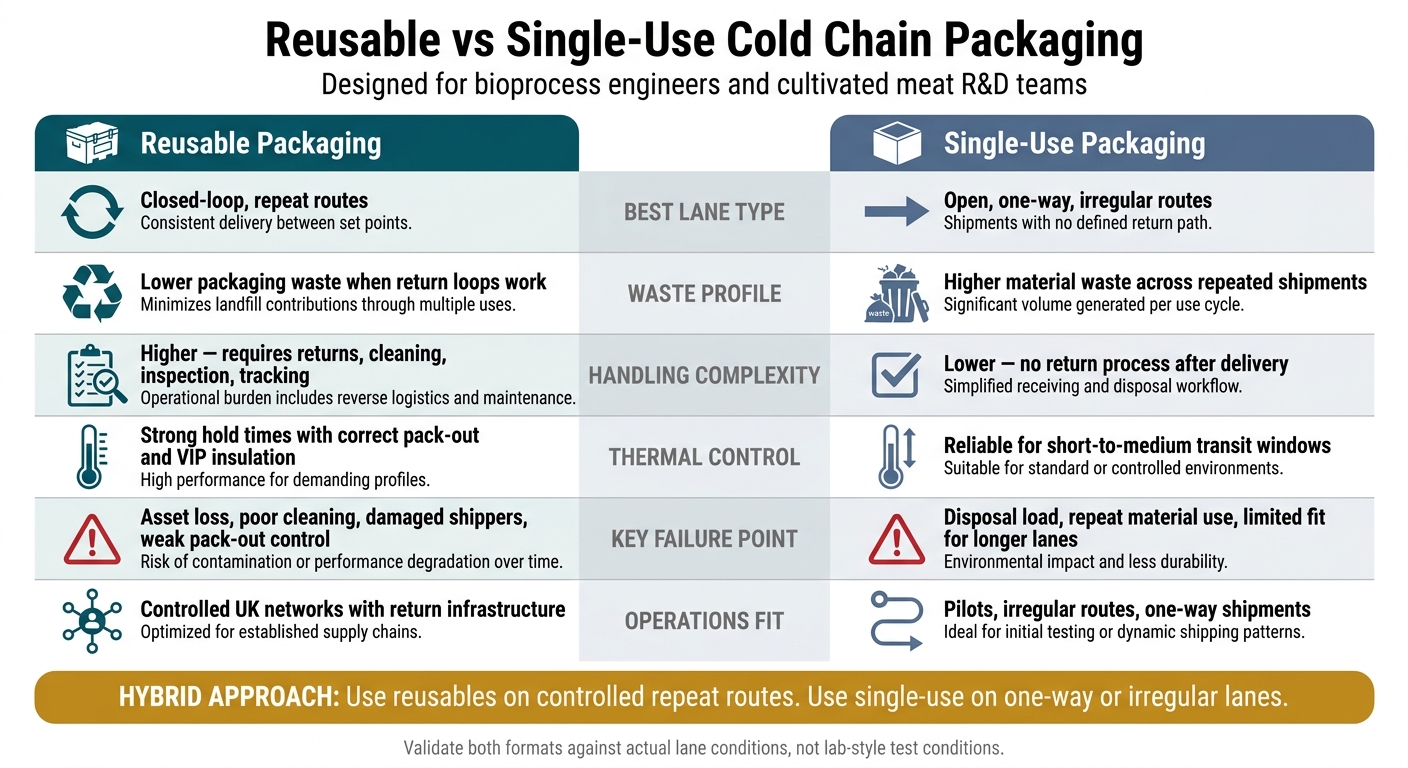
Reusable vs Single-Use Cold Chain Packaging: Which Fits Your Lane?
Neither model wins in every case. The better fit depends on route predictability, return recovery, and validated transit time.
In practice, the choice usually comes down to three checks: route control, waste burden, and validation.
| Criteria | Reusable packaging | Single-use packaging |
|---|---|---|
| Logistics model | Best for controlled, repeat routes with return flows | Best for open, one-way routes and irregular deliveries |
| Waste profile | Lower packaging waste when return loops work well | Higher packaging waste across repeated shipments |
| Handling complexity | Higher due to returns and cleaning control | Lower after delivery because there is no return process |
Waste output and packaging impact
Reusable systems reduce waste only when returns, cleaning, and turnaround are tightly controlled. If that loop slips, the picture changes fast. Washing demand, collection runs, and asset loss can eat into the gain very quickly.
That point matters in cultivated meat cold chains, where packaging is not just a box around the product. It becomes part of the cultivated meat production systems design. A reusable format can look good on paper, but if trays, totes, or insulated shippers do not come back on time, the waste and handling load start to build.
Product safety, validation, and UK fit
Both formats must be validated for the lane they serve. That means the shipper has to hold temperature for the full transit profile, not just under ideal test conditions.
Reusable packs add extra control points. You need inspection, cleaning, and traceability, and those steps have to be managed well. This level of oversight is often integrated into bioprocess control software to ensure consistency across the supply chain. For teams used to GMP-style discipline, that may be workable, but it still adds more moving parts.
Single-use packs remove the return risk, which can make them easier to run on less predictable lanes. But they are not a free pass. They still need route-specific thermal validation, especially where hand-offs, delays, or mixed courier conditions are part of the lane.
When a hybrid model is the better answer
For mixed UK networks, a hybrid setup is often the sensible choice.
- Use reusable packaging on controlled repeat routes with dependable return flows.
- Use single-use packaging on one-way, irregular, or long-distance shipments.
That split tends to work well when some lanes behave like a closed loop and others do not. Put simply: use reusables where you can control the system, and single-use where the system is harder to control.
Conclusion: choosing the right packaging model for cultivated meat distribution
The choice comes down to route control and return infrastructure. Use reusable packaging on controlled lanes where returns are dependable. Use single-use packaging on variable, one-way routes.
The decision should rest on validated thermal performance, logistics fit and waste impact. In practice, that means packaging is a performance choice, not just a purchasing call.
For procurement and operations teams, the main checks are:
- Map route patterns - identify which lanes are closed loops and which are open or irregular.
- Confirm temperature requirements and validate the lane - establish whether the product needs chilled or frozen conditions, then test each format against actual transit profiles, not just ideal conditions.
- Assess return-loop capability - be honest about whether empty reusable assets can be recovered on each lane.
- Weigh waste, cleaning and disposal together - account for the full operational load of each model, including tracking and refurbishment.
FAQs
How do I choose the right packaging for each lane?
Choose packaging for each distribution lane by balancing your cultivated meat’s stability needs with the operational demands and waste footprint of your logistics plan.
Start with the basics: can the packaging hold the required storage conditions and sterile state needed for safety? That’s the first filter.
Single-use packaging can help reduce contamination risk, especially in lanes where handling steps, transfer points, or return logistics add exposure. But there’s a trade-off. Disposable formats also bring more material waste and extra disposal requirements, so they need to be weighed against both site operations and waste handling capacity.
When does reusable packaging stop making sense?
Reusable cold chain packaging stops making sense when the logistics load is bigger than the gain. That usually happens when there’s no clear system to collect, clean and return containers, or when the return journey burns more energy than the packaging saves.
For temperature-sensitive cultivated meat, single-use packaging may also be the right call if a reusable pack can’t hold temperature or sterility across the supply chain.
How should I validate cold chain packaging in real UK transit conditions?
Validate cold chain packaging for cultivated meat under actual UK transit conditions that match your supply chain. That means testing against the temperature swings and journey times your product will face in distribution, not just ideal lab settings. The goal is simple: confirm the pack holds the required product integrity from dispatch through to delivery.
If you're weighing up reusable versus single-use packaging, Cellbase can also help source testing equipment and sensors so you can track transit conditions in real time.


