

If you run cultivated meat process development, nutrient recovery is mostly a question of stream choice, purity targets, and release control. In plain terms: spent media often still holds unused amino acids, vitamins, minerals, and some protein factors; biomass residues hold proteins and intracellular material; and each stream needs a different recovery route before reuse or diversion.
For bioprocess engineers, cell culture scientists, and cultivated meat R&D teams, the article boils down to this:
- Separate the terms first: nutrient recovery is not the same as media recycling, co-product use, or wastewater treatment.
- Start with the streams that matter most: spent proliferation and differentiation media, harvest residues, and cell debris.
- Pick the lightest recovery route that meets spec: clarification, membrane steps, precipitation, chromatography, or biochemical conversion.
- Control the failure points: lactate, ammonia, fouling, hold-up loss, cleaning load, contamination risk, and batch drift.
- Only reuse by release criteria: composition, pH, osmolarity, microbial load, and batch records must all pass.
- Divert lower-grade fractions where they fit best: hydrolysates, fermentation feed, animal feed inputs, or fertiliser routes.
A simple way to think about it: first map the stream, then measure what is left, then decide whether the best outcome is reuse inside media prep or use outside the core process. The article also flags the UK manufacturing side: risk-based quality review, batch documentation, and change control are not optional if a recovered stream goes back into production.
Quick take: if a side stream is too dilute or too mixed for physical separation alone, enzymatic or fermentation conversion may help - but only if the extra processing, controls, and cost stack up.
That is the frame for the rest of the piece.
Where recoverable nutrients are found in cultivated meat production
These nutrient classes tend to show up in a small set of process streams. In practice, recoverable nutrients are concentrated in a few predictable places: spent culture media from the proliferation and differentiation stages, cell debris and harvest residues, and external side streams used as nutrient inputs.
Spent media still contains dissolved amino acids, vitamins, minerals, and growth factors because cells usually consume only part of what was added. Cell debris and non-product biomass from harvest contain proteins, lipids, and intracellular metabolites that can be extracted and upgraded. External side streams, such as agricultural or fermentation-derived inputs, can be processed into media components before they enter the bioreactor.
The first job is simple in principle, even if it takes careful analysis in practice: work out which streams are present and characterise what is in them. That step comes before any choice of recovery method. After that, the focus shifts to extracting and purifying the target fractions.
sbb-itb-ffee270
How nutrients are recovered and purified
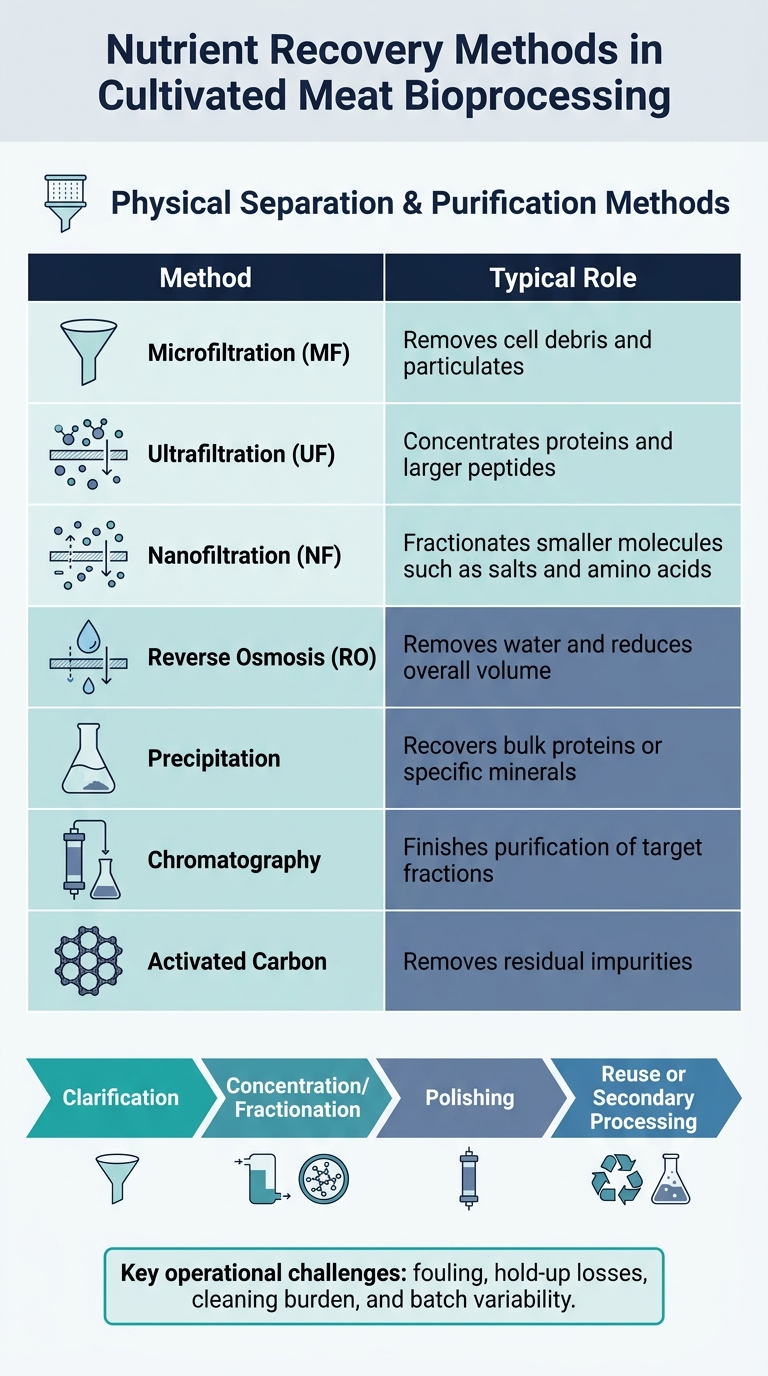
Nutrient Recovery Methods in Cultivated Meat Bioprocessing
Recovery starts with a simple question: what is the least disruptive way to get a useful fraction back out of this stream? The answer depends on the target nutrient, the purity needed, and what happens next. Some streams are suitable for internal reuse in cultivated meat bioprocessing. Others make more sense for secondary valorisation.
In practice, spent media tends to be addressed first, then mixed residues, and then streams that are too dilute or too heterogeneous for physical separation alone.
Media regeneration and inhibitor removal
Spent media is often the first place to look for recovery because, in many cases, it does not need full rebuilding. It usually needs inhibitor removal and polishing. Spent culture media is rarely fully exhausted, but byproducts such as ammonia and lactate build up and start to limit cell performance. The goal of regeneration is to strip out those inhibitors while keeping as much of the useful media composition as possible.
For reuse, the recovered stream has to be fit for the intended route of reuse, with validated removal of impurities that could affect cell growth, product quality, or sterility. In plain terms, that means setting release criteria for:
- composition
- microbial load
- pH
- osmolarity
It also means having clear reject criteria for any batch that falls outside specification.
Membranes, precipitation and chromatography for fraction recovery
Mixed streams usually need solids removal before solute recovery. So the process tends to start with clarification, then move into concentration or fractionation, and finish with polishing. Downstream processing methods are commonly linked in sequence for exactly that reason.
| Method | Typical role |
|---|---|
| Microfiltration (MF) | Removes cell debris and particulates |
| Ultrafiltration (UF) | Concentrates proteins and larger peptides |
| Nanofiltration (NF) | Helps fractionate smaller molecules such as salts and amino acids |
| Reverse osmosis (RO) | Removes water and reduces overall volume |
| Precipitation | Recovers bulk proteins or specific minerals |
| Chromatography | Finishes purification of target fractions |
| Activated carbon | Removes residual impurities |
A typical train clarifies first, then concentrates or fractionates, then polishes before reuse or secondary processing. The hard part is not just picking the unit ops. It is dealing with the limits that show up in day-to-day running: fouling, hold-up losses, cleaning burden, and batch variability.
Enzymatic and fermentation-based upgrading of residual nutrients
When separation on its own cannot recover enough value, biochemical upgrading becomes the fallback route. One option is enzymatic hydrolysis. This breaks proteins into peptides and free amino acids, which can make a mixed stream easier to use in secondary bioprocessing or, with further purification, in media formulation.
Another option is fermentation-based bioconversion, where residual nutrients are converted into higher-value fractions. That can improve recovery, but it comes with extra process burden. Teams need tighter contamination control and closer monitoring of impurities, residual enzymes, and microbial carryover.
For facilities working under GMP-style controls, the main question is pretty direct: is the extra process complexity worth the value recovered? Biological conversion is usually most attractive when the starting stream is too dilute or too heterogeneous for physical separation alone to recover value in an efficient way.
Reuse pathways inside and beyond cultivated meat facilities
Once fractions have been recovered and polished, the next step is simple in principle but strict in practice: send them back into the process or direct them to another use. For cultivated meat production, recovered fractions should only go back into operations after checks confirm composition, purity, consistency, and fit for the intended application.
Internal reuse in media preparation and bioreactor operations
Internal reuse starts with fit-for-purpose validation against the target media specification and contamination limits.
That means a recovered fraction has to match what the process needs, not just look acceptable on paper. A salt stream, buffer component, or water fraction might seem usable, but if it drifts from the required specification or carries unwanted residues, it can affect media preparation and bioreactor performance fast. In this setting, small deviations matter.
Secondary bioprocessing and co-product valorisation
Fractions that fall short of the bar for internal reuse may still hold value. Cell debris and non-product biomass, for example, can be directed into secondary bioprocessing as fermentation feedstocks or for hydrolysate production. They can also be used as co-products outside cultivated meat, including animal feed ingredients or fertiliser inputs.
The choice between internal reuse and secondary valorisation usually comes down to a few practical points:
- Purity of the recovered fraction
- Volume available for reuse or diversion
- Cost of extra processing compared with the value that can be recovered
In other words, the question is not only can this be reused? It is also where does it make the most sense to use it?
Procurement and integration considerations for implementation
Implementation depends on getting the right equipment, materials, and analytical tools in place. That includes the hardware for recovery, the consumables that support it, and the analytics needed to check whether recovered streams are suitable for reuse or diversion.
Cellbase can help teams source verified bioreactors, growth media, scaffolds, sensors, cell lines, and analytical equipment for recovery workflows.
Safety, regulatory and sustainability considerations in a UK context
Recovered nutrients only matter if they can be released through a defined quality and compliance process. Once recovery works at the process level, the next step is simple: can that stream be cleared for reuse under UK food safety controls?
Food safety, GMP and quality control requirements
Recovered streams need a risk-based quality review before reuse. That review should check microbial contamination, chemical carry-over and process residues against set acceptance criteria. Each batch also needs full records for collection, purification, test results and release sign-off.
This is standard GMP discipline. Maintaining media sterility is essential to prevent batch failure during these recovery cycles. If the batch history is weak, or the test data do not support release, the stream should not go back into the process.
Regulatory classification and documentation
Classify each recovered stream by its end use, then document the route through the UK compliance system. Facilities should keep clear records of the recovery step, the purification method, analytical results and the release decision. Any change should go through formal change control so safety, composition and process performance can be checked again.
That documentation is what turns recovery from a technical step into a credible manufacturing programme.
Conclusion: Building a credible nutrient recovery programme
A credible programme starts with a defined use case, documented recovery and a clear quality gate. Validate performance during reuse and confirm that recovery supports product quality as well as process efficiency. Sustainability assessments should be based on measured facility data, not assumptions.
FAQs
Which stream should we recover first?
Prioritise spent media components first. Recovering and reusing unused proteins and nutrients from growth media is a key step in closed-loop systems because it directly improves the economics and resource use of cultivated meat production.
If needed, Cellbase is a specialised B2B marketplace where industry professionals can find filtration and separation equipment for these recovery workflows.
When is spent media suitable for reuse?
Spent media is suitable for reuse only when it fits your current bioprocess workflow and has been validated in your process.
That timing depends on the mode of operation:
- In batch processes, reuse happens after harvest
- In fed-batch, it happens between feed additions
- In perfusion, it is handled as a controlled sidestream
Before reuse, you need to remove inhibitory metabolites such as ammonia and lactate. You also need to track key markers like glucose and osmolality, while keeping sterility tightly controlled throughout.
Reuse makes sense only when cell growth and phenotypic identity stay consistent across passages.
How do we choose between reuse and diversion?
Choose reuse when the nutrient stream can be recovered and fed back into the same bioprocess, or into another one, as a closed-loop input.
If the stream can’t meet purity, quality, or process requirements, choose diversion instead. That means turning it into a different product with value, such as sending collagen-rich fractions into higher-value food or ingredient streams.


