

Cultivated meat production hinges on perfecting the balance of proteins, fats, and carbohydrates to replicate the taste, texture, and nutritional profile of conventional meat. Early products lacked this balance, often resulting in dry or bland outcomes. Companies like Aleph Farms have made progress, achieving macronutrient profiles closer to traditional beef by combining muscle and fat cell cultures. This process involves metabolic engineering, gene editing (e.g., CRISPR), and serum-free media to optimise cell growth and nutrient synthesis.
Key takeaways:
- Protein: Critical for muscle cell structure and texture.
- Fat: Essential for flavour, tenderness, and marbling.
- Carbohydrates: Provide energy for cell growth and contribute to flavour during cooking.
Tools like HPLC and mass spectrometry help measure macronutrient levels, while bioreactor design ensures consistency during large-scale production. Regulatory compliance in the UK and US requires cultivated meat to match conventional meat within a 10% variance in macronutrient composition. With a projected market value of £25 billion by 2030, achieving these standards is essential for commercial success.
Engineering Cell Lines for Cultured Meat and Sustainable Cellular Agriculture #culturedmeat
sbb-itb-ffee270
Macronutrient Functions in Cultivated Meat Production
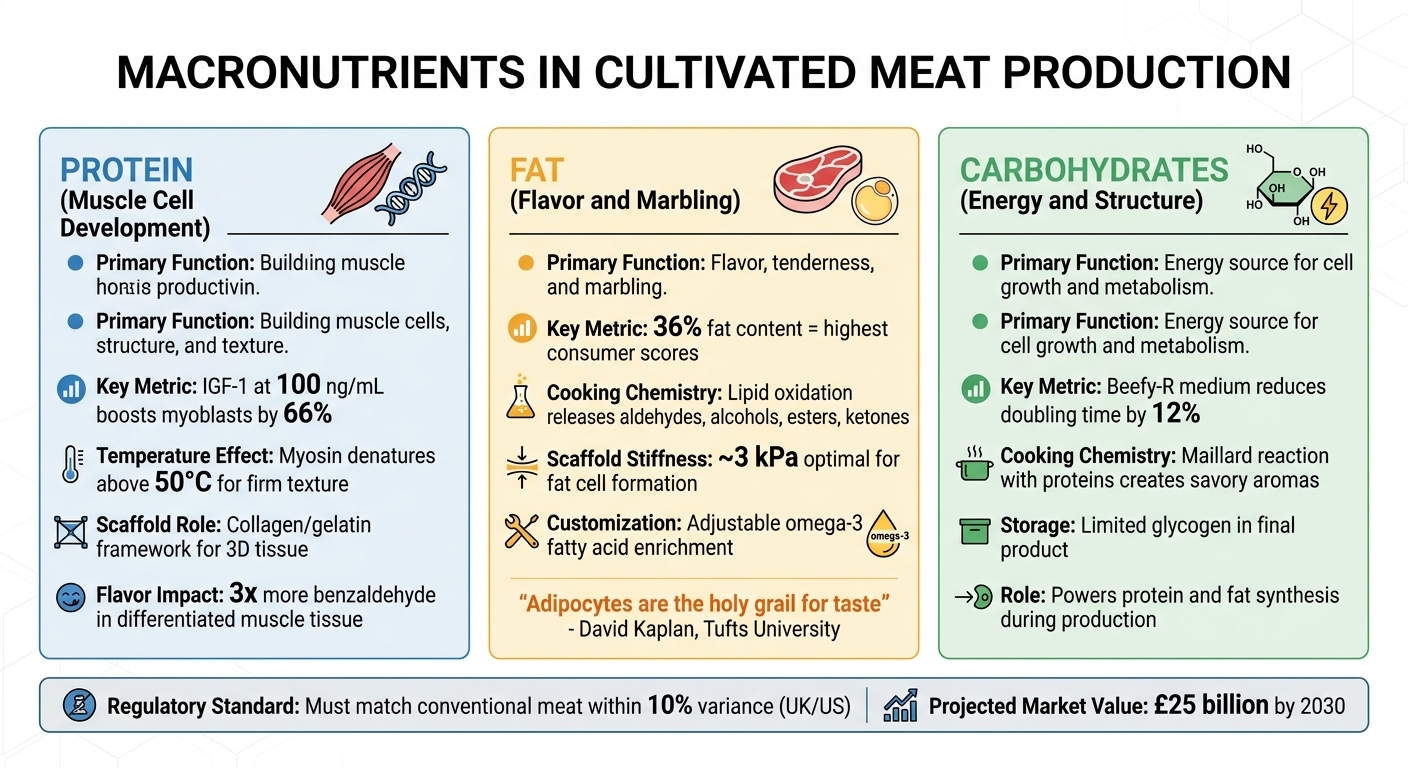
Macronutrient Functions and Key Metrics in Cultivated Meat Production
Macronutrients play distinct roles in shaping cultivated meat to resemble traditional beef, pork, or poultry. Proteins provide structure, fats enhance flavour and tenderness, and carbohydrates fuel the energy-intensive cell growth process. The balance of amino acids, lipids, and glucose in serum-free culture media directly impacts the nutritional profile and composition of the final product [1].
Protein in Muscle Cell Development
Proteins are essential for building muscle cells. They drive cell growth, division, and the maturation of muscle fibres, which are critical for achieving the desired texture and "bite" of the meat [1][2]. Protein-based scaffolds - like collagen, gelatine, or plant-derived isolates - serve as a framework, helping cells align and form structured 3D tissues that replicate the fibrous texture of conventional meat [2].
When cooked, proteins such as myosin heavy chains denature at temperatures above 50°C, creating the firm texture we associate with cooked meat [5]. Research shows that adding 100 ng/mL of insulin-like growth factor (IGF-1) to the culture media can boost myoblast numbers by 66% [2], highlighting how precise protein management supports muscle development. Interestingly, experiments revealed that highly differentiated muscle tissue contained three times more benzaldehyde - a compound linked to flavour - than undifferentiated samples [5].
Fat for Flavour and Marbling
Fat cells, or adipocytes, are key to delivering the flavour, tenderness, and marbling that consumers expect in meat. David Kaplan, Director of the Tufts University Centre for Cellular Agriculture, emphasised this by stating:
Adipocytes are the holy grail for taste [4].
During cooking, lipid oxidation releases volatile compounds like aldehydes, alcohols, esters, and ketones, which contribute to the meat's aroma [4]. In consumer tests, beef with 36% fat content scored the highest for flavour and texture [3][7].
Unlike traditional meat, cultivated meat allows for precise control over its fatty acid profile. By adjusting the lipids in the culture media, producers can enrich the meat with healthier fats, such as omega-3 fatty acids [1]. Additionally, the differentiation of immature cells into fat tissue enhances flavour and texture [1]. Scaffold stiffness also influences tissue formation, with muscle cells requiring a stiffness of around 11 kPa, while fat cells form more effectively at a much lower stiffness of approximately 3 kPa [5].
Carbohydrates for Energy and Structure
Carbohydrates, primarily glucose, act as the main energy source in the basal media, meeting the high metabolic demands of rapidly dividing cells [1][2]. For example, serum-free media like Beefy-R have been shown to reduce cell doubling time by 12% [2].
In the final product, carbohydrates interact with proteins during the Maillard reaction, producing the rich, savoury, and roasted aromas associated with cooked meat [5][6]. However, cultivated meat cells have limited carbohydrate storage, with glycogen making up only a small portion of the final composition. Despite this, glucose remains vital during production, as it powers the metabolic processes needed for synthesising proteins and fats. The next section will explore the analytical methods used to measure these macronutrients in cultivated meat production.
Metabolic Pathway Engineering for Macronutrient Balance
Creating the right mix of protein, fat, and carbohydrates in cultivated meat requires careful tweaking of cellular metabolism. Scientists achieve this through metabolic pathway engineering, which adjusts how cells process nutrients from culture media into muscle tissue and fat. As the Good Food Institute explains:
"Cell line engineering can take place through adaptation or genetic engineering... to dramatically improve the efficiency or productivity of the production process or even influence end product attributes such as nutrition" [1].
By 2023, nearly half of cultivated meat companies were exploring genetic engineering for research or commercial purposes [1]. This growing trend highlights the industry's focus on fine-tuning metabolic pathways to develop products that rival or surpass conventional meat in nutrition, all while cutting production costs. These advancements pave the way for discussions on cutting-edge analytical techniques in later sections.
Genetic and Molecular Engineering Methods
Gene-editing tools like CRISPR-Cas are at the forefront of metabolic pathway modifications. By adding, removing, or rearranging DNA sequences, these techniques enhance cell growth, improve nutrient processing, and balance macronutrient composition.
For instance, in 2016, Upside Foods (formerly Memphis Meats) filed a patent for immortalising chicken skeletal muscle cells. They achieved this by overexpressing the TERT gene and using CRISPR-Cas to delete the p15 and p16 genes [8]. This approach allowed the cells to bypass their natural division limits, enabling indefinite proliferation while retaining the ability to differentiate into protein-rich muscle tissue. This innovation directly contributes to achieving a balanced protein profile in the final product.
In addition to genetic editing, computational tools like genome-scale metabolic models are used to map nutrient uptake and identify the most efficient pathways for converting culture media components into meat [1]. These models help researchers pinpoint genetic changes that can significantly enhance macronutrient synthesis.
Multi-Omics for Pathway Analysis
Multi-omics techniques, including transcriptomics, proteomics, and metabolomics, provide a detailed picture of cellular metabolism. These tools are essential for developing tailored metabolic models for species like bovine, porcine, or avian cells [1].
One practical application involves analysing spent media - the nutrients consumed and metabolites produced by cells. This analysis reveals opportunities to improve how efficiently cells convert nutrients [1]. Additionally, advanced sequencing can uncover cell heterogeneity, helping scientists select cell lines with consistent macronutrient production.
Serum-Free Culture Media Formulation
Switching from animal serum to chemically defined, serum-free media is crucial for consistent macronutrient profiles. Recombinant proteins (like albumin and transferrin) and growth factors (such as IGF-1 and FGF-2) are often produced through precision fermentation using engineered microbes or plants [1][2].
A study by Skrivergaard et al. (referenced in 2025) demonstrated the effectiveness of Tri-basal 2.0+ serum-free medium. This formulation, which included optimised levels of fetuin (600 µg/mL), BSA (75 µg/mL), and FGF2 (2 ng/mL), supported sustained growth of bovine satellite cells, outperforming traditional 10% FBS media [2]. It highlights how precise media composition can enhance macronutrient synthesis.
Statistical tools like Design of Experiments (DoE) and Plackett–Burman designs are used to identify interactions between media components using a serum-free media optimization kit [2]. For example, combining Vitamin C with FGF creates a stronger effect than either alone. The Beefy-R medium, which incorporates rapeseed protein isolate, showed a 10% improvement in cumulative growth and a 12% reduction in doubling time compared to its predecessor, Beefy-9 [2].
Cost-effective media additives are also gaining attention. Plant-based hydrolysates derived from sugarcane bagasse or okara are increasingly used [2]. Researchers at Northwestern University demonstrated that a common stem cell medium could be produced at 97% less cost by optimising its components [1]. The next section will delve into the analytical methods used for precise macronutrient measurement.
Analytical Methods for Macronutrient Measurement
To ensure cultivated meat cells deliver balanced macronutrient profiles, precise analytical methods and bioreactor sensors are essential. These tools confirm that engineered metabolic pathways and media formulations are effectively producing the desired macronutrient ratios. The feedback from these methods is crucial for refining both metabolic processes and nutrient formulations.
High-Performance Liquid Chromatography (HPLC)
HPLC is a key tool for quantifying proteins and lipids in cultivated meat samples. For protein measurement, the bicinchoninic acid (BCA) method is widely used. It provides fast and reliable results when analysing cell and tissue lysates across various media types [10].
Western blotting complements this by identifying and measuring specific proteins like myoglobin, actin, myosin heavy chain, and α‑actinin [9]. Notably, in optimised serum-free differentiation medium (SFDM v2), the expression of myoglobin in 3D bioartificial muscles has reached about 30% of the levels found in traditional bovine muscle tissue [9].
Mass Spectrometry for Lipid and Protein Analysis
Mass spectrometry is another powerful tool, especially for lipid profiling. It can distinguish between different fatty acid species and measure their relative abundance. When combined with HPLC, it provides a complete picture of both protein and lipid composition. Additionally, single-nucleus RNA sequencing (snRNA-seq) offers transcriptomic profiling at the cellular level [9].
This approach identifies specific cell subpopulations, such as proliferating, differentiating, and reserve cells, ensuring that cells are committed to a protein-producing myogenic pathway. It also highlights active metabolic pathways like MEK/ERK and NOTCH, which can guide adjustments to media formulations to maintain nutrient balance during scale-up [9]. Together, HPLC and mass spectrometry create a robust framework for detailed macronutrient analysis.
Nutrient Profiling Assays
Immunofluorescence (IF) staining is used to measure the "fusion index", which reflects the proportion of nuclei within protein-stained regions. This method also verifies actomyosin accumulation in 3D constructs. Multi-marker panels, including Pax7, Ki‑67, myogenin, and desmin, confirm the successful differentiation of cells into protein-rich myotubes [9]. Optimised formulations can achieve nearly 100% fusion indices in 2D cultures, whereas standard in vitro differentiation often yields around 50% [9].
For carbohydrate analysis, glucose oxidase-based assays precisely measure glucose levels in culture media or plasma [10]. Phase holographic live microscopy offers non-invasive monitoring of differentiation kinetics and myofusion. This method tracks cell morphology and biomass accumulation in real time, providing valuable insights into how cells process nutrients throughout the production cycle [9].
Scaling Macronutrient Balance for Commercial Production
Producing cultivated meat on a larger scale comes with the challenge of maintaining consistent macronutrient profiles. The methods discussed earlier play a crucial role in ensuring that protein, fat, and carbohydrate ratios remain stable as production expands. Achieving this balance requires a focus on bioreactor design, adherence to regulatory standards, and meticulous process control.
Bioreactor Design for Scaling
The techniques previously outlined are vital for guiding design decisions during scale-up. The choice of bioreactor significantly influences macronutrient synthesis at commercial levels. For volumes up to 20,000 litres, stirred-tank reactors are the standard. However, for larger capacities exceeding 20,000 litres, air-lift reactors are often preferred due to their ability to reduce shear stress and minimise nutrient and oxygen gradients [11]. Mechanical forces from impellers can compromise cell viability and differentiation, which can disrupt the production of proteins and fats. To address this, adjustments like flow breakers, specialised impeller designs, or adding polox can help manage shear stress without hindering nutrient distribution.
In larger bioreactors, ensuring even oxygen and nutrient distribution becomes more complex. Uneven gradients can lead to some cells overproducing protein while others accumulate excessive lipids, making uniform conditions essential for consistent macronutrient outcomes. Specialised equipment to address these challenges is available via platforms like Cellbase.
Regulatory Requirements for Macronutrient Consistency
Cultivated meat production falls under the joint regulation of the FDA and USDA-FSIS. The FDA oversees the early stages, including cell collection, banking, and differentiation into proteins and fats, while the USDA-FSIS manages the later stages, such as harvesting, processing, and labelling [12][13]. Companies must complete a pre-market consultation with the FDA, during which they provide detailed data about cell lines, manufacturing controls, and production components [12][15]. Consistent macronutrient profiles are essential to meet these regulatory expectations.
"Food made with cultured animal cells must meet the same stringent requirements, including safety requirements, as all other food regulated by the FDA."
– FDA Press Statement, 16th November 2022 [12]
Facilities must adhere to Current Good Manufacturing Practices (CGMP) and implement Hazard Analysis and Critical Control Points (HACCP) systems to manage potential hazards [12][13]. For large-scale production, USDA inspectors verify compliance at least once per shift, ensuring the product is safe, unadulterated, and accurately labelled [12][13]. Labelling, in particular, presents a significant challenge, as it must truthfully represent the product’s macronutrient composition and gain pre-approval from regulators [12][15]. To streamline this process, companies are encouraged to engage with the FDA's Centre for Food Safety and Applied Nutrition early on and maintain detailed batch records throughout cell proliferation and differentiation [13][15].
Case Studies in Scaled Macronutrient Engineering
In November 2022, UPSIDE Foods became the first company to receive a "no questions" letter from the FDA, confirming the safety of its cultivated chicken. Following this milestone, the company secured a USDA inspection grant and demonstrated compliance with FSIS processing and labelling standards, enabling commercial sales [14][15]. Similarly, in March 2023, GOOD Meat (a division of Eat Just, Inc.) received its FDA "no questions" letter for cultivated chicken and completed USDA-FSIS inspections, allowing the product to be served in U.S. restaurants [12][14]. By March 2025, the FDA had completed a pre-market consultation for cultivated pork fat cells, marking progress in regulating specific macronutrient components, like fat, independently of muscle tissue [15].
These examples highlight the necessity of maintaining precise macronutrient consistency and rigorous documentation of metabolic pathways and culture conditions. Companies must prove that their processes consistently deliver the same macronutrient ratios across batches. Achieving this level of reliability depends on advanced analytical methods and precise bioreactor control. The success stories of UPSIDE Foods and GOOD Meat emphasise the critical role of analytical precision and process management in scaling cultivated meat production effectively.
Conclusion
Balancing macronutrients in cultivated meat requires a fine-tuned combination of metabolic engineering, advanced analytical techniques, and scalable bioprocessing. As discussed earlier, tools like genetic modification, multi-omics analysis, HPLC, and mass spectrometry are crucial for achieving consistent profiles of protein, fat, and carbohydrates. Amy Chen, COO of UPSIDE Foods, highlighted this progress, stating:
The basic proof of concept on the science has been done. And now it is a scaling exercise [16].
However, scaling up production presents significant hurdles. High-density cell cultivation in large bioreactors can lead to viscosity issues, uneven oxygen and temperature distribution, and metabolic waste build-up, all of which can hinder cell growth. To capture even 1% of the global protein market, the industry would need 220–440 million litres of fermentation capacity - equivalent to 88–176 Olympic-sized swimming pools. This is a massive leap compared to the biopharma sector, which currently operates at less than 10 pools' capacity [16].
Despite these challenges, there are promising developments. Mosa Meat, for instance, has made strides in reducing media costs, while hybrid products demonstrate how metabolic optimisation can improve economic feasibility [16]. Cultivated meat also offers significant environmental benefits, with the potential to cut greenhouse gas emissions by 92% and reduce land use by 90% compared to conventional beef [17].
Sourcing specialised materials and equipment for macronutrient optimisation remains a critical bottleneck. Platforms like Cellbase are addressing this by connecting cultivated meat companies with suppliers of essential components such as bioreactors, analytical tools, and growth media. Transitioning from pharma-grade to food-grade sterility standards is another key step to cutting costs and accelerating production [16], but this shift also brings challenges related to regulatory compliance and quality assurance.
Progress by companies like UPSIDE Foods and GOOD Meat shows that maintaining macronutrient consistency at scale is possible. With 142 companies now in the space and governments such as the Netherlands (£52 million) and the UK (£15.8 million) investing in alternative protein research [17], the industry is gaining momentum. The path forward will require a balance between analytical precision and metabolic efficiency, achieved through smart engineering and sustained innovation.
FAQs
How do producers determine the ideal protein-to-fat ratio for different cuts?
Producers craft the perfect protein-to-fat balance in cultivated meat by focusing on nutritional targets, taste, and the unique traits of each cut. Tools like gene editing and enzyme overexpression play a role in fine-tuning fat content, while growth media can be adjusted to boost healthier fats, such as omega-3s. By managing the cellular environment and metabolic processes, producers can customise fat levels to align with both health and flavour expectations for different cuts.
How does serum-free media affect fat and protein formation?
Serum-free media play a crucial role in shaping fat and protein composition in cultivated meat by enabling precise control over nutrient availability. This precise control allows adjustments to fatty acid synthesis pathways. For instance, saturated fat levels can be reduced through techniques like gene editing or enzyme overexpression. Furthermore, fat profiles can be improved by incorporating beneficial nutrients such as omega-3 fatty acids.
In addition, metabolomics-guided media formulations help fine-tune the conditions needed for protein synthesis. This optimisation contributes to a more balanced macronutrient profile, enhancing the nutritional quality of cultivated meat.
How is macronutrient consistency maintained when scaling up in large bioreactors?
Maintaining consistency in macronutrient levels during large-scale cultivated meat production hinges on carefully controlling key bioprocess parameters. These include temperature (kept between 37–39°C), pH levels (maintained at 7.2–7.4), dissolved oxygen (ranging from 30–60%), and nutrient concentrations like glucose (typically 5–20 mM).
Using inline sensors and automated systems allows for real-time monitoring and adjustments, ensuring these conditions remain stable throughout the process. Additionally, managing the shift from cell proliferation to differentiation is a critical step to maintain balance and achieve optimal production yields.


