

Scaffold stiffness is a critical factor in cultivated meat production, directly influencing cell growth, differentiation, and the final product's texture. Scaffolds act as a substitute for the extracellular matrix (ECM), providing mechanical cues that guide stem cells into forming muscle, fat, or connective tissue. Here's what you need to know:
- Muscle cells require a stiffness of around 11–12 kPa for proper differentiation and texture development.
- Fat cells thrive in softer environments, with an ideal stiffness of about 3 kPa.
- Scaffold materials like hydrogels like gelatin, alginate, and bacterial nanocellulose are commonly used, each offering specific stiffness properties suited to different cell types.
- Measuring stiffness involves techniques like Young's Modulus testing, Texture Profile Analysis, and atomic force microscopy.
- Stiffness must be fine-tuned to balance cell growth, bioreactor conditions, and the desired texture of the final meat product.
Producers can source tailored scaffold materials through platforms like Cellbase, which offers options designed to meet specific mechanical and biological requirements. Matching scaffold stiffness to cell type is key to ensuring quality and consistency in cultivated meat production.
Dr. Amy Rowat: Marbling cultivated meat with hydrogel scaffolds
sbb-itb-ffee270
How Scaffold Stiffness Affects Cell Growth and Differentiation
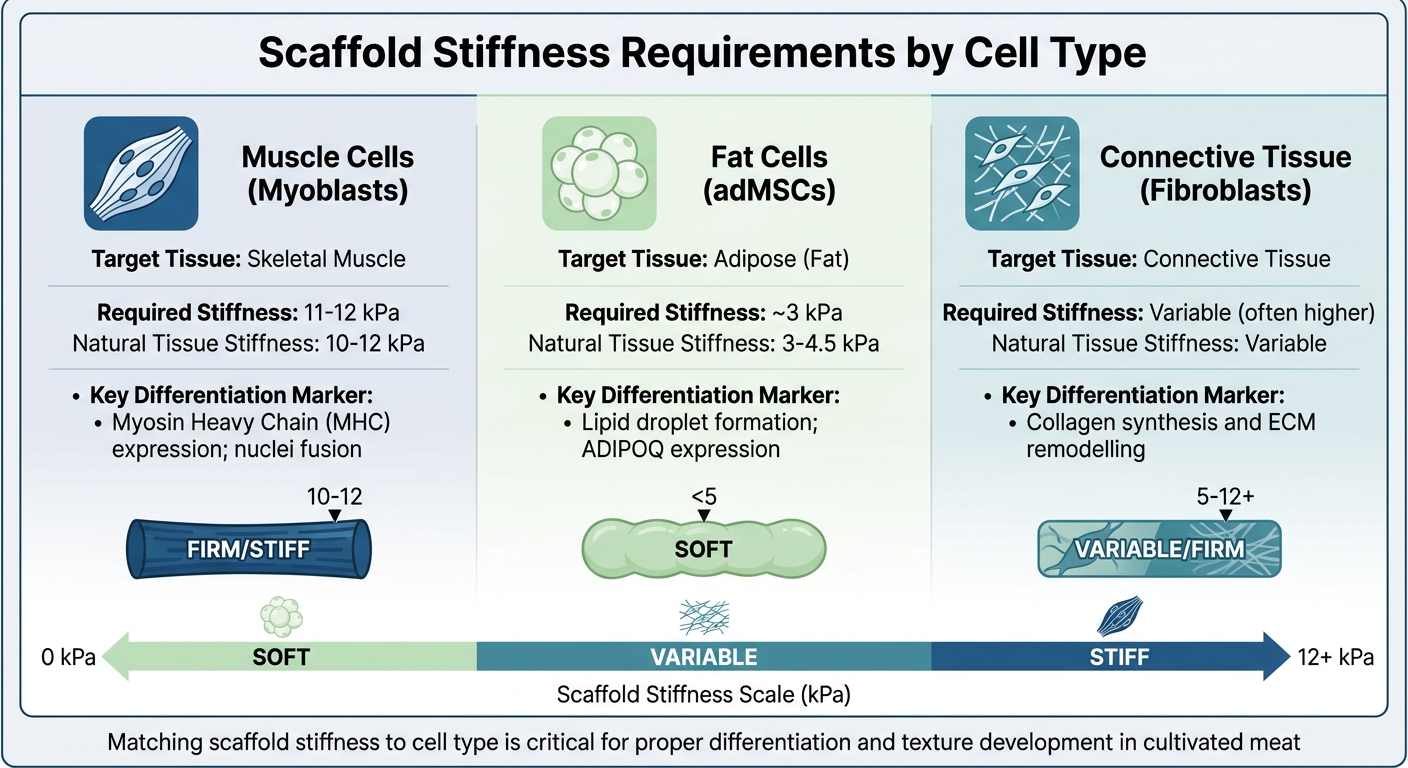
Scaffold Stiffness Requirements by Cell Type for Cultivated Meat Production
How Cells Sense and Respond to Scaffold Stiffness
Cells are remarkably responsive to their surroundings, constantly interpreting mechanical signals through a process called mechanotransduction. In simple terms, this is how cells convert physical cues into biochemical actions. Here's how it works: integrins on the cell surface attach to the scaffold, and the cytoskeleton generates forces that influence cell movement, clustering, and even differentiation [2].
For muscle precursor cells, or myoblasts, proteins like fibronectin and collagen within the extracellular matrix (ECM) are vital for attachment and growth. However, in cultivated meat production, where animal-derived materials are avoided, scaffolds often need surface functionalization such as RGD modifications. This mimics natural ECM binding sites, ensuring strong cell adhesion [2][3].
Scaffold stiffness plays a key role in determining cell fate. Cells can "feel" whether they're on a soft or firm surface, and this mechanical feedback steers stem cells into specific lineages. For example, a firmer scaffold tends to encourage muscle formation, while softer scaffolds favour fat development. Proteomic studies reveal that these differences in stiffness influence gene expression linked to lipid metabolism and muscle formation, starting from the very early stages [3].
This mechanotransduction process not only activates important biochemical pathways but also sets specific stiffness thresholds tailored to different cell types.
Stiffness Requirements for Muscle, Fat, and Connective Tissue Cells
Each cell type thrives within a particular stiffness range, which is essential for proper differentiation.
For skeletal muscle, the ideal scaffold stiffness is around 11 kPa, which closely matches the natural stiffness of muscle tissue (10–12 kPa) [3]. Under these conditions, bovine myoblasts form branched myotubes by day 8 of differentiation, along with increased production of myosin heavy chains (MHC) - the proteins responsible for the texture of meat when cooked [3].
Adipose tissue, on the other hand, requires a much softer environment. The optimal stiffness for fat differentiation is about 3 kPa, aligning with the natural properties of fat tissue (3–4.5 kPa) [3]. Adipose-derived mesenchymal stem cells (adMSCs) grown on 3 kPa scaffolds show significantly more lipid droplet formation compared to those on firmer 11 kPa scaffolds [3].
The table below summarises these stiffness requirements:
| Cell Type | Target Tissue | Required Stiffness (Young's Modulus) | Key Differentiation Marker |
|---|---|---|---|
| Myoblasts | Skeletal Muscle | ~11–12 kPa | Myosin Heavy Chain (MHC) expression; nuclei fusion [2][3] |
| adMSCs | Adipose (Fat) | ~3 kPa | Lipid droplet formation; ADIPOQ expression [3] |
| Fibroblasts | Connective Tissue | Variable (often higher) | Collagen synthesis and ECM remodelling [2] |
Scaffold stiffness doesn't just influence differentiation - it also shapes the texture and cooking quality of cultivated meat. Muscle cells that differentiate well produce more myofibrillar proteins, which firm up during cooking to create the familiar meat texture. On the other hand, scaffolds with lower differentiation levels may lose stiffness when heated, as collagen breaks down [3]. These stiffness-dependent markers are crucial for achieving the right texture and structure in cultivated meat products.
Methods for Measuring and Adjusting Scaffold Stiffness
Measurement Techniques for Scaffold Stiffness
Getting the stiffness of a scaffold just right is crucial for ensuring cells develop properly in cultivated meat production. The mechanical properties of the scaffold directly influence cell differentiation outcomes. One widely used method is Young's Modulus testing, which involves applying a 10% strain compression. This test provides a stiffness reading in kilopascals (kPa), helping determine if the scaffold meets the mechanical requirements for specific cellular applications, such as muscle cell differentiation [4].
For practical applications in cultivated meat, Texture Profile Analysis (TPA) is another effective tool. Borrowed from food science, TPA evaluates properties like hardness, springiness, chewiness, and cohesiveness. These factors are essential for ensuring the scaffold's performance aligns with the texture and mouthfeel of conventional meat products.
If more precision is needed, atomic force microscopy (AFM) and rheometry come into play. AFM provides nanometre-level mapping of stiffness variations across the scaffold's surface, while rheometry focuses on dynamic viscoelastic properties. Together, these methods offer a comprehensive understanding of scaffold mechanics.
Once the stiffness is measured, the next step is modifying it to meet specific requirements.
How to Modify Scaffold Stiffness
After measuring scaffold stiffness, adjustments can be made using various material-based strategies. One of the most effective methods is altering the crosslinking density. Increasing crosslinking makes the scaffold stiffer, while reducing it results in a softer material. This fine-tuning is essential for matching the natural stiffness range of skeletal muscle tissue, which typically falls between 2 and 12 kPa [4].
Composite and blend formulations provide another way to adjust stiffness. For example, combining alginate with other biopolymers or synthetic polymers can create a balance between strength and flexibility [2][4]. Mixing a softer polysaccharide with a stiffer synthetic polymer produces intermediate mechanical properties, making it suitable for co-culturing muscle and fat cells.
Synthetic polymers such as PCL, PLA, and PLGA are also widely used due to their strength and biostability [4]. PCL, in particular, is valued for its mechanical robustness in tissue engineering [4]. These materials can be shaped into scaffolds using techniques like electrospinning or 3D bioprinting, allowing precise control over stiffness. However, synthetic polymers often lack natural binding sites for cells, so surface modifications - like adding RGD motifs - are necessary to enhance cell adhesion [4].
Each material type has its pros and cons. Synthetic materials offer consistency and long shelf lives but may require extra steps for cell dissociation [4]. On the other hand, plant-based materials like soy, wheat, and cellulose are more affordable but often need chemical or structural tweaks to meet the required stiffness and adhesion standards [4]. Adjusting the stiffness not only ensures the scaffold meets mechanical needs but also influences how cells develop, shaping the final product's quality.
Scaffold Stiffness in Bioreactor Environments
How Bioreactor Shear Forces Affect Scaffold Stiffness
In bioreactors, the interplay of agitation and shear forces poses a challenge to scaffold integrity. While agitation ensures proper nutrient distribution, excessive shear can damage scaffolds, leading to structural breakdown and loss of cell adhesion. Striking the right balance is key to maintaining the scaffold's functionality.
During cultivation, cells themselves contribute to changes in scaffold properties. For instance, as myoblasts mature into multinucleated myotubes, they release enzymes such as metalloproteinases, which soften the surrounding material. This enzymatic activity, combined with the mechanical forces within the bioreactor, can alter the scaffold's mechanical properties, potentially pushing cells out of their optimal growth environment.
A bioprocess development study conducted in 2020 and 2021 by researchers like M.P. Hanga and A.W. Nienow focused on optimising agitation conditions in stirred-tank bioreactors. The goal was to scale up the production of bovine adipose-derived stem cells while safeguarding the structural integrity of microcarriers and preventing cell detachment. By carefully controlling the bioreactor's mechanical environment, they demonstrated the importance of precise agitation control to balance these competing demands [1].
These findings highlight the need for tailored approaches to maintain scaffold stability under the dynamic conditions of bioreactors.
Maintaining Scaffold Stability in Bioreactors
To address the challenges of bioreactor environments, maintaining scaffold stability requires a combination of durable materials and finely tuned process conditions. While adjusting scaffold stiffness is particularly important during early cell growth, continuous monitoring and adaptive strategies are essential to ensure long-term performance.
Using materials with strong mechanical resistance, such as bacterial cellulose, can help scaffolds endure higher shear forces without losing their structure. Additionally, crosslinking techniques can further reinforce scaffold durability, making them better suited for dynamic bioreactor conditions.
An innovative example comes from a 2024 study conducted at the National University of Singapore. Researchers, including P. Murugan and S. Singh, developed scaffolds from decellularised asparagus stems for porcine skeletal muscle tissue engineering. The vascular bundles within the asparagus stems provided the necessary rigidity and resilience, allowing the scaffolds to maintain their structural integrity throughout the differentiation of porcine adipose-derived mesenchymal stem cells. Remarkably, these scaffolds even withstood the mechanical and thermal stresses of pan-frying [5].
Another critical factor is calibrating agitation speed in the bioreactor. This ensures adequate oxygenation while minimising stress on the scaffold, preventing degradation that could jeopardise cell attachment and tissue quality. For scaffolds designed to degrade over time, the degradation rate must be carefully managed to ensure that structural support lasts until cells produce enough extracellular matrix to maintain the tissue's shape independently.
These strategies underscore the importance of combining material innovation with process control to tackle the unique demands of bioreactor environments effectively.
Scaffold Materials and Their Stiffness Properties
Gelatin, Alginate, and Bacterial Nanocellulose Scaffolds
When it comes to cultivated meat production, the choice of scaffold material plays a critical role in supporting optimal cell growth. Among the most commonly used materials - gelatin, alginate, and bacterial nanocellulose - each brings distinct stiffness characteristics that cater to specific needs.
Gelatin, derived from animal collagen, is highly compatible with biological systems and can be processed into fibrous or porous microcarriers. Its structure closely resembles the extracellular matrix found in animal tissues, making it particularly effective for engineering muscle tissue. Thanks to its natural cell-binding domains, gelatin supports myoblast attachment and expansion without requiring additional modifications.
Alginate, a biopolymer sourced from algae, is known for its flexibility. By adjusting the type and concentration of divalent cations - such as calcium or barium - used during crosslinking, researchers can fine-tune the scaffold's stiffness to meet specific tissue requirements. This non-toxic material is especially useful for cultivating fat cells, such as preadipocytes. However, since alginate lacks natural cell adhesion properties, it often needs to be modified with RGD (arginyl-glycyl-aspartic acid) sequences to promote effective cell attachment, particularly in dynamic bioreactor conditions.
Bacterial nanocellulose, produced by bacteria like Gluconacetobacter hansenii, is a standout material due to its exceptional mechanical strength and structural integrity. It can endure the shear forces and handling demands of manufacturing, making it ideal for applications that require sturdy support throughout the cultivation and processing phases.
In short, choosing the right material involves matching these specific stiffness properties to the needs of the cells being cultivated.
Matching Materials to Cell Types
The stiffness of the scaffold material must align with the mechanical requirements of the specific cell type. Each cell type thrives in a particular stiffness range, and selecting the right match ensures optimal growth and differentiation.
- Muscle cells grow best in scaffolds with a stiffness range of 2–12 kPa, with around 10 kPa being ideal for proliferation and up to 18 kPa for differentiation [1][2][5]. Gelatin, when processed into aligned fibrous structures, is particularly effective for guiding myotube formation.
- Fat cells prefer much softer environments, with an optimal stiffness of about 3 kPa [5]. Alginate hydrogels, tuned to lower stiffness through controlled crosslinking, are well-suited for carrying adipose-derived stem cells and supporting their development.
- Connective tissue demands higher mechanical strength. While synthetic materials like polycaprolactone (PCL) provide the rigidity needed for cartilage engineering, bacterial nanocellulose offers reliable structural support for more complex tissue architectures. Additionally, blends such as alginate/collagen or PCL/collagen meshes allow for precise control over both mechanical strength and biological functionality.
Sourcing Scaffold Materials Through Cellbase
After understanding the properties and mechanical demands of scaffold materials, finding the right source becomes a critical step in scaling cultivated meat production.
What Cellbase Offers for Scaffold Procurement
Cellbase is a dedicated B2B marketplace tailored specifically to the cultivated meat sector. Unlike generic lab supply platforms, Cellbase focuses on the unique technical needs of this industry, offering scaffold materials with verified mechanical properties. The platform connects researchers and production teams with suppliers who understand the stiffness requirements essential for developing muscle, fat, and connective tissues.
One standout feature is its range of 3D scaffolds designed with specific geometries and mechanical properties. For example, in April 2026, Gelatex introduced its "Muskel Scaffold Starting Kit" on the platform. This nanofibrous scaffold mimics the natural extracellular matrix, making it ideal for muscle cell applications. It’s selected based on factors like mechanical strength, cell compatibility, and controlled degradation rates during cultivation.
For projects with unique stiffness or geometric needs, Cellbase offers custom fabrication services. These bespoke scaffolds are tested for quality control to ensure consistent performance in cell culture environments. This rigorous approach makes it easier for teams to find materials that precisely match their project requirements.
Finding the Right Scaffold Materials on Cellbase
Cellbase simplifies the search for scaffold materials with filtering options for Material Type, Scale Compatibility, and Validation Status. Users can also browse collections like "Scaffolds & Biomaterials", which include additional filters for protein sources and edibility.
For technical questions about materials such as gelatin, alginate, or synthetic polymers, the platform’s "Ask us anything" feature connects users with cultivated meat experts. This tool is particularly useful for ensuring scaffold materials align with bioreactor conditions, including agitation strategies, pH stability (typically 7.1–7.4 for mammalian cells), and real-time monitoring systems.
Global shipping is supported, with cold chain logistics available for temperature-sensitive materials. Additionally, Cellbase provides insights into surface functionalisation techniques, which can improve cell adhesion on more affordable, bio-inert scaffolds like cellulose. These features make scaffold procurement efficient while meeting the high-performance standards required for cultivated meat production.
Conclusion
The fine-tuning of scaffold stiffness plays a crucial role in every phase of cultivated meat production. This mechanical property serves as a key signal that influences cell growth and development. Since natural muscle tissue typically has a stiffness range of 2–12 kPa, replicating these conditions is essential to achieve cultivated meat with the right texture and tenderness [2].
As global demand rises alongside concerns about the environment, refining scaffold mechanics becomes even more critical for sustainable production.
Producers face a delicate balancing act: scaffolds must support dense cell cultures, endure bioreactor conditions, and provide the mechanical cues needed for the desired texture. Lower stiffness levels encourage cell growth, while higher stiffness promotes differentiation into multinucleated myotubes and functional myofibres [2]. Achieving this balance often involves materials like gelatin, alginate, bacterial nanocellulose, or synthetic polymers, which can be tailored to mimic the natural extracellular matrix.
To address these challenges, Cellbase offers a specialised marketplace where researchers and manufacturers can access scaffolds and biomaterials that meet specific mechanical requirements. Users can filter options by material type, scalability, and validation status, ensuring that choices are backed by industry expertise.
Maintaining the right stiffness demands ongoing adjustments throughout production, reflecting the need for precise control over both materials and processes. With its curated supplier network and focus on industry needs, Cellbase streamlines this complex process, helping producers meet the high standards necessary for commercially viable cultivated meat.
FAQs
How do I choose scaffold stiffness for mixed muscle and fat tissues?
When producing cultivated meat, understanding how matrix stiffness affects cell differentiation is key. Scaffolds with adjustable stiffness - like gradient or composite designs - play an important role here. These scaffolds allow stiffer regions to promote muscle growth, while softer areas encourage fat tissue development. By mimicking the stiffness levels found in natural tissue environments, you can improve cell adhesion, differentiation, and maturation. This is a crucial step in creating functional mixed tissues that combine muscle and fat effectively.
Which stiffness test is best for my scaffold type and scale?
When it comes to stiffness testing, the best approach depends heavily on your scaffold's material and its intended use. Common methods include tensile testing, compression testing, and rheological testing. These techniques are crucial for evaluating the mechanical properties that play a key role in cultivated meat production.
For larger-scale scaffolds, using standardised tests helps maintain consistent parameters, ensuring reliability across production. On the other hand, if you're working with smaller or experimental scaffolds, more detailed methods like nanoindentation can provide valuable insights.
Ultimately, the testing method you choose should match your scaffold’s microenvironment and production scale. This alignment is essential for optimising conditions that support cell growth and differentiation.
How can I stop bioreactor shear forces changing scaffold stiffness over time?
To reduce scaffold stiffness changes caused by shear forces in bioreactors, focus on refining bioreactor design and adjusting flow conditions. Systems like airlift or rocking bioreactors are gentler and help lower shear stress. Modifying agitation speeds and flow rates can also create more stable conditions. Additionally, using computational models to simulate and manage flow behaviour can help protect scaffold integrity during the cultivation process.


