

If you run cultivated meat media at scale, direct reuse is not the answer. I’d treat recycling as a closed-loop conditioning step: measure spent media first, remove inhibitors such as ammonia and lactate, recover proteins only where it pays off, then recondition and clear the batch against cell-performance and sterility checks before reuse.
In plain terms, this article shows that media recycling is not “spent in, spent out”. It is a process decision built around three questions:
- What is left that I can reuse?
- What now blocks cell growth or shifts process control?
- What must I restore before the media goes back into culture?
If I were setting up a recycling loop, I’d start with these checks straight away:
- Chemistry: glucose, amino acids, lactate, ammonia, pH, osmolality, salts, iron
- Protein recovery targets: albumin and transferrin
- Safety: debris, microbes, endotoxins, plus toxicity and allergen checks
- Function: viability, doubling time over 4 passages in triplicate, phenotype markers, and differentiation readouts against fresh-media controls
The article also narrows the process choices. Alkalisation with ammonia stripping fits cases where ammonia is the main carry-over issue, but high pH can damage protein activity, so the media often needs extra conditioning before reuse. It also explains where recycling loops sit in batch, fed-batch, and perfusion setups, and when the extra handling, hold-time risk, and contamination control may make recycling the wrong call.
For bioprocess engineers and cell culture teams, the core point is simple: pick the lightest intervention that removes the measured bottleneck, fits your process mode, and still passes release criteria at scale.
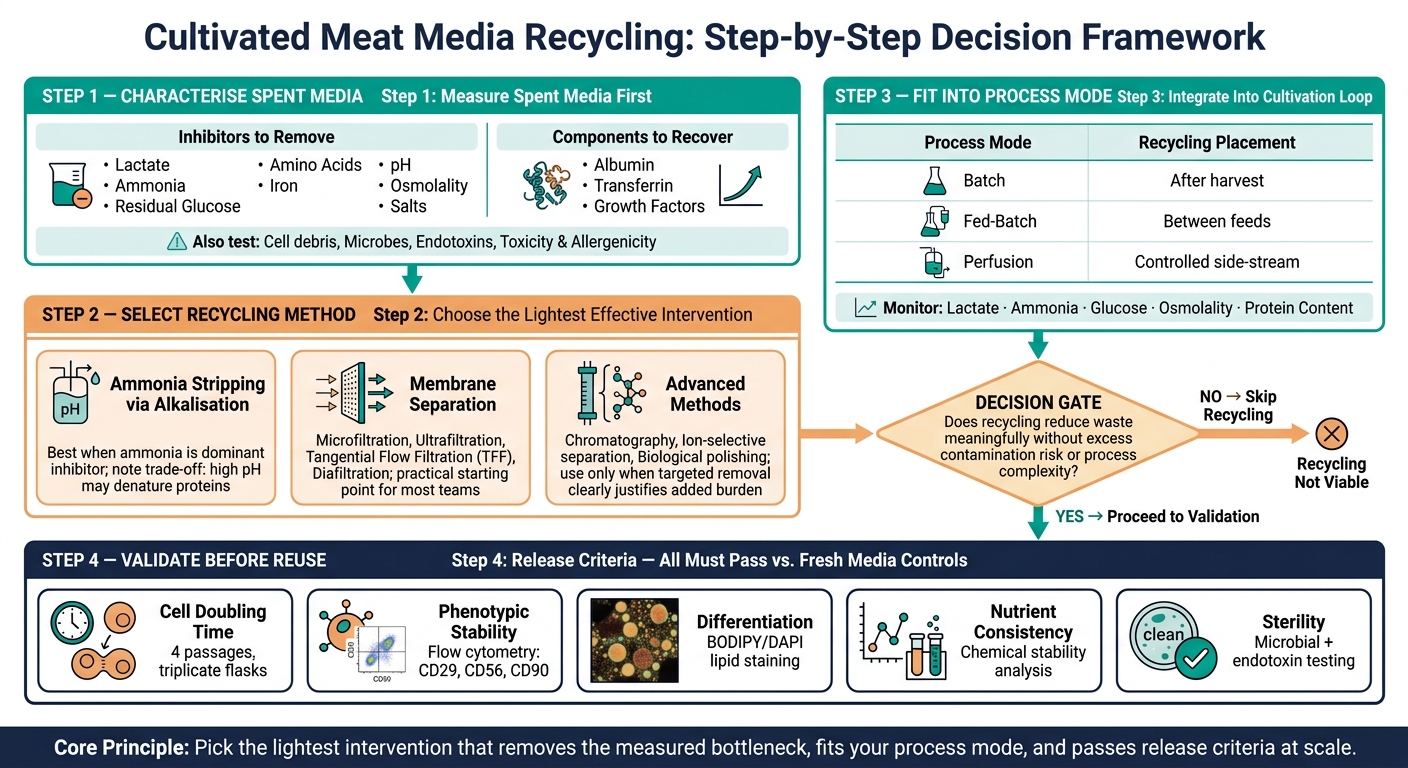
Cultivated Meat Media Recycling: Step-by-Step Decision Framework
How to characterise spent media before recycling
Spent media does not stay chemically static during culture. Cells consume nutrients, release metabolites, shift pH, and change the protein profile of the medium. That means measurement comes first. Before you design any recycling loop, you need a clear picture of what is still usable, what is now inhibitory, and what has become a safety risk.
That characterisation step helps determine whether the right route is simple blending, selective recovery, or full regeneration.
Key inhibitory and recoverable components to measure
Start by measuring two groups of components: inhibitors to remove and components worth recovering.
On the removal side, measure:
- lactate
- ammonia
- residual glucose
- amino acids
- iron
- pH
- osmolality
- salts
On the recovery side, albumin and transferrin are the main targets. Transferrin deserves close attention because high-molecular-weight proteins such as transferrin are prone to batch-to-batch quality fluctuations.
You should also measure growth factors, debris, microbes, and endotoxins before making any recycling decision. Cell debris can interfere with downstream processing and cut overall yield. Microbial and endotoxin testing is also required from a food safety point of view. Safety characterisation should also cover toxicity and allergenicity to meet novel food safety requirements [3][2].
Composition data tells you what changed. Functional testing tells you whether the recycled medium still works in culture.
Performance criteria for recycled media
Composition data on its own is not enough to clear recycled media for reuse. The recycled fraction needs to be checked against functional performance criteria before it goes back into process.
Cell viability and doubling time are the starting point. Track doubling time across four passages in triplicate. That helps you spot latent inhibitory effects that a one-passage test can miss [1]. If you are using suspension culture, confirm that the recycled medium still supports suspension growth, because this shift can slow proliferation when the formulation is not tuned properly [1].
If your process depends on differentiation, then differentiation performance has to be measured directly. For instance, adipogenic potential can be quantified with lipid accumulation markers such as BODIPY together with nuclear staining using DAPI [1]. Phenotypic stability is also worth checking by flow cytometry, using surface markers such as CD29, CD56, and CD90 to confirm that cells maintained in recycled media still retain the intended mesenchymal or myoblast profile [1].
If the recycled fraction contains high-molecular-weight proteins with variable activity, keeping process consistency becomes more difficult. Chemically stable components are usually the safer choice where possible.
Use chemical testing and functional testing together when qualifying recycled media for reuse.
| Performance Criterion | Verification Method | Target Outcome |
|---|---|---|
| Cell proliferation | Doubling time assessment (triplicate flasks, 4+ passages) | Consistent or improved growth rates |
| Phenotypic stability | Flow cytometry (CD29, CD56, CD90) | Retention of mesenchymal or myoblast markers |
| Differentiation | BODIPY/DAPI lipid staining | Successful maturation into muscle or fat cells |
| Media consistency | Chemical stability analysis | Minimal fluctuation in nutrient/growth factor concentration |
| Sterility | Multi-hurdle microbial and endotoxin testing | No viable contaminants; endotoxin within specification |
Only after that can you choose the recycling method that causes the least disruption.
sbb-itb-ffee270
Media recycling techniques used in cultivated meat
The recycling method you choose depends on which component needs to come out and how the rest of the process is set up.
Alkalisation and ammonia stripping
When ammonia is the main inhibitory carry-over, alkalisation and stripping give you a direct removal step. This route makes sense when spent media analysis shows ammonia as the dominant inhibitor.
Alkalisation increases pH, which shifts ammonium (NH₄⁺) to ammonia (NH₃). That ammonia is then stripped from the medium. It’s a simple idea, but there’s a trade-off: high pH can denature sensitive growth factors and proteins. So in practice, the basal media usually needs reconditioning before reuse.
That makes this method useful for ammonia control, but less suitable when protein retention matters.
Process design, environmental impact, and implementation
Once the recovery method is set, the next job is to place it inside the cultivation loop without breaking sterility or process consistency.
Fitting recycling loops into batch, fed-batch, and perfusion systems
Fit recycling at the point where media leaves and then returns to the process. In batch, that means after harvest. In fed-batch, it sits between feeds. In perfusion, it works as a controlled side-stream. That setup keeps the recycling step tied to the way each mode already exchanges media, instead of turning it into a separate handling stage.
Track key process markers such as lactate, ammonia, glucose, osmolality, and protein content using online or offline assays. Set clear sterility controls as well as maximum hold times before recycled media goes back into culture.
When media recycling may not be the right choice
Recycling makes sense only when partial reuse and selective metabolite removal cut waste in a meaningful way, and when the process can tolerate the extra handling plus contamination controls.
Skip recycling when the added process complexity, waste handling burden, or contamination risk is greater than the gain.
Equipment sourcing and validation workflows
Putting a recycling loop in place calls for the right process equipment, sensors, and analytical tools, along with a fixed validation workflow for every recycled batch. For teams sourcing this setup, Cellbase provides verified listings for cultivated meat equipment, sensors, and analytical tools.
Define monitoring and sterility controls before release, so each recycled batch is checked against the same criteria. That validation step is what makes a recycling loop repeatable at production scale.
Conclusion: Choosing the right recycling strategy for cultivated meat
Start with spent-media characterisation. Then pick the least disruptive intervention that the data can support.
Once you know where the bottlenecks are, decide whether recovery or substitution makes more sense. In most cases, ammonia and lactate are the first targets. After that, the next call is whether to recover or replace high-value proteins such as transferrin and albumin, which are often the main recovery targets in cultivated meat media. Chemically stable transferrin alternatives can cut batch-to-batch variation and make the recycling loop easier to run.
If removal is the main goal, begin with the simplest separation step. Membrane methods - microfiltration, ultrafiltration, tangential flow filtration, and diafiltration - are the practical starting point for most teams. Leave chromatography, ion-selective separation, and biological polishing for cases where targeted removal or selective recovery clearly pays for the added process burden.
Whatever mix of techniques you use, process validation is non-negotiable. Recycled media must be shown to support consistent cell growth, maintain phenotypic identity, and preserve differentiation competence across multiple passages. Validation criteria should include:
- Cell doubling time
- Surface marker retention
- Nutrient consistency
- Sterility
Each of these should be checked against serum-free media controls before any recycled batch is cleared for reuse at scale.
Choose the simplest strategy that removes the measured bottlenecks, fits the process mode, and validates at scale.
FAQs
How much spent media can usually be reused?
There’s no fixed percentage or industry-wide standard for how much spent media can be reused in cultivated meat production.
At this stage, most work in the field is aimed elsewhere: using less media overall, swapping out costly components, and improving media-use efficiency across the process.
If you’re looking at media management workflows, Cellbase offers curated industry resources.
What is the biggest risk when recycling media?
The biggest risk is the build-up of contaminants and metabolic waste. As cells grow, they consume key nutrients and release by-products that can slow growth and affect product quality.
In cultivated meat production, the cell environment needs to stay consistent and safe. If media quality drops, it can weaken both safety and scale-up.
When should proteins be replaced rather than recovered?
Proteins should be replaced, not recovered, when the time, cost, and plant setup needed for large-scale recovery or recombinant production outweigh the upside.
In practice, replacement makes sense when a lower-cost, more stable, non-recombinant option can deliver the same biological function. This matters most for expensive media inputs. Transferrin, for example, can account for up to 95% of media costs.


