

Cultivated meat production relies heavily on growth media, which accounts for over 95% of costs. To optimise yields and reduce expenses, it's crucial to adjust the media's nutrients, glucose, amino acids, and growth factors based on the specific cell type and production stage. Here's a quick breakdown of the process:
- Evaluate media performance: Track cell doubling time, viability, metabolic activity, and yield per litre.
- Identify bottlenecks: Check for nutrient depletion, waste accumulation, and pH imbalances using spent media analysis.
- Fine-tune nutrients: Adjust glucose, amino acids, and fatty acids to match cell metabolism and reduce waste.
- Optimise growth factors: Modify concentrations and delivery methods to support cell proliferation and differentiation.
- Use high-throughput screening: Test multiple formulations simultaneously for cost-effective and efficient results.
- Validate changes: Monitor cell growth, nutrient use, and environmental stability across production cycles.
Platforms like Cellbase simplify sourcing affordable, high-quality media components tailored for cultivated meat production. By systematically testing and refining media, you can cut costs and improve yields without compromising quality.
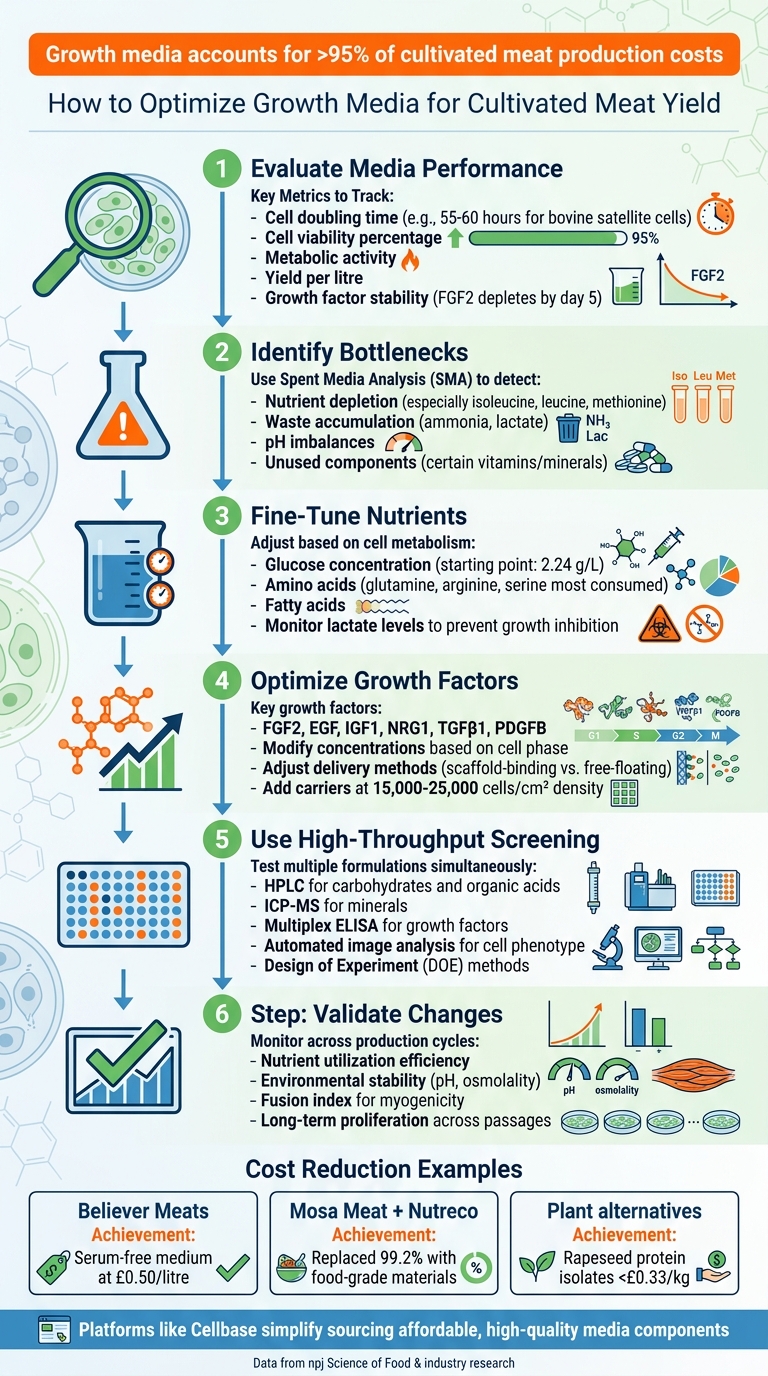
6-Step Process for Optimizing Growth Media in Cultivated Meat Production
Spent media analysis to facilitate cultivated meat media optimization - Ted O'Neill - ISCCM9
sbb-itb-ffee270
Assessing Current Growth Media Performance
Before making adjustments to your growth media, it's crucial to evaluate its current performance. Without a clear baseline, changes might miss the mark, leaving the real issues unresolved. Knowing how your media performs helps you fine-tune nutrient, amino acid, and growth factor levels effectively.
"The leading cost driver and challenge facing CM [cultivated meat] is the media used to culture the cells, since it is currently comprised of numerous indispensable and expensive components."
This step lays the groundwork for precise and meaningful media improvements.
Key Performance Indicators
To understand how well your media is supporting cell growth, focus on these key metrics:
- Cell doubling time: This measures how long it takes for your cell population to double. For example, immortalised bovine satellite cells (iBSCs) typically double in 55 to 60 hours [4]. If your cells take longer, it could suggest that the media composition is holding back growth.
- Cell viability: This is the percentage of healthy cells in your culture. Automated image analysis can make this process consistent and objective, offering reliable data on both viability and cell phenotype across batches [3].
- Metabolic activity: Look at which nutrients are being consumed and what waste products are accumulating. Glutamine is often the most consumed amino acid, followed by arginine and serine [6]. Also, monitor glucose consumption and lactate production - lactate tends to build up as glucose is used and can inhibit growth when levels get too high [6].
- Yield per litre: This metric is crucial for assessing commercial feasibility. For instance, Believer Meats produced a serum-free medium for approximately £0.50 per litre [4]. Achieving such efficiency requires a clear understanding of which components contribute to biomass and which don’t.
- Growth factor stability: Growth factors like basic fibroblast growth factor (FGF2) can diminish significantly by day 5 of culture, often coinciding with increased cell numbers [6]. Rapid depletion of FGF2 can lead to stalled growth mid-culture.
Identifying Bottlenecks
Once you've analysed these performance indicators, you can pinpoint specific bottlenecks through direct measurements like spent media analysis (SMA). This approach involves collecting media samples at intervals and measuring nutrient concentrations using techniques like high-performance liquid chromatography (HPLC) for carbohydrates and organic acids or inductively coupled plasma-mass spectrometry (ICP-MS) for minerals [6].
"Spent media analysis (SMA) is a commonly used and fundamentally simple strategy for cell culture media optimization... to understand which media components are directly utilized by cells and should be supplied in greater quantities, those not consumed over time, and how waste products may accumulate."
- npj Science of Food [6]
Here are some common bottlenecks to watch for:
- Essential amino acid depletion: Amino acids like isoleucine, leucine, and methionine often run out before the culture reaches its target density [6].
- Ammonia accumulation: Glutamine metabolism produces ammonia, which can slow growth. If ammonia levels rise, consider replacing glutamine with alternatives like α-ketoglutarate or pyruvate [4].
- pH imbalances: Lactic acid buildup can cause pH shifts, which vary depending on the cell type. For example, chicken muscle precursor cells (cMPCs) consume glucose more slowly than murine C2C12 myoblasts, leading to different pH dynamics [6].
- Unused components: Some media components, such as certain vitamins and minerals, may not deplete over time. Identifying these can help you reduce costs without affecting performance [6].
Adjusting Nutrient and Glucose Levels
Once you've identified bottlenecks, the next step is to fine-tune glucose and nutrient levels to align with your cells' metabolic needs. Customising these adjustments for your specific cell line can boost productivity while keeping costs manageable.
Setting Glucose Concentration
Glucose consumption isn't one-size-fits-all; it varies significantly between species and cell types. For instance, a mix of 40% high-glucose DMEM and 40% Ham's F10 typically starts with 2.24 g/L glucose [1]. However, chicken muscle precursor cells (cMPCs) utilise glucose at a slower, more linear rate compared to murine C2C12 myoblasts or chicken muscle fibroblasts (cMFBs). These latter cell types can completely deplete glucose by day 10 in standard 2D cultures [1].
To identify the ideal glucose concentration for your cells, calculate their specific consumption rate (ng/cell/day) during the first 24–48 hours of culture. This early measurement reveals metabolic differences before cell density influences glucose depletion [1]. For cells like cMPCs with linear consumption, maintain consistent glucose levels through regular feedings. In contrast, for high-consumption cells like C2C12s, fed-batch strategies can help avoid mid-culture depletion.
Keep an eye on lactate levels, as they tend to rise when glucose is consumed and can inhibit cell growth [1][2]. If lactate becomes an issue, consider reducing initial glucose levels or employing perfusion systems to remove waste.
From here, you can explore more economical nutrient options to further optimise performance.
Using Alternative Nutrient Sources
To make production scalable and affordable, replace costly biomedical-grade components with plant-based alternatives. Plant protein hydrolysates derived from soy, pea, or wheat are excellent supplements that extend cell viability at a lower cost [7]. Rapeseed protein isolates, a by-product of low-cost oilseed meals, are particularly effective substitutes for albumin and cost less than £0.33/kg [5].
"The culture medium is the costliest input in cultivated meat and therefore subject to intense efforts to reduce cost through simplification, by downgrading components, by replacing components with cheaper alternatives, and by being cognisant of appropriate timing of administration."
When substituting glutamine, pyruvate or α-ketoglutarate are good alternatives. They help reduce ammonia build-up, which can otherwise inhibit cell growth [7]. Analysing spent media can also reveal vitamins and minerals that remain unused over time. For example, many water-soluble vitamins and certain minerals in standard media like DMEM are not depleted by cells, indicating they may be over-supplied [1]. Cutting back on these unnecessary components reduces costs without compromising cell performance.
Adjusting Amino Acids, Fatty Acids, and Growth Factors
Using insights from spent media analysis, you can refine the biochemical components of your cell culture media to improve its effectiveness. This involves adjusting amino acids, fatty acids, and growth factors to align with the specific needs of your cells. These elements play a crucial role in supporting cell growth and differentiation.
Balancing Amino Acid and Fatty Acid Profiles
Cells don't consume all amino acids equally. Spent media analysis shows that arginine, isoleucine, leucine, methionine, glutamine, and serine are among the most depleted amino acids in cell types relevant to cultivated meat production [11]. High-performance liquid chromatography (HPLC) is often used to measure free amino acid levels over time [11].
"Understanding these cells' specific nutrient utilisation rates will enable a much more directed approach to generating optimal media formulations for CM." - npj Science of Food [11]
Since different species and cell types exhibit unique metabolic behaviours, a universal medium isn't practical. For example, chicken myoblasts and bovine satellite cells have distinct nutrient requirements [11]. It's also important to consider the cells' differentiation status. Metabolic needs change significantly as cells shift from proliferation to forming myotubes [11].
Fatty acid consumption can be tracked using gas chromatography, helping identify which lipids contribute to biomass formation and which remain unused. With this information, you can adjust fatty acid levels to better support cell growth.
Once amino acid and fatty acid profiles are optimised, growth factor levels can be fine-tuned for complete media optimisation.
Modifying Growth Factor Concentrations
After refining nutrient levels, managing growth factors is critical to steering cell proliferation and differentiation effectively.
Key growth factors for cultivated meat production include FGF2, EGF, IGF1, NRG1, TGFβ1, and PDGFB [8]. Enzyme-linked immunosorbent assay (ELISA) can monitor their depletion over time. For instance, studies reveal that FGF-2 levels drop significantly by day 5, coinciding with an increase in cell numbers [11].
During the proliferation phase, higher doses of growth factors are often necessary. As cells transition to differentiation, adjusting the release kinetics through surface functionalization can improve outcomes [9]. For bovine satellite cells cultured on microcarriers, adding new carriers when cell density reaches 15,000–25,000 cells/cm² helps maintain exponential growth. Waiting until densities exceed 30,000 cells/cm² can lead to slower doubling times due to contact inhibition [10].
Incorporating growth factors into scaffolds or microcarriers offers another strategy to reduce overall usage. This approach provides a sustained, localised release, unlike free-floating delivery [9]. Using binding domains, such as collagen-binding or cellulose-binding tags, allows growth factors to anchor to scaffolds. This slows their diffusion, maintaining effective concentrations for longer periods [9].
Using High-Throughput Screening for Media Testing
High-throughput screening (HTS) transforms media optimisation by allowing researchers to test hundreds of formulations at once. After fine-tuning nutrient and growth factor levels, HTS becomes a powerful tool to speed up the process and uncover interactions that traditional, step-by-step testing might miss.
Screening Methods and Technologies
HTS combines advanced analytical tools and automation to assess how cells perform across various formulations. A key part of this process is Spent Media Analysis (SMA), which tracks nutrient depletion and waste build-up [6]. Techniques like high-performance liquid chromatography (HPLC) are used to measure carbohydrates, organic acids, and water-soluble vitamins, while inductively coupled plasma-mass spectrometry (ICP-MS) monitors trace minerals such as magnesium, calcium, and iron.
For growth factors, multiplex enzyme-linked immunosorbent assay (ELISA) allows simultaneous testing of multiple cytokines and growth factors, including FGF2, IGF-1, and decorin, to determine how quickly they are used up in different formulations. Automated image analysis plays a critical role too, evaluating cell phenotype, viability, and morphology without the need for manual counting - an essential feature when dealing with large datasets [3].
"The most useful technology for media optimisation is high throughput screening of cell cultures, which should include image analysis (potentially automated) to assess cell phenotype and viability." - Bright Green Partners [3]
Design of Experiment (DOE) methods are another vital component, enabling systematic testing of various ingredients and their interactions [4]. This approach is especially useful for identifying alternatives to glutamine, such as α-ketoglutarate or pyruvate, which can prevent ammonia build-up - a common issue in conventional formulations [4]. By calculating per-cell nutrient use (ng/cell/day), researchers can also gain insights into species-specific metabolic needs [6].
These methods provide a strong foundation for comparing and refining media formulations.
Comparing Media Formulations
When analysing HTS results, it’s important to focus on metrics that balance cell performance with cost efficiency. Doubling time (how quickly cells divide) and yield (cells harvested per litre) are key indicators. For example, in September 2022, researchers at Tufts University, led by E.N. O'Neill, conducted an extensive spent media analysis on chicken muscle precursor cells and fibroblasts. Their findings revealed that many components in standard media like DMEM were not fully utilised by the cells, highlighting inefficiencies and unnecessary costs [6].
| Formulation | Doubling Time | Key Cost Reduction Strategy |
|---|---|---|
| Beefy-9 | ~55 hours | Uses recombinant albumin to lower production costs [4] |
| Engineered iBSCs | ~60 hours | Ectopic FGF2 expression eliminates the need for added growth factors [4] |
| Believer Meats SFM | N/A | Relies on food-grade components to significantly cut costs [4] |
| Essential 8 | N/A | High cost driven largely by FGF-2 and TGF-β [4] |
An example of HTS success comes from Mosa Meat, which partnered with Nutreco to replace 99.2% of their basal cell feed (by weight) with food-grade materials, maintaining cell growth comparable to pharmaceutical-grade media [4]. While food-grade materials can dramatically reduce costs, they require rigorous batch testing to ensure quality and avoid contamination due to less stringent production standards [4].
To achieve optimal results, it’s essential to fine-tune growth media and supplements for both cell proliferation and differentiation, ensuring they meet performance demands while remaining cost-effective.
Validating Media Changes and Monitoring Results
When adjusting media formulations, thorough validation is essential to ensure improvements in yield and cost efficiency for cultivated meat production. This process helps identify which adjustments perform well under practical conditions and which fall short.
Testing for Yield Improvements
Start by tracking key proliferation metrics, such as cell density (measured through Presto Blue or Hoechst assays), population doublings, and doubling time, across multiple cell passages. For cultivated meat, myogenicity - the ability of cells to form muscle fibres - is equally important. Use the fusion index (the ratio of cells with at least two nuclei to total nuclei) to confirm that muscle fibre formation remains unaffected by media changes [5].
Automated image analysis can provide objective insights into cell phenotypes and myofibre characteristics. This technology also helps adjust for the rapid breakdown of growth factors, which often have half-lives of less than an hour at 37°C. To counter this, consider double supplementation (e.g., on days 1 and 3) to sustain higher cell densities [3][5]. Additionally, use ELISA to monitor amino acid consumption and growth factor depletion. This will help determine whether nutrients are being efficiently utilised or running out too quickly [3][5].
Keep in mind that media formulations are often species-specific. What works well for bovine satellite cells may not be effective for porcine or chicken cell lines [5]. It’s crucial to test formulations across your target species and cell types. Furthermore, ensure the media supports long-term proliferation across multiple passages, not just short-term growth [5].
While validating nutrient use, it’s equally important to maintain the right environmental conditions to support cell performance.
Controlling Environmental Conditions
Environmental stability plays a key role in sustaining cell growth. Keep pH and osmolality within physiological ranges, and use Spent Media Analysis to track lactate build-up. Adjust feeding strategies as needed to maintain optimal pH, osmolality, and nutrient levels [6]. Different cell types often require customised environmental controls.
Measure early per-cell nutrient consumption (in ng/cell/day) to ensure that cells aren’t limited by media depletion during extended cultures [6]. This analysis helps pinpoint whether slower growth is due to nutrient exhaustion or changes in environmental conditions. Additionally, consider the passage number during testing, as higher passages may show reduced proliferation rates or altered metabolism [6]. Automated monitoring systems, combined with chemically defined media, can minimise batch variability and help maintain consistent environmental conditions throughout the validation process [3][6].
Sourcing Growth Media Through Cellbase
Overview of Cellbase
Once you've fine-tuned your media formulation and validated its performance, the next step is locking in a dependable supply chain. This is where Cellbase steps in. As the first dedicated B2B marketplace tailored for the cultivated meat industry, Cellbase connects researchers and production teams with verified suppliers of essential components like growth media, supplements, and bioprocessing materials. Unlike general lab supply platforms, Cellbase focuses exclusively on cultivated meat production needs.
The platform categorises products into specific groups - Basal Media, Growth Factors & Cytokines, Media Supplements, FBS Alternatives, and Bioprocess Media. To make sourcing even easier, Cellbase includes a filtering system that lets you sort products by technical criteria such as Animal Origin Free, Chemically Defined, Xeno-Free, and Food Grade Status. Suppliers on the platform include names like Multus, Defined Bioscience, and Gibco, with all listings validated for compatibility with standard systems.
For teams moving from R&D to commercial production, the Bioprocess Media collection is a game-changer. It features concentrated powder formulations designed for bioreactor environments and automated feeding systems, which require careful bioreactor cost analysis for scaling, which can significantly cut per-litre costs compared to liquid alternatives [12][13]. This targeted approach simplifies procurement and ensures access to expert support.
Benefits for Cultivated Meat Professionals
Once you've nailed down your media formulation, sourcing affordable, high-quality inputs is crucial for keeping production costs in check. Cellbase simplifies this process by acting as a one-stop shop, eliminating the need to juggle multiple vendor relationships across a fragmented supply chain. The platform offers transparent pricing, a smooth checkout experience, and direct access to experts who can provide guidance on media selection, production processes, and scaling up from R&D to full-scale manufacturing.
Cellbase also addresses a key logistical challenge: maintaining the integrity of temperature-sensitive products like growth factors and supplements. With specialised logistics, including global cold chain shipping, the platform ensures that these critical materials arrive in optimal condition. For cultivated meat professionals, this centralised approach to sourcing tackles some of the biggest hurdles in production [12][13].
Conclusion
Fine-tuning growth media to boost cultivated meat yield requires a customised strategy. Research consistently highlights that a single medium is unlikely to be both ideal and cost-effective for culturing multiple cell types [6].
The process begins with Spent Media Analysis to pinpoint depleted and excess components. From there, adjust glucose, amino acids, and growth factor levels to align with your cell line's metabolic needs while addressing rapid protein degradation. With media often accounting for over 95% of production costs [5], switching to food-grade alternatives and using multi-dose supplementation for unstable growth factors can significantly cut costs without sacrificing yield [5].
Advanced testing methods also play a crucial role in this optimisation. High-throughput screening can accelerate discovery, but real progress comes from validation in production environments like bioreactors. Since the nutrient requirements for differentiation often differ from those for proliferation, testing across the entire production cycle is critical. These adjustments ensure the media supports both cell growth and successful differentiation.
Once the formulation is optimised, securing a dependable supply chain is the next step. Platforms like Cellbase simplify procurement by connecting you with verified suppliers for basal media, growth factors, supplements, and bioprocess-ready formulations. Features like filtering for Animal Origin Free, Chemically Defined, and Xeno-Free products, along with specialised logistics for temperature-sensitive materials, address many practical challenges in media optimisation.
While best practices continue to evolve, the key remains the same: systematic testing, data-driven tweaks, and reliable sourcing can turn small improvements into major advancements.
FAQs
Which spent media tests should I run first to find the main bottleneck?
Analysing spent media is a key step in identifying nutrient deficiencies and waste accumulation. Using metabolomics tools, you can detect critical nutrients such as glucose, amino acids, and energy-related compounds that are either being consumed or wasted. This analysis also sheds light on problems related to cell growth and viability, helping to determine if productivity is being hindered by insufficient nutrients or excessive waste. Conducting early testing allows for precise adjustments to improve cultivated meat yield effectively.
How do I set glucose levels to boost growth without causing lactate build-up?
To support the growth of cultivated meat cells while avoiding lactate build-up, it’s crucial to maintain glucose levels in the range of 5 to 20 mM. Real-time monitoring tools, like inline sensors, can help track both glucose consumption and lactate production. By using this data, you can adjust feeding rates to keep everything in balance. Additionally, employing metabolic analysis techniques, such as metabolomics, can help fine-tune nutrient levels. This approach ensures efficient cell growth while reducing lactate-related stress, ultimately improving yields.
What’s the safest way to switch to food-grade components without losing yield?
To make a safe transition to food-grade components while maintaining yield, it’s crucial to fine-tune and validate your growth media. Start by using metabolomics analysis to tweak essential nutrients like glucose and amino acids. You might also explore customised formulations or partially replacing the medium to sustain cell growth effectively.
Make sure the updated media complies with safety and regulatory requirements, such as the UK’s Novel Food Regulations. To reduce risks, take an incremental approach to testing throughout the transition process.


