

Scaling serum-free media is expensive, but smart strategies can cut costs significantly. The main expense comes from growth factors like FGF-2 and TGF-β, which dominate media costs. For instance, in formulations like Essential 8, these account for 98% of the total price. At industrial scales, even small quantities of these proteins can become a major cost driver in each batch.
Key takeaways include:
- Growth factors drive costs: These proteins are the most expensive media components.
- Bulk purchasing helps: Buying in bulk and using powdered media can lower costs by up to 77%.
- Food-grade vs pharmaceutical-grade: Food-grade components are cheaper but risk contamination.
- Process tweaks save money: Recycling media and optimising formulations reduce waste and expenses.
Platforms like Cellbase connect producers with suppliers, enabling bulk deals and quality assurance. By combining these strategies, serum-free media costs can fall substantially, making cultivated meat production more feasible.
Dr. Peter Stogios: Low-cost growth factors for serum-free media
Main Cost Factors in Serum-Free Media
Serum-free media can account for more than half of the variable operating costs in cultivated meat production, making it a key challenge for scaling up operations [1]. However, not all components contribute equally to these costs. Pinpointing the most expensive ingredients is crucial for moving from lab-scale to commercial production.
The bulk of the cost comes from growth factors and recombinant proteins. These biologically active molecules, like FGF-2, TGF-β, insulin, albumin, and transferrin, are required in tiny amounts but come with hefty price tags. On the other hand, basal media components - such as salts, amino acids, vitamins, and buffers - are relatively inexpensive. While the grade of ingredients (pharmaceutical vs food-grade) also influences costs, recombinant proteins remain the priciest part of the equation.
Growth Factors and Recombinant Proteins
According to the Good Food Institute, serum-free growth media remains expensive, with typical processes requiring significant media spend per production run [2].
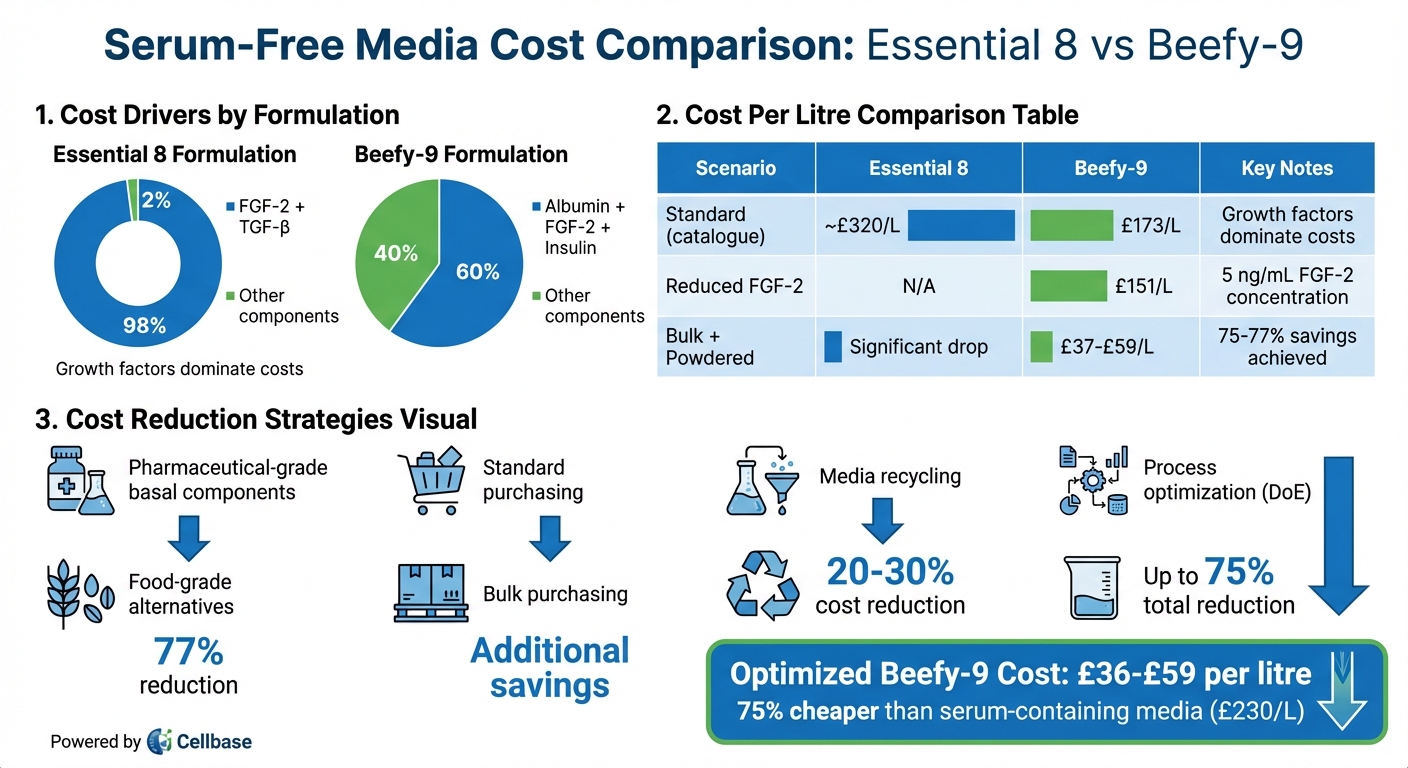
Looking at specific formulations highlights the cost distribution. For instance, in Essential 8, FGF-2 and TGF-β make up around 98% of the total cost [1]. In Beefy-9, albumin, FGF-2, and insulin account for approximately 60% [1][3].
Take the Beefy-9 formulation as an example: lowering the concentration of FGF-2 reduces the cost of the medium. Bulk purchasing and switching to powdered media can bring costs down even further, especially when paired with lower growth factor concentrations [3].
Commercial serum-free media for satellite cells can vary widely in cost [3]. By comparison, serum-containing media (BSC-GM) can also be costly when purchased in non-bulk quantities. This shows that serum-free formulations can be competitive - or even cheaper - if companies optimise growth factor usage and secure bulk discounts without sacrificing cell performance.
While growth factors dominate costs, the grade of basal components also plays a crucial role in overall cost efficiency.
Food-Grade vs Pharmaceutical-Grade Components
Beyond growth factors, the quality grade of basal components significantly impacts costs. Pharmaceutical-grade ingredients are produced to meet strict purity standards, undergo rigorous endotoxin testing, and come with detailed certification, all of which drive up their price. Food-grade components, on the other hand, are much cheaper but come with the risk of inconsistent quality.
Research by Specht highlights the cost difference: food-grade basal components are about 82% cheaper than their pharmaceutical-grade counterparts at a 1 kg scale [1]. Replacing pharmaceutical-grade components with bulk food-grade alternatives can reduce basal media costs by as much as 77% [1]. For large-scale production, where thousands of litres of media are used, this can lead to substantial savings - provided the food-grade materials meet the necessary performance and safety standards.
However, the risks of using food-grade components shouldn't be ignored. For example, a study examining ten commercial food supplements containing chondroitin sulphate and glucosamine found that none contained the declared concentrations accurately. All samples showed keratan sulphate contamination, and most were cytotoxic in cell assays [1]. This highlights the potential challenges of food-grade supply chains, including batch-to-batch variability, unexpected contaminants, and the lack of routine endotoxin testing, which can affect cell performance or even raise safety concerns.
| Component Type | Average Cost Reduction | Purity & Standards | Risks & Challenges |
|---|---|---|---|
| Pharmaceutical-Grade | Baseline (higher cost) | High purity, endotoxin-tested, certified | Lower variability but comes at a higher price |
| Food-Grade | 82% cheaper at 1 kg scale; 77% reduction in basal media cost | Lower purity; no routine endotoxin testing | Batch variability, potential contaminants (e.g. keratan sulphate cytotoxicity) |
For companies in the cultivated meat sector, deciding between pharmaceutical-grade and food-grade components involves balancing cost savings with quality assurance. Many opt for a hybrid strategy - using food-grade basal components where possible but sticking to pharmaceutical-grade recombinant proteins. In such cases, robust quality control measures, such as composition testing and contaminant analysis, are essential. Platforms like Cellbase can assist by linking producers with verified suppliers, enabling transparent price comparisons and access to quality documentation across the supply chain.
Methods to Reduce Media Costs at Scale
Cutting down the costs of serum-free media can be achieved through smart recycling techniques and bulk purchasing strategies, which help lower expenses significantly.
Media Recycling and Waste Reduction
Recycling media involves recovering valuable components from used media. Techniques like ultrafiltration can extract growth factors, amino acids, and other expensive molecules, making them reusable. This method can lead to cost reductions of 20–30% in large-scale bioreactor setups [1].
However, recycled media isn’t without challenges. It can accumulate byproducts, experience pH changes, or suffer from nutrient depletion. To ensure it works as effectively as fresh media, rigorous testing is vital. When done correctly, companies can reduce waste by up to 50% without impacting cell viability [1][3]. Additionally, tools like real-time nutrient sensors, tangential flow filtration, and optimised feeding strategies can further cut waste by 20–40% [1][5].
Bulk Purchasing and Supplier Networks
Bulk purchasing is another proven way to reduce media costs, complementing recycling efforts.
Buying in bulk can significantly lower the cost per litre [3]. This approach leverages economies of scale, reducing per-unit prices as order sizes grow. However, success in bulk purchasing depends on strong supplier relationships to ensure quality isn’t compromised.
Reliable supplier networks play a key role here. They provide access to bulk options and competitive pricing tailored for cultivated meat production. For example, Cellbase serves as a specialised B2B marketplace, connecting producers with trusted suppliers of growth media components. With transparent pricing and industry-focused expertise, Cellbase helps procurement teams compare options, secure bulk deals, and manage risks like batch variability and contamination, which are common with food-grade alternatives.
sbb-itb-ffee270
Process Improvements and Formulation Refinement
Fine-tuning the way media is formulated can lead to significant cost savings. The secret lies in systematically testing and tweaking formulations while ensuring cell performance remains strong, rather than randomly swapping out ingredients and hoping for the best. This method naturally paves the way for optimising protocols that achieve both cost efficiency and reliable cell growth.
The tricky part is striking the right balance between cutting costs and maintaining biological outcomes. Adjusting concentrations can save money per litre, but it’s essential to weigh these savings against the efficiency of cell yield. For example, lowering media costs by reducing component concentrations might inadvertently increase the cost per cell yield if cell growth is compromised. Always keep the cost per cell yield in focus when making adjustments.
Equally important is improving how media is processed. For instance, switching from heat sterilisation to sterile filtration for heat-sensitive growth factors minimises degradation and waste. Other steps, like dissolving salts and buffers first before adding vitamins and growth factors at lower temperatures with gentler mixing, can further reduce waste. Separating production into two stages - creating a bulk basal media first and adding concentrated supplements just before use - also helps prevent losses when batches are compromised [1][3]. These adjustments lay the groundwork for systematic media optimisation using Design of Experiments (DoE).
Design of Experiments (DoE) for Media Optimisation
Design of Experiments (DoE) provides a structured way to refine formulations without relying on endless trial-and-error methods. Instead of adjusting one ingredient at a time, DoE allows multiple factors - like amino acids, glucose, FGF‑2, insulin, and albumin concentrations - to be tested simultaneously. This approach reveals how these components interact and impact growth rate, viability, and differentiation [1][4].
The process often begins with a screening design, such as fractional factorial or Plackett–Burman, to identify the components that truly influence performance. Once these key drivers are identified, response surface methodology can explore more complex interactions. This helps pinpoint formulations that maintain cell performance while reducing the use of costly ingredients. For example, combining concentration reductions with bulk sourcing brought the per-litre cost down substantially - a reduction of about 75% compared to serum-containing media [3]. By integrating DoE with earlier strategies like waste reduction and bulk purchasing, overall media costs can be managed effectively.
When using food-grade inputs, which often vary between batches, DoE becomes even more valuable. It helps establish acceptable ranges for variable components without sacrificing quality. For teams in the UK, platforms like Cellbase streamline this process by connecting procurement specialists with suppliers of growth factors, basal media powders, and sensors. These platforms provide transparent pricing and technical specifications tailored specifically for cultivated meat production, making DoE-driven optimisation more accessible and efficient.
Cost Breakdown Examples: Serum-Free Media Formulations
Serum-Free Media Cost Breakdown: Essential 8 vs Beefy-9 Formulations
Cost Comparison: Essential 8 vs Beefy-9 Media
Let’s dive into the cost dynamics of serum-free media formulations, focusing on two examples: Essential 8 (E8) and Beefy-9. These examples shed light on how growth factor costs and sourcing strategies impact the overall expense of media used in cultivated meat production.
Essential 8, commonly used for pluripotent stem cells, highlights the dominance of specific growth factors in its cost structure. Nearly 98% of its per-litre cost comes from FGF-2 and TGF-β [1]. This makes it an excellent case study for understanding cost efficiency in relation to cell yield.
On the other hand, Beefy-9, a serum-free media designed for bovine satellite cells, presents a different cost breakdown. Here, recombinant albumin, FGF-2, and insulin collectively account for about 60% of the total cost [1][3]. Notably, reducing the concentration of FGF-2 can significantly reduce the overall expense. For instance, when teams opt for bulk purchasing and powdered basal media, the cost of Beefy-9 falls further, especially when FGF-2 levels are reduced. This represents a striking 75% reduction compared to serum-containing media at similar bulk scales [3].
The table below summarises how per-litre costs vary under different purchasing and formulation scenarios:
| Scenario | Essential 8 | Beefy‑9 | Key Notes |
|---|---|---|---|
| Standard (catalogue) | Higher baseline cost | Higher baseline cost | FGF‑2/TGF‑β dominate E8 (98%); albumin/FGF‑2/insulin make up 60% of Beefy‑9 [1][3] |
| Reduced FGF‑2 | N/A | Lower than standard | 5 ng/mL FGF‑2 in Beefy‑9 [3] |
| Bulk/Powdered | Significant drop | Significant drop | 75–77% savings with bulk and food-grade alternatives [1][3] |
While these savings are compelling, it’s essential to consider the trade-offs. Beefy-9’s lower cost per litre doesn’t necessarily translate to lower overall production costs. Its slower cell growth could lead to higher expenses per kilogram of biomass [3]. This is a crucial factor in cultivated meat production, where the ultimate goal is to optimise the cost per kilogram of biomass rather than just focusing on media price.
For teams in the UK sourcing components at scale, global sourcing strategies and platforms like Cellbase simplify the process by connecting users with verified suppliers for recombinant proteins, basal media powders, and food-grade alternatives. These platforms also provide transparent pricing tailored to the specific needs of cultivated meat production, making it easier to manage costs effectively.
Summary: Cost Management for Serum-Free Media Scale-Up
Managing costs effectively is a cornerstone of scaling serum-free media for cultivated meat production. Nearly half of the variable operating costs in this process come from expensive growth factors and recombinant proteins [1]. Growth factors, in particular, dominate the cost breakdown, making their optimisation a key focus [1][2]. Strategies like refining formulations, purchasing in bulk, and streamlining processes are crucial steps towards achieving cost parity with traditional meat.
One impactful approach involves substituting pharmaceutical-grade components with food-grade alternatives, which can slash basal costs by up to 77% [1]. Bulk purchasing further reduces costs by lowering per-litre expenses. Additional savings come from techniques like media recycling, waste reduction, and improved formulation methods, which collectively minimise material and labour costs [1]. Using Design of Experiments (DoE) is another effective tool, enabling teams to pinpoint the lowest effective concentrations of expensive components. This reduces the reliance on costly growth factors while maintaining cell performance [1].
Platforms like Cellbase simplify the procurement process by connecting buyers with verified suppliers of growth media components. With transparent pricing tailored for cultivated meat production, Cellbase makes bulk purchasing and the adoption of food-grade materials more feasible at scale, supporting smarter decisions as production grows.
FAQs
What are the best ways to balance cost and quality when using food-grade components in serum-free media?
To manage costs without sacrificing quality, companies should focus on using food-grade components that meet stringent safety and quality standards. Fine-tuning formulations to cut down on waste and improve production efficiency can also help reduce expenses while maintaining product performance.
Working with trusted, verified suppliers is key to ensuring consistent quality. Platforms like Cellbase can simplify this process by connecting businesses with pre-vetted suppliers and scalable solutions designed specifically for the cultivated meat industry. This strategy allows companies to keep costs in check while upholding the integrity of their products.
What are the risks and advantages of recycling serum-free media during large-scale production?
Recycling serum-free media in large-scale production offers both benefits and challenges. On the upside, it can cut costs by reducing the need for fresh media and help minimise waste, aligning with efforts to create more sustainable systems. These advantages make it an attractive choice for cultivated meat production.
That said, there are hurdles to navigate. Recycling can introduce risks like contamination or the accumulation of metabolic by-products, which can negatively impact cell growth and the overall quality of the product. Moreover, repeated use of the media may lead to the depletion of essential nutrients, diminishing its effectiveness over time. To make the most of its potential while avoiding these pitfalls, implementing strong process controls and reliable monitoring systems is crucial.
How does using Design of Experiments (DoE) help reduce costs in serum-free media development?
Design of Experiments (DoE) offers a smart way to cut costs in serum-free media development by pinpointing the factors that most influence performance. Instead of relying on lengthy trial-and-error processes, researchers can use this method to refine formulations with greater precision and efficiency.
By simplifying adjustments and reducing wasted resources, DoE not only saves on material costs but also speeds up development timelines. This makes it an invaluable approach for scaling up serum-free media production in the cultivated meat sector.


