

Surface functionalisation is key to solving a major challenge in cultivated meat production: helping cells attach and grow on synthetic scaffolds. Many cost-effective scaffold materials, like cellulose or synthetic polymers, lack the natural cell-binding properties found in animal tissues. This limits cell attachment, disrupts growth, and reduces production efficiency.
Here’s how surface functionalisation improves cell adhesion:
- Modifies scaffold surfaces to support cell attachment without altering their structural properties.
- Introduces biofunctional groups (e.g., carboxyl, amine) that mimic natural extracellular matrix (ECM) signals.
- Improves wettability and protein adsorption, creating favourable environments for cells to grow.
Key methods include plasma surface treatment, catecholamine-based coatings, and chemical group attachment. These techniques enhance scaffold compatibility, reduce cell losses during production, and increase tissue growth efficiency. Platforms like Cellbase simplify sourcing specialised materials and tools for these processes, helping scale production from research to commercial levels.
Recent advance in surface modification for regulating cell adhesion and behaviors | RTCL.TV
sbb-itb-ffee270
Why Cells Struggle to Attach to Scaffold Surfaces
Impact of Surface Functionalization on Cell Adhesion in Cultivated Meat Production
The core problem is simple: most synthetic scaffold materials don't naturally interact well with cells. Materials like polystyrene, polylactic acid (PLA), and polyethylene terephthalate (PET) are commonly used in cultivated meat production because they are cost-effective and durable. However, their surfaces actively repel the cells they are supposed to support.
Material Properties That Block Cell Adhesion
Three main material properties are responsible for this issue.
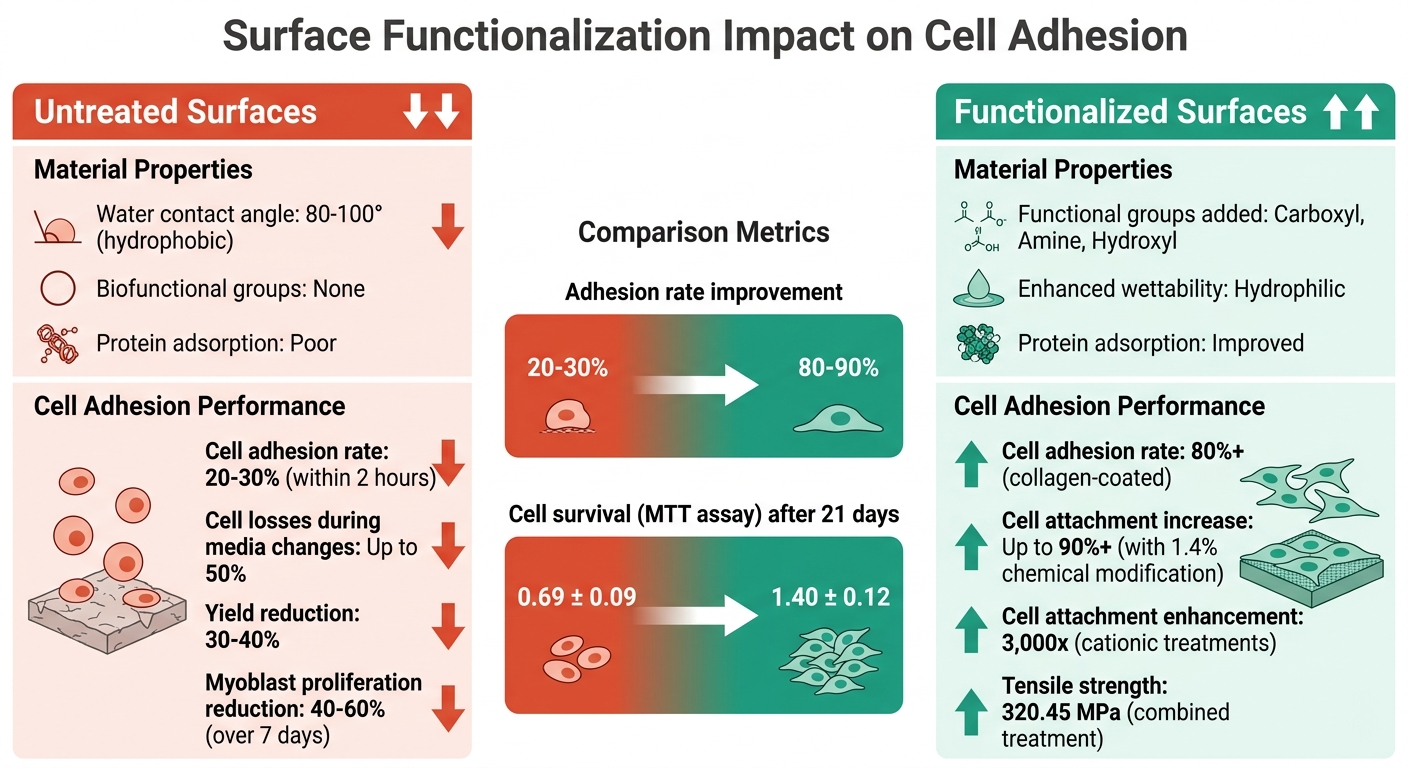
First, low wettability makes these surfaces hydrophobic. When a material has a water contact angle above 90°, like many synthetic polymers, it resists water and, in turn, cell membranes. For example, PLA has contact angles between 80–100°, which causes cells to remain rounded instead of spreading out [3][4].
Second, these materials lack biofunctional groups - the molecular structures that cells need to latch onto. Cells use integrin receptors to attach to specific sequences like RGD peptides or fibronectin-binding sites, which are present in natural extracellular matrices. Synthetic polymers, however, don’t offer these critical binding sites [3].
Third, poor protein adsorption prevents these surfaces from forming the temporary matrix that cells rely on for attachment. PET, for instance, has an inert surface that hinders protein adsorption. On untreated polystyrene, anchorage-dependent cells achieve only 20–30% adhesion within two hours, whereas collagen-coated surfaces support over 80% adhesion [3][4].
The Impact on Production
Weak adhesion has serious consequences for production. Poorly attached cells result in uneven layering and disorganised 3D structures. In dynamic bioreactors, shear forces between 10–100 dyn/cm² can dislodge these cells, leading to up to 50% cell losses during media changes or harvesting [5][6][7].
This inefficiency affects both costs and scalability. To offset poor adhesion, producers must increase cell seeding densities, driving up expenses. Uneven cell growth makes scaling up bioreactor systems difficult, potentially cutting yields by 30–40% and lengthening production cycles [6]. Additionally, synthetic scaffolds without functionalisation can reduce myoblast proliferation by 40–60% over seven days due to limited protein adsorption [3].
To make cultivated meat commercially viable, these adhesion challenges must be addressed. Enhancing scaffold surfaces through targeted functionalisation is essential for improving cell attachment and overcoming these barriers.
Surface Functionalisation Methods That Improve Cell Adhesion
Creating scaffold surfaces that support cell attachment and growth often requires overcoming challenges like low wettability, absence of biofunctional groups, and poor protein adsorption. Three key techniques can transform these inert surfaces into environments where cells can thrive, each offering a unique approach to enhancing cell compatibility.
Plasma Surface Treatment
Plasma treatment modifies only the outermost 10–100 nanometres of scaffold surfaces using ionised gas [8]. This process increases surface energy and wettability by introducing reactive groups such as carboxyl, amine, and hydroxyl. These groups act as chemical anchors, enabling the covalent attachment of bioactive molecules like collagen, gelatin, and RGD peptides, all while maintaining the scaffold's mechanical integrity.
Atmospheric pressure plasma is gaining popularity due to its cost-effectiveness and suitability for continuous production. However, one limitation is hydrophobic recovery - treated surfaces can lose their enhanced hydrophilicity over time. For best results, scaffolds should be used or further processed soon after treatment.
Catecholamine-Based Coatings
Catecholamine-based coatings, such as those derived from dopamine, offer another effective method. These coatings form a thin, adhesive bioactive layer on scaffold surfaces, promoting cell attachment and growth. Their versatility makes them compatible with a wide variety of scaffold materials, and they don’t require specialised equipment, making them an accessible option for many applications.
Chemical Group Attachment
Attaching specific chemical groups to scaffold surfaces allows for precise control over cell behaviour. For instance, oxygen plasma can introduce carboxyl and hydroxyl groups, while ammonia plasma adds amine groups, all of which enhance cell affinity. The type and density of these functional groups can directly influence cellular responses, such as neuron attachment or neurite outgrowth. This precision is especially important for three-dimensional scaffolds, where uniform cell distribution within the porous structure is vital for tissue development.
| Chemical Group | Introduction Method | Primary Benefit |
|---|---|---|
| Carboxyl (-COOH) | Oxygen plasma, acrylic acid grafting | Improves wettability and allows covalent bonding with biomolecules |
| Amine (-NH₂) | Ammonia or nitrogen plasma | Enhances cell affinity and provides sites for protein immobilisation |
| Hydroxyl (-OH) | Oxygen plasma, water vapour plasma | Greatly increases surface hydrophilicity |
| Aldehyde (-CHO) | Specific plasma polymerisation | Facilitates covalent bonding with amino groups in proteins |
Each of these methods offers a pathway to make scaffold surfaces more cell-friendly, addressing specific challenges and enabling better tissue engineering outcomes.
Testing and Improving Surface Functionalisation
Measurement Methods
Testing is essential to confirm the success of surface modifications. One way to assess surface functionalisation is through infiltration testing, which measures the absorption of serum or culture medium. This provides insight into surface energy and hydrophilicity. For instance, studies on PGA biomaterials revealed that combining plasma treatment with a 2 mg/ml polylysine coating led to a maximum infiltration of 3.17 g/g. In contrast, plasma treatment alone achieved only 2.46 g/g.
Mechanical testing ensures that scaffold strength remains intact. For example, plasma treatment at 240 W for four minutes increased tensile strength to around 299.78 MPa. However, excessive plasma power (480 W) caused fibre thinning, reducing strength to approximately 148.11 MPa. Cell adhesion can also be evaluated using fluorescence microscopy with Rhodamine and DAPI staining to count adherent cells. Additionally, MTT assays indicate improved cell survival rates on treated scaffolds, showing 1.40 ± 0.12 compared to 0.69 ± 0.09 after 21 days [9].
These measurements are critical for scaling up cultivated meat production, ensuring reliable cell adhesion across larger scaffold volumes.
Factors to Consider for Better Results
To enhance cell adhesion, processing parameters must be carefully adjusted, incorporating both mechanical and chemical coatings. Plasma parameters should be optimised - moderate etching effectively removes impurities, while excessive power can weaken the fibres. For PGA scaffolds, a plasma treatment of 240 W for four minutes strikes a good balance between performance and preservation of scaffold integrity.
Coating concentration is another key factor. Concentrations exceeding 2 mg/ml may lead to reduced fluidity, uneven coverage, and less flexible scaffolds. Coatings should also be applied immediately after plasma activation to take advantage of the surface's temporary energy boost, which supports better adhesion.
In cultivated meat production, achieving consistent cell attachment across large scaffold volumes is crucial. Combining plasma treatment with chemical coatings generally delivers better results than using either method alone. For example, a combined treatment produced a tensile strength of 320.45 MPa, outperforming plasma treatment (299.78 MPa) and polylysine coating (282.62 MPa) individually [9].
Sourcing Materials Through Cellbase
When it comes to surface functionalisation in cultivated meat production, specialised materials like edible scaffolds, coating agents, and plasma equipment are essential. However, sourcing these materials can be a headache. General lab supply platforms often fall short - they lack the technical know-how and reliable supplier networks tailored to the unique needs of this industry. This makes procurement a complex and time-consuming process.
Enter Cellbase - the first specialised B2B marketplace designed exclusively for the cultivated meat sector. Cellbase connects researchers, production managers, and procurement specialists directly with trusted suppliers offering materials such as scaffolds (PGA, collagen, and gelatin), catecholamine-based coating agents, adhesion peptides, and surface treatment equipment. Every vendor on the platform meets the strict technical and sterility requirements demanded by cultivated meat production.
For production teams exploring various surface functionalisation methods, Cellbase provides a one-stop shop for accessing a wide range of technologies. Instead of juggling multiple generalist suppliers, teams can centralise their sourcing efforts, speeding up the evaluation of new methods and scaling successful protocols from R&D to full production with less hassle.
Smaller companies stand to gain even more from this curated marketplace. They can connect directly with specialised suppliers without needing prior industry relationships. Transparent pricing and verified listings also help reduce procurement costs and minimise technical risks. As new technologies for surface functionalisation emerge, Cellbase doubles as a hub for tracking advancements, allowing teams to adopt new solutions faster than they could through traditional procurement channels.
Conclusion
Surface functionalisation tackles one of the biggest hurdles in cultivated meat production: ensuring cells can attach, spread, and grow on synthetic scaffolds. Without the right surface cues, scaffolds remain inert and unsuitable for cell interaction. By introducing functional groups like amine and carboxyl terminations or grafting adhesion peptides such as RGD, these surfaces are transformed into environments that actively support cell behaviour. As Hassan Rashidi, Jing Yang, and Kevin M. Shakesheff explain:
"Surface engineering is an important strategy in materials fabrication to control and tailor cell interactions whilst preserving desirable bulk materials properties" [1].
This approach allows production teams to separate surface chemistry from the scaffold's bulk properties. Teams can prioritise factors like cost, strength, and degradation rates for the scaffold material, while independently optimising its surface for cell adhesion.
The results speak for themselves. A mere 1.4% chemical modification on cellulose scaffolds can increase cell attachment to over 90% compared to standard tissue culture plastic [2]. Similarly, cationic surface treatments have enhanced cell attachment by nearly 3,000 times on previously non-adhesive materials [2]. These improvements lead to higher cell densities, faster tissue growth, and more consistent outcomes - key factors for scaling production.
With these advances, the conversation shifts. It’s no longer about whether to functionalise but about sourcing the right materials and tools. Plasma systems, coating agents, adhesion peptides, and pre-functionalised scaffolds require specialised suppliers who understand the unique demands of cultivated meat production, including sterility and compatibility. Cellbase simplifies this process by connecting production teams with the technologies they need to move from lab-scale innovations to commercial manufacturing.
As the field evolves, new techniques - like ligand-free cationic modifications or combining chemical and topographical approaches - will emerge. Platforms like Cellbase will play a crucial role in tracking these developments and helping teams implement proven methods at scale.
FAQs
What is the best surface treatment for my scaffold material?
Surface functionalisation techniques, including plasma treatment, protein coatings, and covalent grafting, play a crucial role in improving cell adhesion on scaffold materials. These approaches modify surface characteristics like chemistry, charge, and hydrophilicity, creating conditions that encourage stronger cell attachment and enhanced growth.
How long do plasma-treated surfaces stay cell-friendly?
Plasma-treated surfaces can stay cell-friendly for as long as two years if stored and maintained correctly. That said, the exact duration can differ based on the type of treatment applied and the surrounding environmental conditions. To maintain their effectiveness, it's a good idea to regularly check the surface properties.
How can I confirm functionalisation without weakening the scaffold?
To ensure surface functionalisation is effective without weakening the scaffold, employ tools such as SEM (Scanning Electron Microscopy), AFM (Atomic Force Microscopy), and XPS (X-ray Photoelectron Spectroscopy), along with biological assays. These techniques help evaluate surface chemistry, texture, and biological activity. This approach ensures that any modifications enhance cell adhesion and growth while preserving the scaffold's structural strength.


