

For cultivated meat R&D teams, my starting rule is simple: accept, condition or reject spent media before inoculation, based on batch composition and safety limits - not the original medium recipe.
Secondary fermentation feeds residual nutrients to a different organism; it is not direct media reuse. Laboratory work with Chlorella BDH-1 supports pilot testing, but does not establish production yields or resource savings.[1]
I would assess the process through **three feedstock gates - composition, clarification and sterilisation - **then:
- Match the host, inoculum and feeding mode to the qualified feedstock.
- Check mixing, oxygen transfer, light delivery where needed, and exhaust containment.
- Validate harvest, product quality, hold times and waste treatment across multiple batches.
- Measure energy, water and waste per unit of product, including recovery and rejected batches.
My release rule: <u>fermentation success alone is not enough</u>. You still need intended-use safety testing, batch traceability and confirmation of the applicable UK regulatory pathway.
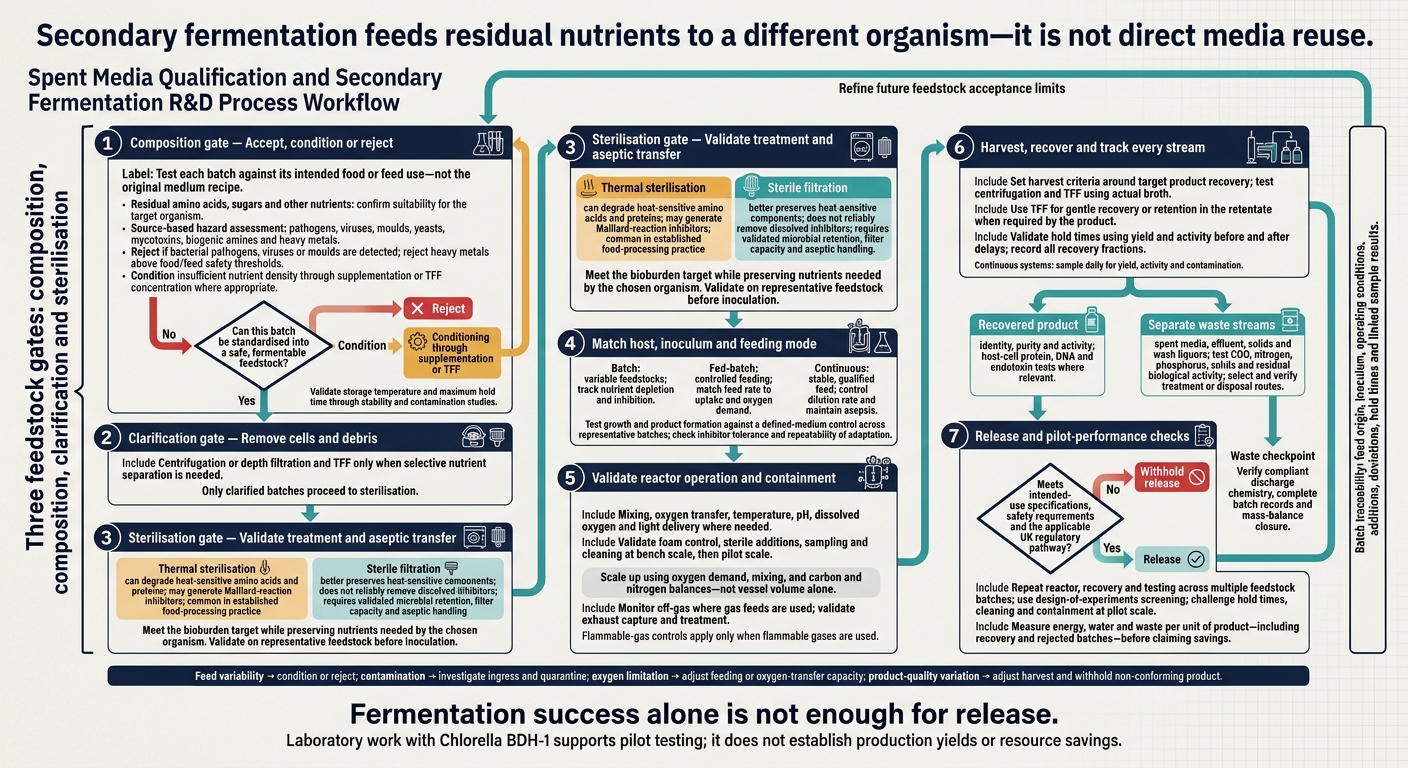
Spent Media Secondary Fermentation: From Feedstock to Release
Feedstock Testing, Conditioning and Sterilisation
Before inoculation, each batch must pass three gates: composition, clarification and sterilisation.
Feedstock Composition and Acceptance Limits
Test each spent-media batch against its intended food or feed use - not the original media recipe. For spent media from cultivated meat production, assess the batch against source specifications for that use.[5] Measure residual amino acids, sugars and other nutrients.[1][5] Use a source-based hazard assessment to set tests for pathogens, viruses, moulds, yeasts, mycotoxins, biogenic amines and heavy metals.[5]
| Parameter | Fermentation effect | Accept, condition or reject |
|---|---|---|
| Residual amino acids | Support secondary biomass growth | Accept if the residual profile supports the target organism’s growth; otherwise condition or reject.[1] |
| Bioburden | Risk of batch failure and safety hazards | Reject if bacterial pathogens, viruses or moulds are detected.[5] |
| Heavy metals | Inhibit microbial growth and contaminate the end product | Reject above safety thresholds for food or feed.[5] |
| Nutrient density | Determines yield | Condition through supplementation or TFF to concentrate nutrients.[2] |
| Solids/particulates | Can interfere with sensors and oxygen transfer | Condition through centrifugation or depth filtration.[2] |
Reject any batch that cannot be standardised into a safe, fermentable feedstock.
Set the storage temperature and maximum hold time using stability and contamination studies.[5] Remove cells and debris by centrifugation or depth filtration. Use tangential flow filtration (TFF) only when selective nutrient separation is needed.[2] Only clarified batches should proceed to sterilisation.
Sterilisation and Aseptic Transfer
Choose a treatment that meets the bioburden target while preserving the nutrients the chosen organism needs.
| Consideration | Thermal sterilisation | Sterile filtration |
|---|---|---|
| Nutrient impact | Can degrade heat-sensitive amino acids and proteins | Better preserves heat-sensitive components |
| Inhibitor control | May generate inhibitors through Maillard reactions | Does not reliably remove dissolved inhibitors |
| Scale-up | Common in established food-processing practice | Requires validated microbial retention, filter capacity and aseptic handling |
Validate the treatment on representative feedstock before inoculation.
sbb-itb-ffee270
Inoculum, Reactor Operation and Off-Gas Control
Host Selection and Inoculum Preparation
After clarification and sterilisation, select a host whose nutrient needs and inhibitor tolerance match the remaining feedstock composition and whose metabolism supports the product target.
Use the best-supported host for the residual nutrient profile; Chlorella BDH-1 is one proven example.[1]
Start with pure seed cultures and expand through the seed train. Check purity, viability and growth phase before transfer to the reactor. Test growth and product formation on representative spent-media batches against a defined-medium control, including tolerance to residual metabolites and other inhibitors. Repeat any adaptation step to check repeatability.
Fermentation Modes and Reactor Design
Set the operating mode by comparing continuous vs fed-batch processing before finalising the feed strategy.
| Mode | Typical use | Key control point |
|---|---|---|
| Batch | Variable feedstocks | Track nutrient depletion and inhibition |
| Fed-batch | Controlled feeding | Match feed rate to uptake and oxygen demand |
| Continuous | Stable, qualified feed | Control dilution rate and maintain asepsis |
Use batch operation for variable feedstocks and fed-batch for tighter feeding control. Choose continuous operation only when feed quality and asepsis remain stable.
Match mixing, oxygen transfer, temperature, pH and dissolved-oxygen settings to the host and broth. Validate foam control, sterile additions, sampling and cleaning at bench scale, then repeat at pilot scale. Assess scale-up using oxygen demand, mixing, and carbon and nitrogen balances - not vessel volume alone.
Off-Gas Monitoring and Exhaust Safety
Plan off-gas monitoring alongside gas supply and containment from the start of reactor design. Where gas feeds are used, track off-gas composition to assess metabolic activity and gas uptake.[8]
Use validated exhaust capture and treatment to prevent biomass, byproducts and aerosols from escaping during processing.[4] Apply flammable-gas controls only where the process uses flammable gases, such as methane.[8]
Harvest, Testing and Facility Integration
Harvest Timing and Product Recovery
Once fermentation reaches the target phase, separate the product and route each residue stream to the appropriate destination. Set harvest criteria around target product recovery. Use harvest yield and quality data to refine the accept, condition or reject decision for future feedstock batches.
In continuous systems, sample daily to track yield, activity and contamination. Link harvest timing to biomass growth and yield targets. Test centrifugation-based recovery and tangential flow filtration (TFF) with the actual broth. Use TFF when the target product requires gentle recovery or retention in the retentate.[2]
Validate hold times by comparing yield and activity before and after each delay. Record all recovery fractions.
Product Quality and Waste-Stream Testing
Before start-up, set sampling points and acceptance limits. Define batch-record fields for feed origin, inoculum, operating conditions, additions, deviations and hold times. Sample incoming feed, harvest broth, recovered product and each separate waste stream, linking every result to its batch record.
| Process stage | Sample | Method | Attribute and decision |
|---|---|---|---|
| Harvest | Biomass or cell slurry | Cell count and yield measurement after centrifugation or TFF | Confirm harvest performance |
| Product release | Recovered product | Identity, purity and activity assays; host-cell protein, DNA and endotoxin tests where relevant | Release only against intended-use specifications |
| Waste treatment | Spent media, effluent, solids and wash liquors | Chemical oxygen demand (COD), nitrogen, phosphorus, solids and residual biological activity tests | Select treatment or disposal route; verify treatment effectiveness |
| Discharge and traceability | Final effluent and associated batch records | Discharge chemistry assays, batch-record audit and mass-balance reconciliation | Confirm batch-record completeness, compliant discharge chemistry and mass-balance closure |
Use these results to decide batch release and route each waste stream.
Scale-Up Testing and Equipment Sourcing
Before pilot integration, repeat recovery and testing across multiple feedstock batches. Use design-of-experiments screening to identify variables that affect performance, then repeat reactor and recovery runs. At pilot scale, challenge hold times, cleaning and containment, and verify recovery performance and waste routing. Before claiming reductions in resource use or waste, measure energy, water and waste per unit of product, including recovery and rejected batches.[7]
| Risk | Check during validation | Control or decision |
|---|---|---|
| Feed variability | Nutrients, metabolites and recovery yield across batches | Set acceptance limits; condition or reject unsuitable feed |
| Contamination | Microbial results; transfer and containment checks | Investigate ingress; quarantine affected material |
| Oxygen limitation | Dissolved oxygen and uptake during peak demand | Adjust feeding or oxygen-transfer capacity |
| Product-quality variation | Identity, purity, activity and hold-time stability | Adjust harvest conditions; withhold non-conforming product |
Check that equipment supports product recovery, sterilisation and waste handling at pilot scale. Provide treatment capacity for peak discharge, suitable analytical capability and digital batch traceability. Use the Cellbase marketplace to source cultivated meat equipment and analytical tools against these requirements.[6]
Conclusion: Accept, Condition or Reject the Feedstock
After sterility testing, recovery and waste-stream checks, use the validated gates to decide whether to accept, condition or reject the feedstock. This decision applies to secondary fermentation, not direct reuse.
Accept clarified, sterilised feedstock only if its residual nutrient profile falls within the chosen host’s acceptance limits.
Reject batches if variability, recovery losses or unsupported light or oxygen demands make the process unworkable at scale.[1][2]
Successful fermentation does not establish UK compliance. Verify safety and the applicable regulatory pathway before releasing a food ingredient.[3][6]
FAQs
How can I set acceptance limits for variable spent media?
Characterise spent media for residual nutrients, metabolic by-products such as ammonia and lactate, and potential contaminants. Standardise data collection to establish validated limits for nutrient depletion and metabolite accumulation.
Integrate these limits into reactor controls so that media outside specifications triggers automated adjustments or diversion. Consistent monitoring helps protect process stability and final cultivated meat quality. Analytical tools and sensors can be sourced through Cellbase, a specialised B2B marketplace.
When does secondary fermentation offer genuine resource savings?
Secondary fermentation can save resources by recovering and reusing materials that would otherwise become waste, supporting a circular bioeconomy [1][2]. Recovering nutrients, such as amino acids, from spent media or using waste streams to grow secondary biomass, such as microalgae, can reduce demand for growth factors and media ingredients [1][2]. These approaches also reduce wastewater output and the need for new inputs, improving resource efficiency in cultivated meat production [2][3].
Which UK approvals would my fermentation-derived ingredient need?
For a fermentation-derived ingredient used in cultivated meat, the approvals you’re likely to need fall under the UK Food Standards Agency (FSA) guidance for cultivated meat, including its safety and risk-management requirements [1][2].
The ingredient must also meet general food-safety requirements. These include the absence of pathogens and toxic compounds, alongside appropriate nutritional and compositional characterisation as part of the safety assessment [3].


