

If I remove serum but keep the same wild-type cell line, I should not expect media tuning alone to stop senescence, drift, or attachment loss. In this article, I show that serum-free success in cultivated meat usually depends on both sides of the system: a defined medium outside the cell, and edits inside the cell that help it keep dividing, stay attached, and retain myogenic function.
For bioprocess engineers and cell culture teams, the core points are simple:
- Serum-free media changes cell behaviour, not just ingredient lists. Uptake of glucose, glutamine, glycine, and cystine can shift under serum-free conditions.
- Primary satellite cells hit cell-line limits early. Wild-type porcine cells often lose myogenic traits by around passage 10.
- CDKN2A knockout is one of the clearest examples in the article: edited porcine satellite cell lines expanded for 15+ passages, kept >90% viability, and in some clones showed ~194-fold higher PAX7 at passage 20 than wild-type controls.
- There is a trade-off. Better expansion does not guarantee late-passage differentiation; some edited lines still showed lower differentiation by passage 30.
- Validation has to happen in the production set-up: the same serum-free medium, the same culture mode, and the same readouts for growth, waste build-up, lineage markers, and fusion.
A short version: if you want a serum-free process that can transfer into manufacturing, I would treat media design, gene edits, clone screening, and bioreactor fit as one linked workflow, not four separate jobs.
| Focus area | What I would check first | Why it matters |
|---|---|---|
| Cell-cycle control | CDKN2A, passage life, PAX7 | Helps show whether the line can expand without early senescence |
| Growth signalling | IGF1R, EGFR, FGFR response | Serum-free systems have lower external signalling support |
| Stress survival | Viability, apoptosis markers, shear response | Serum withdrawal and passaging can push cells into loss |
| Nutrient handling | Glucose use, lactate, ammonia, amino acid uptake | Faster uptake can also mean faster waste build-up |
| Identity retention | PAX7, MYOD, MYOG, fusion index | A fast-growing line is no use if it no longer forms the target tissue |
I then walk through where serum-free culture fails, which edits map to those failure points, and how I would validate an edited line before process transfer.
CRISPR-Cas Genome Editing in Mammalian Cell Lines | Protocol Preview
The Main Biological Barriers to Serum-Free Culture
Removing serum exposes three bottlenecks: signalling, attachment, and cell identity. The trouble starts inside the cell, not just in the media formulation. That matters, because it shapes where teams spend time: media tuning, gene editing, or a mix of both.
| Feature | Serum-Supplemented Culture | Serum-Free Culture |
|---|---|---|
| Proliferation | Robust; supported by diverse growth factors | Variable; prone to replicative senescence and G1/S arrest |
| Attachment | Supported by serum-borne ECM proteins (fibronectin, vitronectin) | Requires exogenous coatings or additives; detachment risk increases |
| Nutrient transport | Facilitated by carrier proteins such as albumin and transferrin | Dependent on less buffered uptake; requires optimised ITS-X and lipid concentrations |
| Apoptosis risk | Low; PI3K-AKT and MAPK-ERK pathways are strongly activated | Higher; sensitivity to oxidative stress and metabolic waste increases |
| Identity stability | Generally stable through early-to-mid passages | High risk of phenotypic drift; stemness markers often decline rapidly |
Loss of Growth and Survival Signalling
Once serum is removed, growth factor levels fall sharply. Cells then lose much of the external support that helps keep PI3K-AKT and MAPK-ERK activity high. In practice, that means more apoptosis and weaker proliferation, which is a direct problem for scale-up.
Adhesion, Nutrient Uptake, and Stress Bottlenecks
Serum does more than feed cells. It also supplies ECM proteins that support attachment and spreading. Without fibronectin, vitronectin, and related factors, primary satellite cells are more likely to detach and enter apoptosis, especially under shear in bioreactor conditions. ROCK inhibition with Y-27632 can help to some extent, but it does not remove the attachment problem.
Nutrient handling also gets harder. Without serum carrier proteins, uptake of glucose, glutamine, glycine, and cystine becomes less buffered [1]. At the same time, metabolic waste such as ammonia and lactate can build up and suppress growth [3]. So even if the basal medium looks fine on paper, transport and waste balance can still become the limiting step.
Phenotypic Drift During Serum-Free Adaptation
Serum-free adaptation can select for subpopulations that tolerate the new conditions but no longer fit the product spec. That's the trap: cells may expand well, yet lose the capacity to form the intended tissue.
Over serial passage, markers such as PAX7, MYOD, and MYOG can decline [2]. Track lineage markers during adaptation so drift shows up early rather than after a long media optimisation cycle. These are the pathways gene editing needs to stabilise.
Gene Editing Approaches That Improve Serum-Free Performance
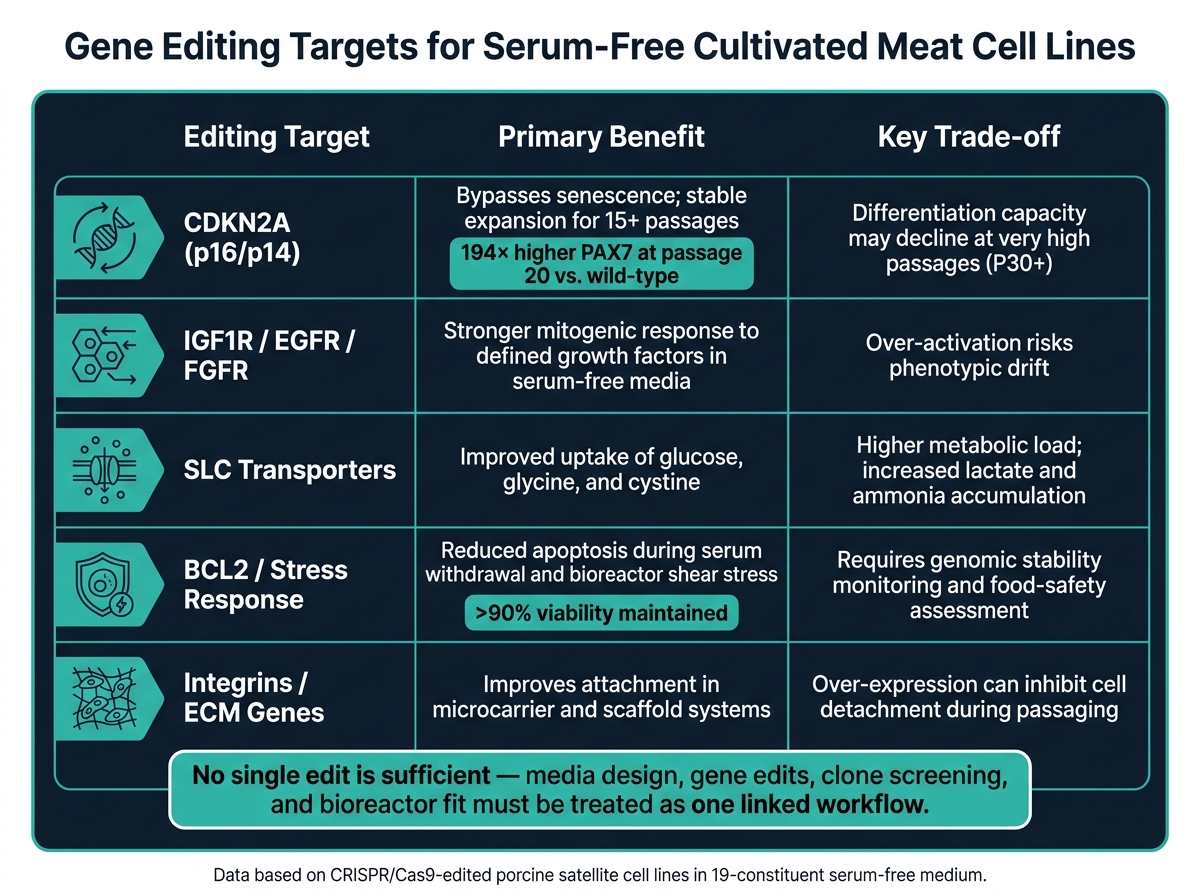
Gene Editing Targets for Serum-Free Cell Culture: Benefits vs. Trade-offs
These barriers fall into three edit classes: signalling, survival, and differentiation.
Editing Growth-Factor Signalling and Nutrient Utilisation
One direct route is to upregulate or sensitise IGF1R, EGFR, and FGFR so cells respond more strongly to IGF-1, EGF, and bFGF [2]. That matters in serum-free media, where growth-factor levels are usually low by design. If signalling improves, cell-cycle control often becomes the next bottleneck.
The cell-cycle regulator CDKN2A stands out here. CRISPR/Cas9 knockout of exon 2 generated CDKN2A−/− porcine satellite cell lines that expanded strongly for more than 15 passages in a 19-constituent serum-free medium. In specific clones, PAX7 expression was upregulated by about 194-fold at passage 20 versus wild-type controls [2].
Edits to solute carrier (SLC) transporters can help avoid uptake limits during scale-up for glucose, glutamine, glycine, and cystine [1]. But there’s a catch. Higher uptake also drives faster lactate and ammonia build-up, so transporter edits need to be planned alongside media exchange and waste control from day one. On their own, uptake edits are not enough.
Improving Cell Survival and Resistance to Serum-Free Stress
Serum withdrawal, routine passaging, and bioreactor shear all push cells into higher-apoptosis conditions. Editing the BCL2 pathway - either by upregulating pro-survival members or suppressing pro-apoptotic ones - can cut cell loss during those transitions. This becomes even more relevant in microcarrier systems, where cells deal with both attachment stress and mechanical stress.
Any edit that improves survival or extends proliferation needs genomic stability checks across the full manufacturing passage range. CDKN2A−/− porcine satellite cells kept viable cell rates above 90% during continuous serum-free proliferation [2]. Even so, teams should check chromosomal integrity at set passage intervals instead of assuming stability will persist.
Balancing Adhesion, Proliferation, and Differentiation Capacity
The toughest part is managing the pull between expansion and differentiation. CDKN2A knockout preserves myogenic potential through passage 10, while wild-type cells in serum-free conditions show almost completely lost myogenic properties. Fusion indices of 16.3% to 56.3% were reported in the edited lines [2]. By passage 30, though, even edited cells can show falling differentiation capacity [2].
| Editing Target | Primary Benefit in Serum-Free Culture | Key Trade-off |
|---|---|---|
| CDKN2A (p16/p14) | Bypasses senescence; stable expansion for 15+ passages [2] | Differentiation capacity may decline at very high passages (P30+) [2] |
| IGF1R / EGFR / FGFR | Stronger mitogenic response to defined growth factors [2] | Over-activation risks phenotypic drift |
| SLC transporters | Improved uptake of glucose, glycine, and cystine [1] | Higher metabolic load; increased lactate and ammonia accumulation [1] |
| BCL2 / stress response | Reduced apoptosis during withdrawal and shear stress [2] | Requires genomic stability monitoring and food-safety assessment [2] |
| Integrins / ECM genes | Improves attachment in microcarrier and scaffold systems [2] | Over-expression can inhibit cell detachment during passaging [2] |
Adhesion edits are most useful in microcarrier or scaffold set-ups. They’re better treated as format-specific tools, not as a fix for every serum-free process.
Inducible CRISPR systems give teams a practical way to handle the expansion-versus-differentiation trade-off. The idea is simple: use inducible edits to separate the expansion phase from differentiation.
None of these edits matter if the phenotype does not hold in the intended serum-free medium.
sbb-itb-ffee270
Building and Validating an Edited Cell Line for Serum-Free Culture
Finding the right edit is only part of the job. The harder part is turning that edit into a stable cell line that can handle serum-free manufacturing. That takes a tight workflow linking editing, clone selection and validation in one pipeline. And that pipeline should directly test the signalling, survival and attachment constraints already identified.
Choosing Editing Tools and Delivery Methods
For targets such as CDKN2A, CRISPR/Cas9 knockout is a practical first step when the aim is to remove a cell-cycle repressor and support long-term expansion [2]. In primary livestock cells, common delivery routes include non-viral transfection systems such as Lipofectamine and viral systems such as lentiCRISPR v2 [2][4]. Before moving into clonal work, confirm delivery efficiency.
One point matters more than it sometimes gets credit for: screen each clone in the exact medium and culture mode planned for production. If the manufacturing process uses a defined serum-free medium, static adherent culture, microcarriers or another set-up, that is the condition the cells should face during screening.
Screening Edited Cells Under the Production Serum-Free Formulation
A common route is to isolate clones by limiting dilution and then confirm the edit by Sanger sequencing at the target locus [2]. Once the edit is verified, screening should continue in the same serum-free formulation and culture mode intended for manufacturing [2][1].
At this stage, measure the basics that tell you whether the clone can live with the process rather than just survive the edit:
- Growth
- Viability
- Glucose consumption
- Lactate production
- Ammonia accumulation
It also makes sense to add PAX7 RT-qPCR early, because stemness loss can show up before a line fails in a more obvious way [1][2].
Characterising Edited Cells Before Process Transfer
Before process transfer, validation should cover four linked areas: genome edit, pathway response, passage stability and function. Each one answers a different problem. Genomic checks deal with phenotypic drift risk. Spent media analysis points to nutrient uptake and waste build-up limits. Fusion index tells you whether myogenic differentiation is still there [2][1].
| Assay Type | What It Measures | Why It Matters for Serum-Free Cultivated Meat Lines |
|---|---|---|
| T7 Endonuclease I / Sanger Sequencing | Editing efficiency and precise genomic sequence | Confirms successful gene knockout or knock-in before scaling [2] |
| RT-qPCR (PAX7, MYOD, MYOG, BAX, CCND1) | Transcript levels of stemness, differentiation and apoptosis markers | Monitors cell health and differentiation potential across long-term passages [2][4] |
| Immunofluorescence (MyHC / CK18) | Lineage-specific protein expression | Ensures cells retain muscle or epithelial identity after editing and adaptation [2][4] |
| Spent Media Analysis | Glucose, amino acids, lactate and ammonia profiles | Determines nutrient requirements and informs bioreactor feed strategy [1] |
| Fusion Index | Percentage of nuclei incorporated into multi-nucleated myotubes | Confirms myogenic differentiation capacity is retained without serum [2] |
| Texture Profile Analysis (TPA) | Hardness, springiness and chewiness of 3D constructs | Validates that edited cells produce a final product with meat-like physical properties [2] |
Genomic validation relies on T7 Endonuclease I assay plus Sanger sequencing of individual clones [2]. Pathway confirmation uses RT-qPCR or Western blot to show that the planned transcript or protein shift has actually happened, including markers such as PAX7, MYOD, MYOG and MyHC [2][4].
For long-term stability, the benchmark is 15-30 passages with repeat checks on growth, viability and marker expression. CDKN2A knockout porcine satellite cells kept viable cell rates above 90% over 15 passages in serum-free conditions, but differentiation capacity started to fall by passage 30 [2].
Functional testing then asks the plainest question of all: are these still the cells you need? In myogenic lines, fusion index shows whether edited cells can still form multinucleated myotubes without serum [2]. Texture Profile Analysis (TPA) then checks whether 3D constructs show meat-like hardness, springiness and chewiness [2].
Use those data to set the clone's transfer conditions for serum-free manufacturing.
From Edited Cell Lines to Serum-Free Manufacturing
Matching Edited Cells to Media and Bioreactor Design
Once a clone passes validation, the job changes. At that point, success depends on how well the cell line fits the process. More screening will not fix a poor process match.
Spent media analysis should drive glucose top-ups, amino acid supplementation, and growth-factor dosing, including defined inputs such as bFGF and IGF-1 [2]. In adherent systems, scaffold seeding density and the adhesion window - around 2 h before bioreactor transfer - should be set from the edited line’s attachment behaviour, not from serum-containing protocols [2]. Those data should then feed directly into decisions on feed timing, seeding density, and transfer timing.
Edited lines can support longer expansion, higher cell density, and steadier marker expression. That means scale-up has to follow the edited line’s measured behaviour, not wild-type assumptions.
In practice, line selection becomes a procurement and scale-up decision, not just a biology decision.
Key Takeaways for R&D, Production, and Procurement Teams
Serum-free adaptation is not just a media formulation issue. It starts with the cell line, and media optimisation on its own will not solve it. Targeted gene editing, especially knockout of cell-cycle repressors such as CDKN2A, deals with the underlying biology that causes primary satellite cells to fail in serum-free conditions. CDKN2A−/− porcine satellite cells maintained PAX7 expression about 194-fold higher than wild-type controls at passage 20, and reached a fusion index of up to 56.3% at passage 10 - a stage where non-edited cells had largely lost myogenic function [2].
For teams across development and manufacturing, the split is fairly clear:
- R&D teams should build a validation pipeline that tests edited clones under actual production conditions from the start. That includes growth, nutrient consumption, lineage stability, and 3D differentiation capacity.
- Production teams should use the edited line’s nutrient profile to set feed design and bioreactor parameters, because assumptions copied from serum-containing protocols are unlikely to hold [1].
- Procurement teams need sourcing plans that match the edited line’s specific requirements, including defined growth factors, lipids, antioxidants, and scaffolds or microcarriers that fit the line’s adhesion profile.
FAQs
Why isn’t media optimisation alone enough?
Media optimisation on its own isn't enough. In many cases, animal cells simply don't have the traits needed for large-scale production, such as shear stress resistance, metabolic efficiency, and viability in high-density suspension.
Serum-free media matter, but they don't fix the cell's built-in limits. Those limits include restricted proliferation lifespan, sensitivity to bioreactor stress, and different nutritional needs across species and developmental stages.
Which gene edits matter most in serum-free culture?
In cultivated meat production, the edits that matter most are the ones that cut dependence on added growth factors. One example is CDKN2A deletion, which can improve porcine satellite cell proliferation and differentiation under serum-free conditions.
Another route is to engineer muscle stem cells for inducible overexpression of FGF2 and mutant RasG12V. That setup supports autocrine signalling and removes the need for recombinant FGF2 in the medium.
How should edited cell lines be validated for manufacturing?
Edited cell lines should undergo genomic, proteomic and functional testing to confirm manufacturing performance and differentiation potential.
In practice, that means checking the edit did what it was meant to do without creating problems somewhere else. Researchers should verify that genetic modifications do not impair differentiation into target tissues, and that intended traits, such as stress resilience or serum-independent growth, are expressed as expected.


