世界初の培養肉B2Bマーケットプレイス:発表を読む

Single-Use vs Stainless Systems: Supplier Review

Single-Use vs Stainless Systems: Supplier Review

David Bell |

If I’m reviewing bioprocess suppliers for cultivated meat, I should not score single-use and stainless systems the same way. One relies on bag films, E&L data, and consumable supply. The other depends on material traceability, hygienic design, CIP/SIP support, and spare-part cover.

For bioprocess engineers, cell culture scientists, and cultivated meat R&D teams, the supplier check usually comes down to four things:

  • technical fit at the working volume
  • quality records and change control
  • site impact such as utilities, cleaning, and automation
  • long-term support for consumables, service, and spares

The article’s core point is simple: single-use often fits seed train and R&D work, while stainless often becomes the standard choice at pilot and production scale. But that only holds if the supplier can support your process with the right data, lead times, and validation package.

You should review:

  • Single-use suppliers for bag-film data, extractables and leachables, mixing data, sensor fit, and consumable lead times
  • Stainless suppliers for 316L or equivalent material records, surface finish, weld logs, drainability, cleaning and sterility evidence, control hardware life plan, and spare-part lead times
  • Both system types for kLa, working-volume performance, automation fit, and facility demand

A missed film change, a poor weld record, or a late bag delivery can stop a run just as fast as weak oxygen transfer. That is why a shared scorecard helps: it keeps QA, engineering, and procurement aligned on the same checks. To help with budgeting, you can also use a cultivated meat equipment cost calculator to estimate capital requirements.

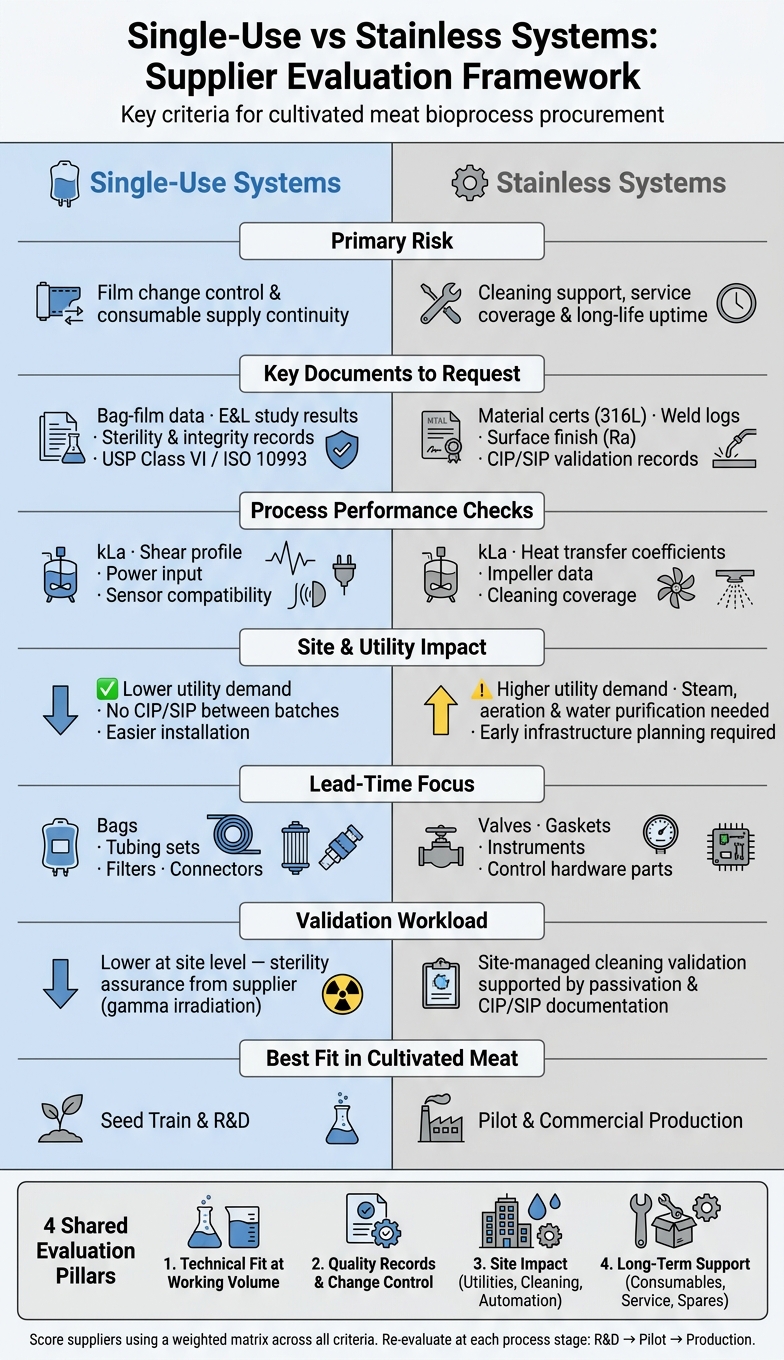
Single-Use vs Stainless Bioprocess Systems: Supplier Evaluation at a Glance

Single-Use vs Stainless Bioprocess Systems: Supplier Evaluation at a Glance

SU & STAINLESS STEEL BIOREACTORS: QUALITY FACTORS FOR CONSIDERATION WHEN SELECTING A SUITABLE SYSTEM

Quick Comparison

Review point Single-use systems Stainless systems
Main supplier risk Film change control and consumable supply Cleaning support, service, and long-life uptime
Key documents Bag-film data, E&L, sterility and integrity records Material certs, weld logs, surface finish, CIP/SIP records
Process checks kLa, shear, power input, sensor support kLa, heat transfer, impeller data, cleaning coverage
Site impact Lower utility demand, no CIP/SIP between batches Higher utility demand, needs CIP/SIP infrastructure
Lead-time focus Bags, tubing, filters, connectors Valves, gaskets, instruments, control parts
Common fit in cultivated meat Seed train and R&D Pilot and commercial production

In short: I’d use one review path for consumable-led systems and another for fixed-asset systems, then score both against process stage, validation load, and facility fit.

2. Single-Use systems: key supplier evaluation criteria

Single-use system suppliers are not all the same. That becomes clear as soon as you look past brochure copy and ask for data. For cultivated meat work, the main checks are simple: material transparency, process performance, and whether the supplier can keep critical consumables in stock without interrupting your run plan.

2.1 Bag film data, extractables and leachables, and change control

Start with the consumables, because they often decide whether a system can be qualified and kept in use.

Ask for bag-film data in a standard format so your team can compare components like-for-like. Review extractables and leachables data at the same time, along with the supplier’s change-control process for material updates. Single-use assemblies need to maintain sterility and keep contamination risk low.

Once you’ve got a clear view of material control, move on to process fit under your operating conditions.

2.2 Mixing performance, control options and utility requirements

Mixing data should be taken at the intended working volume and under the same process conditions you expect to run. Ask for kLa, shear profile, and power-input data at that working volume. Also check that the control system supports the sensors your process needs.

It’s worth documenting energy use and cooling demand at the intended operating scale too. A system can look fine on paper, then become awkward once utility demand shows up in the numbers.

If the performance lines up, the next issue is supply continuity during routine operation.

2.3 Batch changeover time and consumable lead times

With single-use systems, batch turn-around time depends heavily on consumables availability. Review lead times for bags, tubing sets, filters, and connectors, and ask how the supplier manages continuity for critical components[1].

Keep the focus on consumable availability and replenishment reliability. In practice, that is often the main procurement risk to assess.

3. Stainless systems: key supplier evaluation criteria

Stainless systems need a different supplier review from single-use. With single-use, most of the attention goes to bags, filters and other consumables. With stainless, the pressure shifts to documentation, system reliability and long-term support. Put simply, single-use reviews lean on consumables; stainless reviews lean on qualification, service and uptime.

3.1 Material certification, surface finish and hygienic design

Start with traceability. Ask for material certificates, weld records and surface-finish data. If that paperwork is missing, your quality and engineering teams usually end up doing extra qualification work later.

Hygienic design needs close scrutiny. Drainability and weld quality both shape how well you can clean the vessel. A tank that looks fine on a datasheet can still create cleaning problems if liquid pools in dead legs or welds are poorly finished.

Match the specification to the hygiene risk and your regulatory route. Biopharma-grade parts are not always needed. Before procurement, check which specifications your process actually needs and which ones just add cost and qualification burden without improving process performance.

3.2 Cleaning validation, mixing scale-up and control architecture

CIP and SIP capability sits at the centre of stainless system qualification. Ask the supplier for spray coverage data, residue removal evidence and validation support. The cleaning package should show residue removal and contamination control to the standard required at your site.

For mixing and scale-up, ask for data from the working volume you plan to run, not just lab-scale conditions. That point matters. Performance that looks fine in a small vessel does not always carry across cleanly to production scale. Suppliers should be able to show that mixing and oxygen transfer stay stable as vessel size increases.

For control architecture, check that the system supports the critical process parameters you need to control: temperature, pH and dissolved oxygen. Also ask about obsolescence plans for control hardware. A well-performing vessel can still become a headache if key control components are near end of life.

3.3 Utility demand, service coverage and spare-part lead times

Stainless systems usually need more utilities than single-use equivalents. Document steam, aeration, agitation and water-purification demand at the intended operating scale before installation planning starts. If you leave that step too late, facility fit can become a problem fast. This is particularly true when optimising energy use for large-scale stainless assets.

Service coverage and spare-part availability matter just as much for plant uptime. Stainless assets are often kept in service for many years, so it makes sense to ask direct questions about:

  • critical spare-part lead times
  • preventive maintenance schedules
  • obsolescence planning for control hardware

Use a standard comparison template so service coverage, maintenance terms and spare-part lead times are easy to compare side by side.

These checks feed directly into the side-by-side comparison that follows.

4. Single-Use vs stainless: side-by-side supplier comparison

Now that the criteria for both system types are clear, the next job is to compare suppliers in one shared framework. These categories are different enough that a side-by-side review helps procurement, QA and R&D avoid judging unlike evidence as if it were the same.

4.1 Technical and quality review matrix

The table below shows the evidence to ask for with each system type. Use it to compare supplier submissions side by side.

Review Category Single-Use Supplier Evidence Stainless Supplier Evidence
Quality and regulatory Bag film data; E&L study results; change-control commitments for film or resin changes; USP Class VI or ISO 10993 Material certification (e.g. 316L); surface finish (Ra); ASME BPE compliance; weld logs
Technical and process Bag integrity testing; kLa; mixing times Heat transfer coefficients; kLa; impeller performance data; CIP/SIP validation
Control architecture Plug-and-play sensor integration for pH, dissolved oxygen and temperature; batch reporting PLC/SCADA integration; sensor calibration logs; automation software for complex feed strategies
Utilities Compressed air and power demand Steam, aeration and agitation demand
Supply chain Lead times for bags and tubing; safety-stock agreements Lead times for valves and gaskets; local service support

Match the specification to the process need, not the supplier’s sector focus.

The same evidence should also be judged by its effect on turnaround time, validation workload and facility fit.

4.2 Turnaround, flexibility and validation workload: where each system fits

Single-use systems usually cut batch turnaround because bag replacement removes the need for CIP and SIP between runs. The trade-off is consumable lead-time risk. Stainless assets, once qualified, give stronger mechanical continuity and are easier to modify or repair across a multi-year operating life.

Dimension Single-Use Advantage Stainless Advantage
Batch changeover Faster; no CIP/SIP between runs Slower, but less dependent on consumables
Validation workload Lower at site level; sterility assurance from supplier (gamma irradiation) Cleaning validation is site-managed and supported by passivation and CIP/SIP documentation
Procurement risk Higher; consumable lock-in and lead-time exposure Lower for spares; resilience through multiple fabricator options
Long-run continuity - Stronger; assets amortise over known maintenance schedules
Facility fit Lower utility demand; easier to install Higher utility demand; needs early infrastructure planning

Once those trade-offs are clear, turn them into a weighted supplier score.

4.3 A simple scoring method for cultivated meat teams

Put the comparison into a weighted score so procurement, QA and engineering assess suppliers on the same basis. The weighting should reflect your site’s priorities, not a generic template.

Scoring Criterion Suggested priority Single-Use Score (1–5) Stainless Score (1–5) Notes
Technical performance High Compare mixing, kLa and scale-up data against your working volume
Quality documentation High Check E&L, change control and bag integrity for single-use; material certification, surface finish and weld logs for stainless
Validation support High Assess sterility assurance and change-control commitments for single-use; cleaning validation, passivation and CIP/SIP documentation for stainless
Facility fit Medium Document utility demand, footprint and installation requirements before scoring
Automation compatibility Medium Check sensor integration, batch reporting and control architecture
Lead-time resilience High Request worst-case lead times for consumables or spare parts

Multiply the scores by your chosen weighting, then add them across the criteria to compare suppliers on a like-for-like basis. Use the score as a decision aid, not a substitute for review.

5. Conclusion: choosing the right supplier review framework

Once you apply the scorecard, the decision usually gets much simpler. The main question is this: does the supplier fit your process stage, technical needs, and operating model?

Single-use systems often make sense at pilot stage. Stainless steel often makes more sense for commercial production. The point is to match the review criteria to the stage of the process, not to a preferred system type.

Use the same scoring basis when you compare:

  • E&L
  • material certification
  • cleaning validation
  • mixing performance
  • utility demand
  • lead times

If your team is comparing suppliers through a single source, Cellbase provides structured technical data for cultivated meat procurement.

Treat the framework as a working scorecard, not a one-off exercise. Re-score suppliers as the process moves from R&D to pilot and then into production. A supplier that fits well at one stage may not fit as well at the next.

FAQs

When should we switch from single-use to stainless?

It mostly comes down to production volume, process consistency, and how the facility runs day to day.

Single-use systems tend to fit research, pilot-scale work, and low-batch production better. They also make sense when process needs change often. Why? Because they remove the need for extensive cleaning and sterilisation between runs.

Stainless steel systems usually make more sense over the long term when production is high-volume and steady-state. At industrial scale - for example, above 500 kg per month - moving to stainless steel often becomes the more efficient choice.

What supplier documents matter most before qualification?

Before qualification, suppliers should provide the core documents needed to check quality and compliance. That usually includes:

  • certificates of analysis for raw materials
  • validation dossiers for bioreactors and analytical equipment
  • leachables and extractables documentation

These records help confirm that the system performs as expected, is suitable for sterile manufacturing, and aligns with standards such as EU GMP Annex 1.

How should we weigh supply risk against process performance?

Balance what your operation needs in the lab and on the manufacturing floor with what procurement can reliably source. Single-use systems can improve process performance because they remove cleaning and sterilisation steps and cut the risk of cross-contamination. The trade-off is simple: you become more dependent on a steady supply of high-quality consumables.

In research and pilot-scale work, that flexibility often makes single-use a good fit. In commercial production, supply-chain stability matters much more. And in perfusion, dependable access to specialised components matters just as much as the process design itself.

Related Blog Posts

Author David Bell

About the Author

David Bell is the founder of Cultigen Group (parent of Cellbase) and contributing author on all the latest news. With over 25 years in business, founding & exiting several technology startups, he started Cultigen Group in anticipation of the coming regulatory approvals needed for this industry to blossom.

David has been a vegan since 2012 and so finds the space fascinating and fitting to be involved in... "It's exciting to envisage a future in which anyone can eat meat, whilst maintaining the morals around animal cruelty which first shifted my focus all those years ago"