

Elasticity testing is a key focus in cultivated meat R&D. Why? Because scaffold mechanics directly influence cell growth and texture. For bioprocess engineers and cell culture scientists, understanding methods like rheology, uniaxial testing, and nanoindentation is critical to bridge the gap between scaffold design and final product quality.
Key Takeaways:
- Elasticity Metrics: Young's modulus, storage modulus (G'), and springiness impact both cell behaviour and sensory texture.
- Testing Methods: Rheology measures viscoelasticity, while nanoindentation provides precise stiffness mapping. In situ testing ensures real-time, hydrated-state accuracy.
- Material Challenges: Scaffolds range from plant-based proteins to synthetic polymers, each with unique mechanical profiles.
- Emerging Tools: Digital Image Correlation (DIC) and bioreactor-integrated testing offer new ways to refine scaffold performance.
Elasticity testing isn't just a technical step - it shapes the success of cultivated meat by aligning scaffold properties with biological and sensory outcomes. Here's how advanced methods are transforming the field.
Established Methods for Elasticity Testing
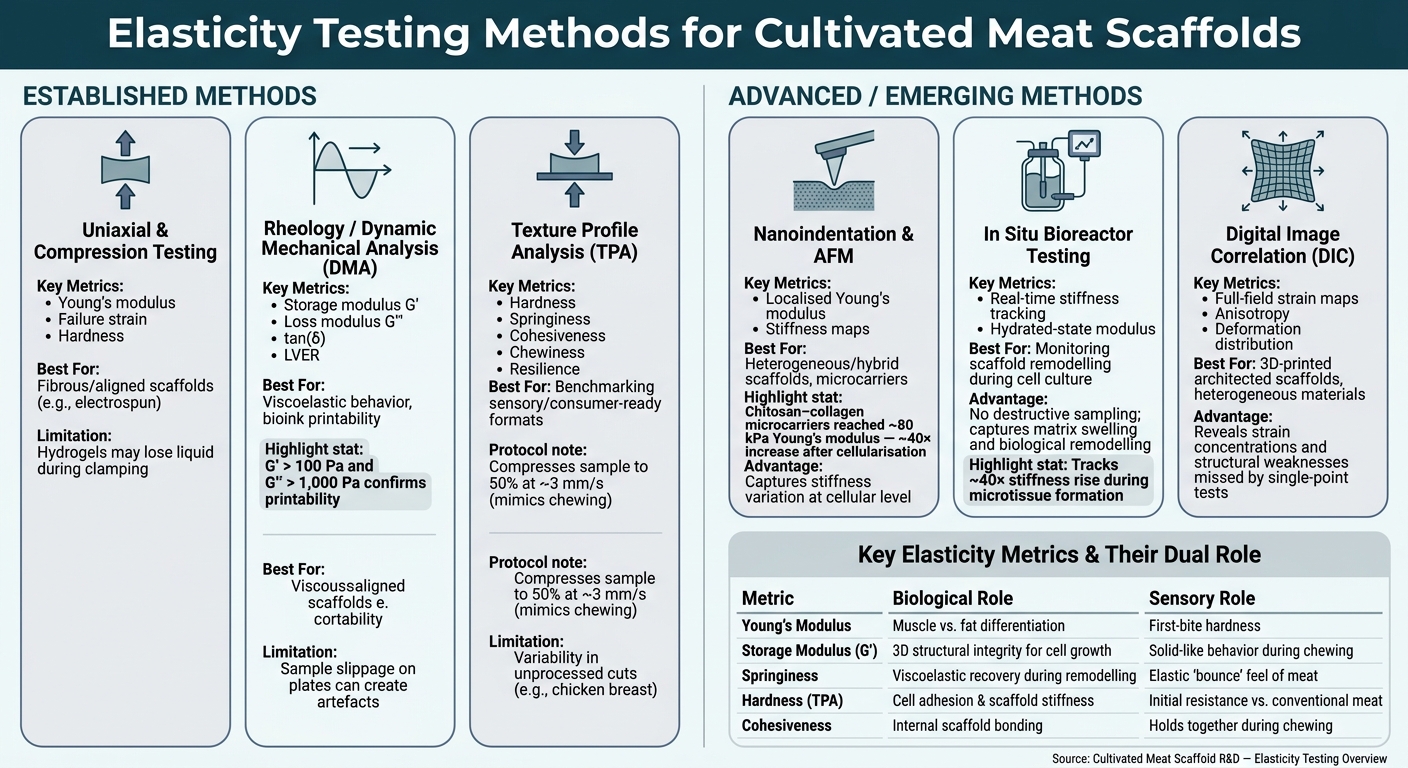
Elasticity Testing Methods for Cultivated Meat Scaffolds: A Comparison Guide
Understanding how elasticity is measured is fundamental for anyone working with cultivated meat scaffolds. Techniques borrowed from tissue engineering and food science remain essential for evaluating scaffolds throughout their development. These methods not only quantify mechanical properties but also provide insights into how scaffolds support cell behaviour and contribute to the final product's texture.
Uniaxial and Compression Testing
Uniaxial tensile testing evaluates how a scaffold reacts when stretched in a single direction. Stress (force per unit area) is plotted against strain (the degree of deformation), and the slope of the linear portion of this curve yields Young's modulus - a measure of stiffness. This method works particularly well for fibrous or aligned scaffolds, like those produced through electrospinning, where directional properties aid in cell alignment and differentiation.
Compression testing, on the other hand, applies force vertically through the sample, following the same stress–strain principles. However, hydrogel-based scaffolds can lose liquid during clamping, which may lead to inaccurate readings. To avoid this, it's best to test these scaffolds in a hydrated environment, ideally using a bioreactor system. Additionally, when calculating Young's modulus for slack samples, the strain should be zeroed at the exact moment the force reading deviates from the baseline, rather than at initial contact [3].
These fundamental mechanical tests set the stage for more complex analyses.
Dynamic Mechanical Analysis (DMA) and Rheology
Rheology is the go-to method for studying the viscoelastic properties that most cultivated meat scaffolds exhibit. Oscillatory rheology, in particular, tests samples across a range of deformation frequencies or amplitudes, measuring how the material stores (G') and dissipates (G'') energy. A key output of this process is the Linear Viscoelastic Range (LVER), which identifies the range where the scaffold maintains its structural integrity [1].
"Rheological characterisation would provide the necessary information to control both the manufacturing process and the final product characteristics." - Scientific Reports [1]
Rheological data isn't just for finished scaffolds - it also plays a crucial role in manufacturing. For instance, in 3D printing, understanding shear-thinning behaviour and flow properties ensures bioinks can be extruded reliably. Researchers at the University of California, Davis, led by Nitin Nitin and Woo-Ju Kim, demonstrated this in a study published in Food Hydrocolloids (2025). They analysed a pectin–soy–pea protein composite and found G' > 100 Pa and G'' > 1,000 Pa - values that confirm the viscoelastic solid behaviour needed for printability [2].
Texture Profile Analysis (TPA)
While methods like rheology and uniaxial testing provide engineering data, Texture Profile Analysis (TPA) bridges the gap to sensory attributes. TPA compresses a sample twice - reducing it to 50% of its original length at around 3 mm/s - to mimic chewing [1]. From this, attributes like hardness, springiness, cohesiveness, chewiness, and resilience are measured. These metrics are invaluable in later stages of development, where the focus shifts to achieving textures comparable to conventional meat.
TPA is particularly useful for raw meat characterisation and is considered more relevant than the Warner-Bratzler shear test, which simulates the cutting of cooked meat rather than the chewing experience. However, TPA results can vary depending on the sample. Processed products like sausages tend to yield more consistent data, while unprocessed cuts like chicken breast may show variability due to factors like delamination and moisture differences [1].
These established methods provide a foundation for exploring newer technologies in elasticity testing.
| Method | Metrics | Applications |
|---|---|---|
| Uniaxial Tensile Testing | Young's modulus, failure strain | Evaluating fibrous or aligned scaffolds |
| Compression / TPA | Hardness, cohesiveness, springiness, chewiness | Benchmarking consumer-ready formats |
| Rheology / DMA | G', G'', tan(δ), LVER | Studying viscoelastic behaviour and manufacturing processes |
Advances in Elasticity Testing Technologies
Traditional methods like rheology and uniaxial testing have been useful in assessing mechanical properties. However, these approaches face limitations when applied to the small, hydrated, and complex structures of cultivated meat scaffolds. Emerging tools are now addressing these challenges with improved precision and relevance for these unique materials.
Nanoindentation and Atomic Force Microscopy (AFM)
When working with heterogeneous or hybrid scaffolds containing living cells, bulk mechanical data often falls short. It cannot reveal how stiffness varies across different regions of a structure. Nanoindentation and AFM-based micro-mechanical testing fill this gap by offering localised stiffness mapping at the cellular level [4].
These techniques are particularly suited to delicate or small materials. For example, microcarriers and 3D-printed hydrogel scaffolds can be tested at specific points on their surfaces, creating a detailed map of mechanical variation [4]. In one case, chitosan–collagen microcarriers showed a significant transformation: their cellularised aggregates reached a Young's modulus of approximately 80 kPa - about 40 times higher than their initial state [4]. Bulk testing would have averaged out these changes, but micro-mechanical mapping captured them in detail.
"The system does not stay mechanically static as the biology develops." - Steve Dragos, CellScale [4]
AFM provides nanoscale precision, while dedicated micro-testers are better suited for samples ranging from 50 µm to 5 mm, such as micromass aggregates of stem cells [4]. These microscale insights are paving the way for the next step: elasticity testing directly within the biological environment.
In Situ Testing in Bioreactors
One major drawback of traditional elasticity testing is its reliance on samples that are removed, dried, or otherwise altered before testing. This disrupts the natural conditions of cultivated meat scaffolds, which depend on hydration and biological remodelling [4].
Integrating elasticity testing tools into bioreactor workflows eliminates these issues. By conducting tests within the bioreactor, researchers can gather data that accurately reflects scaffold behaviour during cell culture. This real-time monitoring tracks stiffness changes and helps determine when scaffolds are ready for further structuring. It also reduces the need for destructive sampling, streamlining the process [4]. As CellScale emphasises, "if the mechanics are wrong, the biological and structural outcome will suffer" [4].
The table below highlights the advantages of in situ testing compared to conventional methods:
| Testing Condition | Advantage for Cultivated Meat |
|---|---|
| Hydrated / In situ | Captures matrix swelling and biological remodelling [4] |
| Real-time | Tracks stiffness increases, such as the ~40× rise during microtissue formation [4] |
| Micro-scale | Provides high-resolution characterisation at the cell-length scale [5] |
Digital Image Correlation and Strain Mapping
While local stiffness is critical, understanding how deformation distributes across a scaffold under mechanical load is equally important. Digital Image Correlation (DIC) addresses this by capturing overall deformation patterns, revealing strain concentrations, anisotropies, and structural weaknesses that single-point measurements might overlook.
This technique is especially useful for architected scaffolds created through 3D printing. These scaffolds' mechanical responses depend heavily on how closely the printed structure aligns with its digital design [1]. DIC enables researchers to verify this by visualising strain distribution in real time. For heterogeneous materials like chicken breast analogues, where fibre orientation and delamination can cause varied responses in bulk tests [1], strain mapping provides a clearer understanding of the scaffold's mechanical behaviour.
These advancements in elasticity testing are deepening our understanding of scaffold mechanics and helping refine cultivated meat production. For researchers seeking specialised testing tools and materials tailored to the unique demands of cultivated meat, platforms like Cellbase offer a trusted marketplace to explore.
Linking Elasticity Metrics to Cell Behaviour and Texture
How Elasticity Affects Cell Development
Scaffold stiffness plays a critical role in guiding cell behaviour. Young's modulus, a measure of stiffness, acts as a biological signal. For example, hydrogels designed to mimic the stiffness of skeletal muscle encourage myogenic differentiation, while softer hydrogels resembling adipose tissue steer stem cells towards fat cell development [7]. This precision matters because the balance of muscle and fat directly affects both the nutritional profile and the texture of cultivated meat.
"A hydrogel formulation closely matching the stiffness of adipose and skeletal muscle tissues promotes myogenic differentiation, leading to a protein-rich muscle block with meat-like texture and flavour." - Nesma El-Sayed Ibrahim, Nature Reviews Bioengineering [7]
Stiffness also influences how cells attach and grow. Bigel scaffolds, which are oleogel-in-hydrogel composites, demonstrate this well. With hardness values between 4.8 N and 7.9 N, these scaffolds support cell proliferation and differentiation into mature myotubes [2]. This highlights how specific mechanical properties can shape biological outcomes.
Additionally, structural design techniques such as directional freeze-drying and 3D bioprinting introduce mechanical gradients within scaffolds. These gradients encourage cells to align along specific directions, which is crucial for replicating the fibrous and anisotropic structure of whole-cut meat [2] [6]. These advances not only improve scaffold selection but also refine elasticity testing protocols to optimise cell behaviour and texture. Ultimately, these biological factors influence the sensory qualities consumers expect from meat products.
How Elasticity Shapes Sensory Outcomes
Elasticity metrics also have a direct impact on how cultivated meat feels and tastes. For instance, stiffer scaffolds with higher Young's modulus values result in firmer textures, while springiness - the ability of a material to recover its shape - affects how closely a product mimics the texture of conventional meat [1]. Chewiness, which combines hardness, cohesiveness, and springiness, is particularly important, as it is one of the most noticeable sensory attributes for consumers [1].
Conventional meat poses a high standard, consisting of roughly 90% muscle fibres and 10% connective tissue [1]. Current cultivated meat prototypes have chewiness levels that fall between processed turkey cold cuts and raw chicken breast [1]. However, some products, like cultivated Frankfurt-style sausages, exhibit a significantly higher Young's modulus than their commercial counterparts [1]. Such discrepancies highlight the need for precise elasticity testing methods, such as nanoindentation and digital image correlation (DIC), to fine-tune production. Adjusting the ratio of polysaccharides (e.g., pectin) to plant proteins (e.g., soy or pea protein isolate) provides a practical way to match the elasticity of specific conventional meats, whether pork, poultry, or fish [2].
Here’s a summary of how key elasticity metrics influence both biological and sensory outcomes:
| Metric | Biological Influence | Sensory Influence |
|---|---|---|
| Young's Modulus | Directs muscle vs. fat differentiation [7] | Determines "first bite" hardness [1] |
| Storage Modulus (G') | Supports 3D structural integrity for cell growth [2] | Governs solid-like behaviour during mastication [1] |
| Springiness | Reflects viscoelastic recovery during remodelling [1] | Produces the "bounce" or elastic feel of meat [1] |
| Hardness (TPA) | Correlates with scaffold stiffness and cell adhesion [2] | Matches the initial resistance of conventional meat [1] |
| Cohesiveness | Indicates internal scaffold bonding [1] | Determines whether the product holds together during chewing [1] |
sbb-itb-ffee270
Practical Considerations for Advanced Elasticity Testing
Standardisation and Reproducibility
Incorporating advanced elasticity testing into routine R&D workflows is no easy task. One of the biggest hurdles lies in sample preparation. For fibrous or non-processed scaffold materials, inconsistencies in thickness, fibre orientation, and moisture content can lead to highly variable results between trials. To minimise these issues, cut samples uniformly - ideally to 3 mm thickness - using methacrylate templates and microtome blades. Additionally, apply a fixed load threshold (0.01 N) to detect initial contact consistently [1].
Hydration is another critical factor. Testing dry scaffolds does not accurately reflect their behaviour in cell-culture conditions. To capture realistic mechanical performance, ensure that tests replicate the aqueous environments used during cell growth. It's also important to remember that scaffolds are not mechanically static. As cells proliferate and deposit extracellular matrix, scaffold stiffness can increase significantly due to biological remodelling [4]. Ignoring this dynamic can lead to inaccurate assessments of scaffold properties.
Rheological testing introduces its own set of complexities. When shear forces are applied, samples can slip from the testing plates, as the scaffold's internal structure often outmatches its adhesion to the plates. This slippage creates artefacts in storage modulus (G′) measurements [1]. To counteract this, use high-roughness plates and ensure deformations stay within the Linear Viscoelastic Range (LVER), as defined by ISO 6721-10. This range is where G′ remains stable within a 5–10% variation. Variability in sample origin, storage conditions, and preparation methods also contributes to discrepancies in reported values, making cross-study comparisons more difficult [1].
These measures are foundational for aligning testing protocols with production equipment.
Integration with Bioprocessing Equipment
Once consistent testing protocols are in place, the next step is to align equipment selection with specific production stages. Choosing the right instruments for each stage is crucial for obtaining reproducible and accurate elasticity measurements. For example, micro-mechanical testers such as the CellScale MicroTester G2 are ideal for analysing delicate microtissues and cellular aggregates during the expansion phase. These instruments can handle samples as small as 50 microns and up to 5 mm, offering sensitivity that standard universal testing machines often lack [4]. On the other hand, for larger, processed formats like sausages or structured whole-cut prototypes, tools like the ZwickiLine are better suited. These instruments can perform both Texture Profile Analysis (TPA) and uniaxial testing, providing the necessary force range for these applications [1].
However, sourcing specialised equipment and scaffold materials remains a significant challenge for R&D teams in cultivated meat. Platforms like Cellbase, a dedicated B2B marketplace for the cultivated meat industry, simplify this process. Cellbase connects researchers and procurement specialists with verified suppliers of scaffolds, bioreactors, sensors, and analytical instruments, all with specifications tailored to cultivated meat production. Instead of sifting through general lab supply catalogues, teams can quickly find equipment designed for low-force and hydrated-state measurements, which are essential for advanced elasticity testing. This streamlined integration supports scaffold characterisation and accelerates procurement for cultivated meat R&D.
Conclusion: Where Elasticity Testing Is Headed
Elasticity testing has evolved far beyond being just a post-production quality check. Today, it's a critical component of scaffold development, influencing decisions from material selection to large-scale bioreactor production. Advanced tools like nanoindentation, atomic force microscopy, and micro-mechanical platforms such as the CellScale MicroTester G2 allow researchers to precisely analyse soft, hydrated structures - capabilities that surpass those of standard industrial equipment.
The insights from these methods are already shaping product development. For example, cellularised microtissue aggregates can achieve a Young's modulus of around 80 kPa. This highlights how biological remodelling during cell culture significantly alters scaffold mechanics. Such dynamic changes emphasise the importance of ongoing mechanical monitoring throughout the process.
Looking ahead, the future of elasticity testing is becoming more defined. Key areas of focus include standardised testing protocols, hydrated-state measurements, and early integration into bioprocessing workflows. Techniques like Texture Profile Analysis and rheological characterisation are emerging as common metrics for comparing cultivated prototypes with commercial products. These methods help identify gaps in properties like springiness, cohesiveness, and chewiness, enabling teams to address issues before moving to costly production stages. This progression underscores the vital connection between precise mechanical testing and optimised scaffold performance.
As discussed earlier, aligning testing approaches with production requirements is essential. However, access to appropriate instruments remains a challenge for many R&D teams. Platforms like Cellbase aim to bridge this gap by connecting researchers and procurement teams with verified suppliers of micro-mechanical testers, analytical tools, scaffolds, and bioprocessing equipment tailored to cultivated meat applications. As the industry grows, having dependable and efficient access to specialised tools will be just as critical as the scientific advancements driving the field forward.
FAQs
Which elasticity test should I use for my scaffold material?
The most suitable test depends on your specific objective:
- Young’s Modulus testing: Ideal for assessing stiffness, which is crucial for cell differentiation. A common approach is using 10% strain compression.
- Micro-mechanical testing: Best for fragile materials like microcarriers, ensuring accurate results without causing damage.
- Texture Profile Analysis: Useful for replicating the texture of meat, providing insights into sensory and structural properties.
- Tensile or Warner-Bratzler testing: Recommended for examining muscle fibre alignment, crucial in cultivated meat applications.
- Rheometry: Offers detailed viscoelastic data, helping to understand material behaviour under different stress conditions.
Specialised equipment for these tests is available through Cellbase.
How do I test scaffold stiffness in a hydrated, in-bioreactor setup?
When assessing scaffold stiffness in a hydrated, in-bioreactor environment, it’s crucial to account for the water-rich conditions. Testing scaffolds under dry conditions often leads to misleading data, as hydration significantly alters their mechanical properties.
Advanced bioreactor systems equipped with integrated force sensors are particularly useful for real-time monitoring of mechanical characteristics like Young’s modulus. Additionally, methods such as atomic force microscopy (AFM) and rheometry provide valuable insights into surface and viscoelastic properties.
For sourcing specialised tools and equipment, platforms like Cellbase offer a reliable marketplace tailored to these needs.
What elasticity targets best match muscle and fat tissue in cultivated meat?
To mimic the properties of natural tissue in cultivated meat, the elasticity of scaffolds must match the specific tissue type being developed. For example, muscle cells thrive in an environment with a stiffness of around 11–12 kPa, which supports their differentiation. In contrast, fat cells require a much softer scaffold, roughly 3 kPa, to promote lipid formation. Cellbase provides researchers and companies with the tools needed to measure and fine-tune these parameters, ensuring the production of high-quality cultivated meat.


