

Maintaining precise temperature, humidity, and pressure is essential for cultivated meat production. These factors influence cell growth, minimise contamination risks, and ensure compliance with strict industry standards like ISO 14644. Here's what you need to know:
- Temperature: Stability at 37°C is critical for consistent cell growth and metabolic activity. Deviations can reduce yields by 20–30%.
- Humidity: Proper control reduces microbial growth, lowering contamination risks in cleanrooms.
- Pressure: Differential pressure ensures clean air flows between zones, preventing airborne contamination.
Top sensor systems for monitoring these conditions include:
- SensoScientific SensoTag: Accurate temperature and humidity readings with robust data logging.
- Vaisala viewLinc: Provides real-time monitoring for temperature, humidity, and pressure.
- E+E Elektronik sensors: Specialised in maintaining pressure cascades to protect cleanroom integrity.
For sourcing, platforms like Cellbase simplify procurement with verified listings and regulatory-compliant options tailored to the cultivated meat industry. Accurate sensors not only ensure compliance but also optimise production efficiency, reducing contamination rates to under 1% annually.
Cleanroom Monitoring with Wireless Sensors
Critical Parameters for Cleanroom Sensors
Maintaining cleanroom conditions in cultivated meat facilities revolves around three main factors: temperature, humidity, and pressure. These elements work together to create a stable and controlled environment essential for producing safe, high-quality products while meeting cleanroom standards.
Temperature Monitoring
Keeping the right temperature is key to ensuring microbial safety and consistent production. For example, deviations from the standard 37°C can disrupt cell growth, lead to unpredictable metabolic activity, and lower production yields [2]. Temperature stability also helps curb microbial growth. As Dr. Heiko Baumgartner explains:
"Air conditioning is also of central importance: constant temperatures and regulated humidity slow down the growth of microorganisms, stabilising production processes" [1].
In addition to temperature, controlling humidity and pressure is equally important for safeguarding production quality.
Humidity Control
Relative humidity complements temperature control by reducing the risk of microbial growth. When humidity levels are not properly managed, microorganisms can multiply faster, increasing the chances of foodborne illnesses [1].
Pressure Regulation
After humidity, maintaining proper differential pressure plays a critical role in preventing airborne contamination. Pressure cascades ensure that air flows from cleaner areas to those with less stringent requirements [1]. This directional airflow acts as a barrier, preventing particles and microorganisms from entering sensitive zones. If pressure becomes unbalanced, the protective barrier can fail, increasing the risk of contamination [1]. Advanced ventilation systems that adjust based on real-time pressure readings not only maintain these critical gradients but can also cut energy use by up to 50% during non-production times [1].
Cleanroom Sensors for Cultivated Meat Production
When it comes to cultivated meat production, using sensors to monitor environmental conditions is a must. These devices help maintain strict contamination control and ensure compliance with regulatory standards. For example, advanced tools like SensoScientific's SensoTag Cellular sensors are built to meet the demands of ISO Class 8 cleanrooms [1]. Below are some sensor systems that highlight different methods to achieve precise environmental control.
SensoScientific Monitoring Systems
SensoScientific's SensoTag Cellular sensors bring real-time monitoring to the table by using 4G IoT technology, cutting out the need for local Wi-Fi. They are designed to work in ISO 7 and ISO 8 cleanrooms, making them ideal for controlled environments. These sensors deliver temperature readings with an accuracy of ±0.5°C across a range of –50°C to 85°C and relative humidity measurements with an accuracy of ±5%RH.
What sets them apart is their unlimited cloud storage and the ability to locally store up to 100,000 readings. This feature simplifies automated regulatory reporting for standards like HACCP, IFS, and BRC. With IP64 waterproof-grade protection and compliance with CDC/VFC requirements, these sensors are built to handle the tough conditions often found in food production [3].
Vaisala viewLinc Monitoring Solutions
Vaisala's viewLinc systems are specifically designed for life sciences, offering precise monitoring of temperature, humidity, and pressure. The integrated software continuously collects real-time data and sends instant alerts if conditions fall outside specified ranges. This precision is critical for maintaining the optimal temperature - usually around 37°C - needed to support steady cell growth in cultivated meat production.
E+E Elektronik Differential Pressure Sensors
E+E Elektronik focuses on differential pressure sensors, which are essential for maintaining stable pressure cascades in pharmaceutical-grade cleanrooms. These sensors are particularly valuable in cultivated meat facilities, where controlling pressure gradients between cleanroom zones is key to preventing airborne contamination during sensitive processes like fermentation and cell culture [1].
sbb-itb-ffee270
Sensor Features and Specifications Compared
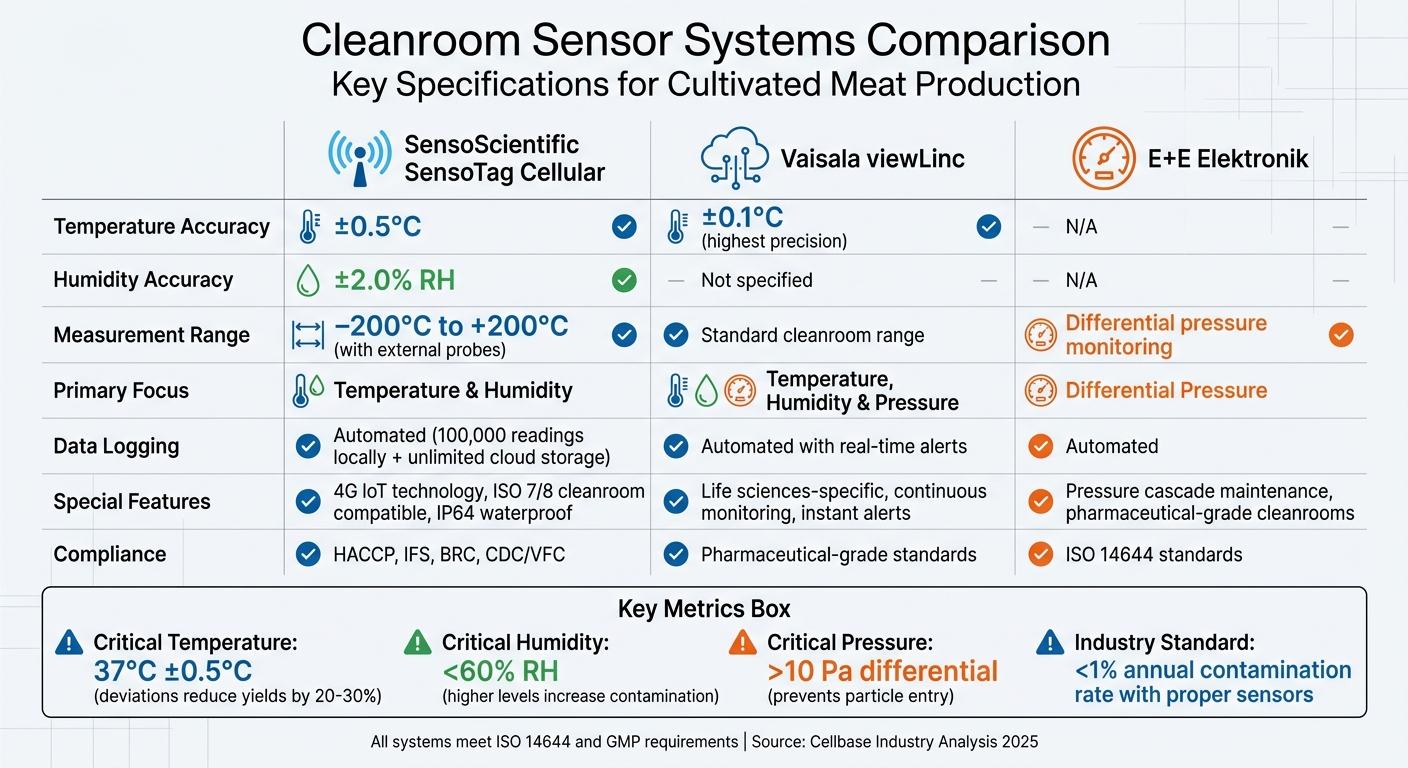
Cleanroom Sensor Systems Comparison for Cultivated Meat Production
When comparing sensors, their unique roles and specifications stand out clearly.
SensoScientific sensors deliver a temperature accuracy of ±0.5°C and a humidity accuracy of ±2.0% RH. They also feature an extended measurement range from –200°C to +200°C when using external probes, making them suitable for both standard cleanroom conditions and specialised low-temperature environments.
Vaisala viewLinc sensors offer exceptional precision with a temperature accuracy of ±0.1°C, which is crucial for maintaining the consistent 37°C required in cultivated meat production.
E+E Elektronik sensors are designed with a focus on differential pressure monitoring. This is key to maintaining stable pressure cascades, reducing the risk of contamination during critical production phases.
Comparison Table
Here's a quick overview of the key differences between these systems:
| Sensor System | Temperature Accuracy | Humidity Accuracy | Primary Monitoring Focus | Data Logging |
|---|---|---|---|---|
| SensoScientific SensoTag Cellular | ±0.5°C | ±2.0% RH | Temperature, Humidity | Automated data logging |
| Vaisala viewLinc | ±0.1°C | Not specified | Temperature, Humidity, Pressure | Automated data logging |
| E+E Elektronik | N/A | N/A | Differential Pressure | Automated data logging |
All three systems include automated data logging, which is essential for meeting regulatory requirements. By 2025, over 140 cultivated meat companies had integrated advanced monitoring systems like these to ensure compliance and optimise production processes [2].
Sourcing Cleanroom Sensors on Cellbase
Cellbase makes it easier to find and purchase sensors tailored for cultivated meat production. As a specialised B2B marketplace, it focuses exclusively on cleanroom sensors that meet the stringent requirements of this industry. Every sensor available on the platform is designed to comply with cultivated meat production standards, ensuring quick and reliable identification of equipment compatible with bioreactors.
The platform offers advanced filtering options, allowing users to search based on regulatory compliance and scale compatibility. Verified listings from trusted suppliers, including well-known names like SensoScientific, Vaisala, and E+E Elektronik, simplify the process. Instead of manually checking for compliance, buyers can compare products directly using clear and transparent specifications.
"Advanced sensor systems and monitoring equipment providing real-time data on critical culture parameters... enable precise process control and documentation essential for both research and commercial production." – Cellbase [2]
In addition to providing a wide range of sensors, Cellbase connects users with Cell Ag Experts who offer support for system integration and calibration [2]. This guidance is invaluable for ensuring that sensors work seamlessly with existing bioreactor control systems or for setting up data logging protocols to meet regulatory standards.
For businesses setting up new facilities or upgrading their monitoring systems, Cellbase caters to different contamination control needs by offering both sterilisable and single-use sensor options [4]. With global shipping options, including cold chain logistics for delicate components, the platform consolidates procurement and shipping processes that would typically require coordination with multiple suppliers [2].
Conclusion
Selecting the right sensors for monitoring temperature, humidity, and pressure is crucial for maintaining the controlled environment required in cultivated meat cleanrooms. Even small deviations can have a big impact. For example, temperatures exceeding 37°C ±0.5°C can reduce cell growth rates by 20–30%, while humidity levels above 60% RH significantly increase contamination risks. Monitoring differential pressure is equally important, as negative pressure differentials below 10 Pa can allow particles to enter, potentially compromising entire batches.
The sensor systems discussed - such as SensoScientific's wireless monitoring, Vaisala viewLinc's cloud-based compliance tools, and E+E Elektronik's precision differential sensors - are designed to tackle these environmental challenges. These tools not only address critical risks but also improve operational efficiency. Features like real-time alerts and automated logging can reduce downtime by up to 40%. Industry data shows that while 70% of cultivation failures are caused by environmental issues, facilities equipped with reliable sensors often report contamination rates of less than 1% annually.
Meeting ISO 14644 standards and GMP requirements calls for sensors with traceable calibration and robust audit trails. Essential features include response times under 4 seconds, temperature accuracy of ±0.1°C, humidity accuracy of ±1.5% RH, and compliance with 21 CFR Part 11. These capabilities ensure regulatory approval and simplify system integration.
For procurement teams, platforms like Cellbase streamline the sourcing process. By connecting buyers with verified suppliers of cleanroom sensors tailored for cultivated meat production, Cellbase ensures that chosen systems align with bioreactor control infrastructure while meeting the stringent standards of this industry.
FAQs
What are the recommended setpoints for temperature, humidity, and pressure in a cleanroom?
For cultivated meat cleanrooms, it's essential to keep the temperature within 18–22°C, maintain humidity levels between 30–60%, and ensure pressure differentials are set at 10–15 Pascals. These parameters create the right environment while reducing the chances of contamination.
How do I choose between wireless, cloud-based and differential pressure sensors?
Wireless sensors offer the convenience of flexible, cable-free installation and provide real-time data transmission, making them an excellent choice for mobile setups or situations where quick deployment is critical. On the other hand, cloud-based sensors are ideal for applications that require remote monitoring, scalable data management, and centralised analytics, allowing for efficient oversight of operations from virtually anywhere.
When it comes to maintaining cleanroom standards, differential pressure sensors play a crucial role. These sensors monitor airflow to uphold ISO classifications, ensuring proper environmental control and reducing the risk of contamination.
The right choice depends on factors like your production scale, the complexity of your data requirements, and the specific environmental conditions of your operation.
What calibration and audit-trail features do sensors need for ISO 14644 and GMP?
To meet the requirements of ISO 14644 and GMP, sensors need regular calibration against traceable reference standards. This process ensures their measurements remain accurate and reliable. Additionally, routine validation is essential to confirm ongoing compliance. Keeping detailed audit trails is equally critical; these records should document calibration activities and system performance, ensuring both regulatory precision and accountability are upheld.


