

Choosing between single-use and reusable bioreactors comes down to cost, scale, and production goals. Single-use systems are cheaper upfront and simpler to maintain but have higher recurring expenses. Reusable stainless steel systems require significant initial investment and infrastructure but are more cost-efficient for large-scale, long-term operations. Here's a quick breakdown:
-
Single-Use Bioreactors:
- Lower purchase costs (£4,000–£40,000).
- Minimal setup and maintenance, no cleaning required.
- Consumable costs (e.g., £8,000 per bag) quickly add up.
- Limited to smaller scales (up to 5,000L).
- Flexible for multi-product use.
-
Reusable Bioreactors:
- Higher upfront costs (£16,000–£160,000+).
- Requires cleaning systems (CIP/SIP) and more utilities.
- Suitable for large-scale production (20,000L+).
- Long-term durability offsets consumable costs.
- Best for single-product, high-volume manufacturing.
Quick Comparison:
| Feature | Single-Use Bioreactors | Reusable Bioreactors |
|---|---|---|
| Upfront Costs | £4,000–£40,000 | £16,000–£160,000+ |
| Max Scale | 5,000L | 20,000L+ |
| Maintenance | Minimal, no cleaning required | CIP/SIP cleaning required |
| Consumables | High (£8,000 per bag) | Low (cleaning chemicals, water) |
| Flexibility | Multi-product use | Single-product focus |
For smaller-scale or multi-product setups, single-use systems are practical. For high-volume, industrial-scale production, reusable systems are better suited. The choice depends on your production scale, budget, and long-term strategy.
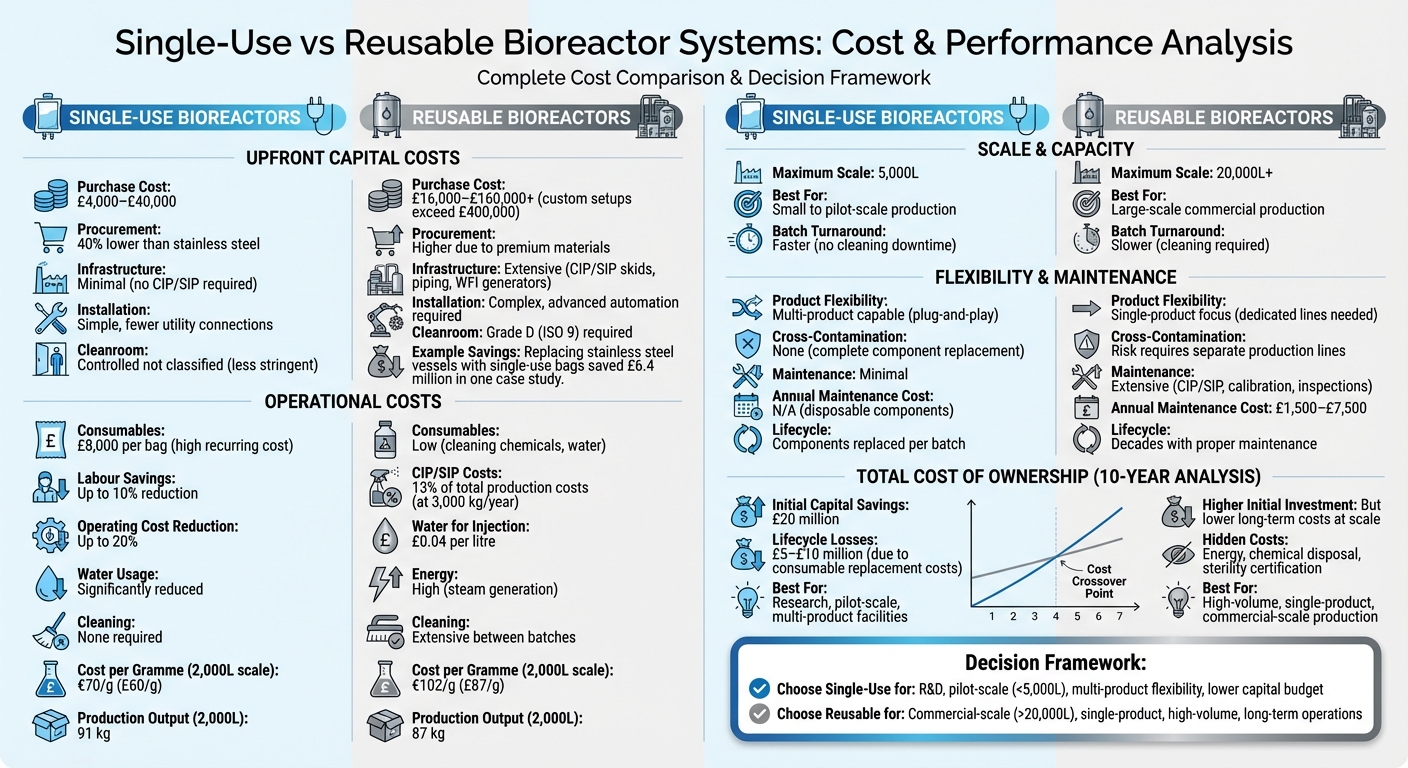
Single-Use vs Reusable Bioreactor Systems Cost Comparison
Upfront Capital Costs
When it comes to bioreactors, the initial investment can vary widely. Single-use systems generally require less upfront spending compared to reusable stainless steel systems. These costs cover not just the equipment itself but also the infrastructure and installation complexities that each system demands.
For cultivated meat producers, these differences in upfront costs play a crucial role in shaping immediate budgets and determining how scalable their production can become in the long run.
Procurement Costs
Single-use bioreactors stand out with procurement costs that are up to 40% lower than those of stainless steel systems [4]. This price gap is largely due to their design: single-use systems use flexible plastic materials, while stainless steel units require premium materials and intricate manufacturing to support steam sterilisation [3].
In addition to being more affordable, single-use equipment often arrives faster. Stainless steel systems, on the other hand, frequently delay project timelines due to longer lead times [1].
However, these cost advantages come with a notable drawback. Each single-use fermenter bag costs around £8,000, and frequent replacements can quickly add up. Within just one to two years, these recurring expenses could surpass the initial investment in a stainless steel bioreactor [1][3]. For producers planning large-scale, long-term operations, this ongoing cost becomes a key factor in financial and operational strategies.
Infrastructure and Installation
The financial picture shifts further when considering installation and infrastructure. Stainless steel systems demand extensive support equipment, such as Clean-in-Place (CIP) and Steam-in-Place (SIP) skids, intricate piping systems, high-capacity Water-for-Injection generators, and advanced automation [1]. For example, a case study showed that replacing stainless steel buffer vessels with single-use bags eliminated two CIP skids, saving over £6.4 million in capital costs [1].
Single-use systems, by contrast, avoid much of this complexity. Their installation is simpler, requiring fewer utility connections and less advanced automation [1]. This simplicity reduces the need for large cleanroom spaces, allowing facilities to downgrade from Grade D (ISO 9) cleanrooms to less stringent "controlled not classified" areas. Additionally, commissioning and qualification are faster since sterility validation is handled by the manufacturer, cutting down on extensive on-site testing [1].
That said, scalability is a limiting factor for single-use systems. They typically cap out at 5,000 litres, whereas stainless steel bioreactors can handle volumes exceeding 20,000 litres - a critical consideration for producers aiming for industrial-scale production [4]. While single-use systems may save on initial costs and simplify setup, their volume limitations could push producers toward stainless steel systems for large-scale operations, impacting both ongoing costs and long-term planning.
Operational and Consumable Costs
Recurring operational expenses play a major role in determining cost efficiency. Single-use systems depend on disposable components like liners, storage bags, tubing, and filters. While these can simplify processes, the costs add up quickly, potentially negating any savings from lower initial investments.
On the other hand, reusable stainless steel systems bring their own recurring expenses. These include cleaning-in-place (CIP) chemicals like detergents and acids, steam-in-place (SIP) resources, and large amounts of Water for Injection (WFI). With WFI costing approximately £0.04 per litre (factoring in capital, maintenance, and utilities), cleaning cycles consume significant resources. In fact, CIP and SIP processes can account for as much as 13% of total production costs in commercial operations producing around 3,000 kg annually [4].
Consumable Costs
The complexity of the system directly influences consumable costs. For simple tasks, such as buffer or media storage, single-use bags are a clear winner. However, the equation changes when it comes to more intricate systems. As Barak I. Barnoon, Associate Director of Process Engineering, and Bob Bader, Senior Manager of Technology, pointed out:
"The high replacement costs for more complex single-use systems, such as large mixing bags or bioreactors, tend to offset any savings that might be realised" [1].
This challenge becomes even more evident when frequent replacements are needed during operations. While stainless steel systems avoid the ongoing expense of bag replacements, they require heavy spending on cleaning chemicals and water. The energy demands for steam generation and the vast amounts of water needed for thorough cleaning add to their cost profile [4]. Dr. Adam Ostrowski, Technical Application Lead at Cellexus, explained:
"The cost of energy, highly toxic chemicals necessary for CIP/SIP processes, their disposal and production of deionised water... can amount to even 13% of the total production costs" [4].
These operational costs highlight the trade-offs between the two systems, especially when labour and utility expenses are factored in.
Labour and Utility Requirements
Labour and utility costs further influence operational expenses. Single-use bioreactors eliminate the need for the lengthy cleaning and sterilisation cycles required for stainless steel systems. This allows staff to focus on production tasks rather than equipment maintenance, leading to labour cost reductions of up to 10% [4]. Dr. Ostrowski noted:
"By avoiding the cleaning of equipment between batches, we also save on staff work time, who can focus on the production instead of equipment maintenance" [4].
Utility consumption also follows this trend. Reusable systems demand considerable energy for steam generation and large volumes of water for cleaning. In contrast, single-use systems significantly cut down water usage and wastewater production [4]. A 2021 study comparing monoclonal antibody production at a 2,000-litre scale showed that single-use systems produced 91 kg of bioproduct at a cost of €70 per gram (around £60/g), while stainless steel systems yielded 87 kg at a higher cost of €102 per gram (roughly £87/g) [4]. Overall, single-use systems can lower operating costs by as much as 20% [4].
Scalability and Production Flexibility
When it comes to scaling production and adapting to shifting demands, single-use and reusable systems each bring distinct advantages and challenges. These factors become increasingly crucial as cultivated meat companies move from research to commercial production or diversify their product offerings.
Scaling Costs
The capacity of production systems plays a key role in scaling decisions. Single-use bioreactors currently max out at around 5,000 litres, while reusable stainless steel systems can handle volumes exceeding 20,000 litres[4]. For companies aiming for large-scale commercial production, these limitations may eventually push them toward reusable systems.
However, single-use systems shine during the scale-up phase. They offer quicker lead times for equipment delivery and installation, giving manufacturers more flexibility to finalise technology choices later in the process. Additionally, the absence of cleaning-in-place (CIP) and sterilisation-in-place (SIP) requirements minimises downtime between batches, allowing for higher throughput even with smaller bioreactor sizes[4]. While single-use systems do come with higher consumable costs at larger volumes, they avoid the hefty capital and operational expenses tied to building and maintaining dedicated cleaning facilities.
Multi-Product Manufacturing
Flexibility in production is just as important as scalability, especially for companies catering to diverse product demands. Reusable stainless steel systems are typically designed for a single bioproduct, which means producing different products often necessitates separate production lines to prevent cross-contamination[4]. Dr. Adam Ostrowski, Technical Application Lead at Cellexus, highlights this limitation:
"A bioprocessing laboratory outfitted with reusable equipment is usually dedicated to only one type of bioproduct, therefore, the production of various preparations requires construction of multiple production lines" [4].
Single-use systems, on the other hand, sidestep this issue entirely. Their "plug-and-play" design allows all components that come into contact with the product to be replaced between batches. This enables the same equipment to be quickly reconfigured for different product lines without contamination risks. As Dr. Ostrowski elaborates:
"Using SU technologies we can completely replace all components of the production line, which come in contact with the process, with new ones, and thus completely separate the processes despite using the same equipment" [4].
This adaptability is especially advantageous for cultivated meat producers working on a variety of product formats. It eliminates the need for separate production lines, reducing both capital investment and the amount of floor space required.
Maintenance and Lifecycle Costs
Maintenance Requirements
When it comes to maintenance, reusable and single-use bioreactor systems present very different challenges. Stainless steel systems demand extensive upkeep, including Clean-in-Place (CIP) and Steam-in-Place (SIP) procedures after every batch. These processes not only require significant time but also lead to extended downtime[4]. Additionally, these systems need regular calibration for critical sensors - such as those monitoring pH, temperature, and dissolved oxygen - and periodic inspections of key components[2].
The costs associated with maintaining reusable equipment can be substantial. For example, expenses for CIP/SIP chemicals and deionised water can account for 13% of total production costs[4]. Annual maintenance costs typically range between £1,500 and £7,500, depending on the complexity of the system and how frequently it’s used[2].
Single-use systems, on the other hand, significantly reduce maintenance demands. Dr. Adam Ostrowski, Technical Application Lead at Cellexus, highlights this shift:
"Switching to a SU system, CIP is minimal, SIP is entirely removed, and the duty of sterility validation is transferred from the operator to the equipment manufacturer"[4].
This change greatly cuts down on labour and utility consumption. However, it does introduce higher ongoing costs for consumables - such as single-use bioreactor bags, which can cost up to £7,500 per batch for production-scale fermenters[1]. These contrasting maintenance needs have a direct impact on the overall cost-effectiveness of each system.
Lifecycle Durability
Stainless steel systems are designed as long-term investments, capable of functioning for decades if properly maintained. However, their economic viability hinges on consistent upkeep and the infrastructure to support CIP/SIP operations. Hidden costs, such as energy consumption, chemical waste disposal, and sterility certification, can erode the durability advantage they offer over time[4].
Single-use systems follow a different economic model. While the hardware - like bag holders and control units - has a reasonable lifespan, the reaction vessels themselves are replaced after each use. This creates recurring expenses that increase with production volume. For instance, in some 10-year Net Present Value analyses, single-use systems showed lifecycle losses of £5 million to £10 million, despite initial savings of £20 million on capital costs. The primary driver of these losses was the high cost of consumable replacements[1].
That said, single-use systems are more cost-effective for simpler tasks, such as buffer storage, where replacement costs are lower. However, for more complex operations involving bioreactor bags, the recurring expenses can outweigh the initial savings over time[1].
sbb-itb-ffee270
Cost Comparison Across Production Scales
Small-Batch Production
For research and pilot-scale production, single-use systems offer noticeable cost advantages. The initial capital required can be up to 40% lower than that of stainless steel systems, making them especially appealing for startups and research labs operating on tight budgets[4]. Beyond the lower upfront costs, operating expenses can also decrease by as much as 20% when using single-use technology[4].
At the 2,000L scale, the cost benefits become even clearer. A study on monoclonal antibody production revealed that single-use systems reduced the cost of goods to €70 per gramme, compared to €102 per gramme with stainless steel systems. Additionally, single-use systems produced 91 kg of product, slightly more than the 87 kg achieved with stainless steel setups[4]. By eliminating the need for cleaning-in-place (CIP) and sterilisation-in-place (SIP) procedures, batch turnaround times improve, and labour costs drop by 10%[4]. However, these advantages start to shift as production scales up to commercial levels.
Commercial-Scale Production
When production volumes increase, the economics of single-use systems become more complex. Stainless steel systems can handle volumes exceeding 20,000L, far surpassing the approximate 5,000L limit of single-use systems[4]. However, single-use setups face higher recurring consumable costs, which can add up significantly over time. On the other hand, stainless steel facilities incur hidden costs related to cleaning and maintenance. For example, at a production scale of 3,000 kg per year, the energy, chemicals, and deionised water needed for CIP/SIP account for 13% of total production costs[4].
For multi-product commercial facilities, the flexibility of single-use systems becomes a key advantage. Dr. Adam Ostrowski, Technical Application Lead at Cellexus, highlights this benefit:
"SU technologies are more flexible and adaptable, and particularly useful where the ability to quickly switch to new requirements is crucial, and your equipment is used for a wide range of applications both upstream and downstream." [4]
This flexibility allows components to be fully replaced between production runs, eliminating cross-contamination risks. This is particularly beneficial for cultivated meat producers working with multiple cell lines or formulations, as it removes the need for dedicated production lines for each product. These cost dynamics illustrate the trade-offs producers must weigh when scaling their operations.
Using Cellbase for Bioreactor Procurement
Once cost trade-offs are clearly defined, the next step is streamlining procurement to maximise these benefits. In the cultivated meat industry, where cost control is critical, choosing the right bioreactor system requires working with suppliers who understand the unique demands of this field.
Cultivated Meat Industry Focus
Cellbase stands out as a specialised B2B marketplace tailored exclusively for the cultivated meat sector, unlike general lab supply platforms focused on pharmaceutical research. It connects procurement teams with suppliers offering bioreactors specifically designed for cultivated meat processes. These range from benchtop systems for research and development to large-scale units exceeding 500 litres for commercial use.
David Bell, Founder of Cellbase, highlights the industry's procurement challenge:
"Finding suppliers for bioreactors... meant googling through pages of pharma suppliers who didn't understand food applications." [5]
Cellbase solves this problem by listing only equipment certified for cultivated meat production. Each listing includes essential details like application context, regulatory compliance, and compatibility. This targeted approach eliminates the hassle of sifting through irrelevant pharmaceutical catalogues, saving weeks in the procurement process. It also lays the groundwork for clear and verifiable cost comparisons, as discussed below.
Verified Listings and Transparent Pricing
Transparent pricing is key when evaluating the costs of single-use versus reusable systems. Cellbase provides upfront pricing information, making it easier to see the higher initial investment required for stainless steel systems compared to the lower upfront costs of single-use options. Additionally, the platform includes operational cost details, such as prices for consumables like tubing and filters, offering a full picture of ongoing expenses.
The platform’s verified supplier network ensures that all equipment meets food-grade certification standards and is built for continuous operation - vital for bioreactors that need to run for long durations. For companies scaling up from pilot projects to full-scale production, Cellbase simplifies decision-making. It allows users to compare single-use systems, typically suitable for capacities up to 5,000 litres, with reusable systems that can handle volumes exceeding 20,000 litres, helping businesses make informed choices at every stage of growth.
Conclusion
Deciding between single-use and reusable bioreactor systems requires careful consideration of costs and production goals. Single-use systems minimise upfront investment and reduce labour by eliminating the need for sterilisation. However, they come with higher recurring costs for consumables like disposable bags and filters. On the other hand, reusable stainless steel systems involve a steep initial investment - ranging from £16,000 to £160,000, with custom setups exceeding £400,000 - but they offer durability and lower consumable expenses. That said, ongoing costs for cleaning and sterilisation (CIP/SIP), including water, energy, and chemicals, can offset some of these savings [4].
The choice also depends on the production stage. For cultivated meat companies in early development or those managing multiple products, single-use systems provide flexibility and quicker turnaround times. But as production scales beyond 5,000 litres and approaches commercial volumes above 20,000 litres, stainless steel systems often become the more cost-effective option, despite the added maintenance requirements [4]. To make an informed decision, it's crucial to calculate the total cost of ownership, factoring in capital expenses, operating costs, energy efficiency, labour, and consumable needs over the system's lifecycle.
Transparent procurement plays a key role in navigating these decisions. Platforms like Cellbase simplify the process by offering verified supplier listings, upfront pricing, and detailed operational cost breakdowns. This clarity helps procurement teams weigh single-use versus reusable systems with a full understanding of both capital and operational expenses.
Ultimately, the most suitable choice depends on factors like current production scale, growth plans, and operational priorities. Whether the focus is on flexibility for research and development or cost optimisation for high-volume manufacturing, understanding these trade-offs ensures the bioreactor system aligns with both immediate needs and long-term financial goals. This alignment is critical for fostering sustainable growth and success in the cultivated meat industry.
FAQs
When does a single-use bioreactor become more expensive than stainless steel?
When recurring consumable costs, such as approximately £6.4 million per year for a 2,000-litre scale, outweigh the higher initial investment and long-term savings of reusable systems, single-use bioreactors can become more costly than stainless steel alternatives. This shift in cost efficiency is particularly noticeable at larger scales or over extended usage periods, where stainless steel systems demonstrate better financial viability.
What costs should be included in total cost of ownership (TCO)?
The total cost of ownership (TCO) covers more than just the initial purchase price. It includes procurement, maintenance, and a range of operational expenses. These can involve cleaning, sterilisation, consumables, infrastructure requirements, and waste management. All of these elements play a crucial role in assessing the long-term financial implications of bioreactor systems used in cultivated meat production.
How do I choose based on scale and number of products?
Single-use bioreactors are a great choice for smaller-scale production or operations that need flexibility. They come with the advantage of lower initial costs and a quick setup process. However, as production scales up, the recurring costs for consumables and the amount of waste generated can become significant.
On the other hand, reusable bioreactors are better suited for larger, stable production setups. While they have higher upfront costs, they tend to be more cost-effective over time. These systems do require cleaning and sterilisation infrastructure, which makes them more practical and economical when operating at higher production volumes.
When deciding between the two, it’s essential to consider your production scale and the volume of cultivated meat you plan to produce. This will help you choose the option that aligns best with your operational and financial goals.


