

Contamination in bioreactors is a major challenge for cultivated meat production, leading to batch failures, financial losses, and regulatory complications. Here's how you can identify and resolve contamination effectively:
- Early Detection: Look for sudden drops in dissolved oxygen, pH changes, or visible turbidity. Use tools like qPCR, ELISA, and flow cytometry for confirmation.
- Containment: Isolate the affected bioreactor immediately to prevent spread. Document all details for compliance and analysis.
- Source Identification: Investigate maintenance logs, raw materials, and environmental monitoring data to pinpoint the contamination source.
- Decontamination: Follow a strict cleaning protocol, including alkaline and acid washes, thermal sterilisation, and chemical sterilisation for sensitive components.
- Prevention: Use aseptic techniques and media sterility protocols, validated raw materials, and continuous monitoring to minimise future risks.
With contamination affecting up to 11.2% of batches, robust protocols are essential to maintain sterility and ensure production success.
How to Identify Contamination in Cultivated Meat Bioreactors
Detecting contamination early is essential to minimise losses in cultivated meat production. Microbial contaminants can rapidly outgrow cultivated meat cells, leading to batch failures if not addressed promptly. Early detection not only prevents further damage but also guides the necessary troubleshooting steps.
Early Warning Signs
Contamination often presents itself through unexpected changes in process parameters. For instance, a sudden drop in dissolved oxygen (DO) levels can signal bacterial contamination, as bacteria consume oxygen far more quickly than cultivated meat cells. Similarly, a sharp decline in pH may indicate microbial activity, particularly from fungi that thrive in acidic conditions.
Other signs include visible turbidity in the medium or abnormal cell morphology observed during routine sampling.
Confirmatory Diagnostic Tests
Once contamination is suspected, confirm its presence and assess its severity using the following methods:
| Diagnostic Method | Primary Target | Key Advantage |
|---|---|---|
| Spectroscopic Sensors | pH, Dissolved Oxygen, Optical Density | Enables real-time, non-invasive monitoring |
| qPCR | Bacterial and Fungal DNA | Highly sensitive; quantifies contaminant levels |
| ELISA | Endotoxins and Antigens | Detects gram-negative bacterial residues, even post-clearance |
| Flow Cytometry | Cell size, shape, and fluorescence | Differentiates viable cultivated cells from contaminants |
| Microscopy | Visible moulds and yeasts | Confirms advanced fungal contamination |
Among these, qPCR stands out for its ability to not only detect contaminants but also measure the concentration of bacterial or fungal DNA, offering a detailed view of the contamination's severity. ELISA, on the other hand, is particularly useful for identifying residual endotoxins from gram-negative bacteria, even when sterility tests indicate no live bacteria.
Special attention should be given to mycoplasma. This microorganism is especially problematic due to its lack of a cell wall, allowing it to bypass standard filtration systems and evade many conventional detection methods [1]. Routine screening of cell lines for mycoplasma using PCR-based assays is strongly recommended.
These diagnostic methods provide the foundation for effective troubleshooting and targeted remediation efforts.
sbb-itb-ffee270
Step-by-Step Guide to Troubleshooting Bioreactor Contamination
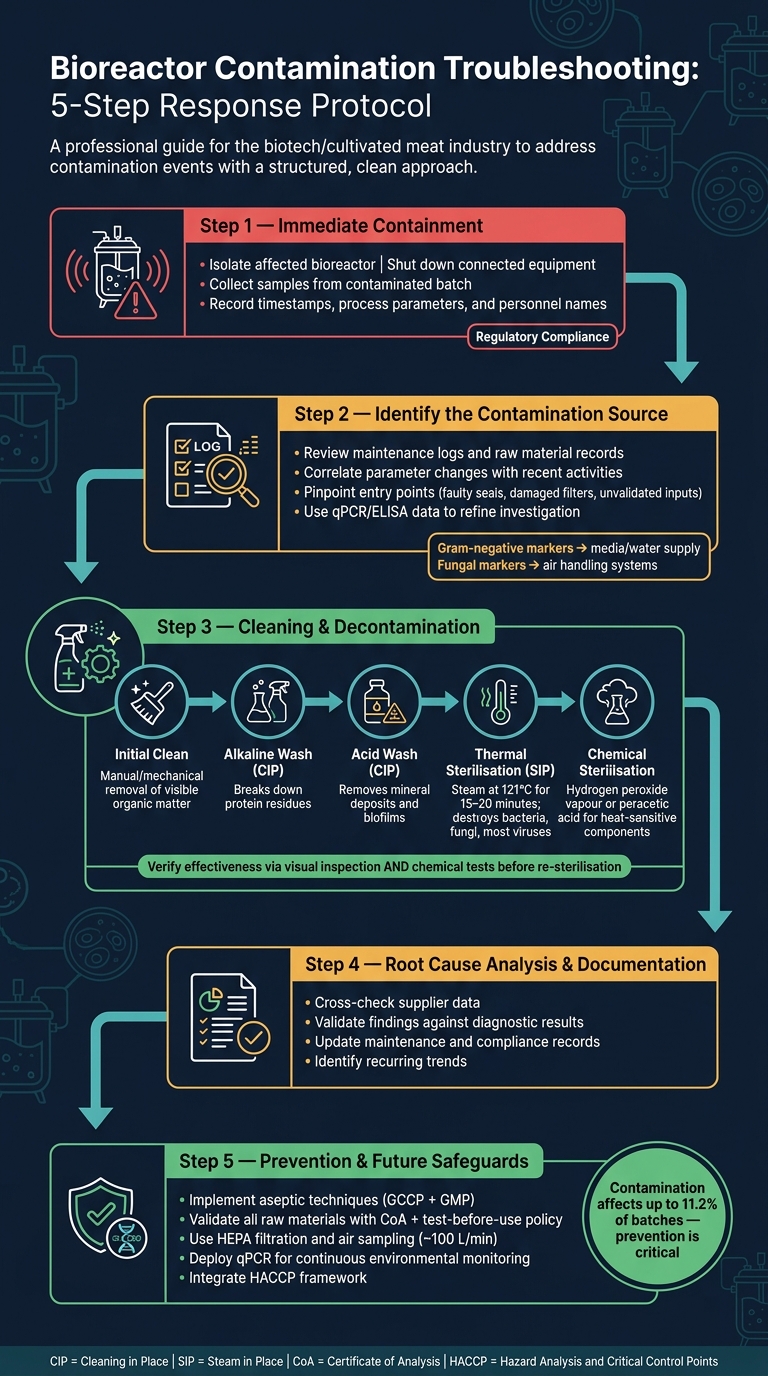
Bioreactor Contamination Troubleshooting: 5-Step Response Protocol
Once contamination is confirmed through the diagnostic methods outlined earlier, taking a structured approach is key. Acting quickly and systematically not only minimises the impact but also helps document the event for future prevention. This guide walks through the essential steps, from containment to decontamination, ensuring an effective response.
Step 1: Immediate Containment
The first step is to prevent the contamination from spreading further. Isolate the affected bioreactor immediately and shut down any connected equipment. Even a minor breach, if left unchecked, can quickly compromise nearby systems [1].
Before initiating cleaning, collect samples from the contaminated batch. Record timestamps, process parameter data at detection, and the names of personnel involved. This documentation is critical for regulatory compliance and for identifying trends or recurring issues.
Step 2: Identifying the Contamination Source
Once the system is secured, begin investigating the root cause. Review maintenance logs, raw material records, and environmental monitoring data. Correlate any observed parameter changes with recent activities, such as media additions, sampling, or equipment servicing.
"Maintaining bioreactor sterility is absolutely critical for producing cultivated meat that is both safe and scalable." - David Bell, Founder, Cultigen Group [1]
Pinpoint potential entry points, such as faulty seals, damaged filters, or inadequately validated raw materials. If diagnostic tools like qPCR or ELISA have identified a specific contaminant, use this data to refine your investigation. For instance, gram-negative bacterial markers often point to issues with the media or water supply, while fungal contamination may suggest problems with air handling systems or environmental breaches. Cross-check supplier data if necessary. These findings will inform the next steps in remediation.
Step 3: Cleaning and Decontamination
Once the source of contamination is identified, follow a precise cleaning and decontamination protocol.
| Step | Method | Purpose |
|---|---|---|
| Initial clean | Manual or mechanical removal | Eliminate visible organic matter |
| Alkaline wash | Alkaline detergent (CIP) | Break down protein residues |
| Acid wash | Acid cleaning agents (CIP) | Remove mineral deposits and biofilms |
| Thermal sterilisation | Steam-in-place (SIP) at 121°C for 15–20 minutes | Destroy bacteria, fungi, and most viruses |
| Chemical sterilisation | Hydrogen peroxide vapour or peracetic acid | Sterilise heat-sensitive components |
The sequence of cleaning steps is critical. Begin with an alkaline wash to break down protein residues, enhancing the effectiveness of the subsequent acid wash in tackling mineral deposits and biofilms [1]. For components sensitive to heat, such as certain sensors or membranes, chemical sterilisation using hydrogen peroxide vapour or peracetic acid is recommended [1].
After cleaning, verify its effectiveness through both visual inspections and chemical tests. A surface that looks clean may still harbour microbes. Only after thorough verification should the system be re-sterilised and prepared for the next production cycle.
How to Prevent Contamination in Future Bioreactor Runs
Dealing with contamination is only part of the challenge. The bigger task lies in preventing it from happening again. In cultivated meat bioprocessing, prevention hinges on three key areas: aseptic practices, validated supply chains, and consistent environmental monitoring. Below, we'll break down the steps to safeguard each of these critical components.
Aseptic Techniques and Process Controls
Contamination can originate from personnel, equipment, or the production environment [2][3]. Each source requires targeted strategies. Training staff in Good Cell Culture Practice (GCCP) alongside Good Manufacturing Practices (GMP) lays the groundwork for maintaining sterility across all stages of the process [3].
Key tools like HEPA filtration and routine air sampling (typically at around 100 L/min) help detect bioaerosols early [2]. Closed-system bioreactors further mitigate risks by limiting exposure through reduced open interventions during runs.
An additional measure is the use of antimicrobial peptides (AMPs). Unlike antibiotics, which are not allowed in food processing, AMPs offer a food-safe alternative. For instance, synthetic peptide 1018-k6 has been shown to inhibit contaminants at a MIC of 37.5 μg/mL, effectively managing bacterial loads up to 10⁶ CFU/mL without affecting muscle cell proliferation [2]. Since cultivated meat production cycles often last two to four weeks, bactericidal solutions like AMPs are more effective than bacteriostatic methods, which only slow bacterial growth.
Aside from internal controls, ensuring the integrity of external inputs is equally essential.
Supplier and Raw Material Validation
Raw materials, especially growth media and supplements and biological inputs, are a common source of contamination. In production cycles that can last up to 28 days, even small amounts of contaminants can multiply significantly if introduced through unverified inputs.
To address this, always require a Certificate of Analysis (CoA) from suppliers, confirming sterility and purity testing. However, don't rely solely on supplier documentation. Implement a "test-before-use" policy for high-risk inputs, and quarantine all incoming materials until they pass internal validation. High-risk contaminants, like mycoplasma, deserve special attention. Due to its lack of a cell wall, mycoplasma can bypass standard filtration systems designed for larger bacteria [1].
Choosing suppliers familiar with the technical demands of cultivated meat production can streamline this process. Platforms like Cellbase make sourcing easier by providing verified listings of GMP-compliant raw materials, such as growth media and cell lines. These suppliers often include attributes like serum-free or GMP-compliant labelling, helping procurement teams identify inputs that meet stringent sterility standards.
Equipment and Environmental Monitoring
Preventing contamination also depends on regular equipment maintenance and continuous environmental monitoring. Faulty seals, worn-out filters, or outdated sensors can create vulnerabilities. Scheduled maintenance is essential to avoid such issues.
Advanced molecular tools like qPCR add another layer of protection by detecting bacterial and fungal DNA at trace levels, enabling early intervention. Integrating frameworks such as HACCP (Hazard Analysis and Critical Control Points) alongside GMP and GCCP shifts the focus from reactive fixes to proactive risk management, ensuring contamination risks are addressed before they escalate.
Conclusion: Building Reliable Contamination Control in Cultivated Meat Bioprocessing
Controlling contamination in cultivated meat production involves multiple layers of defence. This guide highlights key practices: leveraging real-time sensors for early detection, implementing structured response protocols to isolate and trace contamination sources, employing thorough decontamination methods like CIP (Cleaning in Place) and SIP (Steaming in Place), and focusing on prevention through aseptic infrastructure and validated inputs. Such a systematic approach is indispensable due to the high risks inherent in the process.
The consequences of contamination are severe, with the potential to disrupt production cycles at both small and large scales. If initial safeguards fail, the impact on production can be profound.
"The future of cultivated meat doesn't just rest on scientific progress - it hinges on mastering the ongoing challenge of keeping bioreactor systems sterile, even as the industry scales to meet global demand." - Cultivarian Society [1]
Pre-production validation plays a critical role in minimising risks, as unverified raw materials remain a significant source of contamination. Platforms like Cellbase bridge the gap by connecting cultivated meat producers with verified suppliers, underscoring the importance of stringent input validation.
FAQs
When should I stop a run versus trying to recover it?
Deciding whether to halt a run or try recovery hinges on the extent of the contamination. If a breach is confirmed, the batch should be isolated right away to prevent cross-contamination.
In cultivated meat production, microbial growth frequently outpaces recovery attempts, quickly depleting nutrients and oxygen. Signs such as a sharp pH drop, oxygen exhaustion, or noticeable turbidity typically indicate that the batch cannot be salvaged, making termination necessary to preserve sterility and adhere to operational schedules.
How can I distinguish bacteria, fungi and mycoplasma quickly?
Identifying contaminants in cell cultures typically involves a mix of visual inspections and diagnostic tests. Here's how different types of contaminants can present themselves:
- Bacteria: These often lead to noticeable changes in the culture, such as turbidity, foaming, or sudden pH drops. These changes can be detected using probes or observed under a microscope, where bacteria appear as small, motile shapes.
- Fungi: Like bacteria, fungi can cause visible changes. Under a microscope, they are identified by their filamentous mycelia or the presence of spores.
- Mycoplasma: Unlike bacteria and fungi, mycoplasma doesn't produce turbidity or affect pH levels. Detecting these contaminants requires more sensitive techniques, such as PCR or DNA staining. Signs of mycoplasma contamination may include stalled cell growth or poor overall culture performance.
Each type of contaminant requires specific detection strategies to ensure accurate identification and effective management.
What should I validate on incoming media and raw materials before use?
Before incorporating raw materials like growth media and gases into cultivated meat production, it's essential to perform thorough validation to rule out contaminants. Critical tests include bioburden assessments and screening for mycoplasma, viruses, and other microbes. Because many contaminants can't be seen with the naked eye, molecular techniques such as PCR (Polymerase Chain Reaction) play a vital role in identifying trace levels of genetic material. Cellbase supports this process by sourcing materials from suppliers that meet these rigorous standards, ensuring the safety and dependability of your inputs.


