

If I’m choosing a scaffold for myoblast differentiation, I’d start with one rule: stay near native muscle stiffness, then check adhesion chemistry and pore architecture.
For bioprocess engineers and cultivated meat R&D teams, the article’s answer is fairly direct. I’d treat the ~8–17 kPa range as the main mechanical target, because that is where myoblast adhesion, fusion, alignment, and sarcomeric development are usually strongest. But stiffness alone does not decide outcomes. Surface binding sites, matrix remodelling, print fidelity, and anisotropic structure still shape whether cells form organised muscle tissue or stall before maturation.
Here’s the short version:
- Very soft scaffolds (about <5–6 kPa) often lack enough support for stable adhesion and aligned muscle formation.
- Muscle-like scaffolds (about 8–12 kPa, and in some cases up to 17 kPa) are usually the best starting point for myogenic differentiation.
- Intermediate scaffolds (about 10–20 kPa) can work, but often need stronger alignment cues or better surface chemistry.
- Stiff scaffolds (about ≥30 kPa) are less suited to myogenic remodelling and later-stage maturation.
I’d also split the six scaffold types into two groups straight away:
- Research controls: polyacrylamide gels, elastic conductive films
- Food-facing or structure-facing platforms: gelatin, fibrin, silk–tropoelastin, polyurethane-based systems
That split matters because the best material for mechanism studies is not always the best material for structured cultivated meat production.
Quick comparison
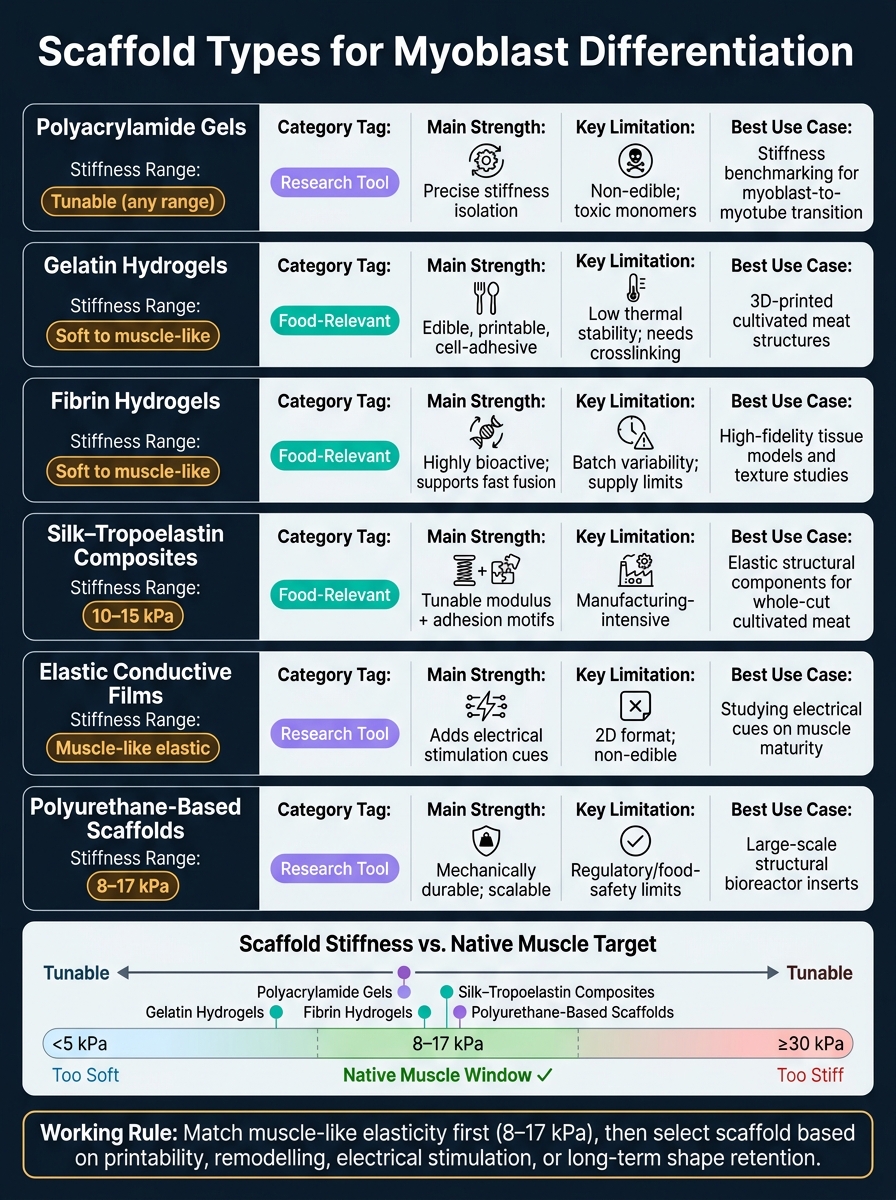
Scaffold Types for Myoblast Differentiation: Stiffness, Bioactivity & Food Relevance
| Scaffold type | Main role | Typical stiffness position | Main strength | Main limit |
|---|---|---|---|---|
| Polyacrylamide gels | Benchmark system | Tunable across ranges | Isolates stiffness effects well | Non-edible; needs protein coating |
| Gelatin hydrogels | Printed food-relevant scaffold | Often soft to muscle-like | Edible and print-friendly | Shape retention depends on process and crosslinking |
| Fibrin hydrogels | Fusion-supportive matrix | Soft to muscle-like | Cell-adhesive and remodelled by myoblasts | Supply and batch variation |
| Silk–tropoelastin composites | Aligned structural scaffold | Often 10–15 kPa | Tunable modulus plus adhesion motifs | More demanding to make |
| Elastic conductive films | Electromechanical test platform | Muscle-like elastic targets | Adds electrical cues | Often 2D and non-edible |
| Polyurethane-based scaffolds | Long-culture structural support | Tunable into 8–17 kPa window | Shape stability and modulus control | Needs surface treatment; food-use limits |
If I had to reduce the article to one working rule, it would be this: match muscle-like elasticity first, then choose the scaffold based on whether you need printability, remodelling, electrical stimulation, or long-term shape retention.
That framing makes the rest of the material comparison much easier to use in day-to-day scaffold selection.
1. Polyacrylamide Gels
Tunable Elasticity
PA gels offer tight control over substrate stiffness, which is why they are often used to study myogenic differentiation [2].
Myogenic Differentiation Outcomes
Polyacrylamide is not naturally cell-adhesive, so it needs to be functionalised with collagen or laminin to support cell attachment. If that step is skipped, cells detach and die [2]. In practice, that makes PA gels a clean system for testing how substrate stiffness shapes myoblast maturation [3][4].
Because PA gels let researchers isolate stiffness from other material cues, they are useful for comparing myogenic responses across different substrate moduli. In structured cultivated meat work, PA gels are used mainly as a stiffness-control benchmark, not as a scaffold for food structuring. That gives researchers a reference point when they compare PA gels with more biologically active scaffold materials.
2. Gelatin Hydrogels
Unlike polyacrylamide, gelatin brings biological cues as well as elasticity.
Material Profile
Gelatin hydrogels are a food-relevant biopolymer platform for supporting cell expansion and differentiation in cultivated meat [3].
Alignment and Architecture
Tendon-gel integrated bioprinting shows that gelatin scaffolds can align fibres into organised, whole-cut structures [3]. In plain terms, gelatin can help you build shape and guide tissue layout at the same time.
That said, this only works when printing preserves cell-friendly pore architecture. If the process drifts, the scaffold may hold its shape poorly or lose the internal features cells need. In myogenic bioprinting, geometry, rheology and print settings need to match; when they do not, structural fidelity drops [1].
Gelatin’s main strength is printability. Its weak point is tight process control.
3. Fibrin Hydrogels
Fibrin changes the discussion from printability on its own to matrix remodelling and support for cell fusion. Fibrin hydrogels provide a cell-adhesive, muscle-relevant matrix that supports myoblast attachment and fusion [2]. That makes fibrin a good fit when the scaffold needs to stay soft, but still has to support organised myotube formation.
Alignment and Architecture
Fibrin’s mechanical behaviour has a direct effect on cell organisation. Its compliance lets myoblasts remodel the matrix as they fuse, which helps support fibre alignment during differentiation [2]. In practice, the main question for fibrin is simple: can the scaffold remain soft enough for remodelling while still maintaining alignment through culture?
Suitability for Structured Cultivated Meat
Fibrin’s mix of remodelability and cell-adhesive behaviour makes it well suited to structured cultivated meat applications where both fusion and fibre organisation matter [3]. Its softness and biological activity work together to shape how well myogenic differentiation proceeds in a structured format - which is the central question this article addresses.
4. Silk–Tropoelastin Composites
Where fibrin depends on remodelling, silk–tropoelastin gives you tighter control over stiffness and alignment.
Silk–tropoelastin composites sit in the muscle-like stiffness window and combine structural support with bioactive adhesion sites. They bring together silk fibroin’s strength and tropoelastin’s elasticity, which means the modulus can be tuned by adjusting the silk fibroin:tropoelastin ratio. In practice, this is usually set in the 10–15 kPa muscle-like range [2]. The main draw is simple: one platform that offers both tunable modulus and adhesion motifs.
Myogenic Differentiation Outcomes
Tropoelastin’s cell-binding motifs improve myoblast adhesion and support earlier differentiation [2].
Alignment and Architecture
Fibre alignment is central to whole-cut structure [3]. Compared with gelatin, silk–tropoelastin offers a more precise route to muscle-like stiffness while still supporting aligned structure [3]. These composites can also be designed with controlled porosity and fibre alignment, which helps support aligned tissue formation.
Suitability for Structured Cultivated Meat
Silk–tropoelastin composites combine muscle-like stiffness, adhesion cues, and alignment control in a single scaffold platform. The main limitation is that mechanical tuning on its own does not provide electrical stimulation or conductivity.
sbb-itb-ffee270
5. Elastic Conductive Films
Compared with the previous scaffolds, elastic conductive films add electrical cues to a mechanically elastic platform. In plain terms, they don’t just tune stiffness. They also introduce electrical stimulation, which matters for muscle cell behaviour.
Myogenic Differentiation Outcomes and Alignment
Conductivity and elasticity both affect myogenic differentiation, cell alignment, and myotube formation. That sounds straightforward, but fabrication can trip things up fast. If scaffold geometry, ink rheology, and print settings aren’t matched well, the construct may keep its outer shape while losing pore structure and cell support [1].
That trade-off matters because pore architecture is not just a manufacturing detail. It helps determine whether cells can attach, spread, and organise in a way that supports muscle tissue development. Elastic conductive films aim to pair muscle-like elasticity with electrical signalling, while still fitting into the stiffness-based comparison used across the other scaffold types.
Suitability for Structured Cultivated Meat
This combination matters most when electrical cues cannot come at the expense of pore fidelity. For structured cultivated meat, elastic conductive films are useful because they can deliver both mechanical and electrical cues that influence myogenic differentiation, cell alignment, and myotube formation.
The hard part is fabrication. The scaffold has to keep its pore fidelity so it stays intact during culture [1].
6. Polyurethane-Based Elastic Scaffolds
Polyurethane (PU) scaffolds give you tight control over stiffness and hold their shape well over long culture periods. The trade-off is straightforward: PU usually needs surface modification before cells attach well. Compared with softer hydrogels and more bioactive composites, PU is less about built-in cell signalling and more about mechanical durability and precise modulus tuning. That makes it useful when scaffold stability matters just as much as myogenic differentiation.
Elastic Modulus Range
Native skeletal muscle sits around 8–17 kPa, so PU is most useful when tuned into that muscle-like window.
Myogenic Differentiation Outcomes
PU performance depends on modulus, viscoelasticity and surface chemistry. Those factors shape whether myoblasts attach, spread, fuse and move towards maturation. If the bulk mechanics are right but the surface is poorly prepared, cell response can still fall short. In practice, PU tends to work best when stiffness tuning is paired with a surface treatment that supports protein adsorption and adhesion.
Alignment and Architecture
PU scaffolds rely on controlled geometry and pore structure to guide alignment and keep the culture stable over time. In other words, the material gives you the mechanical backbone, but the scaffold design still does a lot of the heavy lifting. Fibre arrangement, pore size and overall architecture all affect how well cells organise into aligned muscle-like tissue.
Suitability for Structured Cultivated Meat
For structured cultivated meat, the main appeal of PU is that it can match muscle-like mechanics without giving up scaffold integrity. Cultivated meat scaffolds aim to improve texture, structure and culture performance [4]. Within the materials compared here, PU stands out as the most mechanically durable synthetic option. That makes it a strong fit where stiffness control and long-term structural stability are the top priorities, especially when the scaffold needs to keep its form throughout extended culture.
How Scaffold Elasticity Affects Myogenic Differentiation
1. Elastic Modulus Range
Myogenic differentiation is strongest on substrates that behave more like muscle. Go too soft or too stiff, and adhesion, remodelling, and maturation tend to drop off.
| Stiffness Range | Expected Biological Outcome | Suitability for Structured Cultivated Meat |
|---|---|---|
| Very soft (<5 kPa) | Poor myoblast adhesion; may promote adipogenesis in some stem cell populations [3] | Low - lacks structural integrity for final texture |
| Muscle-like | Supports myoblast adhesion, fusion and sarcomeric organisation | High - closest match to native muscle mechanics |
| Intermediate | Can support differentiation, but usually less effectively than muscle-like scaffolds | Moderate - often needs stronger architectural cues |
| Over-stiff | Less favourable for myogenic remodelling and maturation | Low - mechanical mismatch limits differentiation quality |
That said, modulus is only part of the story. The same stiffness can lead to different cell responses when adhesion chemistry or pore structure changes.
2. Myogenic Differentiation Outcomes
Primary myoblasts from pigs and cattle are anchorage-dependent, so they usually need to attach to a substrate to grow and differentiate well [2]. If you move these cells into suspension without prior adaptation, growth is often very slow or fails altogether [2].
NF2 loss has been reported to shorten porcine and bovine myoblast doubling times and support suspension adaptation, but there’s a trade-off: it can also increase adipogenic potential.
In practice, stiffness sensitivity becomes even more important when the scaffold also has to keep cells aligned through the fusion stage.
3. Alignment and Architecture
Modulus sets the starting point, but anisotropic architecture decides whether myoblasts line up into fibres. Anisotropic scaffolds, made through micropatterning or controlled 3D-printed pore geometry, guide myoblast orientation and can improve fusion index and myotube diameter.
There’s a simple but easy-to-miss point here: scaffold geometry and pore structure have to fit the ink rheology and print settings. If they don’t, the scaffold may keep its outer shape while losing the internal architecture needed for cell survival and tissue formation [1].
Across scaffold types, stiffness works alongside pore geometry and surface chemistry. It doesn’t act alone.
4. Suitability for Structured Cultivated Meat
Choosing a scaffold for structured cultivated meat means balancing muscle fibre organisation, fat co-culture compatibility, and final texture targets. Scaffolds with muscle-like mechanics can support fibre alignment and sarcomeric maturation, but they also need to make room for adipogenic cells when marbling is part of the product design.
That matters because NF2-modified adipose-derived stem cells show enhanced adipogenic potential and lipid accumulation [2]. In a co-culture setting, that can help shape the sensory profile of structured cultivated meat.
For structured cultivated meat, hitting the mechanical target isn’t enough by itself. The scaffold also needs to keep tissue organisation in place during culture.
Pros and Cons of Each Scaffold Type for Structured Cultivated Meat
No single scaffold comes out on top across every metric. In practice, each one trades off stiffness control, bioactivity, and scale-up potential.
The table below pulls those trade-offs into a simple selection guide for structured cultivated meat R&D.
| Scaffold Type | Comparative Advantage | Key Constraint | Best-fit Use Case in Cultivated Meat R&D |
|---|---|---|---|
| Polyacrylamide Gels | Precise stiffness control; benchmark only | Non-edible; toxic monomers | Determining optimal stiffness for myoblast-to-myotube transition |
| Gelatin Hydrogels | Edible, cell-adhesive, print-friendly | Low thermal stability; requires crosslinking for 3D structure | 3D-printed cultivated meat structures |
| Fibrin Hydrogels | Highly bioactive; supports fast fusion | Supply-limited; batch-to-batch variability | High-fidelity tissue engineering and small-scale texture studies |
| Silk–Tropoelastin Composites | Muscle-like, tunable, mechanically robust | Manufacturing-intensive | Elastic structural components for whole-cut cultivated meat |
| Elastic Conductive Films | Adds electrical cues for alignment and maturation | Non-edible polymers; 2D limitation | Studying the effect of electrical cues on muscle maturity |
| Polyurethane-Based Elastic Scaffolds | Mechanically durable, porous, scalable synthetic scaffold | Regulatory hurdles for food safety; non-natural degradation products | Large-scale structural support for non-edible bioreactor inserts |
A useful first cut is simple: is the scaffold a research tool or a food-relevant structural material?
Polyacrylamide gels are the classic case for a research-only platform. They let teams isolate stiffness effects with tight control, which makes them well suited for mapping the myoblast-to-myotube transition. But that’s where their role stops. They’re non-edible, and the toxic monomer issue takes them out of any product-facing workflow.
Gelatin and fibrin sit much closer to the product side because they’re edible and biologically familiar to cells. That matters. If the scaffold can stay in the final construct, you avoid the extra processing step that non-edible carriers bring. The catch is structure. Gelatin is print-friendly and cell-adhesive, but its low thermal stability means it usually needs crosslinking to hold a 3D form. Fibrin gives strong cell-level bioactivity and tends to support fast fusion, which is why it works well in high-fidelity tissue models and small texture studies, but supply limits and batch-to-batch variation can make it awkward for scale.
Silk–Tropoelastin composites, elastic conductive films, and polyurethane-based elastic scaffolds push harder on mechanics and function. Silk–Tropoelastin materials are useful when you want a more muscle-like elastic response and better mechanical strength, especially for whole-cut formats, though the manufacturing burden is not small. Elastic conductive films add electrical input to the system, which is handy when the goal is to study alignment and maturation under stimulation, but they remain a 2D, non-edible format. Polyurethane-based elastic scaffolds bring durability, porosity, and a route to larger-scale synthetic support structures, yet food-safety review and non-natural degradation products are hard limits for direct product use.
That’s the pattern across all six materials: the closer you get to tight experimental control, the more likely you are to give up edibility; the closer you get to food relevance, the more likely you are to run into limits in structure, supply, or process stability at scale.
Conclusion
Across all six scaffold types, one pattern keeps showing up: myogenic differentiation works best in a narrow stiffness range that sits close to native muscle tissue. Chemistry and scaffold architecture can tune that sweet spot, but they don’t cancel out the basic fact that myogenic cells respond very strongly to mechanical cues.
That mechanical window sharpens the main issue. It’s not just which material looks good on paper, but which scaffold type can hit that stiffness range in a food-relevant format. This is where the field splits most clearly: stiffness benchmark platforms are useful for isolating mechanical effects, while food-relevant scaffolds are the ones that must also support aligned muscle formation.
For product-led development, attention is moving towards scaffolds that can hold their structure and scale with fewer compromises.
The practical takeaway is straightforward: stiffness sets the baseline, but structure determines whether cells can make use of it. Elasticity on its own isn’t enough. It has to work alongside alignment, porosity and tissue composition.
In structured cultivated meat, the best scaffold is the one that matches the mechanical target, the architecture and the intended end use.
FAQs
Why is muscle-like stiffness important for myoblast differentiation?
Muscle-like stiffness matters because it mirrors the extracellular matrix that myoblasts experience in living animals. That mechanical match helps the cells contract and build the tension they need to differentiate and mature into muscle fibres.
Get the elasticity right, and the scaffold does more than just support cell attachment. It gives cells the physical signals that guide alignment and tissue organisation, which is key for building structured tissue with a texture closer to conventional meat.
How do pore structure and alignment affect muscle formation?
Pore structure and alignment in scaffolds give precursor cells physical cues that help drive differentiation into mature muscle fibres. When a scaffold mirrors the three-dimensional organisation of native tissue, cells are more likely to align, fuse, and form muscle structures with better function.
For structured cultivated meat, scaffold design matters. It plays a direct role in texture and nutritional density.
Which scaffold types are most suitable for structured cultivated meat?
For structured cultivated meat, the best scaffold options are edible or biodegradable materials built to mimic the 3D organisation of native animal muscle. That matters because structured products need more than cell attachment. They need a framework that helps place muscle, fat and connective tissue cells in the right spatial arrangement so the final tissue starts to resemble a real cut.
Microcarrier scaffolds can work well for ground products. But structured meat is a different job. It needs scaffolds that can support larger, thicker tissue architectures.


