

Monitoring cell density in real time is critical for improving cultivated meat production. Traditional methods, like trypan blue assays, are slow, prone to contamination, and often miss rapid changes in cell growth. Real-time measurement provides continuous data, enabling precise nutrient adjustments, early detection of issues, and consistent product quality.
Various analytical methods for live-cell monitoring include:
- Biocapacitance Sensors: Measure viable cells by detecting intact membranes. Scanning frequency systems reduce errors to 5.5–11%.
- Optical Turbidity Sensors: Track total cell density through light scattering but can't distinguish living from dead cells.
- RF Impedance Monitoring: Ideal for high-density systems, focusing on live cells in micro-carrier or immobilised setups.
- Raman Spectroscopy: Offers detailed chemical profiling, identifying viable cells and metabolites.
- NIR Spectroscopy: Tracks multiple parameters quickly but struggles with overlapping signals.
Each method has strengths and limitations, making calibration and validation essential for accuracy. Platforms like Cellbase can connect producers with tools tailored for cultivated meat processes. Real-time monitoring ensures better control, reduced waste, and optimised production efficiency.
Incyte Arc: Real-Time Viable Cell Density Monitoring for Smarter Bioprocess Control
sbb-itb-ffee270
Technologies for Real-Time Cell Density Measurement
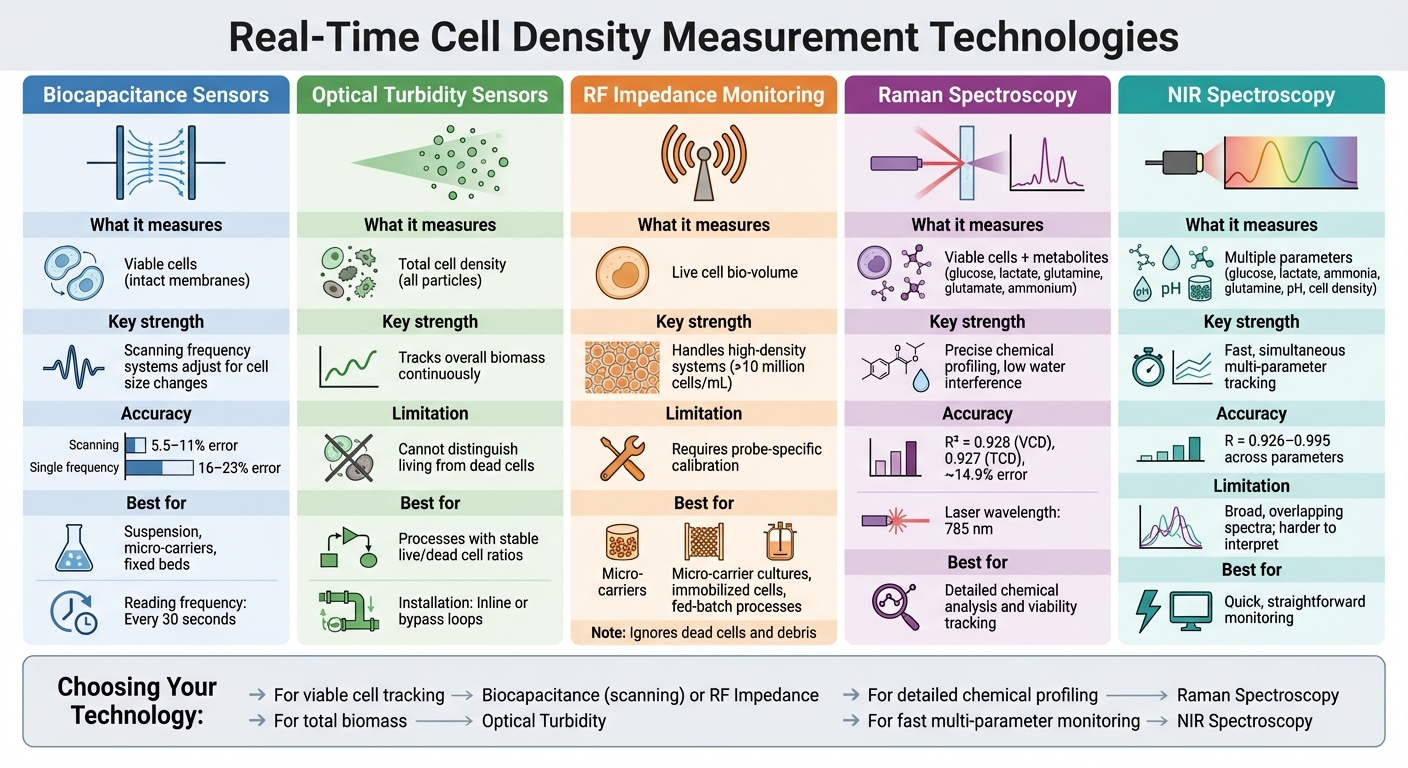
Real-Time Cell Density Measurement Technologies Comparison for Cultivated Meat
To meet the demand for continuous process feedback, various sensors for cultivated meat bioreactors now allow precise real-time measurement of cell density. Each method offers a unique approach, catering to either viable cells or total biomass, depending on the specific needs of the process.
Biocapacitance-Based Sensors
Biocapacitance sensors operate by applying an electric field to a cell suspension. Living cells, with intact membranes, act like tiny capacitors. Their membranes prevent ions in the cytoplasm from passing through, causing polarisation and creating a measurable charge. Dead cells, however, lack intact membranes and don’t contribute to the signal[1].
This technique relies on β-dispersion, where cells fully polarise at frequencies below 100 kHz, resulting in high permittivity. By scanning a range of frequencies (50–20,000 kHz) and applying multivariate analysis, these sensors can correct for changes in cell size. This adjustment reduces measurement errors from 16–23% to a much lower range of 5.5–11%[1].
To ensure accuracy, the probe must first be zeroed in sterile medium before inoculation, followed by calibration using the known concentration of cells at the start. Devices like the Aber FUTURA pico integrate seamlessly into bioreactors, providing fresh readings every 30 seconds. These sensors are highly effective for cells in suspension, attached to micro-carriers, or immobilised in fixed beds - scenarios where traditional counting methods often fall short[1][2].
For measuring overall biomass, optical methods offer another viable option.
Optical Turbidity Sensors
Optical turbidity sensors determine total cell density by measuring the light scattered by all particles in the culture, including living cells, dead cells, and debris. While these sensors cannot differentiate between viable and non-viable biomass, they are particularly useful when the ratio of living to dead cells remains stable throughout the process. Calibration involves correlating turbidity readings with offline cell counts at various stages of the culture. These sensors can be installed inline or in bypass loops, providing continuous monitoring to help determine the optimal harvest timing.
Radio-Frequency Impedance Monitoring
Radio-frequency (RF) impedance monitoring shares some principles with biocapacitance sensors, focusing on detecting cells with intact membranes while ignoring dead cells and debris[1][2]. This method is especially suited for systems involving immobilised cells or micro-carrier cultures, where offline sampling can be difficult. RF impedance can handle viable cell concentrations exceeding 10 million cells/mL in fed-batch processes, making it an excellent choice for high-density cultivated meat production[1]. For sourcing RF impedance probes and specialised monitoring equipment, platforms like Cellbase provide tailored options for cultivated meat bioprocessing.
| Technology | Measures | Key Strength | Limitation |
|---|---|---|---|
| Biocapacitance (Single Freq) | Viable Cell Volume | Simple implementation | Sensitive to diameter changes (16–23% error)[1] |
| Biocapacitance (Scanning) | Viable Cell Concentration | Adjusts for size shifts (5.5–11% error)[1] | Requires multivariate analysis |
| Optical Turbidity | Total Cell Density | Detects overall biomass | Cannot distinguish viable from dead cells[2] |
| RF Impedance | Live Cell Bio-volume | Works well with micro-carriers and fixed beds | Requires probe-specific calibration |
Spectroscopic Methods for Multi-Parameter Analysis
Spectroscopic methods take process monitoring to the next level by going beyond single-parameter measurements like those provided by capacitance and turbidity sensors. These techniques analyse how light interacts with molecules in the culture, offering real-time insights into not just cell counts, but also nutrient levels, metabolite concentrations, and other vital process variables. By creating detailed chemical profiles, they complement capacitance and turbidity sensors, providing richer data for better decision-making.
Raman Spectroscopy
Raman spectroscopy works by measuring the inelastic scattering of light. When a laser (commonly at 785 nm) hits a sample, the scattered light shifts in wavelength based on the chemical bonds of the molecules it encounters. This method's precise chemical profiling makes it possible to differentiate viable cells from dead ones and to identify individual metabolites such as glucose, lactate, glutamine, glutamate, and ammonium - all without disrupting the system[3][5].
One of Raman's key advantages is its low sensitivity to water, a common interference in infrared methods. This makes it particularly well-suited for the nutrient-rich environments found in cultivated meat production[3][5]. The technology can be implemented using fibre-optic immersion probes or by measuring through bioreactor viewports, ensuring sterility is maintained throughout the process[4][5].
Between 2010 and 2011, researchers at Bristol-Myers Squibb demonstrated the potential of in-line Raman spectroscopy in 500-L bioreactors. Using a Kaiser Optical Systems RamanRXN3 instrument, they developed calibration models with coefficients of determination (R²) of 0.928 for viable cell density (VCD) and 0.927 for total cell density (TCD). The average error was around 14.9%, comparable to the 10% error margin of the reference method itself[3].
"Raman spectroscopy... appears to be the most promising spectroscopic method for in-line analysis of complex cell culture systems." - Nicholas R. Abu-Absi, Process Sciences, Bristol-Myers Squibb[3]
To ensure accurate results, the system should be calibrated using offline data alongside PLS regression. Applying first derivative and SNV corrections can help reduce baseline shifts and fluorescence interference[3][4]. As new data becomes available, calibration models should be updated to account for variations between runs[3][4]. For cultivated meat applications, platforms like Cellbase provide access to specialised Raman probes and monitoring equipment tailored to these needs.
Near-Infrared (NIR) Spectroscopy
While Raman spectroscopy is excellent for detailed chemical profiling and distinguishing viable cells from dead ones, NIR spectroscopy offers quick and efficient multi-parameter tracking. By analysing overtones and combination bands, NIR detects analyte concentrations using a flow-cell or immersion probe with a fixed path length (typically 1.0 mm), which helps minimise water interference in the signal[6]. This technique can simultaneously measure glucose, lactate, ammonia, glutamine, pH, and cell density[6].
NIR systems primarily capture cell density signals through baseline effects caused by light scattering[6]. In studies with HEK293 cell cultures, NIR successfully tracked viable cell populations at densities of 8.5–9.0 × 10⁶ cells/mL, with correlation coefficients ranging from 0.926 to 0.995 across various parameters[6].
However, NIR spectra are broad and overlapping, making them harder to interpret compared to Raman. While NIR excels in speed and simplicity, it cannot match Raman's ability to differentiate viable from total cell density based on biochemical differences[3]. Ultimately, the choice between these methods depends on your specific needs: NIR is ideal for fast, straightforward monitoring, while Raman is better for detailed chemical analysis and viability tracking.
Validating and Correlating Real-Time Data
Correlation with Offline Analytical Data
Real-time sensors demand precise calibration using offline reference methods to ensure reliable data. For instance, single-frequency measurements are effective for tracking viable cell volume, thanks to their sensitivity to changes in cell diameter.
Frequency scanning, which measures permittivity across a broad range of frequencies (typically 50 to 20,000 kHz), offers a more nuanced approach. This data feeds into Multivariate Data Analysis (MVDA), allowing differentiation between changes in cell size and cell count. Accurate calibration is essential for maintaining production quality, especially when making real-time process adjustments. A notable example comes from October 2019, when researchers at Sartorius Stedim Biotech validated an inline capacitance probe in 250 mL bioreactors using CHO cells. They developed an Orthogonal Partial Least Squares (OPLS) model based on data from five standard fed-batch cultivations, scanning permittivity at 25 distinct frequencies. This approach enabled the model to predict viable cell concentrations (VCCs) exceeding 10 million cells/mL, with frequency scanning significantly reducing errors compared to single-frequency data [7].
"The model provided a prediction of VCCs with relative errors from 5.5 to 11%, which is a good agreement with the acceptance criterion based on the offline reference method accuracy (approximately 10% relative error) and strongly improved compared with single-frequency results (16 to 23% relative error)." – Springer Nature [7]
To further refine accuracy, applying a Savitzky-Golay filter (second order) helps minimise signal noise before comparison. Additionally, performing a one-point calibration at the inoculation stage enhances sensor precision [7]. These steps collectively lay the groundwork for reliable validation across diverse operational scenarios.
Validation Protocols
Once calibration is addressed, rigorous validation ensures the process remains dependable. One effective method is Leave-One-Batch-Out (LOB) validation. This involves creating multiple models by systematically excluding one batch from the training dataset and using it as a test set to evaluate predictive performance.
Robustness trials are another critical step. In the 2019 study, researchers introduced deliberate process deviations, such as a 30% dilution step and altered feeding strategies, to test the MVDA model's reliability under non-standard conditions. Even with these variations, the model delivered accurate predictions, with relative errors ranging between 6.7% and 13.2%. This level of reliability is particularly crucial for cultivated meat production, where process variability is common during scale-up.
Finally, set realistic acceptance criteria that align with the inherent 10% error margin of offline methods like trypan blue assays. Utilizing standardized cultivated meat inputs can further help stabilize these baselines. By establishing a 10% relative error threshold for real-time sensors, you ensure validation against a practical standard rather than chasing unattainable levels of precision [7].
Integrating Real-Time Monitoring into Process Control
Soft Sensor Model Development
Once calibration is set, the next crucial step is incorporating sensor outputs into process control. After validating real-time sensors, the focus shifts to developing soft sensor models. These models transform raw sensor data into actionable insights, often using algorithms like Partial Least Squares (PLS) or Orthogonal Partial Least Squares (OPLS). These methods help link complex online signals, such as multi-frequency capacitance scanning, to critical process metrics like viable cell concentration (VCC).
To build these models, you'll need paired online and offline data. Preprocessing steps - like mean-centring and scaling - are essential before training the model with standard cultivation data. A noteworthy example comes from Sartorius Stedim Cellca GmbH, where researchers used an Aber Instruments FUTURA pico probe with CHO cell cultures. Their predictive models achieved relative errors between 5.5% and 11%, a clear improvement over single-frequency measurements, which typically show errors ranging from 16% to 23% [7].
Deploying these models enables automated process adjustments. For instance, in cultivated meat production using micro-carriers or fixed beds, radio-frequency impedance sensors offer a unique advantage. They support dynamic nutrient feed and waste removal, based on viable cell volume. As John P. Carvell and Jason E. Dowd highlighted:
"RF Impedance is being used to monitor the concentration of live cells immobilised on micro-carriers or packed beds in cGMP processes where traditional off-line live cell counting methods are inaccurate or impossible to perform" [2].
This level of integration not only enhances process control but also sets the stage for meeting regulatory frameworks, which are explored next.
Alignment with PAT Frameworks
In cultivated meat production, combining real-time monitoring with Process Analytical Technology (PAT) and Quality-by-Design (QbD) principles ensures both regulatory compliance and operational efficiency. The process begins with identifying Critical Quality Attributes (CQAs) and Critical Process Parameters (CPPs). This requires cross-functional collaboration among R&D, quality assurance, and regulatory teams [8]. A phased approach works best: define clear objectives, select appropriate tools, conduct failure mode analyses, integrate with SCADA/MES systems, train staff, and scale up with validation [8].
For example, in January 2026, a global biopharmaceutical company successfully applied this PAT-integrated strategy during a technology transfer across continents. The results? Commercial-scale batch deviation rates under 2% and a 30% reduction in batch disposition timelines compared to earlier campaigns [8].
The move towards Continuous Process Verification (CPV) shifts the focus from retrospective testing to proactive, real-time control. Biocapacitance sensors, for instance, monitor viable cell density and growth kinetics while managing nutrient feeds. This approach not only meets CPV standards but also deepens process understanding [8]. Chemical and bioprocess engineer Akanksha Prasad summed it up well:
"PAT is no longer something that's merely nice to have. It has become the foundation for making next-generation medicines safely, efficiently, and at scale" [8].
This same principle applies to cultivated meat production. Consistent cell growth and product quality demand a rigorous approach to process control and compliance.
For those in the cultivated meat sector, platforms like Cellbase can be invaluable. They offer a trusted marketplace to connect with suppliers of specialised monitoring technologies and other essential tools, making it easier to adopt these advanced strategies.
Practical Considerations for Implementation
Choosing the Right Technology
Selecting the right monitoring system depends on your specific measurement goals. For instance, single-frequency capacitance sensors are often linked to Viable Cell Volume (VCV) rather than Viable Cell Concentration (VCC). This is because their signal reflects both cell numbers and changes in cell size, which can sometimes result in inflated readings - particularly when cells are under stress or ageing.
On the other hand, frequency-scanning systems measure capacitance across a range of frequencies (typically 50 to 20,000 kHz). These systems rely on multivariate models to separate changes in cell size from actual cell density, significantly reducing prediction errors compared to single-frequency systems.
Radio-frequency impedance remains a popular choice due to its affordability and its sensitivity to viable cells. Dead cells and impurities do not polarise, meaning they don't interfere with the signal. When deciding on a system, think about how easily it integrates with sterile bioreactor environments and whether it works with single-use vs reusable bioreactors. Advanced technologies, like Raman spectroscopy or frequency-scanning capacitance, require multivariate modelling approaches (e.g., OPLS or PLS) to interpret their complex data sets [7].
For cultivated meat producers, platforms such as Cellbase can help source verified suppliers of biocapacitance sensors, optical turbidity systems, and other specialised tools tailored for this industry.
Once you've chosen a system, accurate calibration and effective troubleshooting are key to maintaining reliable measurements.
Calibration and Troubleshooting
To ensure accurate readings, start by zeroing the capacitance probe in sterile medium before inoculation. This step ensures that only growth-related changes are detected. Then, perform a one-point calibration by aligning the online trajectory offset with your known inoculation cell concentration. For dependable predictions, train multivariate models using data from at least five standard cultivations to account for variations like different medium lots. Applying a Savitzky–Golay filter (second polynomial order) can help reduce signal noise and smooth out fluctuations. While online systems are powerful, daily offline measurements remain essential. If offline results deviate beyond a set threshold (e.g., 0.05 units for pH), recalibrate your online system [7].
Signal drift is another challenge, often caused by changes in cell diameter due to nutrient limitations, stress, or ageing. Multi-frequency scanning systems can address this by using multivariate analysis to account for these variations.
Offline reference methods, such as trypan blue assays, typically have a measurement error of about 10%. Rather than expecting zero deviation, validate your online system's accuracy against this margin. Additionally, implementing Batch Evolution Models (BEM) can help establish "golden batch" trajectories. These models act as automated alarms, flagging process deviations in real time [7].
Conclusion
Real-time cell density monitoring has evolved into a critical component of cultivated meat production. Continuously tracking viable cell concentrations offers clear advantages: cutting down on medium costs with automated feeding, quickly identifying process deviations, and minimising contamination risks. As one research team highlighted, "VCC is strongly linked to product titers and is considered process attribute, too. Monitoring the VCC enables process optimisation and control that leads to higher titers and efficient processes" [1].
Today’s technology landscape provides several reliable solutions. Among them, frequency-scanning systems combined with multivariate models stand out for delivering accuracy comparable to offline methods.
To implement these systems effectively, careful planning is essential. Success depends on robust calibration through multiple training runs and consistent offline verification.
For cultivated meat producers seeking cell line-specific monitoring tools, Cellbase connects you with trusted suppliers offering biocapacitance sensors, optical systems, and spectroscopic tools tailored to meet the unique challenges of cultivated meat production. The key lies in aligning the technology with your specific process - whether you’re managing cell growth in small development reactors or maintaining precision in large-scale production bioreactors. By integrating these tools, real-time monitoring not only addresses current production needs but also lays the groundwork for scaling up.
As operations grow, the value of real-time data increases. Batch Evolution Models enable you to define "golden batch" trajectories, automatically identifying deviations before they can impact product quality [1]. This shift turns cell density monitoring into a strategic asset for improving processes and reducing risks.
FAQs
Which sensor should I use for viable cell density vs total biomass?
Capacitance sensors are a great option for measuring viable cell density because they detect the capacitance generated by polarised cell membranes. This makes them directly tied to the presence of living cells, allowing for effective real-time monitoring.
That said, these sensors are not the best fit for measuring total biomass. Since they focus mainly on live cells, they don’t account for dead cells or the overall biomass. For viable cell density, though, capacitance sensors remain the go-to solution.
How do I calibrate and validate an inline capacitance probe?
To calibrate an inline capacitance probe, start by using known cell concentrations obtained from offline methods like cell counting. This allows you to match capacitance readings with actual cell numbers. Validation involves testing the probe under different cell densities and media conditions to confirm its accuracy and consistency. It's also crucial to perform regular calibration checks against offline measurements, particularly when scaling up production or altering media conditions. This ensures the probe continues to deliver reliable measurements of viable cell density.
How do I turn online signals into soft sensors for feed control?
To turn online signals into soft sensors for feed control in cultivated meat production, you can rely on real-time sensor data, such as capacitance frequency scanning. By processing these signals through multivariate models, you can estimate critical parameters like viable cell density.
Capacitance-based sensors play a key role here. They measure cell membrane capacitance, which directly reflects cell health. When these sensor outputs are integrated into control algorithms, it becomes possible to automate nutrient adjustments, maintaining ideal growth conditions throughout the process.


