

Maintaining precise temperature control is critical for distributing cultivated meat. Without heat-treatment to kill pathogens, strict cold chain monitoring ensures safety, quality, and compliance with regulations. Here's what you need to know:
- Temperature Ranges: Chilled meat must stay between 0°C and 4°C; frozen products require –18°C or lower. Export-grade items often need ultra-low temperatures below –29°C or cryogenic storage at –150°C.
- Regulations: The FDA's FSMA 204 rule mandates traceability within 24 hours. Automated systems help meet these requirements while reducing errors.
-
Monitoring Tools: IoT sensors, data loggers, and RFID systems each serve specific roles:
- IoT sensors provide real-time tracking for high-value shipments.
- Data loggers record transit conditions for compliance.
- RFID systems streamline warehouse inventory checks.
- Key Features to Look For: Accuracy (±0.5°C), real-time alerts, regulatory compliance (e.g., FDA 21 CFR Part 11), and integration with Warehouse Management Systems (WMS).
- Implementation Tips: Map critical control points, position sensors strategically, and test systems regularly to ensure reliability.
Cold chain monitoring isn't just about compliance - it's about protecting product integrity in a growing industry. Whether you're using IoT sensors for live updates or data loggers for audit records, choosing the right tools and maintaining them properly is non-negotiable for cultivated meat distribution.
How to Select Cold Chain Monitoring Tools
Temperature Requirements for Cultivated Meat
When choosing monitoring tools, start by determining the exact temperature ranges your product needs. For chilled cultivated meat, you'll need equipment that accurately tracks between 0°C and 5°C [6]. Frozen products, on the other hand, require reliable monitoring at –18°C or below [6]. For ultra-low temperature needs - such as cell banks or starter cultures - sensors must handle a range of –80°C to –150°C [2][5].
Precision is everything. Sensors should provide readings with an accuracy of ±0.5°C to ensure compliance and maintain safety [2][5]. Even a minor drift of 1°C can compromise product integrity. Calibration is another critical factor. While annual recalibration works for many products, high-risk cultivated meat often requires recalibration every six months [6].
Monitoring System Requirements
Accurate temperature tracking is only part of the equation. Your monitoring system also needs to handle data effectively. Real-time monitoring through Wi-Fi, cellular (4G/5G), or LoRaWAN connectivity enables immediate action if temperatures deviate - essential for preventing spoilage, as even brief fluctuations can promote bacterial growth [7][2]. Historical data logging is equally important for meeting FSMA and FDA compliance, offering a clear chain-of-custody record to verify temperature stability throughout distribution [3][2].
Regulatory compliance is non-negotiable. Look for tools that meet FDA 21 CFR Part 11 requirements for tamper-proof electronic records and audit trails [5][2]. EN12830 certification ensures reliable temperature performance for storage and transport [5][2]. Automated alerts via SMS or email are also crucial, allowing staff to respond promptly to any issues, 24/7 [5][6]. For seamless operations, opt for systems that integrate with your existing Warehouse Management Systems (WMS) using APIs, which help consolidate inventory data and simplify traceability [3][6].
"One of the most common mistakes in cold chain monitoring... is relying on manual, periodic checks rather than continuous, digitised, real-time monitoring." – Viktor Dlustus, Project Manager, Balloon One [6]
To ensure your monitoring system is a good fit, map out all critical control points from production to delivery. This will help you decide where real-time monitoring is essential and where historical data logging suffices [3]. Customise alert thresholds based on your product's specific sensitivity - whether chilled or frozen - to avoid unnecessary alarms while still ensuring safety [7][5]. By addressing these key factors, you'll be well-prepared to implement and validate an effective monitoring system.
Cold Chain Monitoring in Supply Chain, Logistics and Warehousing
Cold Chain Monitoring Tools for Cultivated Meat
Once you've outlined your specific needs, the next step is choosing the right monitoring tools. When it comes to cultivated meat distribution, three primary technologies are available: IoT sensors for real-time monitoring, data loggers for batch tracking, and RFID systems for inventory management. Let’s break down how each of these tools works and where they excel.
IoT Sensors for Continuous Monitoring
IoT sensors are your go-to option for real-time updates, especially when dealing with high-value shipments where quick action is crucial [9][10]. These devices use 4G/LTE networks to transmit data, ensuring constant oversight. For example, the Milesight TS60x monitors temperature, humidity, and GPS location, all while boasting a battery life of nearly five years [10]. With an impressive temperature accuracy of ±0.3°C within the critical range of –35°C to 0°C, they’re built for precision [10].
But these sensors aren’t limited to tracking temperature. They can detect light exposure (e.g., door openings), tilt and shock (indicating mishandling), and even atmospheric pressure [8][10]. For cultivated meat, it’s essential to pick sensors with external probes like PT100 or DS18B20, which measure the product's core temperature rather than just the surrounding air [10]. Many industrial-grade sensors are IP67-rated, making them waterproof and resistant to frost and condensation - perfect for deep-freeze environments [10].
"Routine data can wait. Risk can't. Normal readings are aggregated and reported at regular intervals for endurance, while temperature excursions, door openings, and tilt events trigger instant alerts." – Milesight [10]
A real-world example: In 2025, a health clinic used Monnit’s ALTA Low Temperature Sensors to protect vaccine storage. When the freezer temperature exceeded –70°C, the system sent an instant alert, allowing staff to transfer the vaccines to backup storage and avoid spoilage [5].
Data Loggers for Batch Monitoring
Data loggers are ideal for tracking environmental conditions over time, especially when real-time updates aren’t necessary [8][9]. These devices store data locally and come in two main types: USB-based loggers for manual retrieval and wireless versions that sync automatically at distribution hubs [8][9]. Many single-use USB loggers can record data for up to 180 days and have a two-year shelf life [5].
These tools are particularly useful for compliance, as they generate encrypted records in formats like PDF or CSV, documenting temperature stability throughout the shipment [5]. With the ability to store up to 5,000 entries, they also ensure no data is lost during temporary connectivity issues [10]. For cultivated meat shipments that need documented proof of temperature control without the added cost of live monitoring, data loggers are a practical choice.
For instance, a seafood distributor used Teltonika EYE Bluetooth sensors (accurate to ±0.5°C) in insulated containers. When an ice pack shifted and caused a temperature spike, the system alerted the driver, allowing them to take corrective action and save the shipment [5].
RFID Systems for Product Tracking
RFID technology offers a seamless way to gather data without breaking the thermal seal of a shipping container [8][11]. RFID loggers, like the Xsense RF HiTag™, can be read externally, ensuring the cold chain remains intact [8][12].
These systems are particularly effective in warehouses and distribution centres, where multiple pallets need to be tracked simultaneously. RFID tags integrated into smart packaging allow stakeholders to verify both location and temperature at every checkpoint without disrupting the cold chain [5].
"Xsense® is a state-of-art IoT cold chain monitoring system. It automatically collects, analyzes, and distributes to all supply chain stakeholders readings of ambient and core conditions, such as temperature, relative humidity, light exposure, shock, and other conditions." – Xsense Ltd [8]
Xsense systems, for example, use HiTag™ dataloggers paired with wireless gateways to monitor products throughout the supply chain - from storage and transit to last-mile delivery [12]. Many of these sensors also include NFC capabilities, allowing technicians to adjust settings via a smartphone without opening the device [10].
How to Implement and Validate Cold Chain Monitoring Systems
Setting Up Monitoring Systems
Begin by mapping out your entire cold chain, covering every warehouse, freezer, refrigerated lorry, and retail endpoint where cultivated meat is stored or transported [13]. After identifying these locations, focus on the Critical Control Points (CCPs) - these are high-risk areas like loading docks, transfer points between vehicles, and spots near heaters or windows where temperature fluctuations are more likely to occur [6].
Position sensors strategically - near doors, ceilings, and corners, but away from cooling vents - to capture accurate and representative temperature readings [6]. For connectivity, use Wi-Fi in fixed locations and rely on cellular networks (3G/4G/5G) or LPWAN for long-distance transport to ensure uninterrupted data transmission [13]. Set temperature thresholds based on the specific product requirements. For instance, frozen cultivated meat typically needs to remain at –18°C, with alerts triggered at –16°C to allow for quick corrective action. Finally, integrate your monitoring devices with cloud-based dashboards and Warehouse Management Systems (WMS) to connect temperature data with inventory and traceability records in real time [13]. These steps ensure comprehensive monitoring across the entire cold chain.
Testing and Validating System Accuracy
Once your system is installed, test its reliability by simulating potential failures. For example, you can mimic scenarios such as door openings, device disconnections, or even sensor tampering to verify that alerts are triggered as expected and that the system maintains accurate records [13]. High-risk products, like fresh cultivated meat, require sensors to be calibrated every six months rather than annually to ensure precise readings [6]. Additionally, conduct drills during quieter periods to confirm that staff can respond quickly to alerts, even when fewer team members are available [6]. This validation process is crucial, as failing to meet cold chain regulations can lead to severe consequences, including product seizures, fines, licence revocation, or even criminal charges [6].
Connecting Monitoring Data to Cloud Platforms
After validating your system, focus on integrating it with cloud platforms. These platforms consolidate data from IoT sensors, RFID tags, and GPS trackers into a single dashboard, offering a comprehensive overview of shipment conditions [7]. Use open communication protocols, such as MQTT or HTTPS, to ensure smooth interaction between hardware and software [7]. Devices should also be configured to store data locally during connectivity outages and automatically upload it once the connection is restored [7].
A practical example of this is Huel, a company that in 2025 adopted Körber WMS to achieve real-time traceability and maintain quality control. Under the guidance of Systems & Projects Director Liam Nicholson, Huel successfully linked real-time monitoring with inventory management, ensuring strict temperature standards for sensitive products [6]. Additionally, set up automated alerts via SMS, email, or app notifications for any threshold breaches, and establish clear escalation protocols to ensure timely responses to these alerts [7].
sbb-itb-ffee270
Comparison of Cold Chain Monitoring Tools
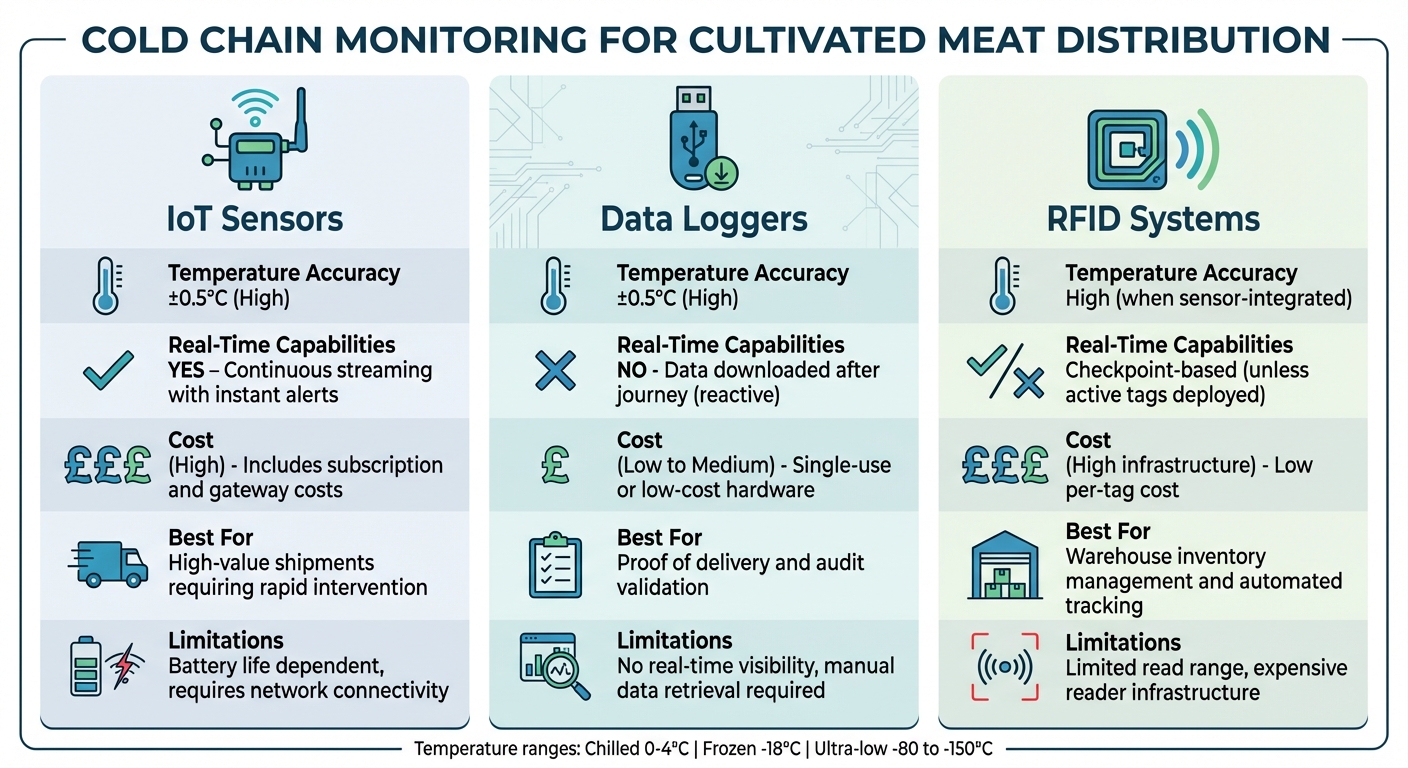
Cold Chain Monitoring Tools Comparison for Cultivated Meat Distribution
Comparison Table: IoT Sensors vs Data Loggers vs RFID Systems
Choosing the right monitoring tool depends on your distribution model, budget, and risk tolerance. Careful evaluation is essential to establish an efficient cold chain monitoring system for cultivated meat distribution.
| Feature | IoT Sensors | Data Loggers | RFID Systems |
|---|---|---|---|
| Temperature Accuracy | High (typically ±0.5°C) [5] | High (typically ±0.5°C) [5] | High (when sensor-integrated) [5] |
| Real-Time Capabilities | Yes; continuous streaming and instant alerts [4][5] | No; data downloaded after journey (reactive) [5] | Checkpoint-based, unless active tags are deployed [14][4] |
| Cost Range | High (£££) – subscription and gateway costs [4][5] | Low to Medium (£) – often single-use or low-cost hardware [5] | High infrastructure (£££) but low per-tag cost [4] |
| Applications for Cultivated Meat | High-value shipments; rapid intervention for sensitive cultivated meat [5] | Proof of delivery; validating temperature history for audits [5] | Inventory management; automated tracking in large warehouses [14][16] |
| Primary Limitations | Dependent on battery life and network connectivity [15][5] | No real-time visibility; requires manual data retrieval [5] | Limited read range; requires expensive reader infrastructure [4] |
This table highlights the strengths and weaknesses of each tool, but their individual roles in cultivated meat distribution deserve a closer look.
IoT Sensors are ideal for high-value shipments, offering instant alerts for even minor temperature changes. This real-time capability ensures quick intervention, preserving the quality of sensitive cultivated meat products.
Data Loggers, on the other hand, are a cost-effective way to maintain a temperature record. While they lack real-time monitoring, they’re excellent for proof of delivery and compliance audits, providing a detailed history of transit conditions.
RFID Systems shine in warehouse environments. They automate inventory tracking, minimise manual errors, and speed up stock checks. However, they require significant investment in infrastructure and are best suited for large-scale operations.
For sourcing these specialised tools, platforms like Cellbase connect buyers with verified suppliers, ensuring access to equipment tailored for cultivated meat production and distribution.
Sourcing Cold Chain Monitoring Tools via Cellbase
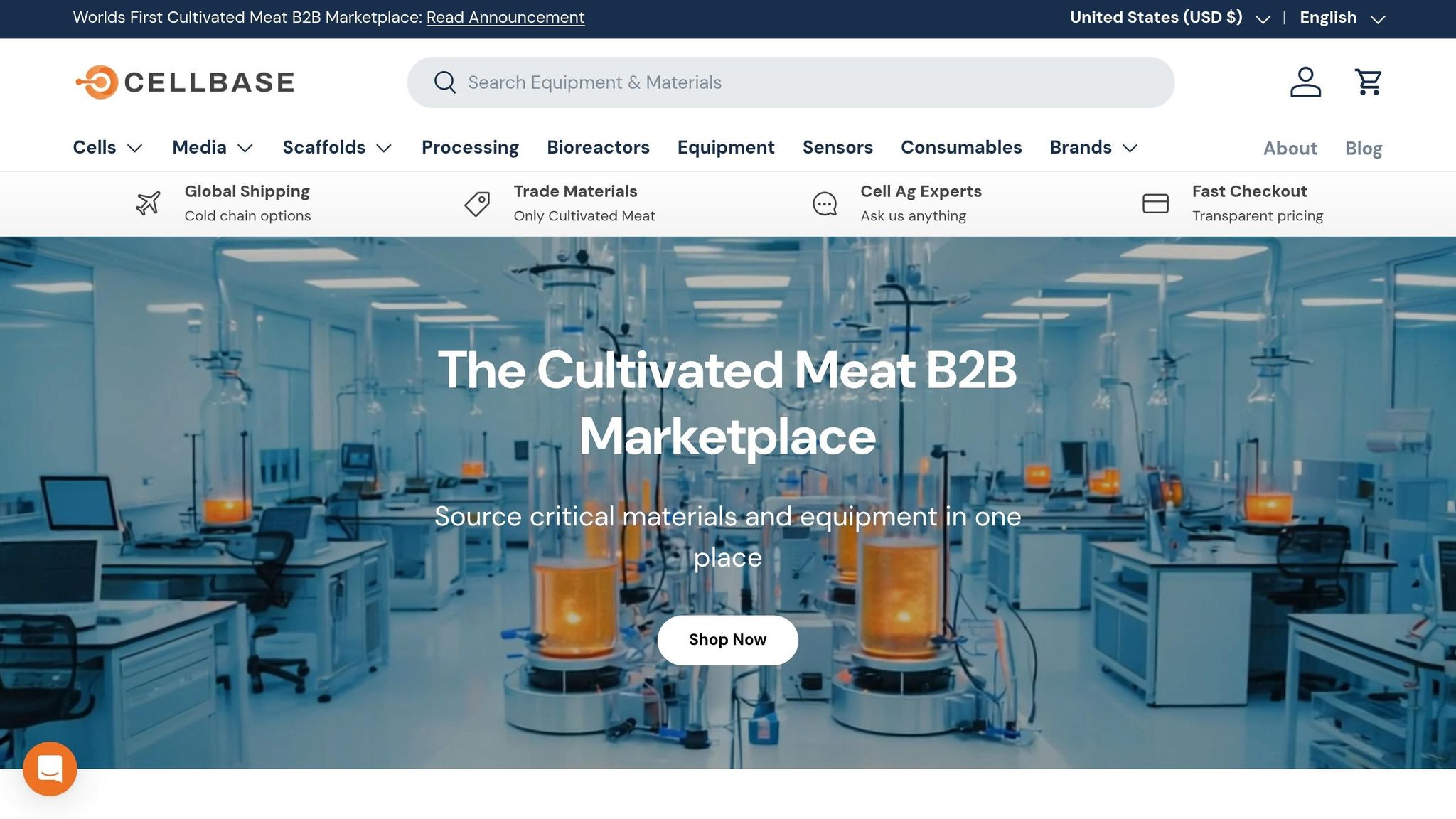
Once you've chosen the right monitoring tools, the next step is sourcing them efficiently. Traditionally, finding cold chain monitoring equipment for cultivated meat distribution meant dealing with multiple lab suppliers, chasing quotes, and ensuring compatibility with workflows. This process was essential to meet the strict demands of cultivated meat distribution [17]. Cellbase simplifies this by providing a dedicated B2B marketplace tailored specifically for cultivated meat. Every vendor on the platform is vetted to ensure their relevance to this unique industry [17].
Cellbase’s "Sensors & Monitoring" collection includes advanced systems designed for real-time tracking of critical parameters. These tools are essential for maintaining proper documentation during distribution [1]. With curated listings, procurement teams can easily compare specifications and make immediate purchases [17]. For current product pricing, check the relevant product pages on Cellbase [1].
"Automated monitoring reduces manual intervention whilst providing comprehensive data logging for regulatory compliance and process optimisation."
– Cellbase [1]
To streamline the selection process, Cellbase offers a use-case filtering feature. This allows buyers to pinpoint products that are either "commercial-ready" or suited for production-scale operations [17]. The monitoring tools available are compatible with standard bioreactor and incubation systems, ensuring seamless integration [1]. Additionally, the "Ask us anything" feature connects users with Cell Ag experts who can assist with sensor selection and technical queries [1].
Global shipping with cold chain options ensures that temperature-sensitive monitoring hardware arrives in perfect condition, ready for use within your distribution network [1]. This efficient sourcing process not only saves time but also helps maintain the integrity of your supply chain, making it easier to meet the demands of cultivated meat distribution.
Maintenance and Compliance Best Practices
Once your monitoring systems are in place, keeping up with maintenance and compliance is key to ensuring product safety and meeting regulatory standards.
Regular calibration and validation are essential for maintaining the accuracy of cold chain monitoring equipment. Schedule routine checks for sensors and data loggers - preferably with professional technical support - to avoid performance drift and ensure compliance with required documentation.
For cultivated meat distributors in the UK, adhering to food safety regulations is non-negotiable. The Food Standards Agency (FSA) and Food Standards Scotland (FSS) classify cultivated meat as "products of animal origin" (POAO). This classification means compliance with Regulation 852/2004 and Meat Hygiene Regulation 853/2004 is mandatory. A critical component of this compliance is implementing a Hazard Analysis and Critical Control Point (HACCP) plan. Such a plan should specifically address cold chain risks, pinpointing where temperature fluctuations might endanger product safety. The FSA plans to complete full safety reviews for at least two cultivated meat products by 2027 [20].
Automated data logging plays a big role here. It reduces the chance of human errors and creates tamper-proof records that align with GMP (Good Manufacturing Practice) standards. Dr Thomas Vincent, Deputy Director of Innovation at the FSA, highlights the importance of these standards:
"This guidance ensures that companies have assessed potential allergenic risks and that they are nutritionally appropriate before they can be authorised for sale. Consumers can be reassured that these innovative new foods will meet the same rigorous safety standards as conventional foods" [19].
Staff training is another vital piece of the puzzle. Employees responsible for monitoring and maintaining equipment should be trained to GMP standards. This includes understanding how to validate systems and manage documentation - especially important for cultivated meat, which doesn’t undergo heat treatment after distribution.
Detailed record-keeping is equally important. Maintain logs of equipment checks, calibrations, and validations. These records not only support audits but also help detect early signs of equipment wear. In October 2024, the UK government allocated £1.6 million to the FSA's Cell-Cultivated Products sandbox programme to support innovation in this space [18].
Conclusion
Cold chain monitoring plays a crucial role in the distribution of cultivated meat. With temperature fluctuations responsible for an estimated 20–30% of waste in perishable goods [21] and the absence of heat-treatment processes to eliminate pathogens [22], maintaining consistent temperature control is vital to ensure both safety and quality.
Choosing the right monitoring tools depends on your distribution needs. For example, IoT sensors with GPS and continuous temperature tracking are ideal for refrigerated lorries requiring round-the-clock monitoring. On the other hand, data loggers provide a cost-effective solution for shorter transport routes where batch monitoring suffices.
To ensure reliability, it's important to test systems against reference thermometers, calibrate sensors every 6–12 months, and conduct simulated transport trials [21]. Additional measures include incorporating geofencing alerts, training staff to use cloud-based dashboards in line with GMP standards, and maintaining digital audit records. These practices not only meet UK safety regulations (like HACCP) but also prevent human error through automated data logging, ensuring tamper-proof records for compliance.
Once your monitoring system is in place and validated, sourcing the right equipment becomes the next priority. For cultivated meat professionals, Cellbase offers a tailored B2B marketplace featuring verified suppliers and expert technical support. With a focus on cultivated meat, the platform provides equipment specifically designed to meet the sector's unique needs, ensuring seamless integration and calibration backed by industry knowledge.
FAQs
What else should I monitor besides temperature?
To ensure the quality and safety of cultivated meat, it's crucial to keep an eye on more than just temperature. Key factors like pH, dissolved oxygen, CO₂ levels, humidity, and, in some cases, glucose, biomass, and metabolites play a significant role. Using real-time sensors to track humidity and gases such as oxygen and CO₂ can help prevent spoilage and microbial growth. This kind of monitoring is essential for maintaining product integrity throughout the distribution process.
How do I choose between IoT sensors, data loggers and RFID?
To find the best tool for monitoring the cold chain in cultivated meat distribution, think about what matters most to your operations:
- IoT sensors: Perfect if you need real-time updates on temperature, humidity, or other environmental factors during transit.
- Data loggers: These are great for post-transport reviews, ensuring compliance by recording conditions throughout the journey.
- RFID: A solid choice for keeping tabs on product location and movement within the supply chain.
Your decision should align with whether your focus is on immediate monitoring, detailed documentation, or tracking logistics.
How do I validate and calibrate a cold chain system?
Validating and calibrating a cold chain system are key steps to maintaining precise temperature control throughout distribution. Calibration involves comparing devices, such as thermometers, against certified reference standards to verify their accuracy. On the other hand, validation examines the entire system under practical, real-world conditions to ensure it consistently operates within the necessary temperature limits. Performing these processes regularly is essential for safeguarding product quality and meeting compliance standards during the distribution of cultivated meat.


