

Ensuring your cultivated meat staff meet GMP standards is essential for product safety, regulatory compliance, and smooth production. This process requires targeted training, competency assessments, and thorough documentation. Here's how you can get started:
- Core Training: Teach staff GMP principles, hygiene protocols, aseptic techniques, and contamination prevention.
- Role-Specific Training: Tailor programmes to different job functions, such as bioreactor operation or quality control.
- Competency Assessments: Use written tests and hands-on evaluations to confirm knowledge and skills.
- Documentation: Maintain detailed training logs and audit-ready records for regulatory compliance.
- Ongoing Training: Schedule regular requalification and update training for regulatory changes.
- Tracking Systems: Implement digital tools to monitor qualifications and requalification deadlines.
With structured programmes and proper oversight, you can minimise risks like contamination or cell line instability while meeting regulatory requirements, including Regulation (EC) 853/2004.
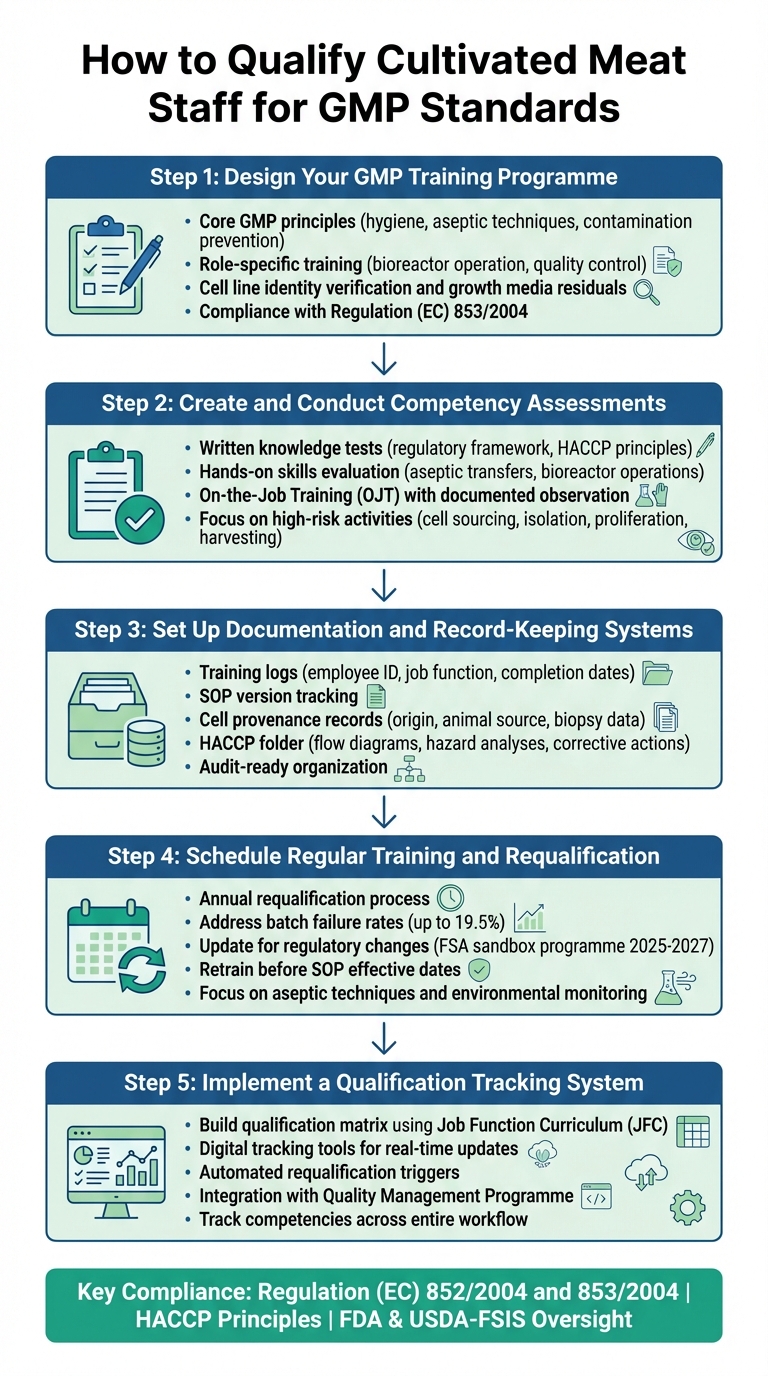
5-Step Process to Qualify Cultivated Meat Staff for GMP Standards
What is GMP? | Good Manufacturing Practices in Food Industry | SafetyCulture
Step 1: Design Your GMP Training Programme
Creating a structured training programme starts with the core principles of GMP that all staff must grasp, no matter their role. According to GMPSOP, initial training should include essential regulations, health and hygiene practices, documentation processes, and the core values that support GMP compliance [5]. For cultivated meat facilities, this foundation must also incorporate aseptic techniques and contamination prevention throughout the entire cell lifecycle - from sourcing starter materials to manufacturing, testing, storage, and distribution [3].
The specific requirements of cultivated meat production mean your training must also address cell line identity verification, growth media residuals, and hazards unique to bioprocessing [1]. Unlike traditional meat production, where slaughter can mitigate pathogen risks, cultivated meat relies entirely on contamination control at every stage of cell culture. The sections below outline these principles and show how they can be adapted for different roles within your facility.
GMP Principles and Fundamentals
To meet the requirements of Regulation (EC) 853/2004 in the context of cultivated meat, your training programme must ensure staff are proficient in hygiene protocols, gowning procedures, and cleanroom behaviour before they enter production areas. Since cultivated meat is classified as a Product of Animal Origin (POAO), the training must align with specific hygiene standards while recognising the unique challenges of working with living cells [1]. This includes understanding how to prevent microbial contamination during critical stages like cell isolation and proliferation, where conventional food safety measures may fall short.
Employees must become skilled in hygiene practices, gowning, and rigorous documentation to satisfy Regulation (EC) 853/2004. Documentation in cultivated meat facilities goes beyond standard record-keeping - staff must meticulously record details about cell isolation and proliferation, creating a clear audit trail for regulatory inspections. As GMPSOP highlights:
"GMP sites must comply with GMP requirements for training by defining the knowledge, skills and attributes colleagues must have to competently perform GMP tasks and other activities" [5].
Customised Training for Different Roles
Once core GMP competencies are established, training should be tailored to specific job functions. A one-size-fits-all approach doesn’t work in cultivated meat facilities, where responsibilities vary greatly. A Job Function Curriculum (JFC) offers a solution by providing a customised list of SOPs, on-the-job training, and role-specific topics [5]. For instance, a bioreactor operator needs practical training in aseptic transfer techniques and equipment operation, while a quality control analyst requires expertise in cell line characterisation and analytical testing protocols.
It’s also essential to differentiate between knowledge-based training for supervisory roles and "Skill/Performance" training for those performing hands-on tasks [5]. For example, a production supervisor overseeing cell harvesting procedures needs theoretical training to provide effective oversight. On the other hand, the technician carrying out the harvest must demonstrate their competence through observed, documented on-the-job training. This tiered approach ensures that the depth and intensity of training correspond to the level of risk each role poses to product quality.
Step 2: Create and Conduct Competency Assessments
Once your training programme is in place, the next step is to assess your staff's knowledge and practical skills in GMP standards. This involves using written tests to evaluate theoretical understanding and direct observation to assess on-the-job performance. These assessments should build on the tailored training provided for different roles, ensuring that employees can both recall and apply GMP procedures effectively. For cultivated meat, the Food Standards Agency highlights the need to address specific hazards such as cell line identity, consistency, divergence, and residual growth media in the final product [1].
By combining theoretical and practical assessments, you create a well-rounded evaluation system. For example, understanding aseptic techniques on paper doesn't always translate to maintaining sterility during real-world tasks, like transferring cells between bioreactors under pressure. This dual approach strengthens your training programme and ensures thorough documentation and readiness for regulatory inspections.
Written Knowledge Tests
Written tests are a great starting point for assessing foundational GMP knowledge. These tests can verify that employees understand the regulatory framework for cultivated meat, including its specific hygiene requirements [1]. They are particularly useful for evaluating information that staff need to perform or oversee tasks routinely. As GMPSOP explains, assessments can include written, verbal, or computer-based formats, as well as case studies and simulations [5].
For cultivated meat production, it’s crucial to test knowledge of risks like cell line divergence, a key safety concern. Questions should also cover HACCP principles and Critical Control Points, especially during cell proliferation and harvesting stages [1]. Scenario-based questions can be particularly effective, such as asking employees to identify the correct response to bioreactor contamination detected during monitoring.
Tailor your test questions to address challenges specific to your facility. For instance, if your site has struggled with recurring issues in cell line handling or documentation, include questions that target these areas [5]. When new or updated Standard Operating Procedures (SOPs) are introduced, written tests can confirm that employees understand the changes before they are implemented. Don’t overlook foundational topics like cleaning protocols, personal hygiene, and waste management - these are essential for supporting HACCP-based systems [1].
Hands-On Skills Evaluation
Practical assessments are essential for verifying that employees can perform GMP tasks correctly in a production setting. These evaluations involve observing staff as they carry out specific tasks in line with your SOPs [5]. In cultivated meat production, this might include monitoring technicians as they perform aseptic transfers, operate bioreactors under sterile conditions, or harvest cells without introducing contamination.
On-the-Job Training (OJT) is a key component of hands-on assessments. This one-on-one approach allows trainers to observe employees performing tasks and assess their skills against predefined criteria. According to GMPSOP, this process includes "a witnessed and documented activity" where a colleague demonstrates their ability to perform a specific task or skill outlined in an SOP [5]. Competence is only confirmed when the employee meets all criteria, with proper documentation to support the assessment.
Focus your practical evaluations on high-risk activities that directly impact product quality. For cultivated meat, this includes critical stages like cell sourcing, isolation, proliferation, and harvesting, where microbial contamination poses significant risks [1]. Before diving into complex tasks like bioreactor operations, ensure staff are proficient in basic hygiene practices such as gowning, cleanroom behaviour, and equipment sanitisation. Assign experienced trainers who are not only skilled in performing these tasks but also capable of evaluating others’ performance to the required standard [5].
Step 3: Set Up Documentation and Record-Keeping Systems
Once competency assessments are complete, having a solid documentation system in place is crucial to prove staff qualifications and compliance with GMP standards.
Good documentation sets apart a training programme that can withstand regulatory scrutiny. Records must clearly demonstrate that every individual performing GMP-related tasks has completed the necessary training before working independently. As GMPSOP highlights: "Training records or reports must be readily available to substantiate that all employees performing GMP Related functions have completed the training requirements" [5]. In cultivated meat production, this documentation is especially critical for meeting hygiene regulations, such as Regulation (EC) 852/2004 and 853/2004 [1][2].
Training Log Management
Your training log system should capture key details for every employee, including their name, ID, job function, and the assigned Job Function Curriculum (JFC) covering all required training. This includes SOPs, on-the-job training, and role-specific topics. For SOP training, the log must detail the SOP title, version number, completion date (which must always be before the effective date of any new or updated procedure), and the trainee's signature. It should also document outcomes of written tests (Level II) and practical evaluations (Level III), as well as any training exemptions [5]. For cultivated meat, ensure the logs cover essential areas like cell sourcing, isolation, proliferation, and the management of growth media and residual components [1].
Prepare Documentation for Audits
To ensure smooth inspections, organise records so they can be retrieved quickly. Establish a formal system for creating, filing, and archiving training documentation [5]. All training materials and assessment tools should be approved by both Site Quality and Production leadership. Assign a Training System Owner to oversee compliance with documentation standards [5]. For cultivated meat production, audit-ready documentation should include personnel records and cell provenance tracking, detailing information like cell origin, animal source, supplier details, and biopsy data [4]. This is especially important because, as of late 2025, there are no standardised procedures for managing cell banks in cultivated meat production [4]. Additionally, your HACCP folder must contain flow diagrams, hazard analyses, monitoring procedures, and records of any corrective actions [1]. The Food Standards Agency advises: "Establish documents and records commensurate with the nature and size of the food business to demonstrate the effective application of the [safety] measures" [1].
sbb-itb-ffee270
Step 4: Schedule Regular Training and Requalification
Maintaining GMP compliance is an ongoing process. As regulations and processes evolve, it’s essential to refresh staff qualifications regularly and keep a close eye on your training system. This includes consistently reviewing individual Job Function Curriculums to ensure all training materials stay up to date [5]. For cultivated meat production, this is especially important due to the industry’s emerging nature and its ever-changing regulatory environment.
Annual Requalification Process
The frequency of requalification may vary between sites, but most GMP systems include periodic "GMP Concept Training" to reinforce understanding and proper application of standards [5]. Annual sessions should be tailored to your facility’s specific needs, incorporating data like contamination incidents or audit findings to address areas requiring improvement. For cultivated meat operations, where batch failure rates can reach up to 19.5% [7], retraining efforts should focus on aseptic techniques and environmental monitoring.
Beyond these annual refreshers, requalification should also be triggered by any changes to products, processes, or SOPs. Training must be completed before the updated SOP’s effective date [5]. To quote the Food Standards Agency:
"When any modification is made in the product, process, or any step, food business operators shall review the procedure and make the necessary changes to it" [1].
For example, if a new bioreactor cleaning protocol is set to take effect on 15 March, all relevant staff must complete their training and demonstrate competency before that date. These regular refreshers, combined with updates for regulatory changes, ensure compliance is always up to standard.
Update Training with Regulatory Changes
In addition to annual requalification, it’s important to update training programmes to reflect changes in regulatory requirements. The cultivated meat industry operates within a complex and evolving regulatory framework. In the UK, for instance, cultivated products are classified as Products of Animal Origin (POAO) and must adhere to hygiene regulations under Regulation (EC) 852/2004 and 853/2004 [1]. Training programmes should be adapted to meet these standards and incorporate initiatives like the FSA's sandbox programme, which will run from 2025 to 2027 [1].
Staff must also understand the broader regulatory landscape. For companies operating internationally or sourcing materials from the US, it’s crucial to be familiar with the joint oversight model. In this system, the FDA oversees cell collection, banking, and cultivation, while the USDA-FSIS handles harvest, processing, packaging, and labelling for livestock, poultry, and catfish [6][8]. As the industry moves towards antibiotic-free production and the use of food-grade materials, retraining on stricter aseptic techniques will also be necessary [7].
To ensure smooth transitions, schedule updates in advance, notify employees promptly, and arrange mandatory make-up sessions for anyone who misses the initial training [5]. This proactive approach keeps your team prepared for regulatory shifts and operational changes.
Step 5: Implement a Qualification Tracking System
Once your training programmes are in place, assessments are complete, and documentation is organised, the next step is to implement a reliable qualification tracking system. This system ensures that staff qualifications and requalification deadlines are monitored effectively. For cultivated meat facilities, where production involves intricate processes like cell sourcing and harvesting, this kind of oversight is essential. It ties together training, assessments, and audit readiness, ensuring compliance runs smoothly across your entire production chain.
Build a Qualification Matrix
The qualification matrix is an extension of the tailored training programmes discussed earlier. It provides a detailed breakdown of role-specific competencies, using the Job Function Curriculum (JFC) as a guide [5]. The JFC outlines all the necessary training - Standard Operating Procedures (SOPs), on-the-job training, and GMP principles - that must stay up to date. For cultivated meat production, the matrix should cover the entire workflow, including cell line management, proliferation techniques, growth media handling, harvesting, and storage protocols [1].
Your matrix should also categorise training into different levels of depth. For instance:
- Communication training: Focuses on general awareness.
- Knowledge training: Provides the information required for routine oversight.
- Skill/performance training: Involves hands-on tasks with competency assessments [5].
For example, a quality assurance manager might need knowledge-level training on bioreactor operations, while a production technician would require skill-level training, complete with documented assessments. This approach ensures that your training aligns with HACCP documentation requirements [1].
Use Digital Tracking Tools
While manual records can work for smaller teams, digital tracking tools are much more efficient as operations grow. These tools not only automate record-keeping but also provide real-time updates on training statuses and alert you to upcoming requalification deadlines [5]. Integrating these tools into your Quality Management Programme ensures comprehensive coverage of the production lifecycle [3]. In cultivated meat facilities, digital systems can track staff proficiency in handling unique challenges like novel allergens, growth media residues, and microbial contamination risks [1].
One key feature of digital tools is the ability to set automated requalification triggers. For example, if there’s a change to a product, process, or SOP, the system can automatically flag the relevant team members for retraining [1]. This ensures compliance with Regulation (EC) 852/2004, which mandates food businesses to maintain procedures based on HACCP principles [1]. Tools like the FSA’s MyHACCP can complement your system by helping manage food safety records alongside training logs [1].
Conclusion
Ensuring staff meet GMP standards in cultivated meat production is a cornerstone of regulatory compliance, product safety, and market readiness. Each step in the process builds a framework that safeguards these critical elements. As highlighted by Best Practice & Research Clinical Haematology, "Implementing current Good Manufacturing Practice (GMP) regulations and principles even in early phases of cell-based therapy studies is crucial for ensuring safety and reproducible quality of these products" [3].
The cultivated meat industry faces unique challenges, particularly in managing biological and chemical risks across all stages of production. The stakes are high, and initiatives like the FSA regulatory sandbox programme have enabled companies such as Mosa Meat, BlueNalu, and Roslin Technologies to influence the development of future safety standards [2]. To stay competitive and compliant, it’s essential that internal training programmes align with these evolving requirements.
Adopting standardised practices benefits more than just regulatory approval; it also streamlines the path to market. According to FSA Research and Evidence, "Standardising such methods might also make product approval processes easier, so cultivated meat products can come to market quicker" [4]. However, as of late 2025, there are no globally standardised rules for managing cell banks in cultivated meat production. Establishing these practices is crucial for integrating training and procurement seamlessly into your operations.
A strong qualification programme also depends on sourcing the right materials and equipment. Cellbase plays a key role here, connecting cultivated meat companies with GMP-compliant growth media, bioreactors, cell lines, and analytical tools through its specialised B2B marketplace. This ensures that procurement aligns with the rigorous standards your trained workforce must uphold, reinforcing the integrity of your entire operation.
FAQs
What does 'competent' mean for GMP roles in cultivated meat?
Being prepared for GMP roles in cultivated meat involves having the right training, skills, and knowledge to meet GMP standards. This means being familiar with quality systems, recognising contamination risks, and understanding regulatory requirements. These expectations are detailed in guidelines related to personnel qualifications and training systems. Ensuring staff are well-trained is crucial for staying compliant and maintaining high production standards in cultivated meat facilities.
How often should GMP requalification take place?
Requalification under GMP guidelines should follow intervals set by thorough risk assessments. Generally, a two-year cycle is recommended. However, certain equipment, such as tablet presses, might justify extending this to three years based on their specific use and processes. It's crucial to tailor requalification schedules to meet both operational demands and regulatory requirements.
What training records do inspectors expect to see first?
Inspectors often examine training records to confirm that personnel have completed the required GMP (Good Manufacturing Practice) training. These records should clearly reflect employees' understanding, skills, and abilities relevant to their specific responsibilities. It's essential to ensure all training is thoroughly documented and shows adherence to GMP requirements.


