

Model Predictive Control (MPC) is transforming how bioreactors are managed, especially in cultivated meat production. Unlike PID systems, which react to changes after they occur, MPC predicts future behaviours, allowing precise adjustments in real-time. This proactive approach reduces variability, improves product yields, and ensures consistency even at large scales.
Key takeaways:
- MPC vs PID: MPC reduces glucose tracking errors by 5.1% and improves protein yields by 3.9% compared to PID systems.
- Challenges with PID: PID struggles with nonlinear biological processes, delays, and changing conditions, often resulting in oscillations or inefficiencies.
- MPC Benefits: Handles disturbances, optimises yields, and supports scalability by integrating advanced monitoring tools like Raman spectroscopy.
- Implementation Hurdles: MPC requires accurate models and higher computational resources, but techniques like adaptive tuning and input blocking help address these challenges.
For cultivated meat producers, MPC offers a robust way to manage complex bioprocesses, ensuring better control over nutrient levels and byproduct formation. While PID remains an option for simpler tasks, MPC is increasingly the preferred choice for scalable, high-performance systems.
1. Model Predictive Control (MPC)
Performance Under Disturbances
MPC uses mathematical models to predict future behaviour, allowing it to adjust control variables in real-time. This makes it particularly effective in bioreactors dealing with fluctuating inlet feeds, sensor noise, and delays in measurement.
In 2021, researchers from the Illinois Institute of Technology and Amgen tested MPC's ability to handle disturbances. They found it improved glucose tracking by 5.1% compared to traditional proportional-integral (PI) control when managing variations in glucose and glutamine concentrations [2]. Earlier, in 2014, Brian Glennon’s team applied Nonlinear Model Predictive Control (NMPC) to a 15-litre pilot bioreactor using CHO 320 mammalian cells. By integrating Kaiser RXN2 Raman spectroscopy for glucose monitoring every six minutes, NMPC maintained a stable 11 mM glucose set-point despite significant process variability and sensor noise [3].
Newer MPC strategies continue to push boundaries. In March 2026, Lipe Carmel and Giacomo Sartori introduced a Multi-Inflow Control (MIC) strategy for Corynebacterium glutamicum fermentations. Their approach, which simultaneously adjusted nutrient input and dilution rates, reduced overshoot by 78.0% when tracking biomass setpoints of 7.0, 13.0, and 15.7 g/L in a single run [6].
These proactive adjustments not only stabilise key variables but also pave the way for better overall yield.
Optimisation of Yields
MPC shifts the focus from simply maintaining intermediate setpoints to maximising final batch outcomes. This is crucial for cultivated meat production, where achieving consistent, high-quality results at scale is a major challenge.
For example, Mudassir M. Rashid's team showed that a critical quality attribute predictive control algorithm boosted product concentration by 3.9% at the end of the run compared to conventional methods [2]. Similarly, incorporating machine learning models into MPC systems has led to over a 2% improvement in final protein production compared to historical averages [1].
While the results are promising, implementing MPC comes with its own set of challenges.
Ease of Implementation
Despite its advantages, deploying MPC in cultivated meat production requires overcoming significant hurdles. The system's effectiveness relies on accurate mathematical models that capture the complexities of bioreactor dynamics. As Touraj Eslami and Alois Jungbauer explain:
"The effectiveness of any feedback design is fundamentally limited by system dynamics and model accuracy" [8].
Nonlinear models, while powerful, demand high computational resources and can cause delays in real-time optimisation [8]. Additionally, Nonlinear MPC's non-convex optimisation can lead to local minima, compromising performance if not properly initialised [3]. Konstantins Dubencovs and colleagues highlight its practical utility:
"MPC is practically the only method that can provide the use of mathematical models in the control of biotechnological processes using standard PC equipment" [4].
Adaptive MPC strategies offer solutions by automatically tuning controller parameters to address biological variability [4] [5]. Integrating Process Analytical Technology (PAT), such as Raman spectroscopy for frequent monitoring, reduces the need for specialised computing infrastructure [8] [3]. Techniques like 'input blocking', which groups the time horizon into blocks, also help manage computational load [8].
Scalability for Cultivated Meat Production
MPC’s ability to manage disturbances and optimise yields makes it a strong candidate for scaling up cultivated meat production. It has already proven itself in biopharmaceutical and microbial processes, where it meets stringent process constraints [1]. For large-scale operations, MPC tackles challenges like mass and heat transfer by adjusting substrate feeds to ensure proper mixing, oxygen levels, and cooling [5].
The benefits are clear: feedback-based nutrient control has increased monoclonal antibody titres by 1.7-fold, while predictive strategies have prevented 4.5–10% product losses over 30 days [3] [7]. Brian Glennon aptly summarises the current state:
"Control of bioprocesses is in its infancy in comparison to the chemical and traditional pharmaceutical sectors... due in part to the challenges associated with bioreactor control: poor process understanding [and] the lack of measurement of relevant process parameters" [3].
Even with these challenges, integrating machine learning into MPC forecast models offers a way forward. These advancements help compensate for the absence of high-fidelity first-principle models, making MPC increasingly suitable for the complex demands of cultivated meat production [1]. For companies in this space, platforms like Cellbase (https://cellbase.com) provide a marketplace to access the tools and expertise needed to adopt advanced control strategies effectively.
2. PID Control and Other Traditional Methods
Performance Under Disturbances
While Model Predictive Control (MPC) excels at anticipating changes, traditional PID (proportional-integral-derivative) controllers have notable drawbacks. PID controllers, widely used in biotech, operate reactively, meaning they only respond after deviations occur. This reactive approach struggles with the nonlinearity and time-dependent nature of biological processes, making PID less effective in such settings [5][9].
A key issue is that PID systems with fixed tuning parameters often fail to maintain stability when process dynamics shift significantly during a cultivation cycle [5]. For example, in mammalian cell cultures, measurement delays - sometimes as long as 24 hours - further reduce PID’s effectiveness [3]. These delays prevent timely adjustments, leading to oscillations or static errors in highly non-linear environments [3].
The performance gap between PID and MPC is backed by data. In a 2021 study by Mudassir M. Rashid, Satish J. Parulekar, and Ali Cinar, PID systems showed a 5.1% higher tracking error for glucose concentration set-points compared to MPC under conditions of unknown disturbances and measurement noise [2]. Additionally, PID signals are often distorted by bioreactor noise from aeration, foam, and mixing processes [5].
Optimisation of Yields
One of PID’s core challenges is its inability to predict metabolic shifts or adapt to changes in critical substrate concentrations. This limitation often leads to issues like "overflow metabolism", where excess substrate results in inhibitory byproducts such as acetate in E. coli or lactate and ammonia in mammalian cells [5].
In mammalian cell cultures - key to cultivated meat production - traditional feeding methods fail to maintain the low nutrient concentrations needed to avoid these byproducts. For instance, controlling glucose and glutamine levels at 0.3 mM and 0.5 mM, respectively, can significantly reduce inhibitory byproducts, cutting ammonia by 74% and lactate by 63% [3]. However, achieving this level of precision is beyond the capabilities of standard PID systems.
Brian Glennon encapsulates the challenge:
"Control of bioprocesses is in its infancy... due to the challenges associated with bioreactor control: poor process understanding, the lack of measurement of relevant process parameters and difficulties inherent in controlling bioprocesses which are dynamic, complex and non-linear" [3].
Ease of Implementation
Despite its limitations, PID remains popular due to its simplicity. It requires minimal computational power and can be implemented with standard equipment [5]. Most setups rely on indirect feedback mechanisms, like pH-stat (adjusting for pH changes from nutrient consumption) or DO-stat (responding to dissolved oxygen spikes when substrates are depleted). However, scaling PID systems is hindered by the lack of reliable online sensors for directly measuring biomass or substrate concentrations [5].
In many small-to-mid-scale facilities, manual adjustments to feeding profiles - often made at 24-hour intervals - are still common. This approach runs counter to the FDA’s Process Analytical Technology (PAT) initiative, which advocates for real-time, automated control [4]. These manual interventions further highlight the challenges of implementing PID in a scalable, efficient way.
Scalability for Cultivated Meat Production
As production scales up, PID’s limitations become even more apparent. Large-scale bioprocesses require precise substrate feeding adjustments to manage factors like mass transfer, mixing, heat transfer, and oxygenation [5]. Fixed tuning parameters cannot handle the significant process fluctuations that occur during fermentation runs [5]. Behzad Moshiri points out:
"Conventional control methods do not succeed in such task [controlling bioprocesses]... they are often inadequate for highly unstable nonlinear bioreactors" [9].
For example, in studies involving penicillin production, the highly nonlinear and unstable nature of bioprocesses caused traditional PID systems to fail at maintaining efficient set-point tracking [9].
In cultivated meat production, where consistency and yield optimisation are critical, these limitations present major challenges. While PID can handle simpler tasks like pH or dissolved oxygen control, its reactive nature and inability to manage complex, large-scale nutrient dynamics make it unsuitable for the advanced requirements of cultivated meat production systems.
Model Predictive Control
sbb-itb-ffee270
Advantages and Disadvantages
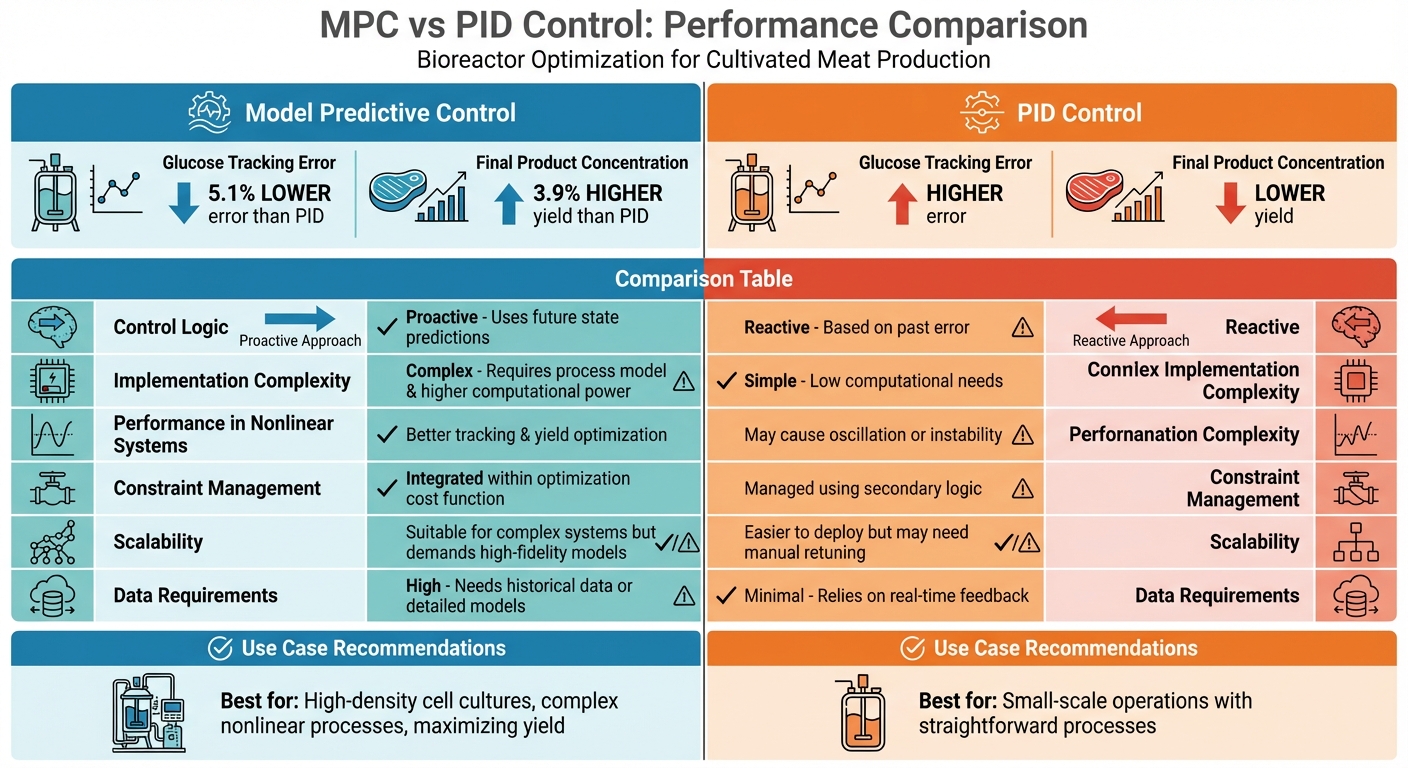
MPC vs PID Control Systems in Bioreactor Performance Comparison
Expanding on earlier performance comparisons, this section examines the pros and cons of using Model Predictive Control (MPC) versus Proportional-Integral-Derivative (PID) control for optimising bioreactors.
In mammalian cell fed-batch bioreactors, MPC outperforms traditional PI algorithms by reducing glucose concentration set-point tracking error by 5.1% and increasing the final product concentration by 3.9%[2]. This predictive capability is especially important in cultivated meat systems, where maintaining precise nutrient levels prevents the formation of inhibitory byproducts.
The fundamental difference between these two strategies is their approach to control. PID control is reactive, addressing deviations only after they occur. MPC, on the other hand, is proactive, using a process model to predict future behaviour and adjust inputs accordingly. However, this improved performance comes with some trade-offs.
MPC requires detailed process modelling and greater computational resources, whereas PID controllers are simpler to implement. PID systems can run on standard Programmable Logic Controllers (PLCs) with minimal modelling, while MPC needs a PC integrated with the bioprocess controller[3][4]. Konstantins Dubencovs from the Latvian State Institute of Wood Chemistry notes:
"MPC is practically the only method that can provide the use of mathematical models in the control of biotechnological processes using standard PC equipment."[4]
Here’s a side-by-side comparison of the two approaches:
| Feature | Traditional PID Control | Model Predictive Control (MPC) |
|---|---|---|
| Control Logic | Reactive; based on past error | Proactive; uses future state predictions |
| Implementation Complexity | Simple; low computational needs | Complex; requires process model and higher computational power |
| Performance in Nonlinear Systems | May cause oscillation or instability | Offers better tracking and yield optimisation |
| Constraint Management | Managed using secondary logic | Integrated within optimisation cost function |
| Scalability | Easier to deploy but may need manual retuning | Suitable for complex systems but demands high-fidelity models |
| Data Requirements | Minimal; relies on real-time feedback | High; needs historical data or detailed models |
These comparisons underline the trade-offs between simplicity and performance. The choice between PID and MPC depends largely on the scale of operations and the technical resources available.
Conclusion
Model Predictive Control (MPC) offers a clear advantage over traditional PID systems in optimising bioreactor performance, particularly for cultivated meat production. In this field, where precise environmental control directly influences product quality and yield, MPC delivers measurable benefits. For instance, it enhances glucose tracking accuracy by 5.1% and increases final product concentration by 3.9% compared to conventional approaches[2]. This predictive capability is especially critical in high-density cell cultures, where maintaining nutrient balance prevents the build-up of harmful byproducts.
MPC is the go-to solution when maximising yield or managing complex, nonlinear processes. It excels in handling high variability, measurement noise, or extended sampling intervals, offering a level of robustness that PID systems simply can't match. However, for smaller-scale operations with straightforward processes, PID control might still be a more cost-effective choice. The contrast between MPC's proactive approach and the reactive nature of PID control highlights its strategic value in high-performance cultivated meat production.
Advancements in computational power and tools like Process Analytical Technology (e.g., Raman spectroscopy and NIR sensors) have made MPC implementation more accessible. These technologies enable real-time optimisation using standard hardware setups, lowering the barriers to adoption[5].
For cultivated meat producers, sourcing specialised bioreactor sensors, analytical instruments, and control equipment is crucial for successful MPC integration. Platforms like Cellbase (https://cellbase.com) provide a dedicated marketplace that connects production teams with trusted suppliers who understand the unique demands of this industry.
MPC represents a pivotal shift in bioreactor control, moving from reactive systems to a predictive, "quality-by-design" approach. As cultivated meat production scales from the lab to commercial operations, MPC will play an essential role in maintaining consistent product quality while driving operational efficiency. This evolution marks a significant step forward in biomanufacturing[3].
FAQs
What data and sensors are required to run MPC in a bioreactor?
Running Model Predictive Control (MPC) in a bioreactor involves the use of sensors to track critical process variables. These include factors like substrate concentrations (such as glucose), dissolved oxygen levels, pH, temperature, and biomass measurements. To maintain accurate and effective control, real-time data acquisition systems are essential for continuously monitoring these variables.
How do you build and validate an MPC model for nonlinear cell cultures?
Developing and validating an MPC model for nonlinear cell cultures starts with creating a precise process model. This can be done using first-principle equations or leveraging machine learning techniques. The next step involves validating this model by comparing its predictions against experimental data from bioreactors. Any discrepancies are addressed by tweaking the model parameters to improve accuracy.
Once the model is integrated into an MPC framework, the controller undergoes testing within bioreactors. Through iterative adjustments, the system is fine-tuned to establish feeding strategies that optimise performance while staying within the required process constraints.
When is PID still a better choice than MPC in cultivated meat production?
Model predictive control (MPC) is highly effective for managing the intricate dynamics and changing conditions of cultivated meat bioreactor processes, especially when precise control is essential. On the other hand, proportional-integral-derivative (PID) control is often the better choice for its simplicity and ease of tuning. PID is particularly suitable when a dynamic model isn't available or needed. It performs well in straightforward systems that demand quick, real-time responses, where the advanced features of MPC might not offer much extra benefit.


