

Real-time particle monitoring systems are transforming how cultivated meat producers maintain sterile conditions. These systems provide instant data on airborne contaminants, replacing outdated methods that take 5–7 days to deliver results. By continuously tracking both viable and non-viable particles, they ensure cleanrooms meet strict ISO 14644-1 and GMP Annex 1 standards.
Key Points:
- Immediate Detection: Detects contamination risks in seconds, reducing risks to cell cultures.
- Viable and Non-Viable Monitoring: Differentiates living microorganisms from inert particles using advanced technology like Laser Induced Fluorescence (LIF).
- Integrated Systems: Monitors multiple factors (temperature, humidity, pressure) alongside particle data.
- Regulatory Compliance: Supports ISO and GMP requirements, automates audit trails, and prevents human errors.
- Cost Savings: Prevents batch losses by enabling fast corrective actions.
These systems are indispensable for cultivated meat production, ensuring product safety and regulatory adherence while reducing operational risks.
Cleanroom Monitoring Explained ; How, when, and why do we do the monitoring in cleanrooms?
sbb-itb-ffee270
How Real-Time Particle Monitoring Systems Work
Real-time particle monitoring systems are designed to detect both non-viable particulates and viable microorganisms simultaneously, providing detailed contamination data in seconds rather than days.
These systems combine two detection methods within a single unit, using separate optical chambers for each. They integrate seamlessly with Facility Monitoring Systems (FMS) or Building Management Systems (BMS) via Ethernet, WiFi, or APIs. This setup ensures continuous data logging and triggers immediate alarms if contamination levels exceed acceptable thresholds[8]. Such rapid feedback is crucial for maintaining the strict cleanroom standards necessary in cultivated meat production systems.
Here’s a closer look at how these systems detect non-viable and viable particles.
Non-Viable Particle Detection
Non-viable particle detection relies on Optical Particle Counting (OPC). As airborne particles move through a red laser beam, they scatter light in a process called Mie scattering. The system measures the intensity of this scattered light to calculate the size and concentration of particles, typically detecting those larger than 500 nanometres[7].
Portable particle counters usually operate at a flow rate of 28.3 L/min (1.0 CFM), while high-flow models sample up to 100 L/min, making them suitable for Grade A environments[8]. To ensure precise measurements, all optical particle counters must meet the calibration requirements of the ISO 21501-4 standard, which governs size resolution and counting accuracy[8].
To complement this, viable particle detection uses fluorescence techniques to identify living contaminants.
Viable Particle Detection
Laser Induced Fluorescence (LIF) is the key to identifying living microorganisms in real time. This method takes advantage of the natural fluorescent properties of certain molecules found in microorganisms, such as NADH and riboflavin. These metabolic markers are also critical when monitoring the efficacy of growth factors during the expansion phase. These molecules absorb laser light and emit it at longer wavelengths. Typically, a blue laser at 405 nm is used to excite these particles[7].
Devices like the BioTrak 9510-BD sensor measure three types of light intensities - scattered light and two fluorescence ranges (430–500 nm and 500–650 nm) - to differentiate microorganisms from inert particles[7]. Patrick M. Hutchins, PhD, Global Product Manager at TSI Inc., explains:
In LIF, each airborne particle is evaluated individually to determine whether an individual particle has characteristics consistent with a microorganism or benign airborne particulate[7].
This method is non-destructive, meaning some systems can collect particles on a gelatin filter after analysis. This allows for laboratory cultivation to identify the specific microbial species present[7].
Key Components of Real-Time Particle Monitoring Systems
Real-time particle monitoring systems combine advanced hardware and software to deliver continuous and precise cleanroom condition data. These systems use a network of particle counters and environmental sensors to measure variables like temperature, humidity, and differential pressure alongside particle data, ensuring comprehensive monitoring of cleanroom environments[9].
The hardware collects raw optical data, such as light scattering intensity and fluorescence, which the software processes to distinguish between viable microorganisms and inert particles[7][10]. Advanced particle counters enhance this process, providing accurate contamination detection - an essential feature for maintaining sterile conditions in cultivated meat production.
Particle Sensors and Counters
Different types of particle sensors play specific roles in cleanroom monitoring. Optical Particle Counters (OPC) detect particles as small as 50 nm by measuring light scattering, while Condensation Particle Counters (CPC) can identify ultrafine particles down to 1 nm. CPCs achieve this by enlarging particles with a growth medium before detection, though they cannot determine particle size - they simply count the particles after enlargement[11].
Modern systems leverage IoT-enabled features for real-time adjustments and remote monitoring. Protocols like JSON, Bluetooth, and Zigbee allow these systems to synchronise environmental data with cloud platforms, enabling remote data visualisation and system management through web browsers. This connectivity improves responsiveness to contamination events and enhances overall system efficiency[11].
Data Processing and Alert Systems
The software component processes raw sensor data into actionable insights, generating compliance reports and monitoring for threshold breaches. If particle counts go beyond pre-set limits, the system triggers immediate alarms - such as visual signals, emails, or SMS alerts - facilitating rapid corrective action[9][7]. As Lighthouse Worldwide Solutions explains:
Real-time monitoring systems allow you to have a contamination event in your cleanroom, you will be alerted immediately[9].
These systems also automate audit trail creation and enable facilities to integrate Standard Operating Procedures (SOPs) directly into the software. This eliminates the risks associated with manual data entry and ensures compliance with regulatory standards like 21 CFR Part 11. Moreover, full implementation of such systems in a cleanroom can be completed in as little as three weeks[9].
Regulatory Standards and Compliance
Cultivated meat production facilities are held to the same stringent cleanroom standards as pharmaceutical and biotech plants. According to ISO 14644-1:2015, air cleanliness is classified on a scale from ISO 1 to ISO 9, determined by the concentration of particles per cubic metre. For aseptic processing zones - where the actual production of cultivated meat takes place - ISO Class 5 is standard. This class allows no more than 3,520 particles of 0.5 microns or larger per cubic metre. Meanwhile, supporting areas typically operate at ISO Class 7 (up to 352,000 particles/m³) or ISO Class 8 (up to 3,520,000 particles/m³) [12][13].
In addition to these ISO standards, the EU GMP Annex 1 framework requires facilities to adopt a Contamination Control Strategy (CCS). This strategy identifies critical control points and monitors both total and viable particles to safeguard the quality of cultivated meat. By detecting environmental contamination early, facilities can ensure product integrity and make informed batch release decisions. Another key requirement is maintaining pressure differentials of 10–15 Pascals between zones, which prevents particles from migrating into areas with stricter cleanliness classifications [12]. Together, these standards form the backbone of regulatory compliance under GMP Annex 1.
ISO 14644 and GMP Annex 1 Requirements
ISO 14644-2 specifies the need for ongoing monitoring between formal classification tests, while ISO 21501-4 outlines annual calibration requirements for light-scattering airborne particle counters to preserve data accuracy [12][13]. Facilities must also document the Installation Qualification (IQ), Operational Qualification (OQ), and Performance Qualification (PQ) of their monitoring systems. These steps are not just procedural - they’re critical for meeting quality system requirements. This is especially important given that over 30% of FDA citations relate to deficiencies in quality systems [12].
A case in point: In June 2024, the FDA issued a warning letter to Optikem International Inc. after inspecting their sterile manufacturing facility in Denver, Colorado. The investigation revealed major ISO 14644 violations, such as rust on HEPA filter frames, gaps in ceiling construction, and insufficient environmental monitoring. The facility only conducted periodic monitoring rather than batch-specific checks and failed to address recurring fungal and bacterial contamination in ISO 5 areas over a two-year span. As a result, the FDA deemed the facility unfit for sterile production, demanding a comprehensive remediation plan and requalification [12].
Continuous vs Periodic Monitoring
Monitoring systems for compliance can operate on either a periodic or continuous basis. Periodic monitoring involves scheduled checks at fixed intervals - typically every six months for ISO Class 5 or cleaner environments, and every 12 months for ISO Class 6–9 [12]. While this approach meets basic compliance needs, it risks overlooking short-lived contamination events that occur between tests.
On the other hand, continuous monitoring offers round-the-clock surveillance, capturing real-time spikes and trends that periodic checks might miss. As noted by Rotronic, continuous systems ensure "consistent, high quality environmental conditions at all times and that changes can be detected as soon as they happen" [13]. For cultivated meat production, this approach has clear benefits. It creates automated, timestamped audit trails for regulatory inspections, supports trend analysis to identify gradual issues like HEPA filter degradation, and aligns with the Contamination Control Strategy required under GMP Annex 1 [12][13].
Additionally, continuous monitoring can reduce the workload associated with periodic classifications. By demonstrating stable environmental conditions, facilities may extend the intervals between formal periodic tests while still meeting compliance standards [12][13]. For those looking to implement such systems, Monitoring as a Service (MaaS) options are available, with costs varying by provider and scope [12].
Benefits of Real-Time Monitoring for Cultivated Meat Cleanrooms
Real-time particle monitoring systems provide instant alerts, allowing operators to respond immediately instead of waiting the typical 5–7 days for traditional results [1]. In cultivated meat facilities, this speed is crucial because a single contamination event in a bioreactor can jeopardise an entire batch. By addressing particle spikes as they occur, operators can avoid costly losses while maintaining the sterile environment needed for healthy cell cultures.
These systems also offer continuous trend analysis, revealing contamination patterns over time [3]. Unlike periodic testing, which might miss short-lived events, real-time monitoring captures every fluctuation. This helps distinguish between temporary anomalies - like particle increases caused by personnel movement - and deeper issues, such as gradual HEPA filter wear. Such insights enable proactive maintenance and fine-tuning of processes. Additionally, these systems integrate with automated operations, streamlining cleanroom management even further.
A key advantage of advanced real-time monitoring lies in viable particle detection. Systems equipped with BAMS (Bioaerosol Mass Spectrometry) technology can differentiate between biological and inert particles [1]. Traditional counters lack this capability, but BAMS uses laser-induced fluorescence to identify bacteria and fungi in microseconds, even capturing viable but non-culturable cells - something conventional methods often miss, detecting only about 1% of contaminants [1]. For cultivated meat production, where biological contamination poses a direct risk to cell cultures, this precision is critical.
Automation also boosts operational efficiency. Real-time systems reduce the need for manual data entry and correlation, cutting down on human error [3]. Integrated platforms monitor multiple parameters simultaneously - such as particle counts, temperature, humidity, differential pressure, and door status - offering a comprehensive view within a single validated system [3][4]. By contextualising particle data alongside environmental factors, teams can better understand contamination events, linking them to factors like pressure changes or high-traffic periods.
From a regulatory standpoint, real-time monitoring aligns with GMP Annex 1 (sections 9.28 and 9.29), which emphasise the use of Rapid Microbiological Methods (RMM) [1]. These systems also support compliance by providing secure audit trails and timestamped data [2]. For cultivated meat producers seeking regulatory approval, this framework not only ensures product safety but also builds trust with both regulators and consumers.
Traditional vs Real-Time Monitoring: A Comparison
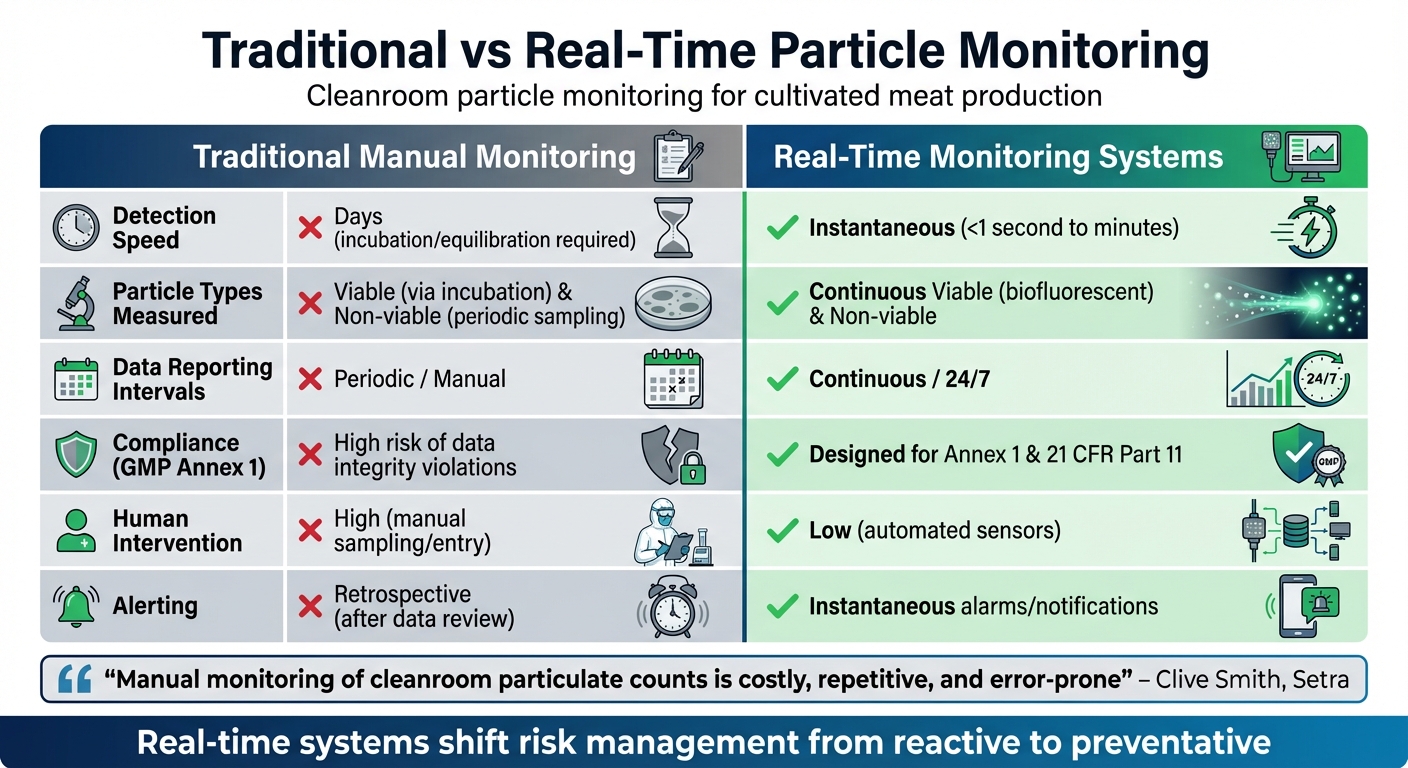
Traditional vs Real-Time Particle Monitoring Systems Comparison
In cultivated meat production, where contamination risks can have severe consequences, recognising the differences between traditional manual monitoring and real-time systems is crucial. These differences go far beyond just speed. Traditional methods rely heavily on manual sampling and laboratory analysis, which often results in outdated or delayed data [9]. As Clive Smith from Setra points out:
Manual monitoring of cleanroom particulate counts is costly, repetitive, and error-prone [18].
Real-time systems, on the other hand, provide continuous data streams that capture transient contamination events - such as those during shift changes or material transfers - that traditional methods often miss [7][19]. Manual monitoring requires personnel to repeatedly enter controlled environments to collect samples or change agar plates, which increases both contamination risk and labour costs [18]. In contrast, real-time sensors, positioned outside critical zones, enable monitoring without direct intervention, significantly reducing these risks [7][9].
Data Integrity and Compliance
Data integrity is another key factor where traditional methods fall short. Many recent FDA-issued 483s and Warning Letters have flagged data integrity issues stemming from manual workflows [18]. These systems are prone to human errors like transcription mistakes, record loss, or data corruption. Real-time systems, however, automate data collection, adhering to ALCOA+ principles (Attributable, Legible, Contemporaneous, Original, Accurate) [15][18]. For cultivated meat producers, this automated compliance framework is a game-changer when navigating strict regulatory requirements.
Actionable Information for Risk Management
The time delay between sample collection and contamination detection in traditional systems severely limits the actionability of the information. As Patrick M. Hutchins, PhD, Global Product Manager at TSI Inc., explains:
The longer the period between sample collection and detection of contamination the less actionable the information becomes [7].
Real-time systems address this by providing immediate alerts when parameters deviate from acceptable thresholds, enabling swift corrective actions to prevent product loss [9][17]. For cultivated meat facilities, where a single contamination event can compromise an entire batch, this proactive approach shifts risk management from reactive to preventative.
Feature Comparison Table
| Feature | Traditional Manual Monitoring | Real-Time Monitoring Systems |
|---|---|---|
| Detection Speed | Days (incubation/equilibration) [7][19] | Instantaneous (<1 second to minutes) [7] |
| Particle Types Measured | Viable (via incubation) & Non-viable (periodic) [16] | Continuous Viable (biofluorescent) & Non-viable [15][16] |
| Data Reporting Intervals | Periodic / Manual [9][18] | Continuous / 24/7 [9][14] |
| Compliance (GMP Annex 1) | High risk of data integrity violations [18] | Designed for Annex 1 & 21 CFR Part 11 [14][16][18] |
| Human Intervention | High (manual sampling/entry) [18] | Low (automated sensors) [9] |
| Alerting | Retrospective (after data review) [9] | Instantaneous alarms/notifications [9][17] |
Implementing Real-Time Monitoring in Cultivated Meat Production
System Selection and Key Considerations
When choosing a monitoring system for your cleanroom, it's essential to align its specifications with the cleanroom classification and operational requirements. For ISO 5 cleanrooms - commonly used in areas like bioreactors and filling zones - systems must continuously monitor particles ≥0.5 µm at 1 CFM, while also meeting GMP compliance standards [20][23]. The particle size detection range should ideally cover 0.3 to 25 µm to ensure compatibility with a wide range of ISO standards [1][5].
For ISO 5 environments, look for systems capable of detecting particles ≥0.5 µm, with additional features like integrated laser-induced fluorescence for viable detection. This technology allows seamless software integration while distinguishing biological particles from inert ones. Bio-fluorescent particle counters (BFPCs) are particularly useful as they replace traditional colony-forming units (CFUs) with aerosol fluorescent units (AFUs), offering a more advanced detection method [1]. Systems such as the BioTrak® Real-Time Viable Particle Counter meet ISO 21501-4 standards, providing results every minute. They also come with gelatin filters that can operate for up to nine hours, ensuring reliable and continuous monitoring [21][22]. These features help maintain compliance with GMP Annex 1 and ISO standards.
To enhance functionality, opt for systems that include real-time alerts, trend analysis, and data integrity features compliant with 21 CFR Part 11 [6]. Flow rates ranging from 0.15 to 2.8 L/min make these systems suitable for various cleanroom zones. Automation is another key benefit, eliminating manual transcription errors and enabling immediate responses to potential issues [21][22]. Scalable options like the Rapid-C+ are particularly well-suited for continuous viable and total particle counting using biofluorescence [20][23].
Defining your technical needs is the first step; sourcing the right equipment is the next critical phase.
Sourcing Equipment via Cellbase
Efficient procurement is crucial for meeting the rigorous demands of real-time monitoring in cultivated meat production. However, navigating the challenges of scaling cultivated meat and the fragmented supplier landscape for cleanroom monitoring equipment can be daunting. This is where Cellbase, the first B2B marketplace dedicated to the cultivated meat industry, comes in. It connects R&D teams, production managers, and procurement specialists with verified suppliers offering particle counters and sensors specifically designed for cleanroom use.
Unlike general laboratory supply platforms, Cellbase provides clear pricing information for specialised equipment like BioTrak® and Rapid-C+ systems. These listings are tailored to meet the unique technical requirements of cultivated meat production, including GMP-compliant viable detection and seamless integration capabilities. By offering detailed use-case specifications, Cellbase simplifies the sourcing process, enabling faster and more informed decisions while reducing technical risks.
For cultivated meat producers, Cellbase bridges the gap between cleanroom standards and production workflows. It streamlines the entire procurement process, from initial equipment selection to installation, ensuring that you have access to the right suppliers who understand the specific needs of your industry.
Conclusion
Real-time particle monitoring systems are now a cornerstone for cultivated meat facilities that need to uphold strict cleanroom standards. These systems continuously monitor contamination risks, ensuring compliance with ISO 14644-1 and GMP Annex 1 while safeguarding product quality. As Meghan Kelley from Setra explains:
The continuous logging of particle counting data can help exonerate a compliant cleanroom in the case of an incident investigation [6].
This reliable record-keeping not only simplifies audits but also enables swift corrective actions when irregularities arise.
Beyond regulatory compliance, real-time monitoring brings operational advantages that periodic testing simply can't offer. Automated systems reduce errors from manual data handling, provide round-the-clock oversight, and allow teams to perform root cause analysis by linking particle counts to other environmental factors like basal media preparation conditions. This integration helps production teams quickly pinpoint problems - like faulty door seals or air handling issues - before they affect product quality.
However, finding the right monitoring equipment remains a key hurdle for cultivated meat producers, given the fragmented supplier landscape. Cellbase tackles this challenge by connecting R&D teams and procurement experts with trusted suppliers offering GMP-compliant particle counters and sensors. By providing detailed specifications and up-to-date product information, the platform simplifies purchasing decisions and ensures the equipment aligns with the specific needs of cultivated meat cleanrooms.
FAQs
How accurate is viable particle detection compared with culture plates?
Viable particle detection offers a more precise approach than culture plates when it comes to identifying microbial contamination in real-time. Culture plates require incubation and the growth of colonies, a process that can take several days. Even then, they may fail to detect microbes that struggle to thrive under standard growth conditions.
In contrast, real-time monitoring systems deliver instant results, allowing quicker action. That said, their effectiveness hinges on the efficiency of the sampling method and the sensitivity of the detection technology used.
Where should sensors be placed in an ISO 5 cultivated meat cleanroom?
To maintain strict cleanroom standards in an ISO 5 environment for cultivated meat production, sensors need to be strategically placed at critical sampling points. These should include areas with significant airflow activity and spots prone to potential contamination. This careful positioning ensures accurate tracking of particle levels and overall environmental conditions, which are essential for reliable production outcomes.
What validation evidence do auditors expect for continuous monitoring?
Auditors require proof that the cleanroom system consistently performs within the specified parameters. This involves maintaining detailed documentation showing that monitoring systems are functioning as intended and adhering to standards like ISO 14644 and GMP guidelines. Thorough validation is key to confirming that all systems align with regulatory requirements and uphold the cleanroom's integrity.


