

For bioprocess engineers and cultivated meat R&D professionals, choosing the right scaffold material means balancing performance and sustainability goals. Here's what you need to know upfront:
- Plant-based scaffolds: Derived from renewable sources like cellulose, soy protein, and alginate. They are biodegradable, edible, and have a lower carbon footprint but may require surface modifications for cell adhesion.
- Synthetic scaffolds: Made from polymers like PCL and PLA. These offer precision and consistency but rely on petroleum, leading to higher emissions and waste. Non-edible versions also complicate production processes.
Quick Comparison
| Criteria | Plant-Based Biomaterials | Synthetic Biomaterials |
|---|---|---|
| Source | Renewable (e.g., cellulose, soy) | Petroleum-derived |
| Carbon Emissions | Lower (sequester carbon) | High (fossil fuel-based) |
| Biodegradability | High | Low |
| Edibility | Often edible | Rarely edible |
| Scalability | Challenges with consistency | Industrial-scale production |
| Cost | Generally lower | Often higher |
Key takeaway: Plant-based scaffolds align better with sustainability goals but face technical challenges like cell adhesion and scalability. Synthetic options provide reliability but come with environmental trade-offs. Hybrid solutions or microbial-derived materials may offer a middle ground.
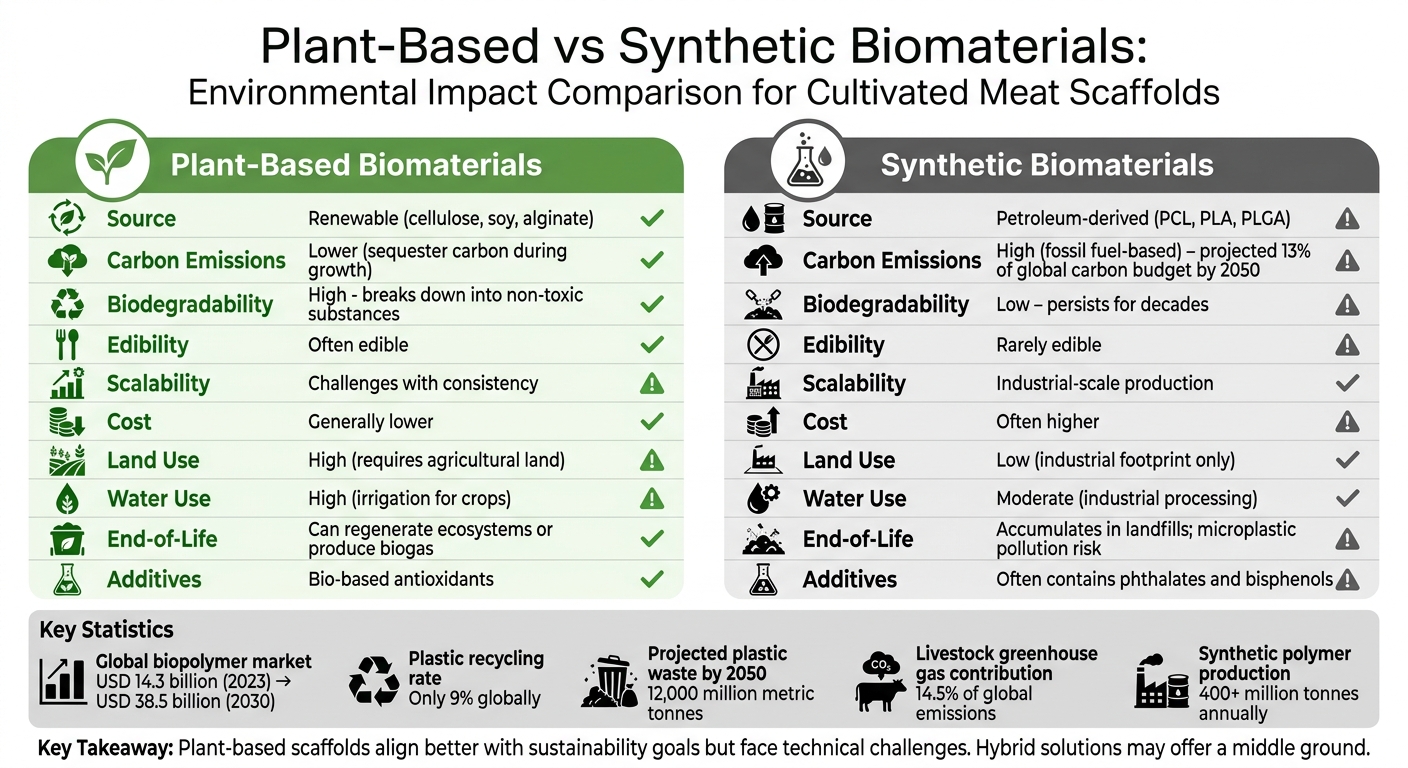
Plant-Based vs Synthetic Biomaterials Environmental Impact Comparison
How Plant-Based Biomaterials Are Produced
Plant-based biomaterials are developed from a variety of renewable feedstocks, including polysaccharides like cellulose, starch, and pectin, as well as proteins such as soy, chickpea, zein, and wheat. Additionally, marine and fungal sources like alginate, carrageenan, and chitosan play a role. Many of these materials are derived from agricultural by-products, such as wheat husks, rice husks, corn cobs, and citrus peel waste, aligning with a zero-waste approach.
Once collected, the raw materials are subjected to extraction and modification processes to prepare them for use in scaffolds. For example, cellulose is chemically altered to produce derivatives like carboxymethyl cellulose, while chitin is transformed into chitosan through deacetylation. Pectin extraction can involve hydrothermal-assisted, ultrasound-assisted, or enzyme-assisted techniques. Since plant-based materials often lack the natural cell-binding domains found in animal-derived proteins, they are functionalised with RGD motifs or integrin-recognised sequences to improve cell adhesion and growth. These enhanced biomaterials are then shaped using advanced fabrication methods.
Structuring and fabrication processes convert the modified polymers into three-dimensional scaffolds. Techniques like electrospinning, rotary jet spinning (RJS), and 3D bioprinting are commonly employed. For instance, in October 2022, a research team led by Professor Huang Dejian at the National University of Singapore successfully 3D-printed edible scaffolds using cereal prolamins. These scaffolds supported pig muscle cell growth and replicated meat texture [5]. Such methods are critical in improving the compatibility of plant-based biomaterials for use in cultivated meat scaffolds.
Another innovative method is decellularisation, which removes cellular material from plant tissues like spinach leaves, leeks, or broccoli florets while preserving the cellulose-based cell wall and vascular structures. The resulting scaffolds feature interconnected pore networks that resemble circulatory systems, offering a pre-vascularised framework. Emerging approaches, such as those using supercritical CO₂, maintain scaffold hydration and mechanical integrity with a reduced environmental footprint compared to traditional chemical detergents [2].
The production of plant-based biomaterials takes advantage of existing agricultural infrastructure and by-products, cutting down on the need for energy-intensive chemical processes. Unlike synthetic polymers derived from petroleum, which often require harmful additives like phthalates and bisphenols, plant-based alternatives are renewable and biodegradable. This makes them an environmentally friendly choice that aligns with the sustainability goals of cultivated meat production. The growing demand for these materials is reflected in the global biopolymer market, which was valued at approximately USD 14.3 billion in 2023 and is expected to reach USD 38.5 billion by 2030 [3].
sbb-itb-ffee270
How Synthetic Biomaterials Are Produced
Synthetic biomaterials like PET (polyethylene terephthalate), polycaprolactone (PCL), polylactic acid (PLA), and polylactic acid-co-glycolic acid (PLGA) are predominantly created from petroleum-based feedstocks. The process begins with extracting and refining fossil fuels, which are then transformed into specific chemical monomers through energy-intensive synthesis in specialised facilities [3][4].
Once the polymers are synthesised, they are shaped into scaffold structures using techniques such as electrospinning, 3D bioprinting, and extrusion. These methods allow precise control over factors like pore size, mechanical properties, and surface texture [4]. For fibrous or textile scaffolds, the viscous polymer is forced through a spinneret to form threads, which can then be woven or layered [8]. However, these fabrication methods demand specialised equipment and consume significant energy at every stage of production, raising environmental concerns.
The scale of global synthetic polymer production is immense, exceeding 400 million tonnes annually [3]. While this industrial capacity ensures consistent quality and extended shelf-life, it also amplifies environmental challenges, including resource depletion, high energy usage, and the accumulation of waste across supply chains.
When it comes to cultivated meat scaffolds, synthetic polymers offer both possibilities and limitations. Medical-grade PCL, PLA, and PLGA are biocompatible and can be engineered to degrade at controlled rates [4]. However, these polymers are often costly, making them impractical for large-scale food production. Another major challenge is that non-edible synthetic scaffolds must be removed before consumption, adding complexity and cost to the manufacturing process [4][7]. This contrasts with edible, plant-based scaffolds, which can remain in the final product, improving efficiency and reducing waste.
The environmental footprint of petroleum-based polymers is another critical issue. Their production and lifecycle contribute significantly to carbon emissions, which conflicts with the sustainability goals of cultivated meat production. Many synthetic polymers also contain additives like phthalates and bisphenols, which pose health and ecological risks [3]. Furthermore, their durability means they can take decades or even centuries to degrade, contributing to the growing problem of microplastics in ecosystems, including air, water, and soil [8]. These environmental disadvantages highlight the need for thoughtful material choices in cultivated meat production, especially when compared to renewable, biodegradable plant-based alternatives.
Environmental Impact Comparison: Plant-Based vs Synthetic Biomaterials
Choosing scaffold materials with a lower environmental footprint is a critical factor in cultivated meat production. Here, we compare plant-based and synthetic biomaterials across key environmental metrics to guide material selection.
Greenhouse Gas Emissions and Carbon Footprint
Synthetic polymers are associated with high carbon emissions throughout their lifecycle, largely due to their origin in fossil fuels. Projections indicate that plastic production and disposal could account for 13% of the global carbon budget by 2050 [3].
On the other hand, plant-based biomaterials like PLA, cellulose, and starch are derived from renewable resources such as corn, sugarcane, and wood. These materials sequester carbon during crop growth, potentially supporting Net Zero targets [3][4]. However, their environmental benefits hinge on responsible feedstock sourcing and disposal. For instance, some biopolymers only degrade effectively in industrial composting facilities, limiting their overall impact if improperly managed [3].
| Material Type | Common Examples | Primary Feedstock | Lifecycle Emissions |
|---|---|---|---|
| Synthetic | PET, PCL, PLGA, Nylon | Petroleum / Fossil Fuels | High emissions from extraction and refining; long-lasting waste |
| Plant-Based | PLA, Cellulose, Starch | Corn, Sugarcane, Wood | Lower emissions during production; carbon sequestration during growth |
| Microbial | PHA, PHB, Xanthan Gum | Organic Waste / Sugars | Variable emissions; potential for zero-waste if feedstocks are waste-derived |
Recycling rates for synthetic plastics remain alarmingly low - only about 9% of global production has been recycled [3]. This issue is especially relevant for cultivated meat, as the industry seeks to minimise emissions linked to livestock, which currently contribute 14.5% of global greenhouse gases [4]. Next, we examine water consumption and land use.
Water Consumption and Land Use
Plant-based biomaterials depend on agricultural feedstocks, which demand significant land and water resources. For example, producing PLA involves growing crops like corn and sugarcane, which require irrigation and occupy arable land that could otherwise be used for food production [6][9]. The environmental impact of these materials is influenced by factors such as the location of cultivation and the intensity of resource use.
Synthetic biomaterials bypass agricultural demands entirely, relying instead on petroleum extraction and industrial processing. However, approximately 8% of the world’s oil is allocated to plastic production [9].
| Metric | Plant-Based Biomaterials | Synthetic Biomaterials |
|---|---|---|
| Primary Raw Material | Corn, Sugarcane, Soy, Microorganisms [4][9] | Petroleum / Fossil Fuels [9] |
| Land Use Impact | High (requires agricultural land; competes with food production) [6][9] | Low (industrial footprint only) [9] |
| Water Use Impact | High (irrigation for crops) [9] | Moderate (industrial processing water) [4] |
| Renewability | Renewable [9] | Non-renewable [9] |
| Associated Pollution | Fertiliser and pesticide runoff [9] | Emissions from oil extraction and refining [9] |
While plant-based materials contribute to rural economies and are widely cultivated, they also pose challenges due to their reliance on finite agricultural resources [9]. For cultivated meat scaffolds, materials like soy, wheat, and cellulose are often preferred for their cost-effectiveness and consumer appeal, despite these resource demands [4]. Shifting focus to waste management, the next section explores biodegradability and disposal.
Biodegradability and End-of-Life Disposal
Plant-based biomaterials, such as polysaccharides and proteins, are naturally biodegradable. They can reintegrate into ecosystems or serve as biogas feedstock when properly managed [1]. In contrast, synthetic polymers typically resist degradation. By 2050, an estimated 12,000 million metric tonnes of plastic waste could accumulate in landfills and the environment, contributing to persistent microplastics in air, water, soil, and even human blood [1][3].
The environmental advantages of biopolymers depend heavily on their disposal. For example, starch-based films degrade efficiently in industrial composting systems but may persist in marine environments if mishandled [1]. Synthetic polymers often contain harmful additives like phthalates and bisphenols, which can leach into the environment and disrupt endocrine systems. Over 93% of Americans have detectable levels of plastic-related chemicals in their bodies [3].
| Feature | Plant-Based Biomaterials | Synthetic Biomaterials |
|---|---|---|
| Biodegradability | High; breaks down into non-toxic substances [1][3] | Low; persists for decades [1] |
| Carbon Footprint | Lower; supports Net Zero goals [1] | High; significant emissions throughout lifecycle [1] |
| End-of-Life | Can regenerate ecosystems or produce biogas [1] | Accumulates in landfills; risk of microplastic pollution [3] |
| Resource Origin | Renewable (crops, wood) [3] | Non-renewable (fossil fuels) [1] |
| Additives | Often uses bio-based antioxidants (e.g., essential oils) [1] | Frequently contains endocrine disruptors (e.g., phthalates) [3] |
For cultivated meat scaffolds, plant-based options like cellulose and alginate provide an additional benefit - they are often edible, simplifying processes and reducing waste [4]. Synthetic scaffolds, such as PCL, PLA, and PLGA, may require removal steps or specialised disposal, increasing both complexity and costs [4]. Legislative measures like the European Union's Single-Use Plastics Directive (2019/904) are driving industries to adopt biodegradable alternatives, underscoring the importance of environmentally conscious material selection [1].
Using These Biomaterials for Cultivated Meat Scaffolds
Choosing the right biomaterials for cultivated meat scaffolds involves balancing mechanical strength, biocompatibility, and environmental considerations. Synthetic polymers like PCL, PLA, and PLGA provide excellent mechanical properties and allow precise control over their physical and chemical characteristics to meet specific tissue needs [4]. However, these materials often come with challenges - they're typically non-edible, degrade slowly, and require costly processing steps, which can conflict with the industry's focus on sustainability [4].
While synthetic scaffolds are known for their precision, plant-derived materials offer a different set of advantages. Biomaterials such as cellulose, soy, and zein naturally feature interconnected pores and vascular-like structures, closely resembling the 3D microenvironment of the extracellular matrix [4][2]. However, one major drawback of plant-based scaffolds is their lack of natural cell-binding domains (like RGD motifs), which are critical for cell attachment. Addressing this limitation often requires surface modifications or the integration of peptides [4]. Additionally, achieving consistent quality and scalability with these materials remains a significant hurdle [2].
Scaffolds must also mimic the stiffness of natural muscle tissue (ranging from 2 to 12 kPa) to support proper cell differentiation and maturation [4]. Synthetic materials can be engineered for adjustable porosity and strength, while plant-based scaffolds may need reinforcement or hybrid designs that combine synthetic and natural components [4]. For cultivated meat producers aiming to balance high performance with eco-conscious practices, plant-derived scaffolds hold promise - provided challenges like cell adhesion and standardisation can be overcome. Platforms such as Cellbase help bridge the gap by connecting procurement teams with suppliers offering tailored scaffold materials, whether synthetic or plant-based, to meet the demands of cultivated meat production.
Key Takeaways for Biomaterial Selection
Choosing the right biomaterial for cultivated meat scaffolds involves balancing environmental impact with functional requirements. Plant-based materials, such as cellulose and alginate, are biodegradable but often lack the mechanical strength and cell-binding capabilities found in synthetic polymers like PCL (polycaprolactone) or PLA (polylactic acid) [1][4]. On the other hand, synthetic polymers offer consistency and precision but come with a significant environmental cost, with projections suggesting they could contribute to 13% of the global carbon budget by 2050 [3].
Edibility is a key factor. Edible scaffolds simplify the production process by eliminating the need for expensive cell dissociation steps [4]. However, plant-based materials may need surface treatments, such as RGD peptide coatings, to enhance cell adhesion [4]. Additionally, procurement teams should carefully assess feedstock sourcing to ensure biopolymers are derived from residues, avoiding competition with food supplies [1][3].
Hybrid scaffolds are gaining attention as a promising solution. These combine the mechanical strength of synthetic materials with the biocompatibility of plant-based options. Meanwhile, microbial-derived biopolymers like PHA (polyhydroxyalkanoates) or bacterial cellulose offer high purity and scalability without the land-use concerns associated with conventional crops [3][4]. With the global biopolymer market expected to reach USD 38.5 billion by 2030, growing at a CAGR of 15.2%, the industry is clearly moving towards more sustainable materials [3].
FAQs
How can plant-based scaffolds be improved for cell adhesion?
Plant-based scaffolds can be improved for cell adhesion by tweaking their surface topography and biochemical characteristics. For instance, surface functionalisation - through chemical changes or specialised coatings - can add bioactive molecules and boost hydrophilicity, which enhances how well cells attach. Adjusting surface patterns and creating interconnected pore structures can also promote better cell growth, making these scaffolds more suitable for applications in cultivated meat production and tissue engineering.
Are plant-based biomaterials always lower-carbon once land and water use are considered?
Plant-based biomaterials don't always guarantee a lower carbon footprint, especially when factors like land and water usage are taken into account. Their overall environmental impact hinges on aspects such as how much land is required, the amount of water consumed, and the lifecycle processes involved in their production. While they are often seen as a more eco-friendly alternative to synthetic materials, their total impact - including resource demands and biodegradability - can vary significantly.
In the context of cultivated meat scaffolds, plant-based materials are evaluated based on their ability to support cell adhesion, their degradation properties, and how scalable they are for production. However, the actual advantages they offer depend greatly on the efficiency of production methods and how well resources are utilised.
When should cultivated meat teams use hybrid or microbial-derived scaffolds instead?
When plant-based scaffolds fail to meet the structural or functional demands of tissue engineering, cultivated meat teams should consider hybrid or microbial-derived scaffolds as alternatives. Hybrid scaffolds, which blend plant-based materials with synthetic or microbial components, can improve biocompatibility, mechanical strength, and cellular adhesion. On the other hand, microbial-derived polymers offer adjustable properties and scalability, making them a strong choice when plant-based scaffolds lack stability, suitable surface features, or the ability to be biochemically customised.


