

Large-scale bioreactors used in cultivated meat production consume 25–45% of total operating costs due to energy demand. Key processes like aeration, mixing, and temperature control become less efficient as bioreactor volumes increase, leading to higher energy use. For example, energy requirements can reach 10–20 kWh per kilogramme of biomass, significantly more than plant-based alternatives.
To address this, strategies such as optimising aeration systems, adopting low-energy pumping and filtration methods, and improving mixing designs have shown promising results. For instance, Mosa Meat's 1,500-litre bioreactor upgrade reduced power use by 49% while maintaining production efficiency. Similarly, advanced technologies like fine bubble diffusers and low-shear impellers can cut energy consumption by 30–50%.
Key insights:
- Aeration consumes the most energy (40–60%), followed by mixing (20–35%).
- Fine bubble diffusers and advanced oxygen control can improve efficiency by up to 60%.
- Low-pressure membranes and gravity-driven filtration reduce pumping energy by 40–90%.
- Upgraded mixing systems (e.g., axial impellers) lower power demand by 15–35%.
Reducing energy use not only lowers costs but also supports scalability and reduces carbon emissions. Tools like Cellbase can help producers source efficient bioreactor components tailored for cultivated meat production.
Challenges in Reducing Power Demand
Reducing energy use in large-scale bioreactors is no straightforward task. Mammalian cells demand tightly controlled conditions, so cutting energy use risks compromising cell viability and yield. The difficulty lies in finding a balance between energy efficiency and the strict requirements of cell culture. Below are some of the key areas where energy losses occur, highlighting the complexity of the problem.
Aeration and Oxygen Transfer Limitations
Aeration is among the most energy-intensive processes in large-scale bioreactors. Cultivated meat production depends on maintaining precise dissolved oxygen levels, usually achieved through continuous gas sparging. As bioreactor volumes grow, the surface-to-volume ratio decreases, making passive gas exchange insufficient. This drives reliance on active aeration, requiring higher gas flow rates and additional energy for compression. While smaller bubbles improve oxygen transfer efficiency, they also increase shear stress, which can damage cells. On the other hand, larger bubbles reduce shear stress but compromise oxygen diffusion.
This trade-off presents a significant challenge, laying the groundwork for energy-saving strategies.
High Pumping and Filtration Demands
Pumping systems used for circulation, perfusion, and harvesting represent another major source of energy consumption. In perfusion cultures, fresh media is continuously supplied while spent media is removed. However, as cells accumulate, the transmembrane pressure rises due to increased membrane resistance. Clearing fouled membranes through backwashing cycles adds further to energy costs. Hollow fibre bioreactors, which rely on diffusion and perfusion rather than agitation, shift energy demands from mixing to pumping and filtration. Despite this shift, the overall energy requirements remain high.
These challenges highlight the need for more efficient designs and processes.
Mixing and Gas Dispersion Inefficiencies
Stirred-tank bioreactors rely heavily on mechanical mixing, which is another significant energy drain. However, conventional impeller designs - like Rushton turbines or pitched-blade impellers - often fall short in large-scale applications. They can create localised high-shear zones that damage cells while leaving other areas inadequately mixed. Poor gas dispersion compounds the problem, as uneven bubble distribution may require operators to increase impeller speed or gas flow rates. These inefficiencies often limit bioreactor volumes to around 20,000 litres to maintain effective mixing [3].
Addressing these inefficiencies is crucial for improving energy efficiency in bioreactor operations.
sbb-itb-ffee270
Solutions to Reduce Power Demand in Bioreactors
To tackle energy losses in aeration, pumping, and mixing, these strategies focus on practical adjustments that maintain both cell viability and production yield.
Improving Aeration Systems
Intermittent Aeration
Intermittent aeration adjusts oxygen delivery based on real-time dissolved oxygen (DO) levels. By activating aeration only when DO drops below 30–50% saturation, compressor runtime can be reduced by 20–40%, cutting aeration power consumption by 15–25% [1][2].
Fine Bubble Diffusers
Fine bubble diffusers create bubbles between 0.5–2 mm in diameter, increasing the surface area for oxygen transfer. This boosts oxygen transfer efficiency from 4–6 kg O₂/kWh (typical of coarse diffusers) to 8–12 kg O₂/kWh, resulting in energy savings of 30–50%. For instance, a 5,000-litre cultivated meat bioreactor using ceramic or EPDM membrane diffusers achieved a 35% reduction in power consumption while maintaining kLa values of 50–200 h⁻¹. When paired with DO feedback loops, efficiency can improve by an additional 10–15% [4].
Advanced Oxygen Control Systems
Advanced systems like membrane-less oxygenation and electrochemical oxygen generators offer on-demand oxygen delivery, cutting energy use by up to 60% compared to traditional sparging. A UK-based cultivated meat pilot in 2024 demonstrated a reduction in aeration power from 0.5 kW/m³ to 0.25 kW/m³, while sustaining high cell densities. Predictive algorithms help fine-tune oxygen delivery, and non-invasive monitoring tools (e.g., Raman spectroscopy) prevent lactate spikes [1][2].
These aeration upgrades pave the way for additional energy savings in pumping and filtration.
Energy-Efficient Pumping and Filtration
Low-Pressure Membranes
Ultrafiltration membranes designed for low-pressure operation (0.1–0.5 bar), often enhanced with anti-fouling coatings, can reduce pumping energy by 40–60%. Ceramic flat-sheet membranes with pore sizes of 0.01–0.1 μm handle high cell densities (around 10⁸ cells/mL) and achieve flux rates of 50–100 litres per square metre per hour, compared to 20–40 LMH for polymeric options. In a 20,000-litre system, shear-enhanced modules reduced energy use by 50%, lowering power requirements from 2–3 kWh/m³ to 1–1.5 kWh/m³. Pre-treating with proteases to degrade extracellular matrix components extends cleaning cycles, further reducing energy demands [4].
Gravity-Driven Filtration
Gravity-driven filtration eliminates the need for pumps by relying on minimal hydrostatic pressure (0.01–0.1 bar), achieving energy savings of 70–90% in perfusion modes. Systems like tilted plate settlers or dead-end filters with pore sizes of 10–50 μm can capture over 95% of biomass at flux rates of 10–20 LMH. A European trial in 2025 processed 5,000 litres daily with zero pumping power, recovering 98% viable cells. Vibration-assisted settling also helps manage the high viscosity of media additives , such as specialized cultivated meat inputs,, making this approach suitable for continuous harvesting [1][2].
By minimising pumping energy, attention can shift to optimising mixing and gas dispersion.
Advanced Mixing and Gas Dispersion Techniques
Low-Shear Axial Impellers
Low-shear axial impellers, such as hydrofoil designs like the Lightnin A310, provide uniform flow with energy demands of just 0.2–0.5 W/m³ (compared to 1–2 W/m³ for Rushton turbines). These impellers achieve blending in under 60 seconds with kLa values exceeding 100 h⁻¹, while protecting delicate cells. In a 50,000-litre cultivated meat bioreactor, axial impellers reduced mixing power from 200 kW to 90 kW - a 55% reduction - without affecting CO₂ stripping efficiency. A 2023 upgrade by Sartorius to a 10,000-litre bioreactor cut mixing power from 2.5 kW/m³ to 1.1 kW/m³ (56% savings) and improved kLa by 30%, with cell viability remaining above 95% [5].
Macrospargers
Macrospargers, featuring holes of 10–50 mm, generate larger bubbles that improve bulk mixing and CO₂ desorption while requiring 20–40% less power than microspargers. In high-density cultures, they also reduce the need for vigorous agitation by about 30%. A 15,000-litre case study showed total power savings of 25%, with optimised sparger ring placement and intermittent pulsing cycles adding an extra 15% efficiency [1][2].
Process and Operational Improvements
Operational adjustments can further lower energy consumption beyond equipment upgrades.
Reducing Mixed Liquor Suspended Solids (MLSS)
Lowering MLSS concentrations from 10–20 g/L to 5–10 g/L reduces viscosity and oxygen demand, cutting aeration and mixing power by 25–40%. A UK facility trial in 2024 achieved a 30% energy saving (0.8 kWh per kg of biomass) by combining MLSS reduction with pH-stat feeding [4].
Hydraulic Optimisation and Pump Control
Widening pipes improves flow efficiency by 20–30%, reducing pumping loads. Variable frequency drives (VFDs) can further save 20–40% in electrical consumption by matching pump output to real-time demand. Maintaining a temperature of 37°C reduces heating requirements by approximately 15% [4].
Energy Recovery Systems
Energy recovery systems capture waste heat for reuse. Combined heat and power (CHP) units recover 60–80% of heat from compressors and exhaust for tasks like media sterilisation. For instance, a 100 kW CHP system in a 50,000-litre plant recovered 35% of total power consumed. Additional options include modular biogas CHP systems from anaerobic digestion and heat pumps with efficiencies up to 300% for low-grade waste heat. Incorporating renewable energy sources like solar PV or wind can offset 20–50% of a facility's electricity needs [1][2].
Comparison of Energy Reduction Strategies
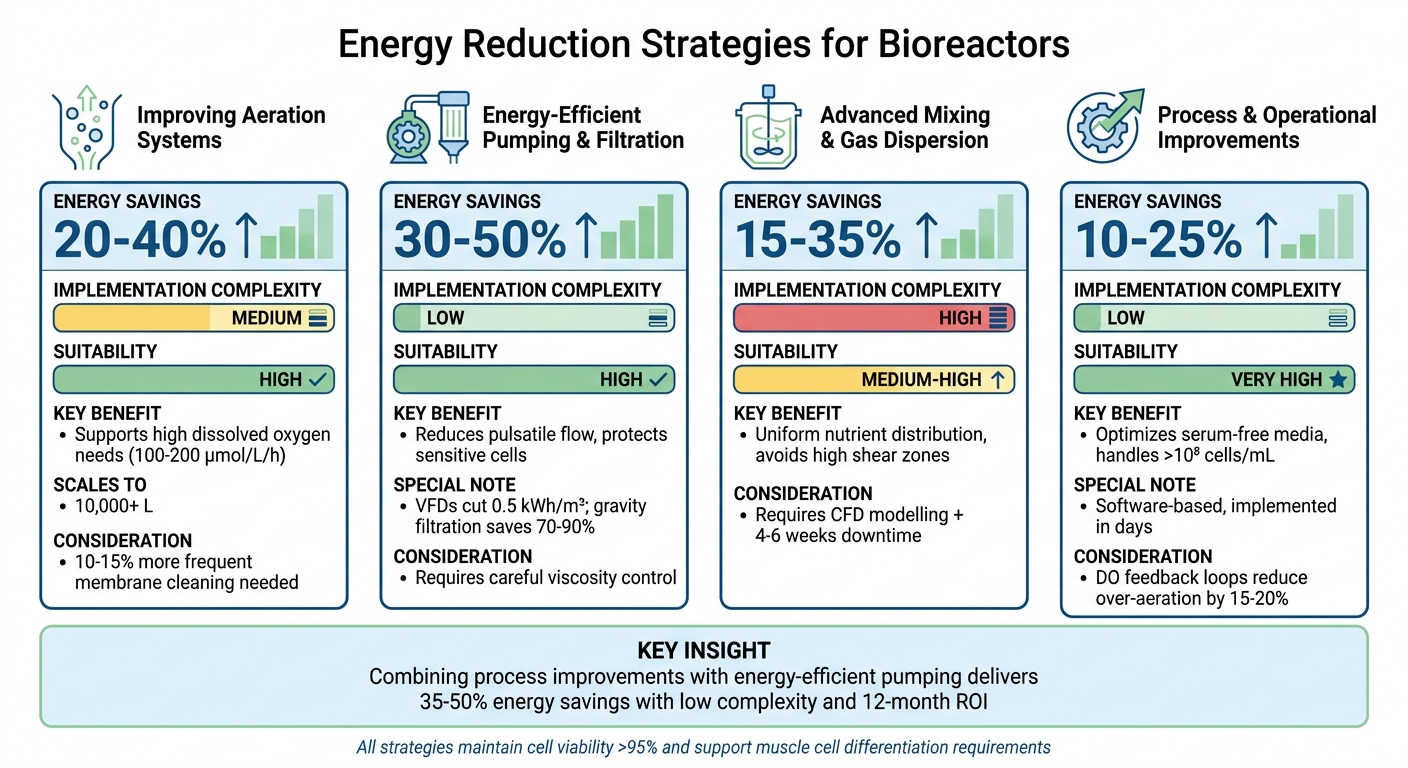
Energy Reduction Strategies for Bioreactors in Cultivated Meat Production
Building on earlier discussions of challenges and scaling cultivated meat processes, this section compares key strategies for reducing power consumption, highlighting their efficiencies and trade-offs.
The following table outlines four approaches to lowering energy demand:
| Strategy | Energy Savings | Implementation Complexity | Suitability for Cultivated Meat | Key Considerations |
|---|---|---|---|---|
| Improving Aeration Systems | 20–40% | Medium | High (supports high dissolved oxygen needs at 100–200 µmol/L/h; scales to 10,000+ L with low shear) | Membrane aerators may need cleaning 10–15% more frequently due to biofouling |
| Energy-Efficient Pumping and Filtration | 30–50% | Low | High (reduces pulsatile flow, protecting sensitive cells; ideal for perfusion at 1–5 vessel volumes/day) | Variable frequency drives (VFDs) can cut pumping energy by up to 0.5 kWh/m³; gravity-driven filtration offers 70–90% savings but requires careful viscosity control |
| Advanced Mixing and Gas Dispersion | 15–35% | High | Medium-high (critical for uniform nutrient distribution; avoids high shear zones through CFD-based designs) | Requires CFD modelling and 4–6 weeks of downtime for new system installations |
| Process and Operational Improvements | 10–25% | Low | Very high (optimises serum-free media and dense cultures >10⁸ cells/mL with minimal hardware risks) | Software-based controls can be implemented in days; DO feedback loops reduce over-aeration by 15–20% and sustain growth rates >0.03 h⁻¹ |
Combining process improvements with energy-efficient pumping can deliver energy savings of 35–50%, offering low implementation complexity and a return on investment within 12 months. Aeration upgrades, while capable of achieving up to 40% savings, involve moderate complexity and require additional maintenance. Advanced mixing strategies, best suited for new builds, rely on CFD validation for effective implementation.
Each of these strategies supports the high oxygen demands critical for muscle cell differentiation while maintaining cell viability. For instance, energy-efficient pumping minimises risks to sensitive cells, while advanced mixing ensures even nutrient distribution, an essential factor for cell growth.
Cellbase serves as a resource for connecting production managers and procurement teams with verified suppliers of energy-efficient bioreactor components. These include microbubble aerators, VFD-compatible pumps, CFD-optimised impellers, and DO sensors - specifically tailored for the unique requirements of cultivated meat production.
This comparison provides a foundation for integrating energy-saving strategies and highlights the role of specialised components, available through Cellbase, in achieving efficient and scalable production.
Using Cellbase for Equipment Procurement
Efficient procurement plays a crucial role in achieving energy-saving advancements in cultivated meat production. Cellbase bridges the gap between industry professionals and suppliers by offering a marketplace specifically tailored to the needs of cultivated meat production - an area often overlooked by general laboratory suppliers.
The platform features curated listings for bioreactors, including stirred tank, airlift, and stainless steel models, all designed to optimise key processes like gas transfer, mixing, and aeration [6]. Each listing provides detailed specifications, such as compatibility with scaffolds, suitability for serum-free media, or compliance with GMP standards. This setup allows users to quickly identify and select equipment that matches their precise requirements. Additionally, clear pricing and direct supplier contact streamline the procurement process and minimise technical risks.
For R&D teams moving from bench-scale experiments to pilot-scale production, Cellbase offers searchable catalogues that can be filtered by factors such as production volume, compatibility with specific cell types, and operational needs. This ensures that teams are connected with suppliers who understand the unique challenges of cultivated meat production.
Beyond procurement, Cellbase provides market intelligence dashboards that highlight demand trends and emerging technologies. These insights help procurement specialists plan for future needs as production scales, ensuring they stay ahead of industry developments. By simplifying and focusing the equipment selection process, the platform supports the adoption of energy-efficient solutions essential for scaling cultivated meat production.
Conclusion
To compete with conventional protein, cultivated meat producers need to reduce energy demands in large-scale bioreactors. With energy costs contributing 30–50% of operational expenses for vessels over 1,000 L, improving energy efficiency is critical to achieving a target cost of under £10/kg by 2030. Strategies such as optimising aeration, using energy-efficient pumps and filtration systems, adopting advanced mixing techniques, and refining processes could collectively lower energy use by 20–40% while maintaining cell viability.
These methods are already proving effective in pilot studies. For example, a UK pilot in 2024 operating a 1,500 L bioreactor combined variable frequency drive pumps with microbubble aeration, cutting power demand from 45 kWh/m³ to 29 kWh/m³. Similarly, a European retrofit achieved a 27% energy reduction, showing the potential for commercial scalability. Beyond cost savings, these upgrades also reduce carbon emissions by 15–25% per optimised run, meeting regulatory demands for lower energy use in biotech while enabling higher cell densities in production.
The first step towards implementation is conducting an energy audit to pinpoint areas for improvement. Aeration systems should be a top priority; switching to fine-pore spargers or membrane contactors can reduce compressor energy by 25–35%. Pilot-scale modifications at 100–500 L should aim for energy use below 20 kWh/kg biomass. Platforms like Cellbase simplify access to energy-efficient, pre-vetted equipment tailored for cultivated meat production, helping producers achieve a return on investment within 12–18 months.
FAQs
Where should I start when auditing a bioreactor’s power use?
When looking to optimise energy use in bioreactors, start by examining the core elements that influence energy consumption: mixing, aeration, and temperature control. These processes are often the primary contributors to power demand.
Pay close attention to mixing efficiency, which involves factors like power input per unit volume, impeller design, and agitation speed. Fine-tuning these can significantly lower energy requirements while still ensuring proper mixing of the culture medium.
For oxygen transfer, assess the aeration system's performance. Efficient oxygen delivery often hinges on bubble size, gas flow rates, and the use of spargers or diffusers. Meanwhile, heat management systems should be evaluated for their ability to maintain precise temperature control without excessive energy use.
Real-time sensors and automated control systems can be invaluable here. They allow for continuous monitoring of key parameters, enabling dynamic adjustments to reduce energy consumption without compromising bioreactor performance.
How can I reduce aeration energy without affecting cell viability?
To reduce aeration energy while preserving cell viability, consider implementing dynamic control strategies. Automated systems that adjust aeration rates in response to oxygen levels are particularly effective. Fine-tuning agitation and aeration parameters - like using variable-speed drives or demand-driven oxygen transfer - can also make a big difference. Additionally, advanced tools such as real-time sensors and AI-driven systems provide precise adjustments, ensuring efficient aeration without negatively impacting cell health.
Which upgrades usually deliver the fastest energy savings at scale?
The quickest way to achieve large-scale energy savings often lies in implementing upgrades like automated control systems, dynamic mixing controls, and advanced bioreactor designs, such as mesh reactors or airlift reactors. These technologies help cut down energy use without compromising productivity.


