

Wenn Sie kultiviertes Fleisch in großem Maßstab produzieren, ist die Abfallbehandlung nicht nur Entsorgung - es geht um Medienkosten, Wasserbelastung, Kontaminationskontrolle und Versorgungsanforderungen.
Ich sehe den Hauptpunkt des Artikels als einfach: der beste Weg ist normalerweise eine schrittweise Hierarchie, nicht ein einziger Pfad. Beginnen Sie mit den Strömen, die am meisten zur Produktion zurückführen können, und bewegen Sie dann niedrigwertigere Rückstände zur Wasser- oder Energierückgewinnung. In diesem Stück sind die fünf Wege Wiederverwendung und Regeneration von verbrauchtem Medium, gezielte Nährstoffrückgewinnung, Biomasseverarbeitung, Wasserrückgewinnung, und anaerobe Behandlung.
Einige Zahlen verdeutlichen die Kompromisse:
- TFF-unterstützte kontinuierliche Kultur wurde über über 20 Tage, 130 Milliarden Zellen pro Liter, und 43% w/v Biomasse
- Mikroalgen-basierte Rückgewinnung wurde berichtet, um Aminosäuren und Serum um 50% zu reduzieren
- Die gleiche Algenarbeit zeigte 40% höheres Muskelzellwachstum, mit einigen Tests bei mehr als 2× der Standard-Medium-Leistung
- Die hier zitierte Sterilisationskontrolle beträgt 121 °C für 15 Minuten
Wenn ich den gesamten Artikel auf Entscheidungslogik reduzieren müsste, wäre es dies:
- Verwenden Sie die Wiederverwendung von verbrauchtem Medium , wenn Ihr Futter genau definiert ist, Ihre Anlage geschlossen ist und Sie bereits Perfusions-Hardware betreiben
- Verwenden Sie gezielte Nährstoffrückgewinnung , wenn einige Medienkomponenten die Kosten treiben und vollständiges Recycling zu riskant oder zu schwer stabil zu halten ist
- Verwenden Sie Biomasseverarbeitung , wenn die verbleibenden Feststoffe zu gemischt oder zu erschöpft für selektive Rückgewinnung sind
- Verwenden Sie Wasseraufbereitung nach der Feststoffentfernung, aber nur, wenn Ihr Standort aseptische Kontrolle über den gesamten Wiederverwendungskreislauf halten kann
- Verwenden Sie anaerobe Behandlung als letzten Schritt für organische Rückstände, die nicht mehr in die Kultur zurückgeführt werden können
Was am meisten zählt, ist nicht die Schlagzeilen-Rückgewinnungsausbeute, sondern die Passung mit Ihrer tatsächlichen Anlage: Futterzusammensetzung, Kontaminationsrisiko, Versorgungsbelastung, Bioreaktor-Ausrüstungsanpassung, und Standortlayout.
Kostentreiber der Produktion von kultiviertem Fleisch
sbb-itb-ffee270
Schneller Vergleich
| Pfad | Am besten geeignetes Futter | Hauptnutzen | Risikostufe | Anlagenanpassung |
|---|---|---|---|---|
| Verbrauchte Medienwiederverwendung / -regeneration | Definierte Medien mit kostspieligen Eingaben wie Wachstumsfaktoren | Wasser + Restnährstoffe zurück in den Prozess | Hoch | Geschlossene, kontinuierliche Systeme mit TFF- oder Perfusionshardware |
| Gezielte Nährstoffrückgewinnung | Verbrauchte Medien mit verbleibenden Aminosäuren oder Wachstumsfaktorwert | Ausgewählte Medienkomponenten oder biologische Ersatzstoffe | Mittel | Standorte, die Trennung oder Algenverarbeitung hinzufügen können |
| Biomasseverarbeitung | Zelltrümmer, Mikrokörper, Gerüstrückstände, gemischte Feststoffe | Handhabung von Massengütern, Hydrolyse oder Zuführung zur späteren Behandlung | Mittel | Anlagen mit zusätzlichen Feststoffbehandlungsschritten oder externer Unterstützung |
| Wasserrückgewinnung | Wässrige Ströme nach Feststoffentfernung | Wasser wiederverwenden, manchmal mit teilweiser Nährstoffrückgabe | Mittel | Anlagen, die um integrierte Filtrations- und Wiederverwendungsschleifen herum entworfen sind |
| Anaerobe Behandlung | Restorganik und verbrauchte Konzentrate | Biogas | Niedrig in der Produktionslinie, aber separate Abfallzonen sind erforderlich | Endbehandlung außerhalb steriler Bereiche |
Also, wenn Sie ein Bioprozessingenieur oder Zellkulturwissenschaftler sind, ist die Erkenntnis einfach: zuerst die teuersten Eingaben zurückgewinnen, aber nur dort, wo die Schleife unter Kontrolle bleibt. Sobald das Recycling zu viel Kontaminationsdruck, Trennlast oder Versorgungsbedarf hinzufügt, ist es besser, auf Wassergewinnung oder Verdauung umzustellen und die breiteren Herausforderungen der Skalierung von kultiviertem Fleisch.
1. Wiederverwendung und Regeneration von verbrauchtem Medium
Die Wiederverwendung von verbrauchtem Medium bringt nutzbares Wasser und Nährstoffe zurück in den Prozess, anstatt den gesamten Strom nach einem Durchlauf zu entsorgen. Das Ziel ist einfach: hemmende Nebenprodukte entfernen, während die Teile des Mediums, die noch Wert haben, erhalten bleiben.
Futterzusammensetzung
Die Zusammensetzung des Mediums ist einer der ersten Filter für die Machbarkeit. Wenn das Medium Serum oder rekombinante Wachstumsfaktoren enthält, wird die Regeneration attraktiver, da diese Eingaben kostspielig sind und sich eine Rückgewinnung lohnt [2][4].
Rückgewinnungsausbeute
Sobald das Futter geeignet erscheint, ist die nächste Frage die Rückgewinnungsausbeute: Wie viel nutzbares Medium kann zurückgewonnen werden, ohne Wachstum, Stoffwechsel oder Produktqualität zu beeinträchtigen?
Die beiden Haupttechniken sind Tangentialflussfiltration (TFF) und zentrifugenunterstützte Perfusion. Beide werden verwendet, um Nebenprodukte zu entfernen, während Nährstoffe und Wasser inline recycelt werden. Forschung von Believer Meats und der Hebräischen Universität Jerusalem zeigte, dass TFF-unterstützte kontinuierliche vs. fed-batch Herstellung die Kultur über 20 Tage aufrechterhielt, mit einer Biomasseexpansion von 130 Milliarden Zellen pro Liter bei einer Ausbeute von 43% Gewicht pro Volumen [3][5]. Das ist wichtig, weil es zeigt, dass kontinuierlicher Betrieb lange Kulturdauern und hohe Biomassewerte gleichzeitig halten kann, was die inline Regeneration weitaus praktikabler erscheinen lässt.
Es gibt auch einen anderen Weg. Anstatt den verbrauchten Strom direkt zu recyceln, kann er als Rohstoff verwendet werden. Verbrauchte Medien können Mikroalgen wie Chlorella BDH-1. unterstützen. Die geerntete Algenbiomasse wird dann zu Lysat verarbeitet und verwendet, um einen Teil des Serum- und Aminosäurebedarfs zu ersetzen, während das Muskelzellwachstum weiterhin unterstützt wird [2].
Kontaminationsrisiko
Jede Recycling-Schleife erhöht den Kontaminationsdruck. Mikrobielle Eindringung und virale Übertragung sind die offensichtlichen Bedenken, insbesondere bei langen Läufen. Deshalb ist das Design von geschlossenen Systemen hier so wichtig.
Nützliche Risikokontrollen umfassen:
- HEPA-gefilterte Handhabung
- Automatisierte Probenahme
- Sterilisation bei 121 °C für 15 Minuten
- Geschlossene Prozessarchitektur
Für verlängerte Kulturläufe ist auch genetisches Monitoring ratsam, einschließlich RNA-Sequenzierung [4].
Nutzungs- und Geräteanpassung
TFF und zentrifugenunterstützte Perfusion sind keine Plug-and-Play-Erweiterungen. Sie benötigen spezialisierte Bioreaktorbaugruppen und Filterstapel, daher muss die Geräteanpassung früh im Prozessdesign überprüft werden [3][5]. SIP und CIP erhöhen auch den Dampf- und Wärmebedarf, was die Versorgungsbelastung erhöhen kann.
Selbst mit dieser zusätzlichen Belastung kann die Regeneration den Bedarf an frischem Medium reduzieren.Das reduziert den Wasser- und Nährstoffverbrauch und kann einen Teil der Betriebskosten im großen Maßstab ausgleichen [1][4]. In der Praxis passt dieser Weg am besten in geschlossene, kontinuierliche Anlagen, die bereits über Perfusionshardware und strenge Sterilisationskontrollen verfügen.
Dieser Weg bietet das größte Potenzial zur Medienkompensation, bringt jedoch auch die schwierigsten Herausforderungen in Bezug auf Kontaminationskontrolle und Integration mit sich. Wenn sich die vollständige Regeneration als zu instabil erweist, wird die selektive Rückgewinnung spezifischer Nährstoffe der nächste Schritt.
2. Zielgerichtete Nährstoffrückgewinnung aus verbrauchtem Medium
Die vollständige Medienregeneration versucht, den gesamten Strom zu recyceln. Die zielgerichtete Nährstoffrückgewinnung ist selektiver. Die Idee ist einfach: Finde die teuersten Teile, die im verbrauchten Medium verbleiben, und gewinne oder ersetze diese zuerst. Bei kultiviertem Fleisch bedeutet das normalerweise Aminosäuren und Wachstumsfaktoren, , da sie einen Großteil der Medienkosten ausmachen.
Futterzusammensetzung
Was Sie zurückgewinnen können, hängt davon ab, was sich noch im Strom befindet. Wenn das verbrauchte Medium noch hochwertige Aminosäuren oder Wachstumsfaktoren enthält, macht eine direkte Rückgewinnung Sinn. Wenn es mehr Restaminosäuren und Metaboliten enthält, könnte eine biologische Umwandlung besser geeignet sein.
Rückgewinnungsausbeute
Nachdem Sie den Strom identifiziert haben, ist der nächste Schritt praktisch: Wie viel nutzbares Material können Sie zurückgewinnen, ohne zu viel zusätzliche Trennarbeit hinzuzufügen?
Im August 2026 arbeiteten Forscher der University of Queensland, unter der Leitung von Melanie Oey, mit Magic Valley zusammen, um Chlorella BDH-1 Mikroalgen direkt auf verbrauchtem Kulturmedium zu züchten. Die Algen nutzten die Restnährstoffe im verbrauchten Medium, und das Lysat, das aus diesem Prozess hervorging, reduzierte den Bedarf an Aminosäuren und Serum, während es das Wachstum von Muskelzellen weiterhin unterstützte.Die Studie berichtete von einer 50%igen Reduktion der Aminosäuren und des Serums, einer 40%igen Zunahme des Muskelzellwachstums, und in einigen Tests mehr als der doppelten Leistung des Standardmediums [2].
Kontaminationsrisiko
Die biologische Rückgewinnung verändert das Kontaminationsbild. Es ist nicht dasselbe wie mechanische Filtration. Mikroalgen und Säugetierzellen benötigen eine physische Trennung sowie strenge Prozesskontrollen [2]. Jedes Algenlysat muss ebenfalls getestet werden, bevor es wieder in das Kultursystem gelangt. Dazu gehören Überprüfungen auf Restwachstumsmedienkomponenten, Antibiotika und Verarbeitungschemikalien [4].
Nutzungs- und Geräteanpassung
Die biologische Rückgewinnung verändert auch die Anlagenkonfiguration. Standard-Mammalian-Zellanlagen verfügen normalerweise nicht über die Ausrüstung, die für die auf Algen basierende Rückgewinnung erforderlich ist, wie Lichtzufuhr und physische Trennung von Säugetierzellen [2]. TFF erhöht die Pump- und Filtrationsbelastung. Die auf Algen basierende Rückgewinnung erhöht den Lichtbedarf.
In der Praxis passt mechanische Rückgewinnung leichter zu perfusionsbasierten Anlagen. Algenbasierte Rückgewinnung passt zu Standorten, die Trennungsschritte und Lichtzufuhrsysteme hinzufügen können.
Wenn der zurückgewonnene Nährwert die zusätzliche Prozessbelastung nicht mehr deckt, ist der nächste Schritt, die nicht-produktive Biomasse zu verwerten.
3. Biomasseverarbeitung und -verwertung
Wenn die selektive Nährstoffrückgewinnung keinen Sinn mehr ergibt, sollten die verbleibenden Feststoffe als Massenverarbeitungsstrom behandelt werden.In der Praxis bedeutet das normalerweise den Umgang mit Restbiomasse wie Zelltrümmern, verbrauchten Mikrokörpern und Gerüstrückständen, die zu erschöpft oder zu vermischt sind, um eine gezielte Nährstoffrückgewinnung zu rechtfertigen. An diesem Punkt ändert sich der Fokus. Es geht nicht mehr darum, hochwerte Fraktionen zu isolieren. Es geht darum, die geeignetste Methode zur Verarbeitung des Übriggebliebenen zu wählen.
Futterzusammensetzung
Stark erschöpfte Ströme haben wenig Zutatenwert. In diesen Fällen ist thermische Verarbeitung oder anaerobe Behandlung in der Regel der praktischere Weg.
Gerüstrückstände machen die Dinge komplizierter. Häufige biologisch abbaubare Materialien, einschließlich Polymilchsäure (PLA), Polycaprolacton (PCL), Alginat und Zellulose, zersetzen sich jeweils unterschiedlich. Vor jeder nachgelagerten Verwendung sollten Rückstände und Vernetzer einem Gerüsttest unterzogen werden, um die Lebensmitteltauglichkeit zu bestätigen.
Rückgewinnungsausbeute
Sobald der Strom klassifiziert wurde, hängt das Rückgewinnungspotenzial davon ab, wie viel nutzbares Festmaterial noch vorhanden ist. Für Biomasseströme, die nicht direkt recycelt werden können, sinken die Rückgewinnungsausbeuten schnell. Dennoch können Ströme, die für eine selektive Rückgewinnung zu arm sind, immer noch als Rohstoff für Hydrolyse, Vergärung oder andere sekundäre Verarbeitungen dienen.
Kontaminationsrisiko
Die Produktion von kultiviertem Fleisch reduziert den Pathogendruck, aber Restbiomasse muss vor der Wiederverwendung auf Mikroben, verbleibende Medienkomponenten und Prozesschemikalien überprüft werden.
Nutzungs- und Geräteanpassung
Die Vor-Ort-Verarbeitung erfordert Hydrolyse- und Sterilisationsausrüstung, die in den meisten kultivierten Fleischanlagen nicht standardmäßig vorhanden ist [1]. Geschlossene Kreislaufanlagen sind besser für die interne Behandlung geeignet. Andere Einrichtungen benötigen möglicherweise eine externe Verarbeitung, bis Trennungs- und Hochskalierungsprobleme gelöst sind [2].
Wenn der Strom hauptsächlich wässrig ist, ist es besser, von der Verarbeitung von Massengütern zur Wassergewinnung zu wechseln.
4. Wassergewinnung und -wiederverwendung
Nach der Entfernung der Biomasse wird die flüssige Fraktion zum Hauptstrom für die Wassergewinnung. Zu diesem Zeitpunkt, sobald die Feststoffe entfernt sind, geht es hauptsächlich darum, wie Wasser wiederverwendet werden kann, ohne die Prozesskontrolle zu stören.
Zusammensetzung der Zufuhr
Der Hauptwässrige Strom ist verbrauchtes Kulturmedium. Es enthält Wasser, Restnährstoffe, Aminosäuren und Stoffwechselnebenprodukte. Das Rückgewinnungsdesign muss auch mit separatem Prozesswasser aus CIP- und SIP-Kreisläufen umgehen, und diese Ströme müssen sorgfältig integriert werden, um den aseptischen Betrieb zu schützen [4].
Rückgewinnungsausbeute
TFF kann Stoffwechselnebenprodukte entfernen, während Wasser und eine nutzbare Nährstoffbasis zurück in den Prozess geleitet werden [3]. Es gibt auch einen experimentellen Weg: die biologische Rückgewinnung mit Mikroalgen. In diesem Setup kehrt Wasser in das System zurück, verbleibende Nährstoffe werden von der Kultur aufgenommen, und nutzbares Lysat kann zurückgeführt werden, um das Zellwachstum zu unterstützen [2].
Wenn die direkte Wiederverwendung in der Praxis nicht stabil bleibt, könnte derselbe Strom besser zur Energierückgewinnung passen.
Kontaminationsrisiko
Die Wiederverwendung von Wasser erfordert eine strenge Kontaminationskontrolle. Der Betrieb im geschlossenen Kreislauf sollte die Integration von CIP/SIP mit HEPA-Filtration in Bioreaktoren kombinieren, um die mikrobielle Kontamination während der Wiederverwendung von Wasser und Medien zu reduzieren [4]. Einfach ausgedrückt, wird das Design des Versorgungssystems zur Hauptentwurfsgrenze.
Nutzungs- und Ausrüstungsanpassung
Wasserwiederverwendung erhöht den Energiebedarf, daher müssen Filtration, Zentrifugation und standortweite Wasserkreisläufe als ein System geplant werden [1]. Das Gleiche gilt für die Wiederverwendung von Kühl- und Reinigungswasser. Diese Entscheidungen werden auf Werksebene getroffen, nicht nur auf der Ebene der Betriebseinheit, und sollten von Anfang an in das Anlagendesign integriert werden.
Wasserwiedergewinnung funktioniert nur, wenn die Kontaminationskontrolle und die standortweite Versorgungsintegration beherrschbar bleiben. Wenn der Flüssigkeitsstrom nicht zuverlässig wiedergewonnen werden kann, ist die anaerobe Behandlung der praktischere Rückgriff.
5. Anaerobe Behandlung und Energierückgewinnung
Wenn Wiederverwendung und Nährstoffrückgewinnung keinen Sinn mehr ergeben, ist die anaerobe Vergärung normalerweise der nächste Schritt für verbleibende organische Stoffe.Anstatt Nährstoffe in einen weiteren Kultivierungszyklus zurückzuführen, wandelt es organische Abfälle in Biogas um, hauptsächlich Methan, das helfen kann, den Wärme- und Strombedarf der Anlage zu decken.
Futterzusammensetzung
Die anaerobe Behandlung eignet sich für organische Rückstände mit geringem Wert, die nach Wiederverwendung und Rückgewinnung übrig bleiben. Dazu gehören verbrauchte Medienkonzentrate, Zellbiomasse und Filtrationsrückstände. CIP/SIP-Rückstände sollten aus dem Fermenterfutter herausgehalten werden, da sie die Prozessstabilität. stören können. In der Praxis bedeutet das, dass eine Vorabtrennung vor der Vergärung ein Muss ist.
Rückgewinnungsausbeute
Die anaerobe Vergärung wandelt organische Stoffe in Biogas um, nicht in wiederverwendbare Nährstoffe [2].
Kontaminationsrisiko
Sterile Produktionsbereiche müssen von Abfallbehandlungszonen getrennt bleiben [2]. Verdauungsanlagen sollten außerhalb steriler Zonen platziert werden, um das Risiko der Übertragung von Krankheitserregern zurück in die Produktion zu verringern, einschließlich der Übertragung von Krankheitserregern wie E. coli oder Salmonella [1].
Versorgungs- und Ausrüstungsanpassung
Im Gegensatz zu Rückgewinnungswegen befindet sich die Verdauung außerhalb der Kultivierungslinie und ist auf eine separate Versorgungsinfrastruktur angewiesen. Anaerobe Vergärung benötigt einen eigenen Platzbedarf, Biogasbehandlung und physische Trennung von sterilen Produktionsbereichen [1][3].
Abwägungen, Vorteile und Einschränkungen jedes Weges
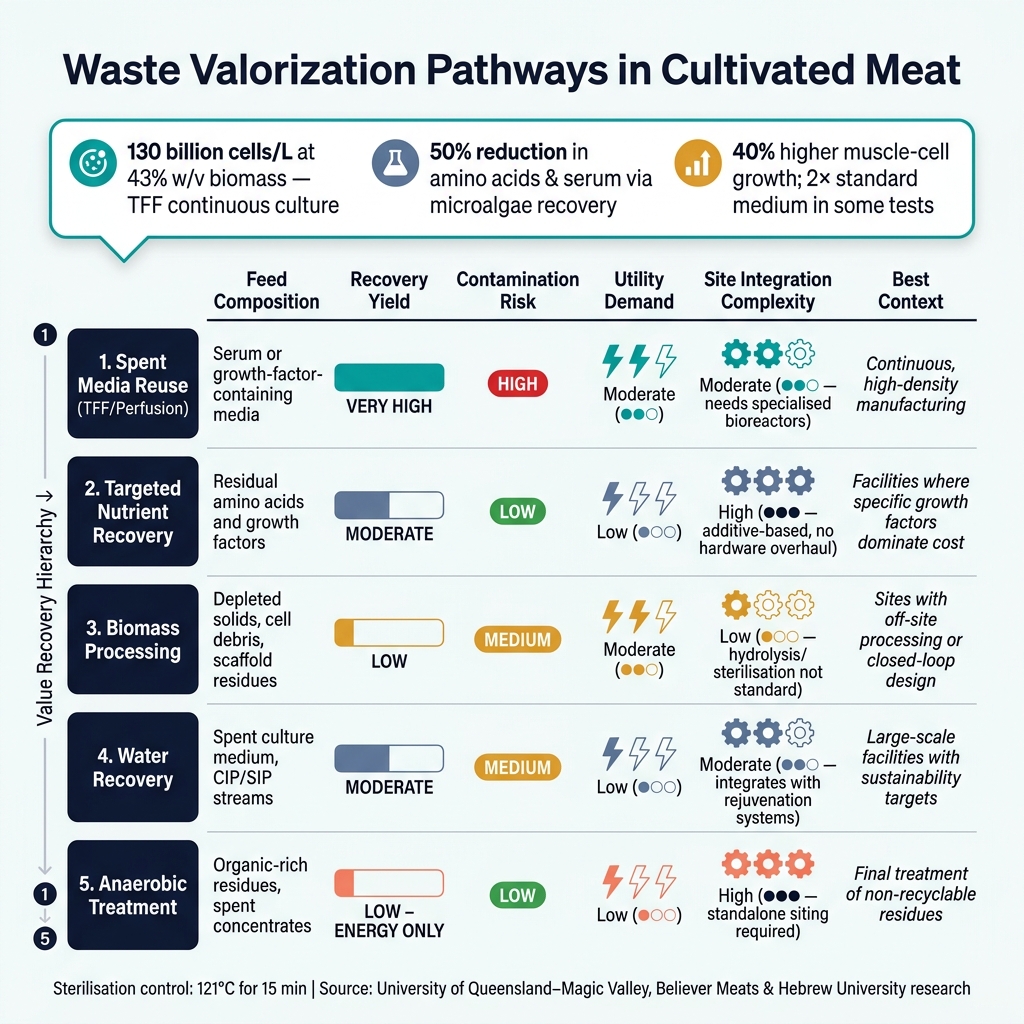
Abfallverwertungswege in kultiviertem Fleisch: Rückgewinnungshierarchie & Abwägungen
Die obigen Abschnitte beschreiben jeden Weg im Detail. Dieser Vergleich untersucht, wo jeder Weg auf Einrichtungsebene am besten passt.Es gibt keine Einheitslösung für jeden Abfallstrom. Jeder Weg funktioniert gut innerhalb eines bestimmten Betriebsfensters, und es ist genauso wichtig zu wissen, wo die Leistung nachlässt, wie zu wissen, wo sie am besten funktioniert.
Wiederverwendung von verbrauchtem Medium bietet die höchste Rückgewinnungsausbeute. Der Kompromiss ist die Prozesskomplexität. Es eignet sich für streng kontrollierte kontinuierliche Systeme, insbesondere dort, wo Betreiber Laktat, Ammoniak und andere Stoffwechselnebenprodukte in Echtzeit mit Bioprozesssteuerungssoftware verwalten können.
Zielgerichtete Nährstoffrückgewinnung ist selektiver. Es ist einfacher in einen bestehenden Prozess zu integrieren als die vollständige Medienregeneration, aber es gewinnt einen kleineren Anteil des Gesamtwerts des Abfallstroms zurück.
Biomasseverarbeitung kommt ins Spiel, wenn sich selektive Rückgewinnung nicht mehr lohnt. Zu diesem Zeitpunkt sind Reststoffe in der Regel besser für Hydrolyse oder Vergärung geeignet als für eine weitere Nährstoffextraktion.
Wasseraufbereitung hilft hauptsächlich, indem sie den Bedarf an Versorgungsleistungen senkt. Dennoch besteht ein moderates Kontaminationsrisiko, wenn die Reinigung nicht gründlich genug ist [4][3].
Anaerobe Behandlung hat den geringsten Rückgewinnungswert in Bezug auf Prozesseingaben, passt jedoch am besten als letzter Schritt für Rückstände, die nicht wieder in die Produktion zurückgeführt werden können. In diesem Fall ist der Hauptnutzen Biogas anstelle von Medienkomponenten [1].
Der Hauptunterschied ist einfach: Wird ein nutzbares Medium, spezifische Nährstoffe, Restbiomasse, Wasser oder nur Energie zurückgewonnen? Die folgende Tabelle fasst diese Kompromisse auf Einrichtungsebene zusammen.
| Pfad | Futterzusammensetzung | Rückgewinnungsausbeute | Kontaminationsrisiko | Versorgungsbedarf | Standortintegration | Bester Kontext |
|---|---|---|---|---|---|---|
| Wiederverwendung von verbrauchtem Medium (TFF/Perfusion) | Serum- oder wachstumsfaktorhaltige Medien | Sehr hoch | Hoch - erfordert strenge geschlossene Systemkontrollen | Moderat | Moderat - benötigt spezialisierte Bioreaktoren | Kontinuierliche, hochdichte Fertigung |
| Gezielte Nährstoffrückgewinnung | Restaminosäuren und Wachstumsfaktoren | Moderat | Niedrig - stabile Zusätze, keine komplexe Trennung | Niedrig | Hoch - zusatzbasiert, keine Hardware-Überholung | Anlagen, bei denen spezifische Wachstumsfaktoren die Kosten dominieren |
| Biomasseverarbeitung | Erschöpfte Feststoffe, Zelltrümmer, Gerüstrückstände | Niedrig | Moderat - Screening erforderlich vor Wiederverwendung | Moderat | Niedrig - Hydrolyse- und Sterilisationsausrüstung nicht standardmäßig | Standorte mit externen Verarbeitungskapazitäten oder geschlossenem Kreislaufdesign |
| Wasserrückgewinnung | Verbrauchtes Kulturmedium, CIP/SIP-Ströme | Moderat | Moderat - Reinigungssorgfalt ist entscheidend | Niedrig | Moderat - integriert mit Erneuerungssystemen | Großanlagen mit Nachhaltigkeitszielen |
| Anaerobe Behandlung | Organisch reiche Rückstände, verbrauchte Konzentrate | Niedrig - nur Energie | Niedrig - befindet sich außerhalb steriler Produktionsbereiche | Niedrig | Hoch - eigenständige Standortwahl | Endbehandlung nicht recycelbarer Rückstände |
Fazit
Kein einzelner Pfad gewinnt den gesamten Wert, der in den Abfallströmen von kultiviertem Fleisch steckt, zurück.Wiederverwendung von verbrauchtem Medium und gezielte Nährstoffrückgewinnung behalten den größten Wert. Im Gegensatz dazu tragen Biomasseverarbeitung, Wasseraufbereitung und anaerobe Behandlung mehr dazu bei, die verbleibende Last zu reduzieren, als hochwertige Eingaben zu erhalten. In der Praxis funktionieren diese Wege am besten als Wertwiedergewinnungshierarchie.
Die anaerobe Behandlung steht am Ende dieser Kette für Rückstände, die nicht recycelt werden können.
Auf Einrichtungsebene kommen die besten Ergebnisse normalerweise von Sequenzierung der Rückgewinnungsschritte anstatt sich nur auf einen Weg zu verlassen. Die biologische Rückgewinnung erscheint besonders vielversprechend, wenn die Nährstoffwerte noch hoch genug sind, um sie zu rechtfertigen. Jüngste Arbeiten der University of Queensland–Magic Valley zeigen, dass die auf Mikroalgen basierende Rückgewinnung den Kreisschluss weiter vorantreiben kann, indem verbrauchtes Medium in wiederverwendbare Biomasse umgewandelt wird [2].
Das macht auch die Beschaffung zu einem Teil des Prozessdesigns und nicht nur zu einer Einkaufsaufgabe.
FAQs
Welchen Abfallstrom sollten wir zuerst priorisieren?
Kulturmedien Rückgewinnung und Recycling sollten in der Produktion von kultiviertem Fleisch an erster Stelle stehen. Medien machen den größten Anteil der Produktionskosten aus und haben den größten Einfluss auf den Prozess-Fußabdruck.
Die Rückgewinnung von Nährstoffen wie Aminosäuren und Glukose oder die Entfernung von hemmenden Nebenprodukten wie Laktat und Ammoniak zielt direkt auf zwei der Hauptbarrieren für den kommerziellen Maßstab: Kosten und Prozess-Fußabdruck.
Wann ist die vollständige Wiederverwendung von Medien besser als die gezielte Rückgewinnung?
Die vollständige Wiederverwendung von Medien funktioniert am besten, wenn das verbrauchte Medium noch genügend verwertbare Nährstoffe enthält, um einen weiteren Zyklus zu unterstützen.Das umfasst nicht nur übrig gebliebene Basiskomponenten, sondern auch zellsekretierte Wachstumsfaktoren und Zytokine , die sonst verworfen würden. In diesem Setup können Sie das Verbrauchte auffüllen und das Medium mit nur begrenzter Abfallentfernung recyceln.
In der Praxis ist dieser Ansatz besser geeignet für einen Online-Rezirkulationskreislauf. Die Idee ist einfach: Entfernen Sie unerwünschte Nebenprodukte, während sie sich ansammeln, und halten Sie den Rest des Mediums im System. Das kann den Verlust von Rohmaterialien reduzieren und eine bessere Nutzung von teuren Komponenten ermöglichen. Natürlich funktioniert das nur, wenn Sterilität aufrechterhalten wird und das Kontaminationsrisiko streng unter Kontrolle gehalten wird.
Was stoppt normalerweise die Wiederverwendung von Wasser im industriellen Maßstab?
Im industriellen Maßstab wird die Wiederverwendung von Wasser in der Produktion von kultiviertem Fleisch hauptsächlich durch die Notwendigkeit begrenzt, sterile Bedingungen im Bioreaktor aufrechtzuerhalten.Der Prozess ist äußerst empfindlich gegenüber Kontamination durch Bakterien, Pilze oder Viren, daher ist eine aseptische Umgebung unverzichtbar.
Es gibt auch eine Datenlücke. Viele Teams haben immer noch keine quantifizierbaren Daten über die Qualität des während der Verarbeitung erzeugten Wassers, was die Wiederverwendung schwerer zu bewerten und zu kontrollieren macht.
Techniken wie Medienverjüngung und Perfusion können den Wasserverbrauch verbessern. Sie hängen jedoch weiterhin von einer robusten Sterilisation ab, um Sicherheitsrisiken zu kontrollieren und regulatorische Standards zu erfüllen.


